When you click on links to various merchants on this site and make a purchase, this can result in this site earning a commission. Affiliate programs and affiliations include, but are not limited to, the eBay Partner Network.
Weight: 45.4 g
Ounces: 1.60 oz
Pounds: 0.10 lb
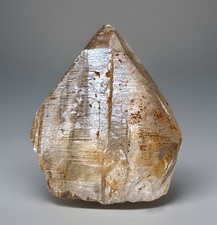
Carats: 227 ct⸻DimensionsLongest Dimension: 44.60 mm⸻Converted Dimensions4.46 cm / 1.76 in⸻This piece comes from my personal collection, carefully kept as a natural mineral display specimen.I named this crystal “The Golden Aegis” for its distinctive natural shield-like form. Its broad shoulders narrow toward a well-preserved termination, creating a balanced, almost pentagonal silhouette reminiscent of an ancient shield. The pale golden body, scattered yellow-brown mineral traces, and complex Himalayan growth textures give it a strong architectural appearance.This specimen comes from Ganesh Himal, Nepal. Its most striking feature is the combination of different natural surface textures across the crystal. One face is relatively clear and lustrous, with strong light transmission and dense horizontal growth striations. Fine parallel lines, stepped structures, and geometric patterns create the appearance collectors often describe as Akashic-style lines and circuit-board texture.Other faces are naturally frosted and carry much more complex surface development. Mountain-like ridges, fault-like structures, and layered growth patterns intersect in different directions. Some lines travel horizontally across the crystal while deeper structures rise vertically toward the termination. Viewed through the transparent body, these overlapping patterns create pronounced front-to-back depth, resembling mountain ridges crossing one another.The contrast between lustrous and frosted crystal faces is especially noticeable when the specimen is rotated. Smooth reflective areas transition into misted surfaces, stepped growth zones, and more heavily textured sections, giving each side a different character.Golden to yellow-brown mineral material appears throughout the specimen, particularly along recessed areas, etched pits, grooves, face boundaries, and rougher growth zones. Small amounts of yellow mineral-rich residue are also naturally retained in several depressions. These golden accents follow the crystal’s surface topography rather than forming a uniform coating, highlighting its growth architecture. The exact mineral composition of these coatings has not been analytically tested.Along the sides are additional natural dissolution and etching textures, including shallow pits, recessed grooves, irregular etched surfaces, and several curved or spiral-like patterns. These contrast with the straighter horizontal and vertical growth lines found on the main faces.The termination remains well defined, with multiple natural faces converging toward the top. Together with the broad lower body, it creates the shield-shaped profile that inspired the name The Golden Aegis.The base shows a natural extraction/contact area. Portions of this surface have developed a fine frosted, mist-like texture with secondary growth or healing-like features, giving the lower section a softer appearance rather than a freshly exposed surface.Under transmitted light, the pale golden quartz becomes brighter and more transparent. The overlapping growth structures become easier to see through the body, while golden mineral traces illuminate along grooves and recessed areas, revealing additional depth.Natural Features* Natural shield-like crystal form
* Distinctive pentagonal silhouette
* Balanced broad-shouldered architecture
* Pale golden Himalayan quartz
* Well-preserved termination
* High-clarity and translucent zones
* Strong vitreous luster
* Glossy and naturally frosted face contrast
* Dense horizontal growth striations
* Fine parallel and stepped growth lines
* Vertical and multi-directional growth structures
* Akashic-style linework
* Circuit-board-like texture
* Mountain-like growth patterns
* Intersecting fault-like textures
* Layered front-to-back visual depth
* Golden to yellow-brown mineral coating
* Mineral-rich residue within recessed areas
* Natural dissolution pits and grooves
* Curved and spiral-like etching
* Natural extraction/contact base
* Frosted basal texture
* Secondary growth / healing-like basal features
* Natural, untreated and unpolished specimen