When you click on links to various merchants on this site and make a purchase, this can result in this site earning a commission. Affiliate programs and affiliations include, but are not limited to, the eBay Partner Network.
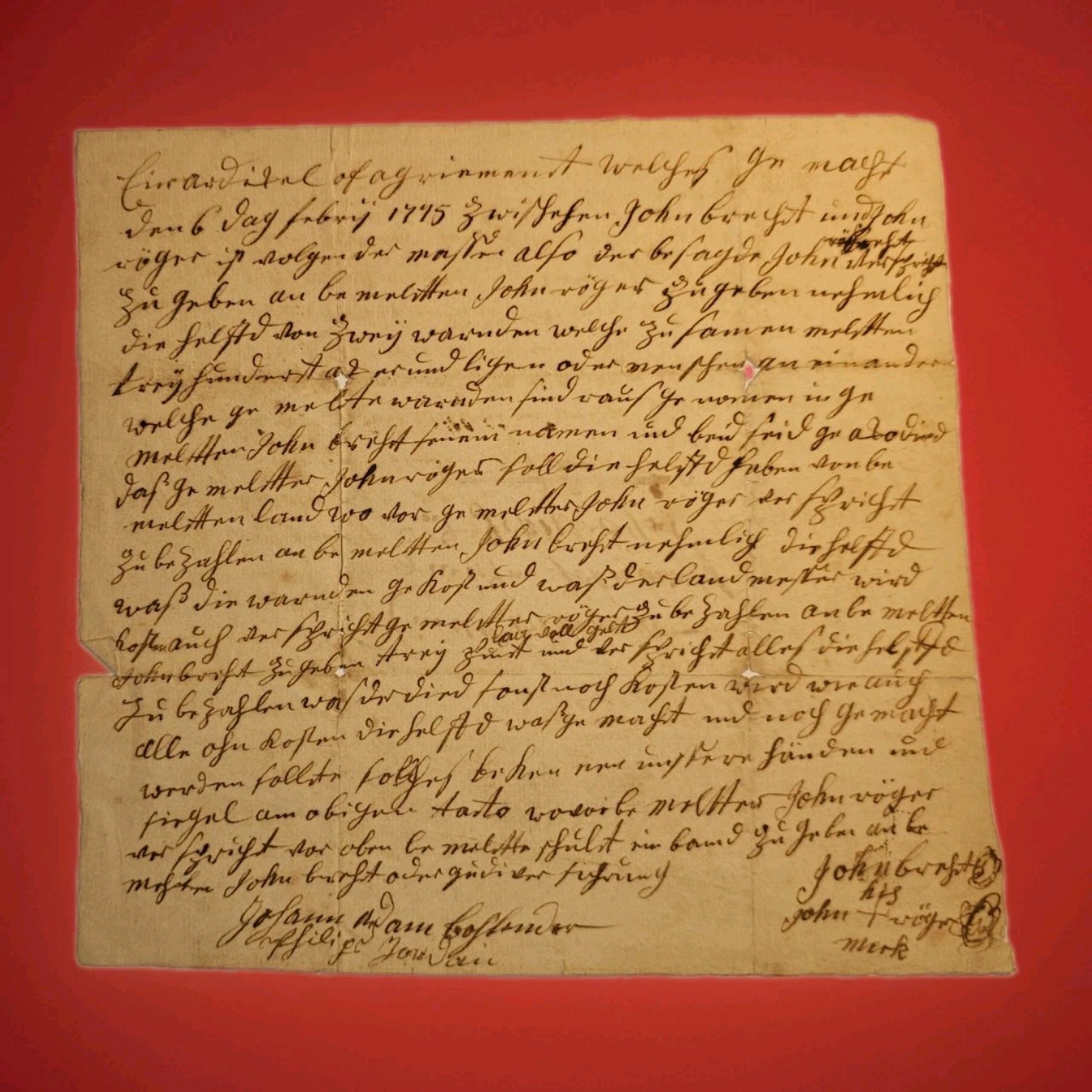
This unusual document records an agreement between two Pennsylvania German men concerning the ownership, expenses, land, goods, and operation of a mill. It is written primarily in German dialect/Kurrent script but incorporates English legal terminology, making it an excellent example of the bilingual legal culture of Pennsylvania’s German-speaking communities in the late colonial period.
The agreement appears to divide interests in the mill and associated property approximately 50/50, with each party responsible for portions of earlier purchases, land value, and future costs. The language also appears to extend the obligations to the parties’ heirs, indicating that this was a serious property and ownership settlement rather than a casual business arrangement.
Both principal parties signed by personal marks, while the document was written and subscribed by a literate German-speaking scribe.
Names appearing in the document
John Reyer / Royer
The second principal is most plausibly read as John Reyer or Royer, rather than the earlier tentative reading “Wöyner.”
This identification may have a significant Lancaster County connection. Rev. John Casper Stoever’s Pennsylvania German church records document a Johannes Reyer of Warwick Township marrying Maria Elisabetha Neu of Lebanon on October 20, 1767.
A John Royer also appears in the 1775 Warwick Township Association under Captain Peter Grubb, placing a man of the same name in the same township during the exact year this agreement was written.
The Royer/Reyer family was one of the established Pennsylvania German families of the Warwick and Brickerville area. Earlier members of the family owned substantial acreage in the region, and the historic German Reformed congregation at Brickerville was long associated with the Royer family.
A surviving Lancaster County archival record also documents a February 20, 1774 discharge from Daniel Royer and John Royer to Christian Royer, showing members of the family actively settling property interests less than one year before this mill agreement.
It has not yet been conclusively proven that all of these references concern the same John Royer, but the geographic and chronological overlap is compelling and offers excellent potential for further research.
John Bercht / Brecht / Braught
The first principal has previously been read as John Burst, but closer examination suggests the surname may instead be Bercht, Brecht, or Braught.
The Brecht/Braught family was also present in the Warwick-Lancaster County region before the Revolution. A surviving 1758 Warwick Township land survey refers to property adjoining Jacob Braught, confirming the family’s presence in the immediate area.
One possible candidate is Johannes Brecht, later known as John Bright, born 1736 and died 1817, a Pennsylvania German farmer associated with the Lebanon-Bethel-Jonestown region. He was of the correct generation and later had Revolutionary-era connections.
At present, however, the precise identity of the John Brecht/Braught named in this document remains unresolved. Future research into Lancaster County deeds, tax lists, mill records, and adjoining landowners may determine exactly which member of the family was involved.
Johann Adam Hostender / Hostader
The agreement was written by a man signing approximately:
Johann Adam Hostender
He appears to have served as the scribe or document writer for the two principals.
A particularly interesting possible match appears in Lancaster County’s official oath records:
Adam Hostader — 1778 — Deed Book L, page 403
The county index separately lists an Adam Hostetter, suggesting that Hostader was itself a recorded surname form, rather than simply a clerk’s misspelling of Hostetter.
If Johann Adam Hostender and the 1778 Adam Hostader are the same man, this document may preserve a rare example of his handwriting and activity three years before that official county record.
Hostender was evidently more literate than the two contracting parties, both of whom executed the agreement by marks. He may have been a local scrivener, schoolmaster, church clerk, or simply a literate German-speaking neighbor accustomed to preparing legal documents.
Historical Context
The agreement is dated February 6, 1775.
That places it only about ten weeks before the Battles of Lexington and Concord on April 19, 1775.
While the document itself is not a military record, it captures ordinary economic life in colonial Pennsylvania immediately before the Revolution transformed the region. Mills were among the most important businesses in rural Pennsylvania. Farmers depended upon local gristmills for processing grain, and ownership of a mill, its water rights, land, equipment, and access roads could represent a substantial investment.
The document therefore provides a fascinating window into the world of Pennsylvania German farmers, landowners, and mill operators on the eve of the American Revolution.
Possible Geographic Connection
Current research points most strongly toward the Warwick–Brickerville–Cocalico area of Lancaster County, Pennsylvania, although the precise mill has not yet been identified.
This area contained a dense Pennsylvania German population and numerous early water-powered mills. Both the Royer/Reyer and Brecht/Braught surnames are documented in the broader region.
Future research into:
- 1770s Lancaster County tax rolls
- deed books and land warrants
- mill assessments
- watercourse surveys
- estate files
- Revolutionary militia records
- church records
- adjoining property descriptions
may eventually identify the actual mill and conclusively determine the identities of the men involved.
Why This Document Is Interesting
This is more than a routine receipt or promissory note. It combines several desirable features for collectors of early Americana:
- Original 1775 colonial date
- Pennsylvania German manuscript
- German and English legal language
- Mill and land ownership
- Business partnership/property settlement
- Two original manuscript marks
- Named German-American scribe
- Possible Warwick Township / Lancaster County connection
- Potential Revolutionary militia connection through John Royer
- Excellent opportunity for additional genealogical and property research
The document survives with expected age toning, folds, edge wear, staining, and other signs of nearly 250 years of existence. Please examine photographs carefully for condition and handwriting.
An evocative piece of colonial Pennsylvania German history, documenting a mill partnership at the very beginning of the Revolutionary era.