When you click on links to various merchants on this site and make a purchase, this can result in this site earning a commission. Affiliate programs and affiliations include, but are not limited to, the eBay Partner Network.
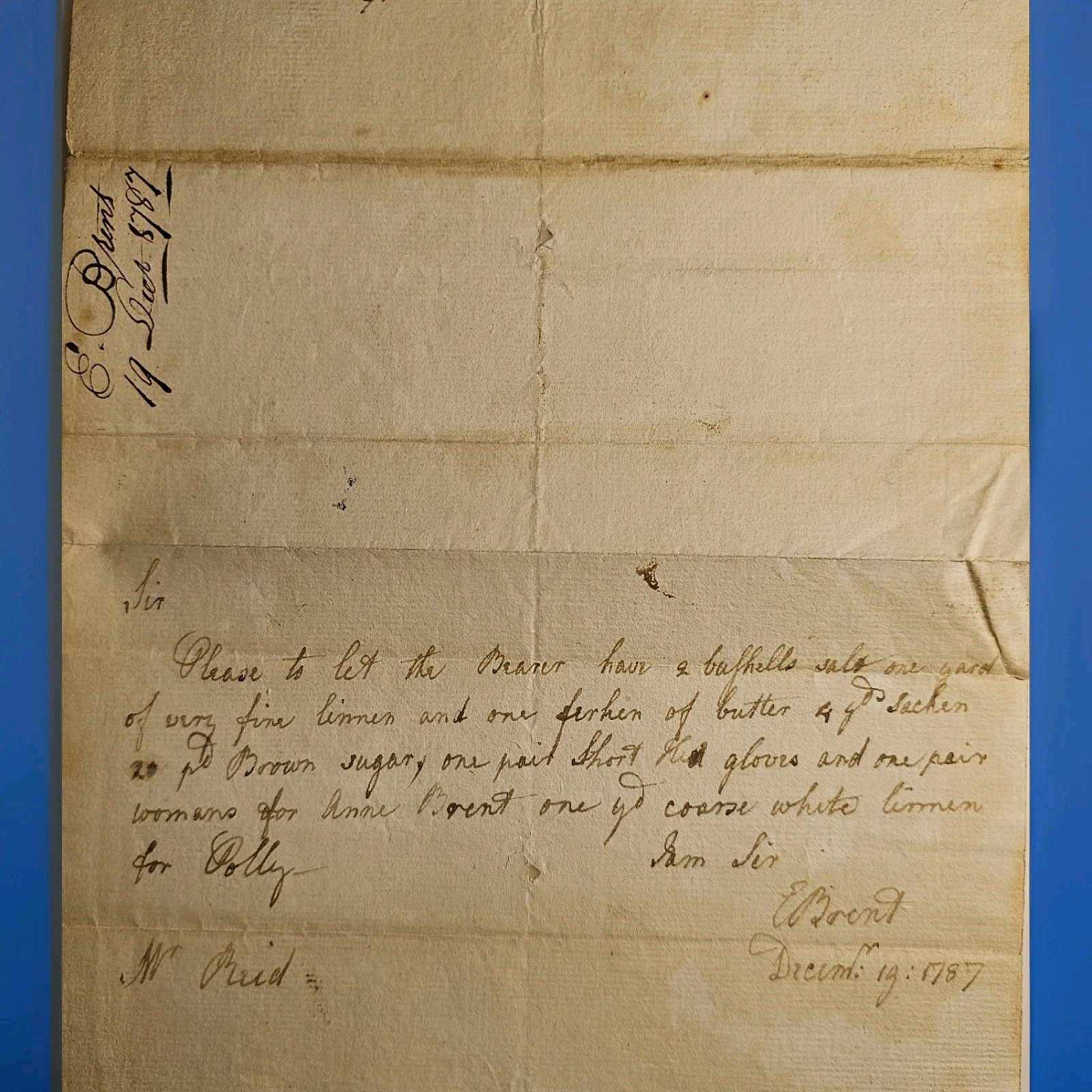
Exceptional Revolutionary-era merchant provisioning manuscript dated December 19, 1787, addressed to “Mr. Reid” of the important Dumfries, Virginia merchant firm Huie, Reid & Co., one of the major Potomac River commercial houses operating in post-Revolutionary Virginia.
The document records a household order for:
- 2 bushels of salt
- very fine linen
- one firkin of butter
- 50 lb “sacken” brown sugar
- short kid gloves
- coarse white linen
- additional household textiles and goods “for Polly”
Signed and endorsed by a member of the influential Brent family, one of the oldest and most politically connected Catholic planter dynasties in colonial Virginia and Maryland.
The manuscript survives from the exact commercial world surrounding the Potomac tobacco trade and the elite Northern Virginia households connected to the Washington-era Chesapeake economy. Huie, Reid & Co. operated from Dumfries, Virginia, then one of the most important tobacco ports in America, supplying imported luxury and household goods throughout the region.
The Brent family was deeply tied to the Carroll family, Revolutionary Virginia politics, and the planter aristocracy of Stafford County and Aquia Creek. Family relations included William Brent (1733–1782), member of the Fifth Revolutionary Convention and prominent Virginia legislator, as well as connections to John Carroll, the first Catholic bishop in the United States, and later Robert Brent, the first mayor of Washington, D.C.
Importantly, a materially similar merchant provisioning manuscript from this same Potomac River commercial and plantation network is preserved today within the archives of George Washington’s Mount Vernon, underscoring the institutional and historical relevance of this type of surviving correspondence.
The letter is written on period laid paper bearing the watermark “J Bigg,” associated with English papermaker John Bigg, whose papers are frequently encountered on important 18th-century American manuscripts, merchant records, and plantation correspondence.
A remarkable survival documenting:
- post-Revolutionary American commerce
- Virginia plantation life
- Dumfries tobacco trade
- Atlantic mercantile networks
- and elite Chesapeake household provisioning
Condition:
- Original 1787 manuscript
- Strong legibility
- Original folds
- Minor edge wear and age toning
- “J Bigg” watermark visible
- Approx. 7.5\" x 5.5\"
An outstanding and highly displayable artifact of Washington-era Virginia commerce and Chesapeake mercantile history.