When you click on links to various merchants on this site and make a purchase, this can result in this site earning a commission. Affiliate programs and affiliations include, but are not limited to, the eBay Partner Network.
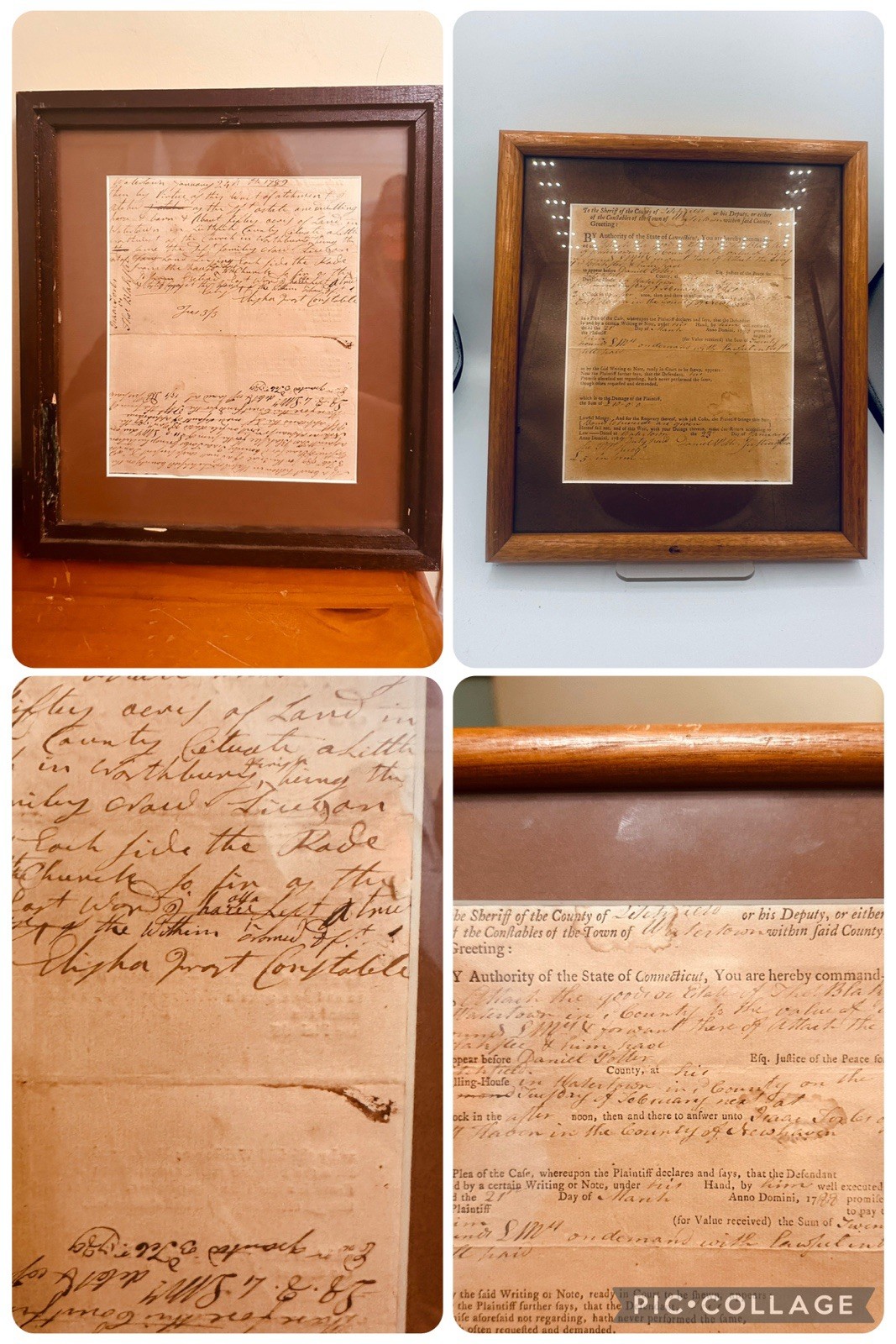
1789 Connecticut Court Writ Signed Daniel Potter Litchfield County Watertown
SIGNED BY:
Daniel Potter Justice of the Peace
Elisha Frost Constable
10” x 11.25” Framed
6” x 7.25” Paper
Double Sided Document
Plastic 2 Sides
Wood frame
Not taking out a frame
Daniel Potter (1758–1842), a Justice of the Peace for Litchfield County, Connecticut, serving the Watertown area. Daniel Potter was a graduate of Yale College, Class of 1780
The Daniel Potter who signed your 1789 document was almost certainly Your document is signed “Daniel Potter, Justice of the Peace,” and other surviving court records from the same period identify him in that exact role.
Elisha Frost Constable also signed
From what I can read, this appears to be an original Connecticut court writ (summons) dated 1789, shortly after the U.S. Constitution went into effect.
Some of the key details visible include:
* State: Connecticut
* Date: 1789
* County: Litchfield County
* Town: Watertown
* Type: Civil lawsuit (“In a Plea of the Case”)
* Justice of the Peace: Daniel Potter (his signature appears at the bottom)
* Amount of the suit: The plaintiff is seeking £10-0-0 (ten pounds lawful money) as damages.
* The underlying dispute concerns a promissory note dated March 21, 1788, for approximately £20 (“Twenty…” is visible), which the defendant allegedly failed to pay.
Other names that appear to be present (though some are difficult to decipher) include:
* Daniel Potter (clearly signed)
* Litchfield County
* Watertown
* A plaintiff surname that looks like Turner
* A defendant whose name appears to begin with “E…” but is still too faint to identify confidently.
Historical significance
Documents from 1789 are desirable because they date to the first year under the new U.S. federal government. Connecticut legal documents from this period are collected for:
* Early American legal history
* Connecticut history
* Genealogy
* Manuscript and autograph collectors
The fact that this is an original signed court document is a significant plus.
1789 Connecticut document it’s an original signed Litchfield County court writ involving a promissory note, as that will attract the right collectors.
The Daniel Potter who signed your 1789 document was almost certainly Daniel Potter (1758–1842), a Justice of the Peace for Litchfield County, Connecticut, serving the Watertown area. Your document is signed “Daniel Potter, Justice of the Peace,” and other surviving court records from the same period identify him in that exact role.
Here’s what is known about him:
* Born: February 17, 1758, in Plymouth (then Northbury), Connecticut.
* Died: April 27, 1842, at age 84.
* Residence: Lived in the Northbury/Watertown area of Litchfield County.
* Occupation: Justice of the Peace, handling local civil and criminal matters such as debt collections, writs, warrants, and property disputes.
One interesting piece of evidence is that the Litchfield Historical Society holds another original writ dated April 3, 1793, addressed to Daniel Potter, Justice of the Peace, concerning the theft of pork and flour from a cellar in Watertown. That confirms he was actively serving in this office during the same era as your 1789 document.
Yes. While Daniel Potter was not a nationally famous judge or politician, he was a documented local judicial official in the early years of the United States. Collectors of:
* early Connecticut legal documents,
* Litchfield County history,
* and signed 18th-century manuscripts
generally prefer documents that bear the signature of an identified Justice of the Peace rather than an unsigned court form.
Based on what you’ve shown me, your document is becoming a more attractive historical piece because it combines:
* an original 1789 Connecticut court writ,
* a clear Daniel Potter signature,
* and a well-preserved printed legal form from the first year of the new federal government.
* Born: February 17, 1758, in Plymouth, Connecticut.
* Died: April 27, 1842, in Plymouth, Connecticut.
* Occupation: Farmer and Justice of the Peace serving the Watertown/Plymouth area of Litchfield County in the late 18th century.
A Justice of the Peace in 1789 was not the same as a county judge. Instead, he was a local judicial officer appointed to:
* Hear civil disputes, especially debt and promissory note cases.
* Issue writs and summonses.
* Take depositions and acknowledgments.
* Perform marriages.
* Handle minor criminal matters.
Your document is exactly the type of case a Justice of the Peace would have processed—a civil action over an unpaid promissory note.
Education
Daniel Potter was a graduate of Yale College, Class of 1780, an uncommon distinction for a local magistrate on the Connecticut frontier at that time.
Family
He married Martha Humiston in 1781 and had four children, including Dr. Horace Potter.
Collectibility
The signature of an identified Yale-educated Justice of the Peace from 1789 adds historical interest. While Daniel Potter was not a nationally famous figure, collectors appreciate original documents signed by identifiable colonial and early federal-era local officials. That provenance makes your writ more desirable than an unsigned printed form.
One thing I’d still like to determine is whether your signature is the earliest known style Daniel Potter used after graduating from Yale and beginning public service. If it is, that could make your 1789 document one of the earliest surviving books examples of his official signature.