When you click on links to various merchants on this site and make a purchase, this can result in this site earning a commission. Affiliate programs and affiliations include, but are not limited to, the eBay Partner Network.
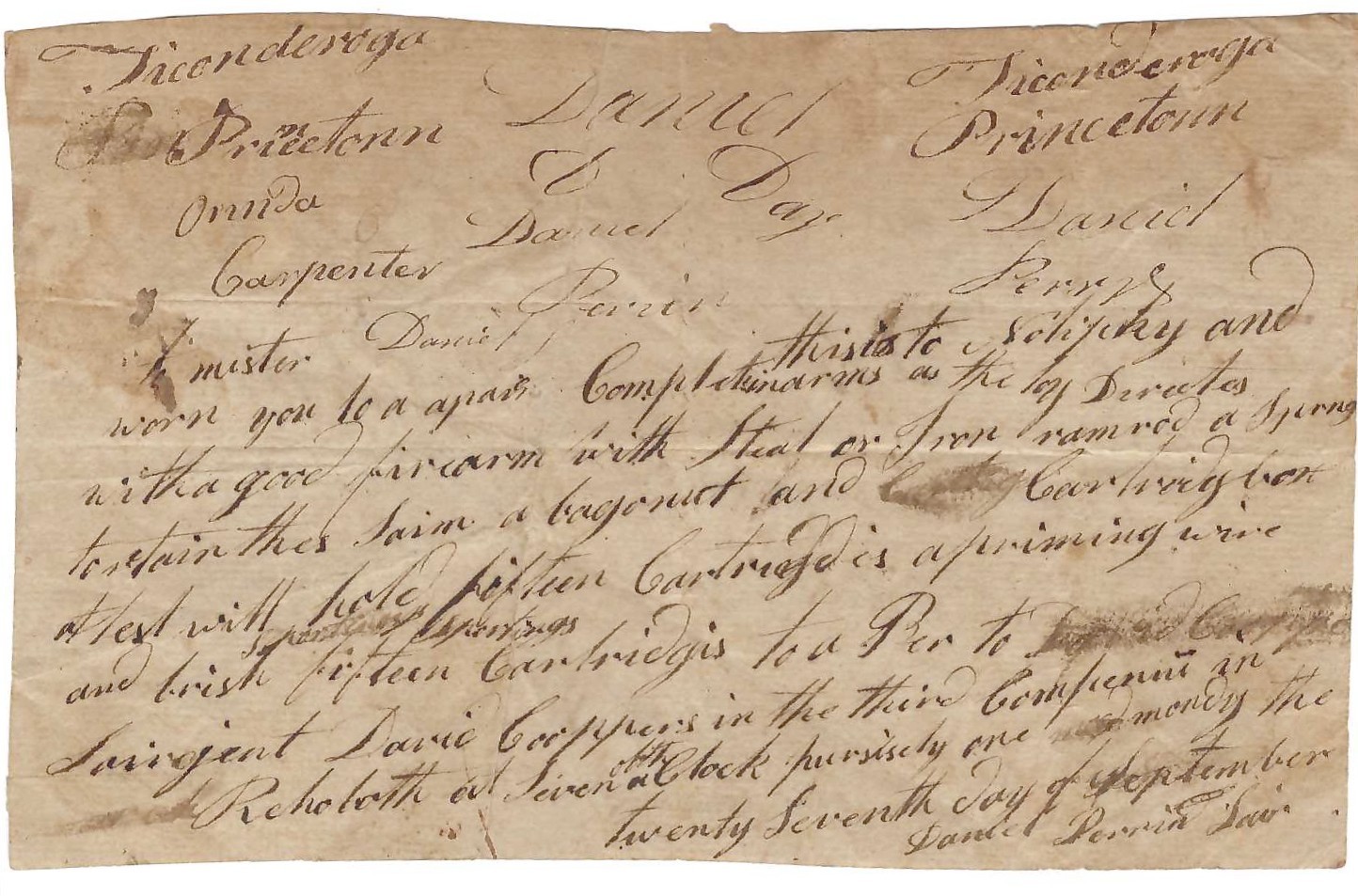
One-page, 4 ½ x 7, 1791 Rehoboth, Massachusetts, very basic manuscript muster call for a soldier to appear. As follows, “To Mister Daniel Perrin, warn you to appear as the town directs with a good firearm with steal or from ramrod...a bayonet and cartridge box that will hold fifteen cartridges to Sargeant David Cooper’s in the Third Company...at seven o’clock precisely on Monday the twenty seventh day of September.” Perrin’s name appears at the end of the document, possibly indicating that he received it. At the very top, the words Ticonderoga and Princeton appear, which may be related to Cooper or Perrin’s veteran status in Revolutionary War actions. Verso contains scattered information, some not discernible. One sentence notes “to all sixty soldiers that belong to the Third Company in Rehoboth,” apparently designating the nature of the document.
In 1791, Rehoboth, Massachusetts, had a well-organized military presence during and after the Revolutionary War, which ended in 1783. DAVID COOPER was a sergeant in the Third Company of the local militia. All able-bodied men between the ages of 16 and 60 were required to enroll in their local militia. The Third Company was one of several units drawn from the local population to handle regional defense and civil order. In the early Republic, all able-bodied men were required to participate in regular training days, known as musters. These were essential for maintaining readiness, inspecting equipment and practicing drills under the command of local officers. In 1791, the United States suffered a major defeat at the Battle of the Wabash. This resulted in a national crisis that led to the Militia Act of 1792, which required all states to reorganize and verify their militia rolls. Every town was expected to maintain at least one company of about 60 men for immediate defense or as a pool for federal drafts.
Failure for soldiers to show up for an ordered muster could include monetary fines. A soldier who failed to appear armed and equipped typically faced a fine of five shillings per day. More serious cases could result in court-martial or pay forfeiture. If a soldier refused to pay the assessed fine, he could be subjected to physical punishment, including being tied neck and heals or riding the wooden horse, a painful action, for up to an hour. Finally, the soldier could be subject to jail time.
Daniel Perrin (1763-1838) was a prime candidate for service in the local militia. The Perrin family was deeply involved in the military structure of Rehoboth. Captain Jesse Perrin led local units during the Revolution and Sergeant Lemuel Perrin served in the Bristol County militia.
Folds, toning and some staining.
Everything we sell is guaranteed authentic forever to the original buyer. We also offer a 30-day return policy. If you discover a problem or are dissatisfied with an item, please contact us immediately. Our goal is to please every customer. We are pleased to be members of The Manuscript Society, Universal Autograph Collectors Club, The Ephemera Society, the Southern New England Antiquarian Booksellers and the Preferred Autograph Dealers and sale Houses. [M 129]