When you click on links to various merchants on this site and make a purchase, this can result in this site earning a commission. Affiliate programs and affiliations include, but are not limited to, the eBay Partner Network.
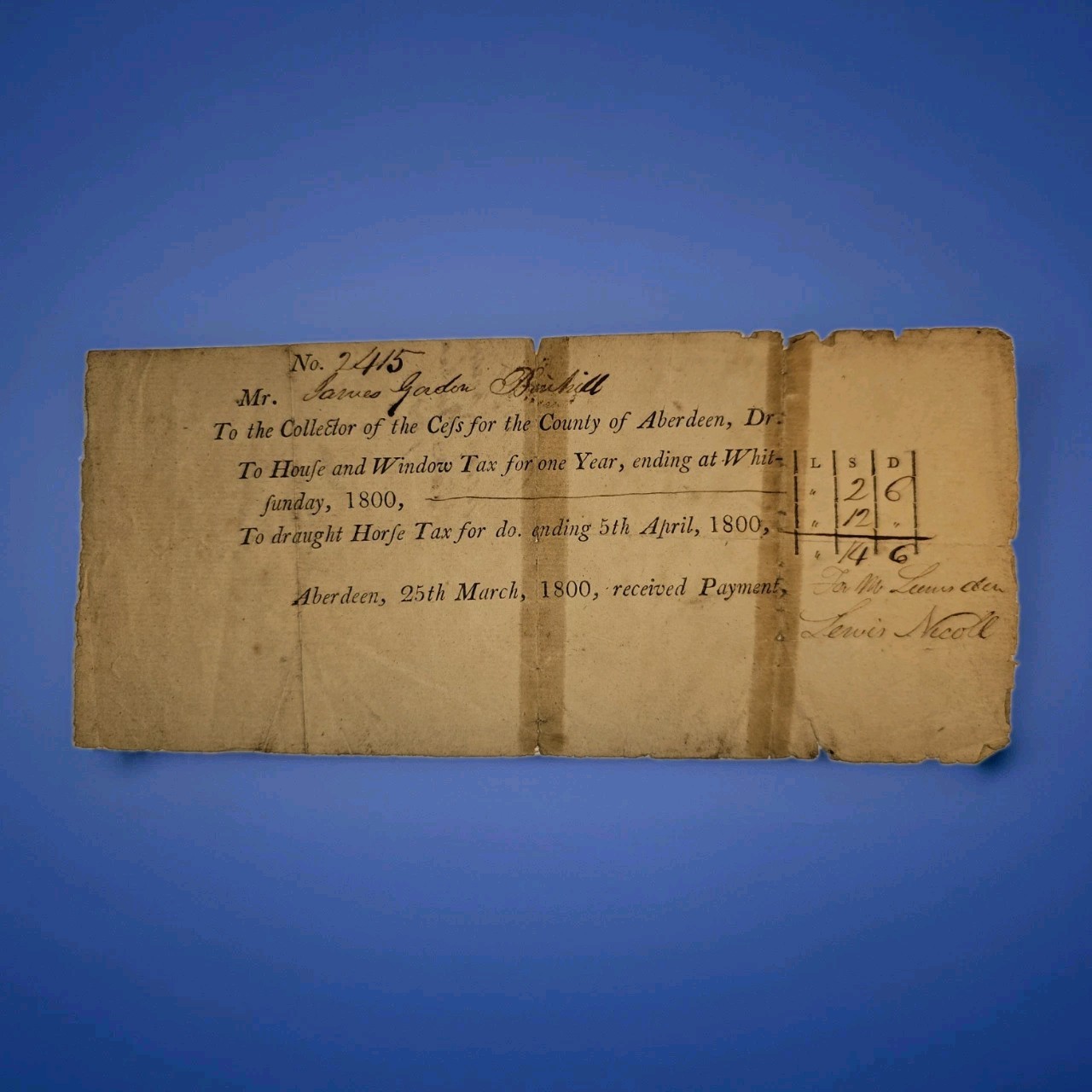
The document was issued under the authority of the Collector of the Cess for the County of Aberdeen and is signed by Lewis Nicoll, apparently acting on behalf of Mr. Lumsden, the county collector.
An especially attractive feature is the paper itself: when held to light, it reveals a clear 1795 dated watermark, showing that the sheet was manufactured approximately five years before the receipt was issued.
This is a desirable surviving example of late-Georgian Scottish taxation during the period of the wars with Revolutionary France.
Transcription
Recto:
No. 2415
Mr. James Gordon Birchhill
To the Collector of the Cess for the County of Aberdeen, Dr.
To House and Window Tax for one Year, ending at Whitsunday, 1800
2 shillings 6 pence
To draught Horse Tax for do. ending 5th April, 1800
12 shillings
Total: 14 shillings 6 pence
Aberdeen, 25th March, 1800, received Payment
For Mr. Lumsden
Lewis Nicoll
Verso docket:
Receipt for
horse & house
Tax Birchhill
1800
Historical Significance
This document records two of the distinctive British assessed taxes of the Georgian period.
The House and Window Tax was based partly upon the size and value of a residence, with the number of windows serving as a convenient measure of taxable wealth. The tax became one of the most recognizable forms of Georgian taxation and remained controversial because householders could reduce their liability by blocking or eliminating windows.
The Draught Horse Tax applied to working horses used for transport, hauling, and agricultural purposes. In this case, the horse assessment of 12 shillings was substantially larger than Gordon\'s house and window assessment of 2 shillings 6 pence, suggesting that the working horse represented the more significant taxable asset.
The receipt was issued in 1800, when Britain was engaged in the French Revolutionary Wars. The expanding system of assessed duties on houses, windows, horses, servants, carriages, and other property formed part of the government\'s effort to raise revenue during this expensive period of European warfare.
The terminology “Collector of the Cess” is particularly Scottish and reflects the administrative system used for county taxation and assessment.
James Gordon of Birchhill
James Gordon was the taxpayer named on the receipt.
The document identifies him as:
“Mr. James Gordon Birchhill”
and the reverse again refers to:
“Tax Birchhill.”
This indicates that Birchhill was Gordon\'s property, farm, or place of residence, rather than part of his surname. Scottish records of this period frequently identified landowners and substantial tenants by the name of their estate or holding.
Gordon was therefore likely a farmer, rural proprietor, or substantial agricultural tenant in Aberdeenshire. His liability for a draught horse tax is particularly consistent with an agricultural establishment where horses were required for plowing, hauling, or transportation.
The Gordon surname was deeply established throughout Aberdeenshire, although the receipt alone does not establish which particular branch of the extensive Gordon family James Gordon belonged to. For that reason, no connection to a titled or prominent Gordon line is claimed here without further documentation.
Mr. Lumsden
The receipt states that payment was received:
“For Mr. Lumsden.”
The Lumsden involved is very likely Harry or Hary Lumsden of Belhelvie, an Aberdeen advocate and prominent county official who served as Collector of County Rates for Aberdeenshire beginning in 1799.
Lumsden belonged to the professional and landed establishment of late-18th- and early-19th-century Aberdeenshire. His career included work as an advocate and notary, along with involvement in county administration, banking, and public affairs.
He is known to have served for many years in the collection of Aberdeenshire county rates, making the 1800 date of this receipt especially appropriate for the beginning of his tenure.
The document therefore appears to preserve a receipt issued through his county tax-collection office.
Lewis Nicoll
The actual manuscript signature at lower right is:
Lewis Nicoll
Nicoll was associated with Aberdeen\'s legal profession and became an advocate in Aberdeen.
At the time of this receipt in 1800, he appears to have been functioning as a legal clerk, deputy, or authorized collecting agent, receiving Gordon\'s payment and signing the receipt on Lumsden\'s behalf.
His later association with the Society of Advocates in Aberdeen places him within the city\'s professional legal community. Thus, rather than being merely an anonymous tax clerk, Nicoll was part of the network of Aberdeen lawyers and administrators responsible for handling financial and governmental business.
The wording:
“For Mr. Lumsden / Lewis Nicoll”
shows that Nicoll was acting under the authority of the principal collector.
1795 Watermark
One of the most appealing physical features of the document is its dated paper watermark.
When illuminated from behind, the sheet clearly shows the date:
1795
This indicates that the paper itself was manufactured approximately five years before the tax receipt was completed in 1800.
The watermark is incorporated into the structure of the paper during manufacture and therefore provides a useful additional indication that this is genuine period paper rather than a later reproduction or facsimile.
For collectors of early paper, fiscal documents, and Scottish manuscripts, the combination of an 1800 dated document with a visible 1795 watermark is particularly attractive.
Summary
This original document combines several desirable features:
- March 25, 1800 date
- Aberdeen / Aberdeenshire, Scotland
- James Gordon of Birchhill
- House & Window Tax
- Draught Horse Tax
- 14 shillings 6 pence total payment
- Collector of the Cess administration
- Association with Mr. Lumsden
- Original Lewis Nicoll signature
- Contemporary reverse tax docket
- Clear 1795 dated watermark
- Original late-18th-century laid paper
- Georgian taxation and social-history interest
It is an excellent primary-source artifact illustrating taxation, agriculture, property ownership, legal administration, and everyday economic life in Scotland at the beginning of the 19th century.
Condition
Original period document with substantial age and handling wear consistent with a working tax receipt more than 225 years old.
There are old folds, staining, toning, edge wear and losses, and old reinforcement or adhesive along folds on the reverse. Despite this, the principal printed text, taxpayer\'s name, tax amounts, date, signature, reverse docket, and 1795 watermark remain visible and legible.
Please examine all photographs carefully, as they form an important part of the condition description.
Guaranteed original 1800 document, not a reproduction.