When you click on links to various merchants on this site and make a purchase, this can result in this site earning a commission. Affiliate programs and affiliations include, but are not limited to, the eBay Partner Network.
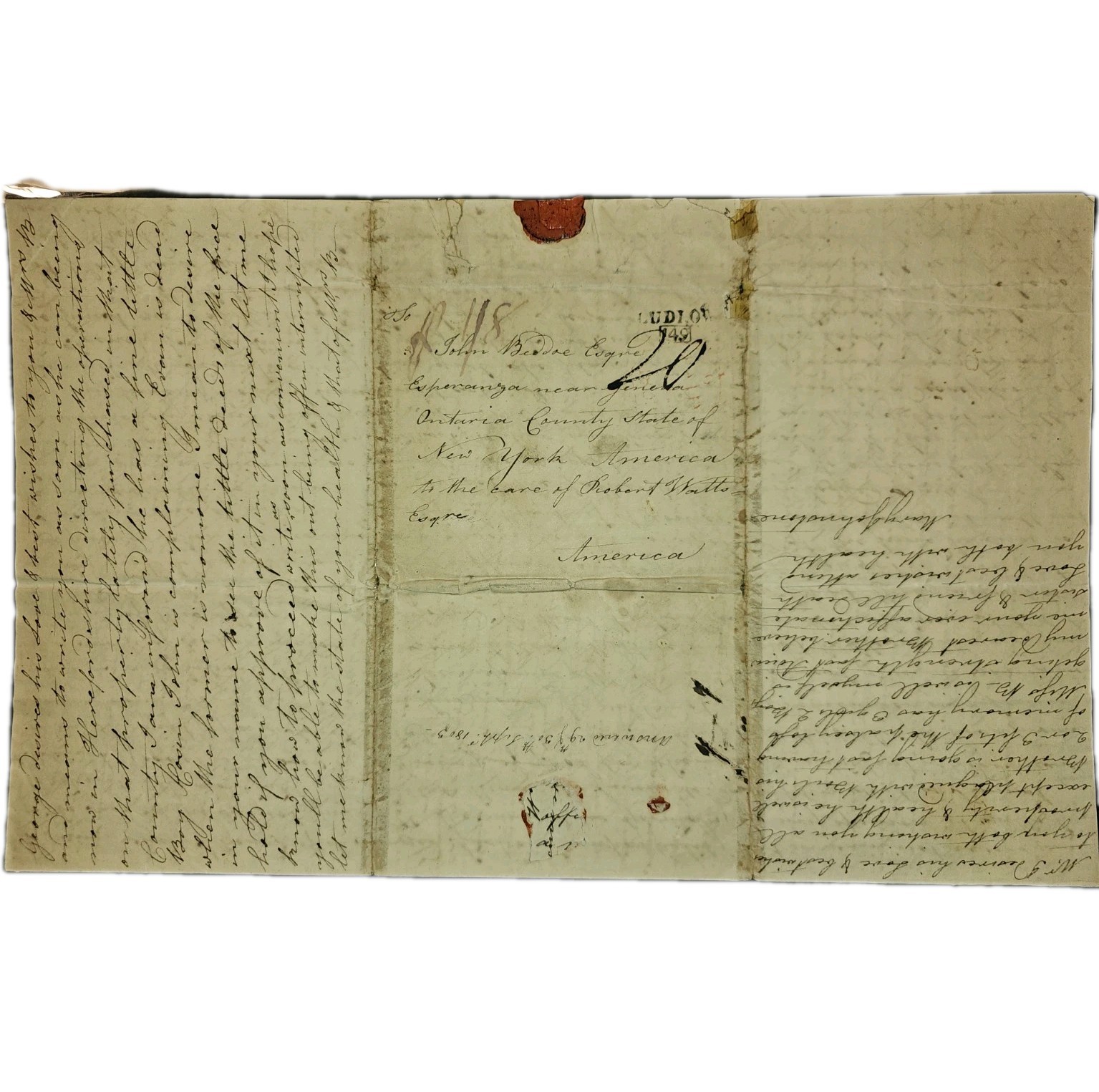
This is a remarkable early transatlantic stampless folded letter, written from Lisburn, Ireland on April 7, 1803 by Mary Johnstone to her brother John B. Dice, Esq. of Ontario County, New York (via Robert Watts). The four-page letter is entirely cross-written (written in two directions to save postage), a scarce survival from the early 19th century.
Mary’s letter is both deeply personal and profoundly historical. She writes of:
The death of John’s child in New York, offering words of consolation.
Their mother’s decline, suffering “fits of the palsy” (strokes) that left her without speech or memory.
Their father, who at advanced age “is wonderfully supported.”
Updates on siblings and “Miss B.” (also mentioned in later 1807 correspondence).
Expressions of faith and religious encouragement, urging her brother and his wife to find solace in God and raise their children in Christian instruction.
Greetings to Mr. and Mrs. Robert Watts, who handled Dice’s mail in America.
The letter is signed:
“Your ever affectionate Sister, Mary Johnstone.”
---
Postal / Physical Features
Origin: Lisburn, Ireland
Date: April 7, 1803
Format: 4-page folded stampless letter
Hand: Dense cross-writing, legible with care
Seal remnants still present
Addressed to: John B. Dice, Esq., Esperanza near Geneva, Ontario County, New York, America, care of Robert Watts, Esq.
---
Historical / Genealogical Interest
Early Irish-American immigrant family correspondence.
Dice family emigrated from Ireland; this letter shows how ties to Lisburn were maintained.
Mentions of Robert Watts, a New York contact/merchant.
Provides rare firsthand descriptions of illness (strokes, memory loss), family ties, and religious worldviews of 1803 Ireland.
Early Lisburn linen town context adds trade and social history significance.
---
Condition
Very good for age. Paper toned, folds and expected wear from mailing. Cross-writing is dense but readable under good light. Small edge wear and minor paper loss from seal opening.
---
Collector Value
Letters of this type — early 1800s Irish cross-written stampless transatlantic covers with rich family content — are highly collectible for both postal history and genealogy. Retail value typically in the