When you click on links to various merchants on this site and make a purchase, this can result in this site earning a commission. Affiliate programs and affiliations include, but are not limited to, the eBay Partner Network.
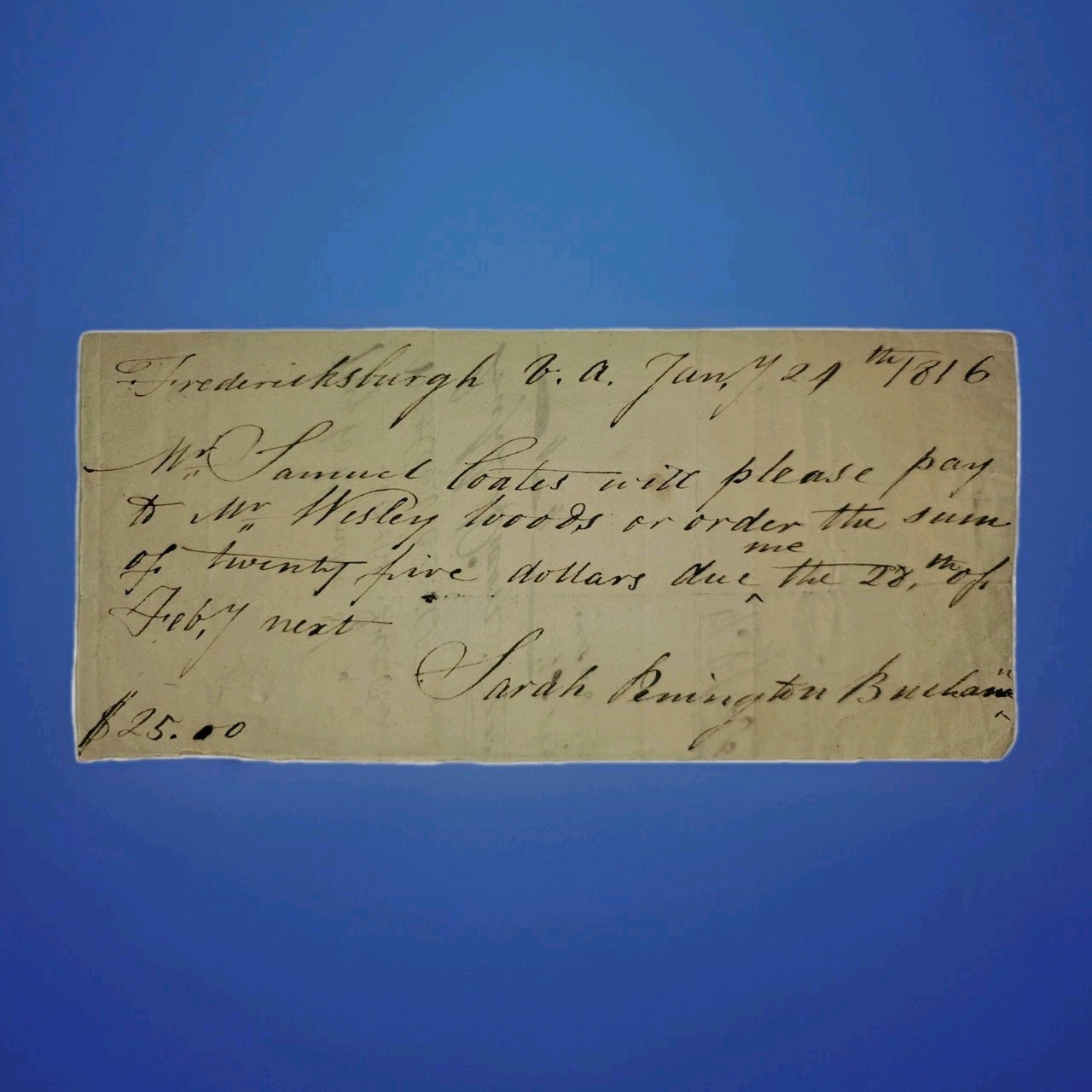
Original 1816 promissory note from Fredericksburg, Virginia, measuring 8 inches x 4.5 inches, issued by Sarah Pennington Buchanan (née Nesbit) and routed through Wesley Woods and Joseph Dixon, with payment directed to Samuel Coates, commonly identified as the same Samuel Coates who served as a Director of the First Bank of the United States.
This is a multi-party, fully signed piece of early-American financial history from the immediate post–War of 1812 period, featuring a female issuer, a national-level banking figure, and a Virginia merchant-credit chain.
---
🖋 Full Transcription
Front:
Fredericksburgh, Va. January 29th 1816
Mr. Samuel Coates will please pay to Mr. Wesley Woods or order the sum of twenty five dollars due the 28th of Feb’y next.
Sarah Pennington Buchanan
$25.00
---
Reverse (Endorsement & Docketing):
Pay to the order of Joseph Dixon
Wesley Woods
Joseph Dixon
(Second appearance of Joseph Dixon as a docketing or confirming signature, along with ink calculations and notations including the due date Feb 28 / 1816 and a faint reference to “Woods & Son.”)
There is no Inglish Dixon – just Joseph Dixon twice, once as endorsee and once as a further signature/docketing.
---
👤 Biographies & Historical Notes
⭐ Sarah Pennington Buchanan (née Nesbit)
Sarah Pennington Buchanan, born Sarah Nesbit, later using Pennington as a family middle name, married into the Buchanan family as the wife of George Anderson Buchanan.
Her signing of this 1816 financial instrument is a rare example of a woman directly authorizing a credit obligation in early-19th-century Virginia. At this time, most legal and financial documents were signed by men, so female signatures – especially on negotiable paper – have strong appeal for collectors of women’s history and genealogical material.
Her name connects three family lines of interest to researchers and collectors:
Nesbit (Nesbitt / Nisbet)
Pennington
---
⭐ Samuel Coates – Director of the First Bank of the United States
Samuel Coates (1748–1830) was a prominent merchant and civic leader, widely known for his role with the First Bank of the United States in Philadelphia, where he served as a Director. The First Bank, created under Alexander Hamilton’s financial program, was the central institution of early American national finance.
While this note is dated 1816 (after the Bank’s original charter period), Coates remained an important figure in the broader commercial and credit network. His appearance here as the party instructed to “pay” the note ties this Virginia obligation into the national financial system that linked regional merchants to major banking centers.
For collectors of:
Early U.S. banking history
Hamilton-era financial institutions
Documents connected to the First Bank of the U.S.
…this name significantly enhances interest and value.
---
⭐ Wesley Woods (“Woods & Son”)
Wesley Woods appears here as the initial payee and endorser:
> Pay to the order of Joseph Dixon
Wesley Woods
The docketing reference to “Woods & Son” suggests Woods was part of a family-run mercantile or supply firm in the Fredericksburg area. Merchants like Woods often handled local credit, taking promissory notes in payment and passing them along to settle their own obligations.
His role shows this document was part of real commercial circulation, not merely a private household IOU.
---
⭐ Joseph Dixon (Endorsee & Docketing Signature)
Joseph Dixon is the merchant-creditor to whom the note is endorsed and whose name appears twice on the reverse:
1. As the endorsee (the one to whom Woods directs payment)
2. Again as a signature/docket, confirming his interest in or receipt of the note
This double appearance is typical of working financial paper in the early 1800s. It demonstrates that the note went fully into Dixon’s hands as an asset, likely used as part of his own accounts.
For genealogists and regional historians, Dixon is a recognizable Virginia surname, adding another researchable layer to the document.
---
🏛 Why This Piece Is Important
Dated January 29, 1816 – early American republican period, post–War of 1812
Origin: Fredericksburg, Virginia – a key transportation and trade hub between Richmond and the Mid-Atlantic
Female issuer – rare example of a woman authorizing a financial instrument in 1816
Named connection to Samuel Coates, associated with the First Bank of the U.S.
Merchant endorsement chain – Woods → Dixon, with multiple signatures
Size: 8" x 3.5", nice displayable format with attractive early script
Ideal for collectors of:
Early American banking and finance
Virginia and Fredericksburg history
Women’s history in legal/financial contexts
Genealogical manuscripts (Nesbit, Pennington, Buchanan, Woods, Dixon)
Original 19th-century handwritten documents and promissory notes
---
📐 Size
Approx. 8 inches x 4.5 inches
---