When you click on links to various merchants on this site and make a purchase, this can result in this site earning a commission. Affiliate programs and affiliations include, but are not limited to, the eBay Partner Network.
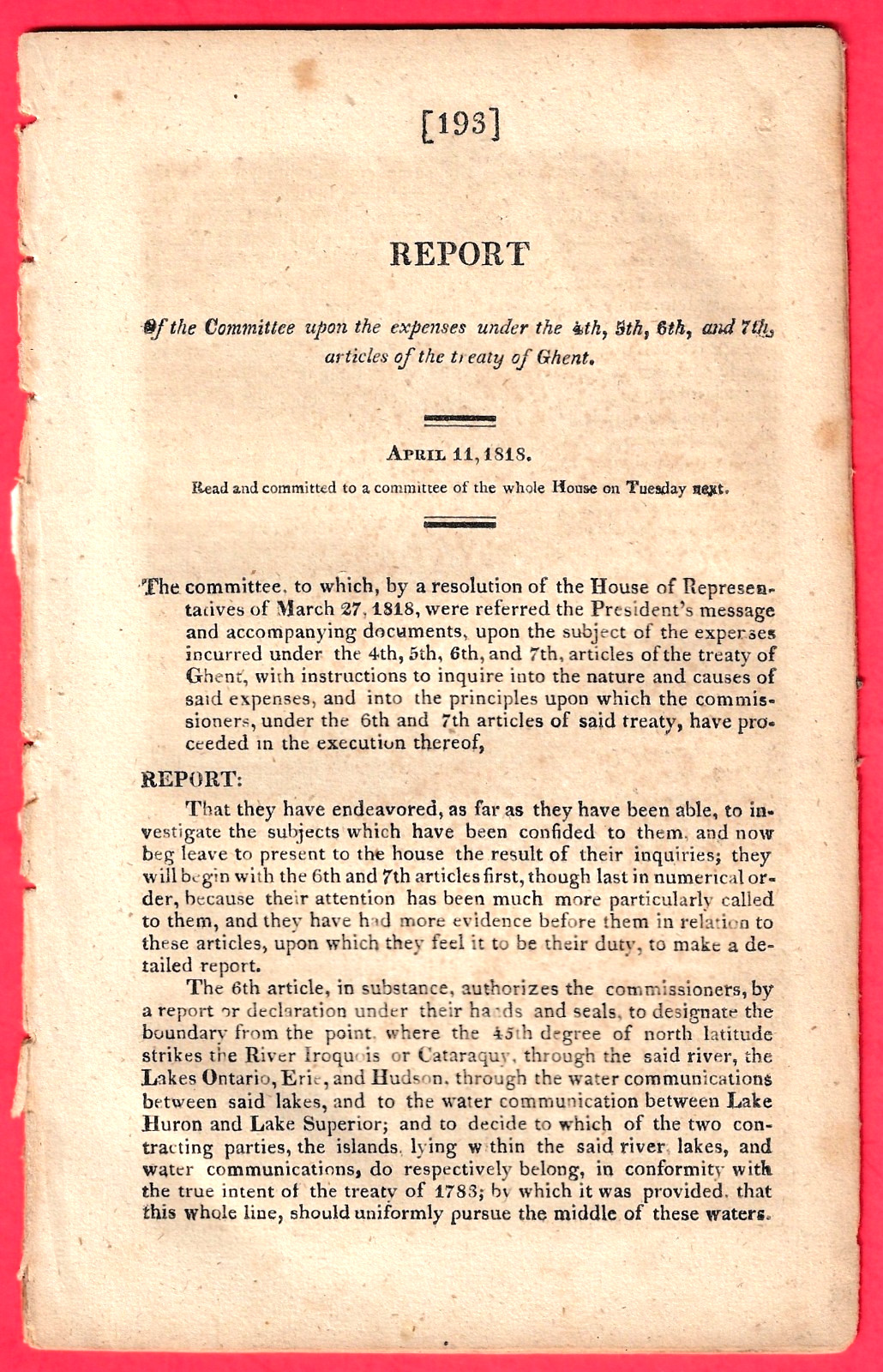
The document titled "Report of the committee upon the expenses under the 4th, 5th, 6th, and 7th articles of the Treaty of Ghent" is an official U.S. Congressional document issued on April 11, 1818. It was published during the 15th Congress, 1st Session, as House Document 193 (Serial Set Vol. 11).The primary purpose of this report was to audit and evaluate the financial costs incurred by the joint boundary commissions established to survey and map the U.S.–Canada border.
Overview of the Targeted Treaty Articles: The Treaty of Ghent, signed on December 24, 1814, officially ended the War of 1812. Because pre-war border lines were vague, Articles 4, 5, 6, and 7 mandated the appointment of joint British and American commissioners to physically survey and distribute territory. Article 4: Focused on determining ownership of islands in the Bay of Passamaquoddy and the Bay of Fundy. Article 5: Tasked with surveying the complex northeastern boundary from the source of the St. Croix River to the St. Lawrence River. Article 6: Handled the boundary tracking through the middle of the St. Lawrence River and into Lakes Ontario, Erie, and Huron. Article 7: Extended the water boundary survey from Lake Huron to the Lake of the Woods
Focus of the 1818 Congressional Report. By 1818, the high financial cost of maintaining these distinct surveying teams became a point of concern for Congress. The report evaluated: Commission Salaries: The pay allocated to the individual commissioners, agents, and specialized geographers. Operational Spending: The mounting expense of field labor, provisions, boat hires, and surveying equipment in remote wilderness areas. Progress Auditing: Checking if the financial output matched the speed of the boundary resolutions. For example, while the Article 4 commission successfully finalized its decision in late 1817, the Article 5 commission was plagued by massive delays and skyrocketing costs, eventually leading to a complete impasse that wasn't resolved until the Webster-Ashburton Treaty of 1842
The Report's Impact on Future Values. As a direct result of the financial values exposed in this April 11, 1818 report, Congress passed new legislation to aggressively control spending on foreign boundary missions. They placed strict caps on future surveyor expenses, restricted the hiring of excessive auxiliary staff, and demanded rigid line-item accounting for all future wilderness mapping expeditions.
This original 16-page document was disbound from a large volume. Paper toning ("ageing"); good collectible condition.
955 Our 27th year on