When you click on links to various merchants on this site and make a purchase, this can result in this site earning a commission. Affiliate programs and affiliations include, but are not limited to, the eBay Partner Network.
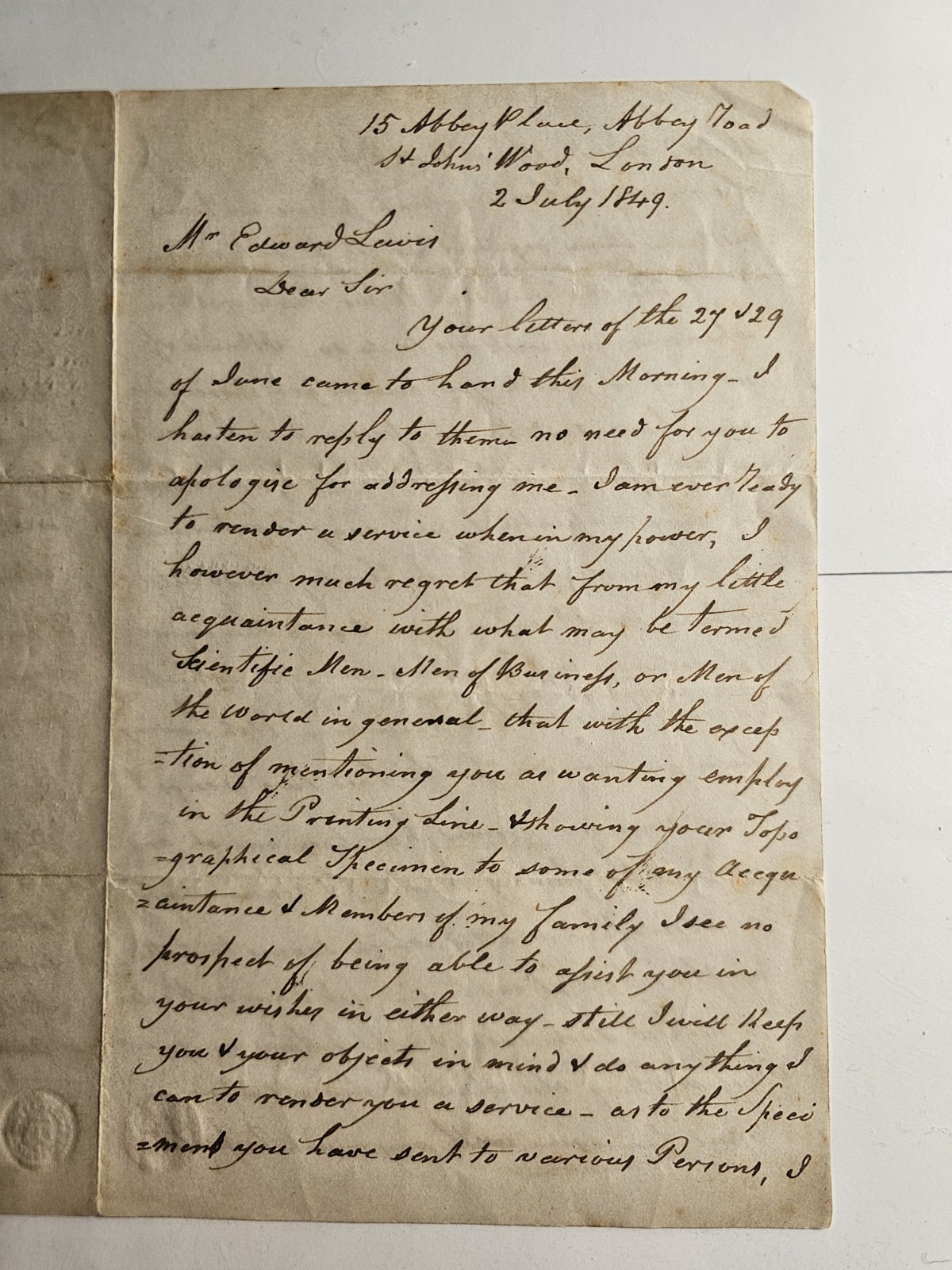
A compelling and historically grounded autograph letter signed (ALS) dated July 2, 1849, written from 15 Abbey Place, Abbey Road, St. John’s Wood, London, and signed by Philip Camm.
This letter offers a clear and uncommon look into mid-19th century job-seeking practices within the printing and typography trade, with direct references to “typographical specimens” being circulated in search of employment.
✉️ Summary of Content
The recipient, Edward Lewis, had sent typographical samples in pursuit of work in the printing trade. Camm responds:
- Acknowledging receipt of the letter and specimens
- Explaining he has shared them among acquaintances and family
- Admitting he lacks the necessary connections to secure employment
- Advising that specimens sent out must be requested back directly from recipients
- Offering to return the sample sent to him upon request
The letter provides a candid explanation of how employment functioned at the time—entirely dependent on personal networks and introductions.
🧠 Historical Significance
This is more than routine correspondence—it documents:
- Real-world job hunting in 1849, before formal hiring systems
- Use of typographical specimens as a portfolio/resume
- The limitations of social networks in securing work
- A clear example of Victorian patronage culture in practice
The postscript further references efforts to secure support for a candidate in the Governesses Benevolent Institution, reinforcing how influence and connections shaped both employment and charitable outcomes.
👤 About Philip Camm
The letter is signed by Philip Camm (c.1774–1858), likely the same individual recorded as:
- “Late of Trinidad” in contemporary records
- Associated with the West Indies planter/merchant class
- Later residing in England (Clifton and London)
He represents the class of absentee colonial landowners living in England, whose social networks did not always extend into skilled trades such as printing—reflected directly in the content of this letter.
📏 Physical Details
- Date: July 2, 1849
- Location: St. John’s Wood, London
- Format: Folded letter, handwritten on both sides
- Signature: Philip Camm (clear and legible)
- Condition:
- Original folds as expected
- Light toning and edge wear
- Overall well-preserved with strong legibility
📚 Collector Appeal
- Printing & typography history
- Victorian employment practices
- London social and economic history
- West Indies / colonial-era connections
- Named correspondence with full content
💡 Final Notes
A well-rounded and highly readable 19th-century letter that captures the reality of work, class, and connection in Victorian England, with strong crossover appeal to collectors of trade history and social ephemera.