When you click on links to various merchants on this site and make a purchase, this can result in this site earning a commission. Affiliate programs and affiliations include, but are not limited to, the eBay Partner Network.
We combine shipping when buying multiple items.
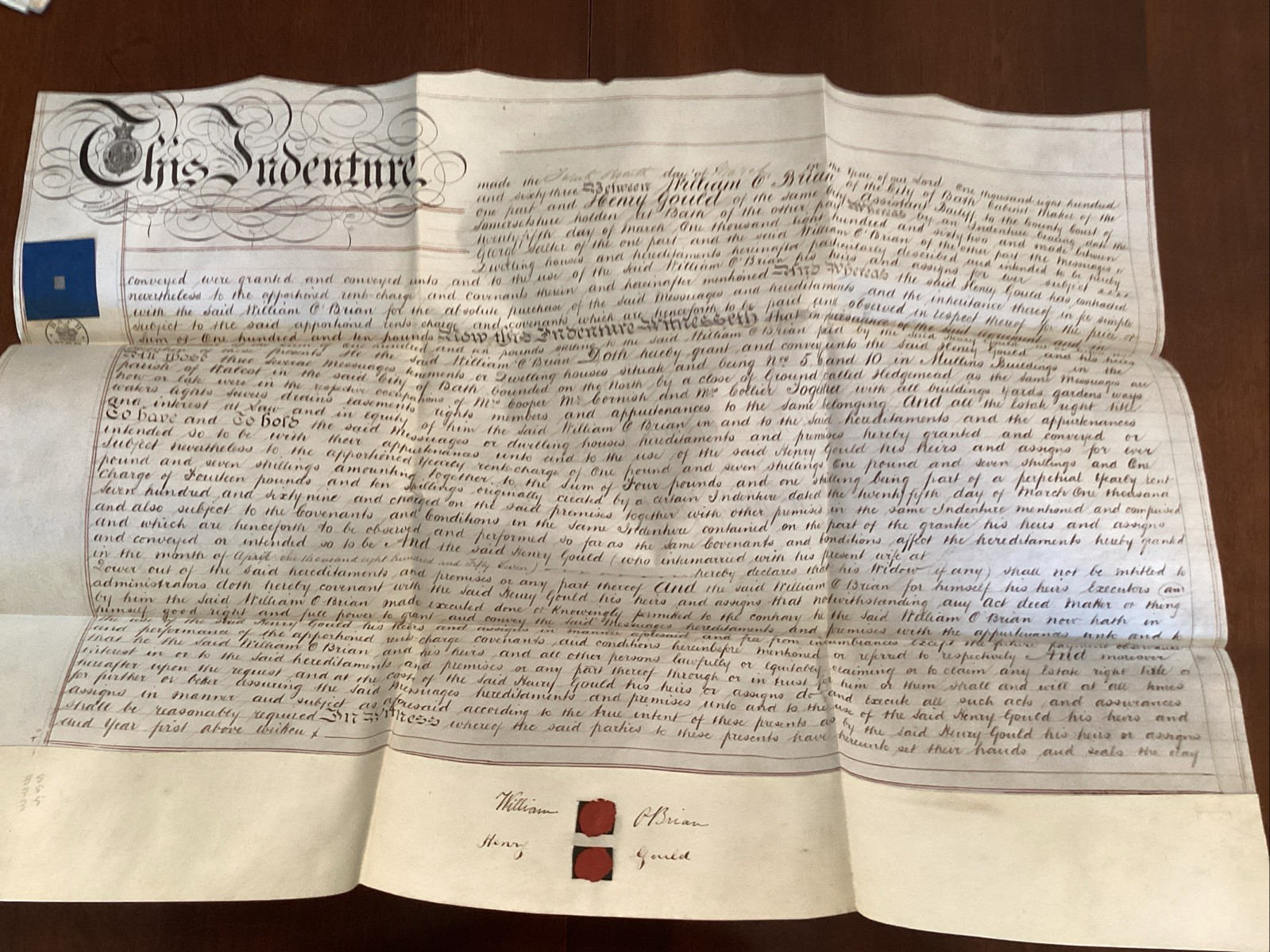
1863 Victorian Vellum Conveyance Mullins Buildings Walcot Bath Somerset William O’Brian Henry Gould Cabinet Maker County Court Bailiff Wax Seal
Approximately 22" by 28”
1863 Victorian Conveyance — Nos. 5, 6 & 10 Mullins Buildings, Walcot, Bath, Somerset
Mr. William O’Brian to Mr. Henry Gould | Dated 27th March 1863 | Consideration: £110
A fine original vellum indenture dated 27th March 1863, conveying three dwelling houses — Nos. 5, 6, and 10 Mullins Buildings in the Parish of Walcot, City of Bath, County of Somerset — from Mr. William O’Brian of the City of Bath to Mr. Henry Gould of Bath, for the consideration of £110.
The Properties Described:
Three messuages or dwelling houses situated and being Nos. 5, 6, and 10 in Mullins Buildings, Parish of Walcot, City of Bath — bounded on the North by a close of ground called Hedgemead, with neighboring occupiers including Mr. Cooper, Mr. Cornish, and Mr. Collier — together with all buildings, yards, gardens, ways, members, and appurtenances. The properties are conveyed to Henry Gould his heirs and assigns forever, subject to an apportioned perpetual yearly rent-charge of £4 1s (being One pound and seven shillings and One pound and seven shillings and One shilling, totaling £4 1s) — part of a larger perpetual yearly rent-charge of £14 10s created by a prior Indenture dated 25th March 1862 and charged upon the said premises together with other premises in that Indenture mentioned.
Walcot and Mullins Buildings — Historical Context:
The Parish of Walcot was one of Bath’s most populous Georgian and Victorian parishes, stretching along the northeastern edge of the city from the upper town toward Hedgemead. Mullins Buildings was a terrace of working and lower-middle-class dwellinghouses in this area. The neighboring Hedgemead close later became the site of Hedgemead Park (opened 1889) — a public park created after landslips destroyed housing in this exact area. This document therefore relates to properties in one of Victorian Bath’s most historically significant urban development zones.
Significant Parties:
∙ William O’Brian of the City of Bath — vendor; signs in full with a clear educated hand; receipts £110 witnessed by his solicitor; the O’Brian family held multiple properties in Walcot as evidenced by the prior rent-charge Indenture of 1862 referencing other premises in the same title
∙ Henry Gould of Bath — purchaser; described in the document as Cabinet Maker of the City of Bath and notably as Assistant Bailiff to the County Court of Somersetshire holden at Bath — a dual occupation combining skilled craftwork with a minor judicial administrative role, providing a vivid portrait of Victorian Bath’s aspiring lower-middle class; the document notes his present wife but expressly excludes her right of dower over the purchased properties
∙ John Stone, Solicitor, Bath — witness to O’Brian’s execution; a Bath solicitor
∙ John Pearce of Abbey Street, Bath — witness to Henry Gould’s execution; Abbey Street was a well-known Bath address adjacent to the Abbey precinct
Physical Description:
Single large vellum sheet with elaborate engraved blackletter “This Indenture” heading bearing a Royal Arms stamp, printed by Harrington St., 27 Strand, London. Written in fine mid-Victorian copperplate and engrossing hand with red ruling lines. Bears two intact red wax seals on green paper wafers — signed “William O’Brian” and “Henry Gould”. Receipt for £110 signed “William O’Brian” witnessed by John Stone. Bath county blind embossed stamp present (27-11-63). Age-appropriate toning and fold wear. Overall condition very good.