When you click on links to various merchants on this site and make a purchase, this can result in this site earning a commission. Affiliate programs and affiliations include, but are not limited to, the eBay Partner Network.
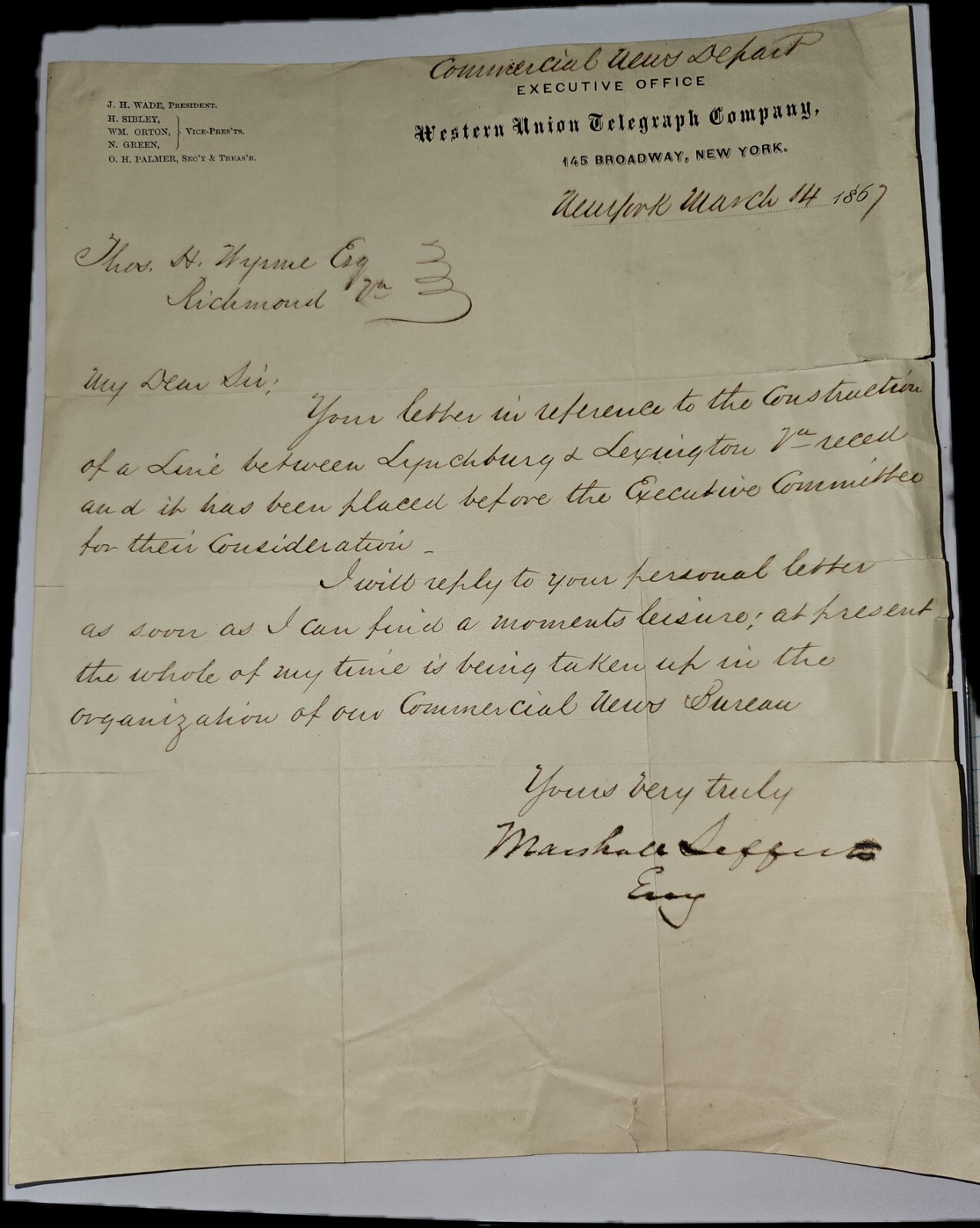
An incredibly old Western Union that was a post civil war request from Thomas H Wynne esquire to drop communications lines between Lynchburg VA and Lexington VA as part of Virginia\'s rebuilding after the Civil War. The author of the letter was an electrical engineer and an Esq for Western Union but he came up with some incredible patents that they purchased the rights to for troubleshooting electric lines.
The letter reads as follows .
\"**Commercial News Depart**
**Executive Office**
**Western Union Telegraph Company.**
**145 Broadway, New York.**
**New York, March 14, 1867**
Thos. H. Wynne Esq.
Richmond, Va
My Dear Sir,
Your letter in reference to the construction of a line between Lynchburg & Lexington Va. received and it has been placed before the Executive Committee for their consideration.
I will reply to your personal letter as soon as I can find a moment’s leisure; at present the whole of my time is being taken up in the organization of our Commercial News Bureau.
Your very truly,
Marshall Lefferts
Esq.\"
Thomas H. Wynne was a notable figure in Virginia’s history, particularly during the 19th century. Wynne served in the Virginia House of Delegates from 1861 to 1863 and later in the Virginia Senate from 1872 to 18751. His involvement in politics and public service during a tumultuous period in American history, including the Civil War and Reconstruction era, suggests that he was an influential voice in the state’s legislative matters.
---
This letter is an official communication from Marshall Lefferts, an executive at the Western Union Telegraph Company, to Thos. H. Wynne Esq. in Richmond, Virginia. It acknowledges the receipt of Wynne’s letter about constructing a telegraph line between Lynchburg and Lexington, Virginia, and mentions that the matter has been referred to the Executive Committee for consideration. Lefferts also notes that he is currently busy with organizing the Commercial News Bureau and will respond to Wynne\'s personal letter when he finds some free time.
LEFFERTS, Marshall, engineer, born in Bedford, L. I., 15 January, 1821; died near Newark, New Jersey, 3 , July, 1876. He was educated in the common schools, was first a clerk, and subsequently a civil engineer, and, returning to mercantile pursuits, became a partner in the importing-house of Monewood and Company, New York. In 1849 he became president of the New York, New England, and New York state telegraph companies, from which office he retired in 1860 and began a system of telegraph-wires, which was worked on the automatic plan of transmission. These patents were subsequently purchased by the American (now the Western Union) telegraph company, of which he became electric engineer, and at the same time he was consulting engineer of the Atlantic cable company. He was the first in the United States to make and apply instruments for the detection of faults in electric cables, and to reduce the system of relays to common standards. He resigned his office with the Western Union telegraph company in 1867 to organize the commercial news department of that company, became president of the gold and stock telegraph company in 1869, and when, two years afterward, the latter purchased the commercial news department, he again assumed its control. He joined the New York 7th regiment in 1851 as a private, became its lieutenant-colonel the next year, and its colonel in 1859. In 1861 this regiment, under his command, was the first to leave the city for the seat of war. It was again called out in 1862 and in 1863, and at the latter date was stationed in Frederick, Maryland, where Colonel Lefferts was military governor, returning to New York to protect the city in the draft riots of July, 1863. At the close of the war he resigned his command, and accepted that of commandant of the veteran corps of the 7th regiment, holding office until his death, which occurred on the railroad train while he was going with his corps to the Fourth of July parade in Philadelphia in 1876.