When you click on links to various merchants on this site and make a purchase, this can result in this site earning a commission. Affiliate programs and affiliations include, but are not limited to, the eBay Partner Network.
1871 VICTORIA WOODHULL AUTOGRAPH LETTER TO ELIZABETH CADY STANTON — MENTIONS ISABELLA BEECHER HOOKER & “IMPORTANT STOCK OPERATIONS”SUMMARY OF IMPORTANCE
Offered here is an exceptional April 20, 1871 autograph letter signed by Victoria C. Woodhull (1838–1927), the pioneering Wall Street broker, radical newspaper publisher, women’s-rights advocate, and woman widely recognized as the first female candidate for President of the United States.
The letter is addressed familiarly:
“My Dear Mrs Stanton”
— identifying the recipient as Elizabeth Cady Stanton (1815–1902), one of the founders and foremost intellectual leaders of the American women’s suffrage movement.
Within the body of the letter, Woodhull refers to a planned meeting with:
“Mrs Hooker”
— Isabella Beecher Hooker (1822–1907), another major suffrage leader, close associate of Stanton and Susan B. Anthony, member of the celebrated Beecher family, and one of Woodhull’s important supporters during her dramatic emergence within the suffrage movement in 1871.
Woodhull explains why she cannot attend:
“some important Stock operations call me down town very early.”
That sentence gives the document exceptional historical resonance.
In just a few handwritten lines, this single letter directly intermingles three important women of the nineteenth-century American suffrage movement — Victoria Woodhull, Elizabeth Cady Stanton, and Isabella Beecher Hooker — while simultaneously documenting Woodhull’s groundbreaking activities as a woman conducting business on Wall Street.
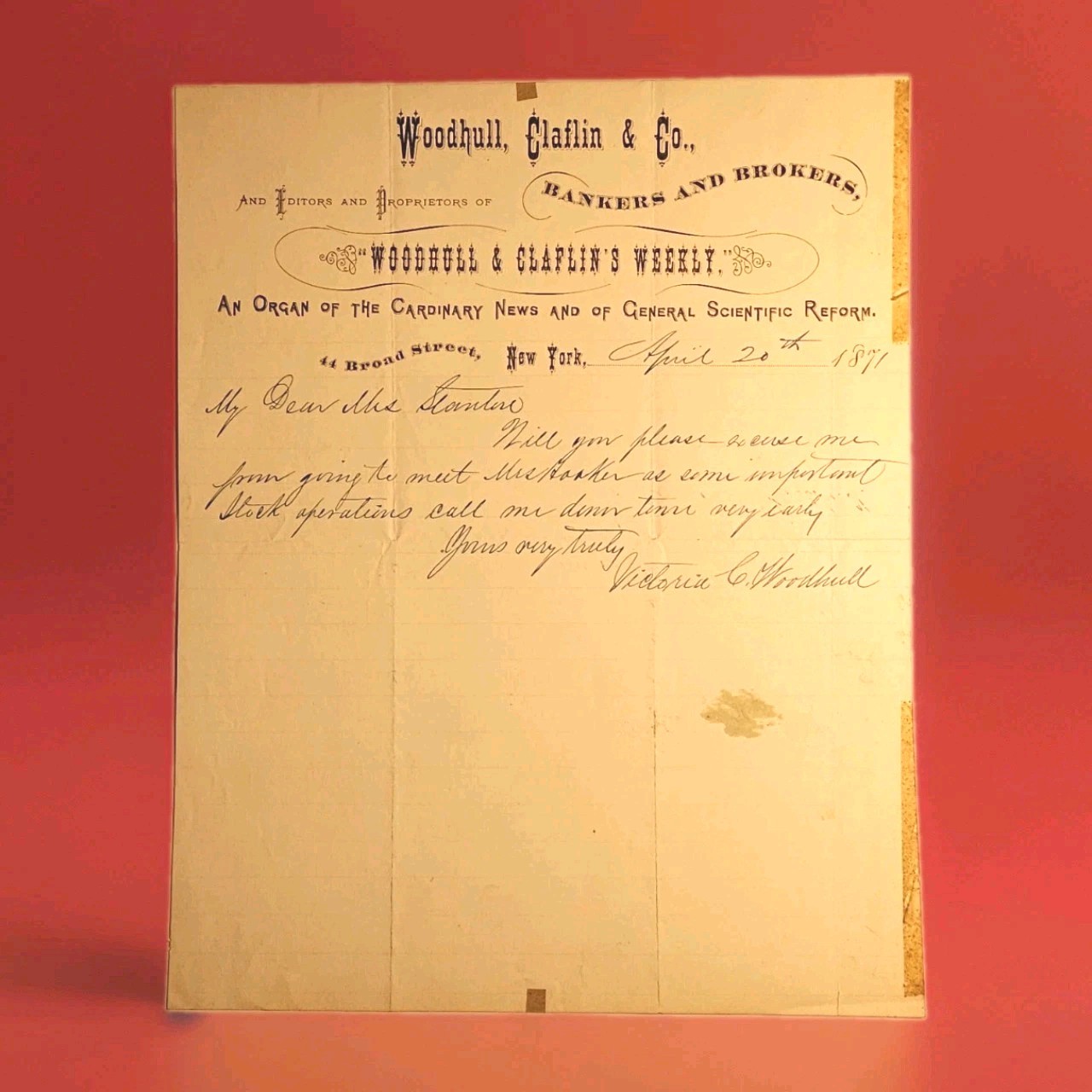
The letter is written on the elaborate stationery of:
WOODHULL, CLAFLIN & CO.
BANKERS AND BROKERS
Editors and Proprietors of WOODHULL & CLAFLIN’S WEEKLY
44 Broad Street, New York
The combination of author, recipient, third-party reference, Wall Street content, 1871 date, suffrage association, and extraordinary business letterhead makes this far more historically meaningful than a routine Victoria Woodhull autograph.
TRANSCRIPTION
44 Broad Street, New York
April 20th 1871
My Dear Mrs Stanton
Will you please excuse me
from going to meet Mrs Hooker as some important
Stock operations call me down town very early.
Yours very truly,
Victoria C. Woodhull
WHY THIS LETTER IS SO SIGNIFICANT
This document captures an extraordinary convergence of women’s political activism, women in finance, radical journalism, and presidential history at a crucial moment in 1871.
Victoria Woodhull was not merely corresponding with acquaintances.
She was writing to Elizabeth Cady Stanton, one of the principal architects of the organized American women’s-rights movement, concerning a proposed meeting with Isabella Beecher Hooker, another important suffrage leader.
And Woodhull was forced to miss that meeting because:
“some important Stock operations call me down town very early.”
That is almost a perfect encapsulation of Woodhull’s extraordinary historical role.
At a time when American women could not vote in national elections and faced enormous legal and social restrictions on their economic independence, Woodhull was simultaneously:
Operating a brokerage in New York’s financial district
Publishing a radical national newspaper
Advancing a constitutional argument for women’s voting rights
Working personally with leaders of the suffrage movement
Preparing for the political activity that would culminate in her historic presidential campaign
The letter therefore documents something much larger than a canceled appointment.
It shows three leading women reformers interacting as active participants in political and public life, while Woodhull herself is pulled away by the demands of high finance.
THREE MAJOR WOMEN INTERMINGLED IN A SINGLE DOCUMENT
Perhaps the most compelling feature of this manuscript is the presence of Woodhull, Stanton, and Hooker together in a single short communication.
Each woman occupied a distinct position within the struggle for women’s equality.
Victoria Woodhull
Woodhull challenged the boundaries of what women were supposedly capable of doing in business, journalism, politics, sexuality, and public life.
Elizabeth Cady Stanton
Stanton supplied much of the intellectual and philosophical foundation of the American women’s-rights movement, beginning with Seneca Falls and continuing through decades of suffrage leadership.
Isabella Beecher Hooker
Hooker connected the movement with one of nineteenth-century America’s most famous reform families and became an energetic suffrage organizer and advocate who strongly supported Woodhull during this period.
Their appearance together is therefore not merely a collection of famous names.
It represents an actual working network of women reformers at a moment when the suffrage movement was experimenting with new constitutional, political, and organizational strategies.
Woodhull writes directly to Stanton about meeting Hooker.
That makes all three women participants in the substance of the document:
Woodhull — author
Stanton — recipient
Hooker — intended meeting participant
For a collector of women’s history, that three-way association is particularly powerful.
THE APRIL 1871 CONTEXT
The date — April 20, 1871 — is especially important.
Woodhull had recently vaulted into the highest levels of the national suffrage debate.
In January 1871, she appeared before the House Judiciary Committee and argued that women already possessed the constitutional right to vote under the Fourteenth and Fifteenth Amendments.
Rather than asking women simply to wait for a future suffrage amendment, Woodhull contended that the Constitution could already be interpreted as protecting their political rights.
Her argument intersected with what became known as the “New Departure” suffrage strategy.
It attracted the attention of prominent reformers, including Elizabeth Cady Stanton and Isabella Beecher Hooker.
The timing of the present letter is particularly striking because surviving contemporary correspondence establishes that Stanton was actively discussing and defending Woodhull during this exact month.
On April 5, 1871 — only fifteen days before this letter — Stanton wrote enthusiastically about Woodhull, following recent personal interaction with her in Philadelphia.
That near-contemporary evidence provides exceptionally strong context for Woodhull’s familiar salutation:
“My Dear Mrs Stanton.”
This was written during a period of genuine personal and political interaction between them.
VICTORIA C. WOODHULL1838–1927
Victoria Claflin Woodhull was among the most unconventional and controversial public figures of nineteenth-century America.
Born in Homer, Ohio, in 1838, she rose from an impoverished and highly unconventional family background to become nationally famous as a spiritualist, lecturer, stockbroker, newspaper publisher, political activist, social reformer, and presidential candidate.
Her career repeatedly challenged contemporary assumptions about the proper place of women in American society.
Wall Street Pioneer
In 1870, Victoria Woodhull and her younger sister Tennessee Celeste “Tennie” Claflin established:
Woodhull, Claflin & Co., Bankers and Brokers
Their brokerage operated at 44 Broad Street in New York, the exact address appearing at the head of this letter.
Women publicly conducting brokerage business in the Wall Street financial district was sensational in 1870.
The sisters became famous almost immediately.
That makes Woodhull’s statement in the present letter:
“some important Stock operations call me down town very early”
particularly important.
It is not later commentary about her career. It is Woodhull herself, in real time, referring to the actual financial operations occupying her attention as a Wall Street broker.
Woodhull & Claflin’s Weekly
Also in 1870, Woodhull and Claflin established the radical newspaper:
Woodhull & Claflin’s Weekly
The newspaper is prominently advertised on the letterhead of this document.
It provided Woodhull with a national platform for an unusually broad program of reform, including:
The paper later became famous for publishing an English-language version of Karl Marx and Friedrich Engels’ Communist Manifesto.
Thus the letterhead alone represents two of Woodhull’s most important historical identities:
the Wall Street broker and the radical publisher.
Women’s Suffrage
Woodhull became an aggressive advocate for women’s political equality.
Her 1871 congressional appearance made her one of the most visible advocates of the argument that women already possessed constitutional voting rights.
This placed her directly in the orbit of established suffrage leaders including Stanton, Anthony, and Hooker.
First Female Presidential Candidate
In 1872, Woodhull was nominated for President by the Equal Rights Party.
She is widely recognized as the first woman to run for President of the United States.
Her campaign occurred almost fifty years before ratification of the Nineteenth Amendment constitutionally prohibited denial of the vote on account of sex.
The audacity of her presidential candidacy made Woodhull one of the most controversial political figures of the era and cemented her place in American women’s history.
Later Life
Woodhull eventually moved to England, married banker John offerdulph Martin, and continued her involvement in publishing and reform.
She died in England in 1927, having lived long enough to see American women finally achieve constitutionally protected national voting rights.
ELIZABETH CADY STANTON1815–1902
Elizabeth Cady Stanton was one of the foundational figures of the American women’s-rights movement and among the most important reformers of nineteenth-century America.
Born in Johnstown, New York, in 1815, Stanton became involved in abolitionism and reform before emerging as one of the foremost advocates of women’s legal and political equality.
Seneca Falls
In 1848, Stanton helped organize the landmark Seneca Falls Convention.
She was the principal force behind its famous Declaration of Sentiments, which deliberately echoed the language of the Declaration of Independence and proclaimed:
“all men and women are created equal.”
The convention became one of the foundational events in the organized American movement for women’s rights.
Partnership with Susan B. Anthony
Stanton later formed her legendary partnership with Susan B. Anthony.
The two complemented one another remarkably well.
Stanton was a powerful writer, thinker, and political theorist, while Anthony became one of the movement’s most tireless organizers and lecturers.
Together they fought for changes involving:
By 1871, Stanton and Anthony were leaders of the National Woman Suffrage Association.
Stanton and Woodhull
Stanton became interested in Woodhull during Woodhull’s rapid rise within suffrage circles.
Her surviving April 1871 correspondence demonstrates that this was not merely a distant acquaintance.
Only fifteen days before the present letter, Stanton was enthusiastically discussing Woodhull and defending her involvement in the movement.
The salutation:
“My Dear Mrs Stanton”
therefore carries considerable historical weight.
It reflects the personal familiarity that had developed between a foundational leader of the movement and its flamboyant new Wall Street ally.
ISABELLA BEECHER HOOKER1822–1907
Isabella Beecher Hooker was a leading nineteenth-century American women’s-rights advocate and a member of one of the most famous families in American reform history.
Born in 1822, she was a daughter of prominent Congregationalist minister Lyman Beecher.
Her siblings and half-siblings included several nationally important figures.
Most famously, Isabella was the half-sister of:
Harriet Beecher Stowe (1811–1896) — author of Uncle Tom’s Cabin, the enormously influential antislavery novel.
She was also the half-sister of:
Henry Ward Beecher (1813–1887) — one of the most famous American clergymen of the nineteenth century.
Isabella married attorney John Hooker, who supported many of her reform activities.
Suffrage Leadership
Hooker became deeply involved in the campaign for women’s voting rights.
She worked closely with leaders including:
Elizabeth Cady Stanton
Susan B. Anthony
Victoria Woodhull
and became particularly important in Connecticut suffrage organization.
Hooker was among those who responded enthusiastically to Woodhull’s dramatic arrival in the suffrage movement in 1871.
Her identification as the “Mrs Hooker” whom Woodhull and Stanton intended to meet makes complete historical sense within this documented circle.
Hooker and Woodhull
Hooker became one of Woodhull’s notable supporters during this period and shared her enthusiasm for pursuing women’s rights through constitutional and political action.
Thus her appearance in this letter is more than an incidental reference.
It places Woodhull within an identifiable network of national suffrage leaders at the precise moment she was attempting to transform herself from Wall Street celebrity into a major political reform figure.
TENNESSEE CELESTE “TENNIE” CLAFLIN
Although she is not named in the handwritten text, Tennessee Claflin is represented prominently through the printed heading “Woodhull, Claflin & Co.”
Tennie was Victoria’s younger sister and partner in her most famous financial and publishing ventures.
Together they operated the brokerage at 44 Broad Street and published Woodhull & Claflin’s Weekly.
The sisters’ public entry into Wall Street became a national sensation and challenged assumptions about women’s ability to participate independently in American financial life.
WHY THE “IMPORTANT STOCK OPERATIONS” LINE MATTERS
For autograph collectors, letters with content directly related to the historical reason a person is famous are generally much more compelling than routine correspondence.
That principle applies particularly strongly here.
Woodhull does not merely use brokerage letterhead.
She explicitly states that:
“some important Stock operations call me down town very early.”
The business advertised at the top of the sheet is therefore the same business being discussed in Woodhull’s handwriting.
That creates a rare unity between letterhead and manuscript content.
Even more remarkably, the Wall Street reference occurs in a communication involving Elizabeth Cady Stanton and Isabella Beecher Hooker.
The document consequently embodies Woodhull’s extraordinary attempt to occupy two spheres from which women had traditionally been largely excluded:
financial power and political power.
WALL STREET MEETS WOMEN’S SUFFRAGE
There is a particularly evocative symbolism to this letter.
At the top of the page:
WOODHULL, CLAFLIN & CO. — BANKERS AND BROKERS
Below it:
“My Dear Mrs Stanton”
Then:
“meet Mrs Hooker”
And finally:
“important Stock operations”
In four short elements, the document captures an enormous transformation in nineteenth-century American life.
A woman is operating a brokerage.
She is corresponding with a founder of the women’s-rights movement.
They are arranging to meet another major suffragist.
And financial business is important enough to interrupt their political and social schedule.
For collectors of women’s history, it is difficult to imagine a more concentrated illustration of women moving simultaneously into economic and political public life.
CONDITION
Original handwritten letter on printed Woodhull, Claflin & Co. / Woodhull & Claflin’s Weekly stationery.
The sheet exhibits expected evidence of age and historical handling, including:
The elaborate printed heading remains highly attractive and readily legible.
The manuscript text is clear, including the historically important:
“Stock letter concludes with Woodhull’s full handwritten signature:
Victoria C. Woodhull
Please review all photographs carefully, as they constitute an important part of the condition description.
OVERALL HISTORICAL SIGNIFICANCE
This is not simply a signed Victoria Woodhull letter.
It is an unusually rich association manuscript connecting three major women of the nineteenth-century American suffrage movement at precisely the moment when Woodhull was becoming a national political figure.
Victoria Woodhull writes it.
Elizabeth Cady Stanton receives it.
Isabella Beecher Hooker is the woman they intend to meet.
And Woodhull cannot attend because:
“some important Stock operations call me down town very early.”
That extraordinary combination brings together:
Victoria Woodhull
Elizabeth Cady Stanton
Isabella Beecher Hooker
Women’s suffrage
Wall Street
Women in finance
Woodhull, Claflin & Co.
Woodhull & Claflin’s Weekly
The Beecher family
The New Departure suffrage movement
Women’s economic independence
Radical nineteenth-century journalism
Presidential history
The first female presidential candidacy
Few documents so compactly demonstrate the intersection between the economic emancipation and political emancipation of American women.
Written in April 1871, at the height of Woodhull’s entrance into the national suffrage movement and only a year before her historic presidential campaign, this is an exceptionally evocative primary-source artifact of American women’s history, Wall Street history, and the struggle for equal political rights.