When you click on links to various merchants on this site and make a purchase, this can result in this site earning a commission. Affiliate programs and affiliations include, but are not limited to, the eBay Partner Network.
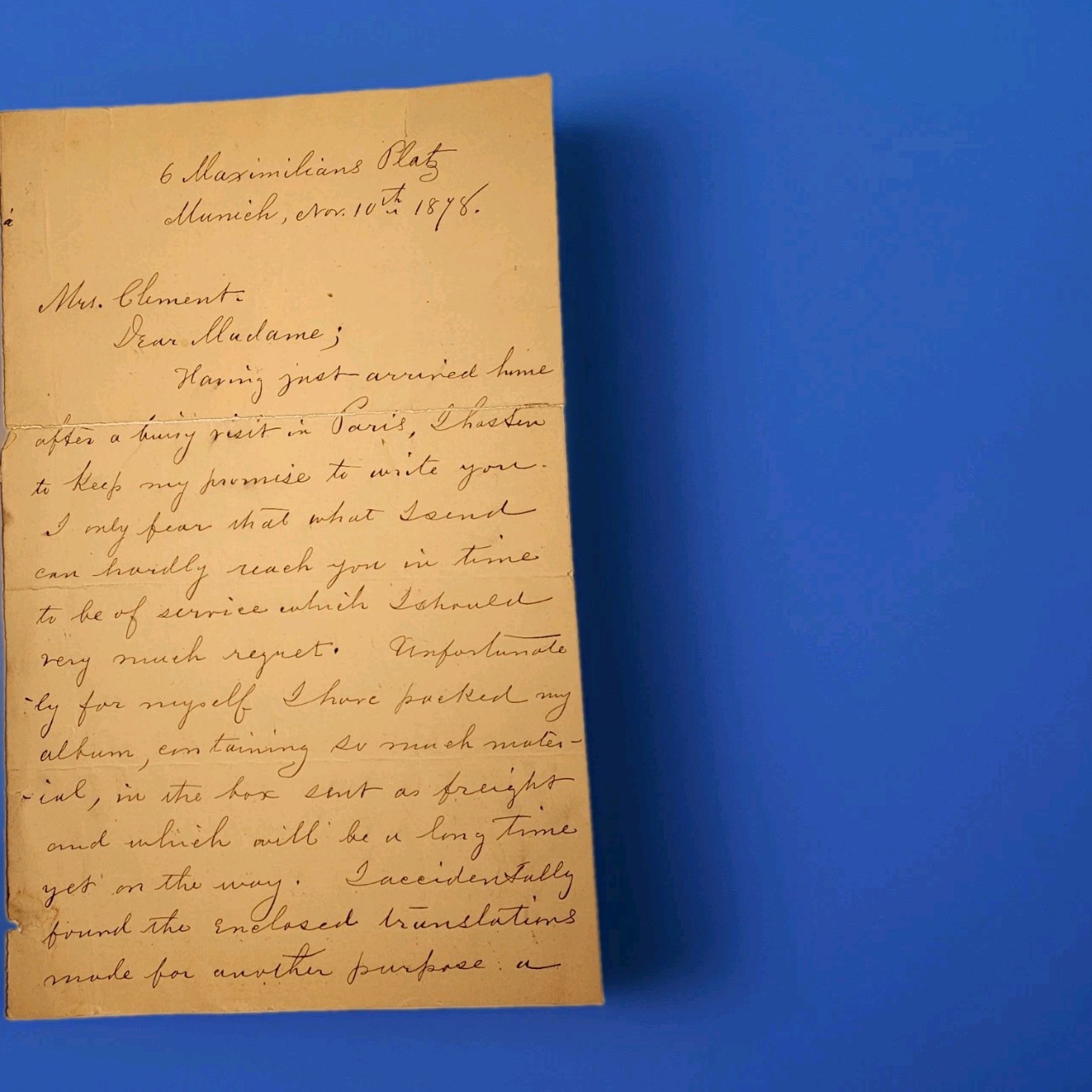
Offered here is an important multi-page handwritten letter and group of original biographical notes by American painter David Dalhoff Neal (1838–1915), written from 6 Maximilians Platz, Munich, on November 10, 1876, and addressed to the noted American art historian and author Clara Erskine Clement (1834–1916).
The group is especially significant because it appears to document Neal’s direct contribution of firsthand biographical information on contemporary artists to Clement while she was gathering material for her major reference work, Artists of the Nineteenth Century and Their Works: A Handbook Containing Two Thousand and Fifty Biographical Sketches, published in 1879 with Laurence Hutton.
Neal’s signed covering letter explains that he has recently returned from a busy visit to Paris and is writing to fulfill a promise. He regrets that his material may arrive too late to be useful, noting that his album containing much of the information had been packed away in a freight box and would take considerable time to arrive. He had, however, unexpectedly found a number of translations and notes prepared for another purpose and sends these to Clement.
The accompanying manuscript sheets contain biographical and professional information on several artists associated with the Munich Academy, the Piloty school, Parisian training circles, and the broader European art world.
Among the artists discussed are:
- Conrad Beckmann, described in connection with Hanover, Munich, Kaulbach, Piloty, and his reputation as a genre painter.
- Wilhelm Lindenschmit the Younger, important Munich historical painter and professor.
- Other artists associated with German exhibitions and the Munich Academy, including references to reputations, paintings, training, and artistic careers.
- Annie de Hlasko / Hlasko, identified by Neal as having been born in Philadelphia in 1857 and trained in Paris under Jacquesson de la Chevreuse and later under the celebrated landscape painter Jean-Baptiste Guillemet.
The packet is therefore considerably more than a routine autograph letter. It represents working source material exchanged between a major American expatriate painter and one of the leading American popular art historians of the nineteenth century.
Historical Importance
Clara Erskine Clement was actively compiling biographical information on living and recently deceased artists during the 1870s. Neal, by then deeply embedded in the Munich art world and familiar with Parisian artistic circles, was exceptionally well positioned to provide accurate contemporary information.
This correspondence gives a rare glimpse into how nineteenth-century art-reference books were actually assembled. Clement depended not simply on previously published sources, but also on direct communication with artists and knowledgeable figures abroad.
Neal’s comments, translations, and artist biographies may therefore represent primary-source editorial material gathered for Clement’s later published handbook.
The presence of information on the relatively obscure American woman artist Annie Hlasko is particularly interesting. Neal’s near-contemporary account of her birthplace and Parisian training may preserve valuable biographical information from within the artistic community itself.
David Dalhoff Neal Biography
David Dalhoff Neal (1838–1915) was an American painter best known for portraits and historical compositions and was one of the important American artists associated with nineteenth-century Munich.
Born in Lowell, Massachusetts, Neal began his artistic career in the United States before traveling to Europe for formal training. He studied at the Royal Academy of Fine Arts in Munich and later worked in the circle of the influential historical painter Carl Theodor von Piloty.
Neal became deeply established in Munich artistic society and spent much of his professional life in Germany. His work reflected the highly finished academic historical style for which the Munich school became famous.
Among his important early successes was The First Meeting of Mary Stuart and Rizzio, for which he received major recognition from the Royal Bavarian Academy. He subsequently developed a substantial career as a historical painter and portraitist while maintaining connections with American patrons and artists.
By 1876, when this letter was written, Neal occupied an unusually valuable position between the American and European art worlds. His familiarity with Munich Academy circles, German artists, Parisian painters, exhibitions, and American artists studying abroad explains why Clement sought information from him.
The letter is signed:
“David Neal”
Clara Erskine Clement Biography
Clara Erskine Clement (1834–1916), later known as Clara Erskine Clement Waters, was an influential American author, traveler, and art historian whose handbooks introduced generations of English-speaking readers to the history of art and the biographies of artists.
Born in 1834, she was privately educated and developed strong interests in literature, history, travel, and the fine arts.
She married James Hazen Clement in 1852 and was therefore known as Mrs. Clement at the time of this correspondence. After his death, she married Edwin Forbes Waters in 1882 and thereafter frequently published under the name Clara Erskine Clement Waters.
Clement traveled extensively in Europe, giving her direct exposure to major museums, collections, monuments, and artistic centers. She became particularly known for creating accessible reference books aimed at general readers, students, collectors, and travelers.
Her publications included:
- A Handbook of Legendary and Mythological Art — 1871
- Painters, Sculptors, Architects, Engravers, and Their Works — 1874
- Artists of the Nineteenth Century and Their Works — 1879, with Laurence Hutton
- Women in the Fine Arts — 1904
Her books were widely used as reference works in the late nineteenth and early twentieth centuries.
This 1876 correspondence provides unusually direct evidence of Clement’s research process, showing that she solicited information from professional artists who personally knew the European artistic world she was attempting to document.
Conrad Beckmann Biography
Conrad Beckmann was a German painter associated with the nineteenth-century Munich school. Neal’s notes describe him as Hanover-born and connect his artistic education with the Munich Academy, Wilhelm von Kaulbach, and Carl von Piloty.
Beckmann became known particularly for genre painting and belonged to the generation of German artists whose careers developed during Munich’s rise as one of the principal artistic centers of Europe.
Neal’s remarks are especially valuable because they come from another painter working within essentially the same artistic environment.
Wilhelm Lindenschmit the Younger Biography
Wilhelm Lindenschmit the Younger (1829–1895) was a prominent German historical painter and professor at the Munich Academy.
Born into an artistic family, Lindenschmit became associated with Munich’s academic tradition and developed a reputation for ambitious historical and narrative compositions. His work frequently drew upon German history, religious themes, and subjects connected with the Reformation.
He became an influential teacher and an important representative of Munich historical painting during the second half of the nineteenth century.
His inclusion in Neal’s notes reinforces the packet’s close relationship to the institutional and academic art world of Munich.
Annie Hlasko Biography
Annie Hlasko, identified in Neal’s manuscript as “Annie de Hlasko,” was an American-born woman artist associated with Parisian artistic training.
Neal records that she was:
“born at Philadelphia in 1857”
and states that she was for many years a pupil of Jacquesson de la Chevreuse in Paris, afterward studying with the celebrated French landscape painter Jean-Baptiste Guillemet.
Because Hlasko remains comparatively obscure today, Neal’s handwritten biographical notice is of particular scholarly interest. It represents testimony from an established contemporary artist regarding the education and career of an American woman studying within the French academic system.
Jean-Baptiste-Antoine Guillemet Biography
He exhibited regularly and developed a reputation for landscape painting, particularly scenes of the French countryside and coast. He moved in artistic circles that overlapped with several of the major painters of his generation.
Neal specifically identifies Guillemet as one of Annie Hlasko’s instructors, making his name important to understanding her artistic training.
Overall Significance
This group combines several highly collectible and research-oriented subjects:
American art history — Munich Academy — Carl von Piloty circle — nineteenth-century artists — women artists — Paris art training — publishing history — art-historical scholarship — autograph correspondence.
Most importantly, it represents a direct exchange between an established American painter living inside the European art world and an American author attempting to document that world for publication.
Rather than simply discussing a forthcoming book, Neal actually supplied Clement with the raw biographical information from which such a reference work could be constructed.
That distinction gives the group unusual documentary importance.
Condition
Original nineteenth-century manuscript material showing expected age toning, folds, edge wear, tears, small losses, staining/foxing, and other signs of age and handling. Several sheets have separation or weakness along old folds. Please examine all photographs carefully for the exact condition.
The manuscript remains highly legible overall and retains the original signed covering letter together with the associated biographical notes.
Original manuscript material, not a reproduction.