When you click on links to various merchants on this site and make a purchase, this can result in this site earning a commission. Affiliate programs and affiliations include, but are not limited to, the eBay Partner Network.
📜 ABOUT THIS PIECE OF HISTORY 📜
The May 1, 1880 issue of Harpers Weekly is one of the most historically charged issues of the entire year — three full pages, three stories, three of the defining tensions of Gilded Age America laid out with unflinching directness. An engineering marvel being born beneath the Hudson River. The great migration of Black Americans out of the post-Reconstruction South, documented in a before-and-after full page of extraordinary historical power. And a court of inquiry sitting at West Point to investigate one of the most racially explosive incidents in the history of the United States Military Academy. This is Harpers Weekly at its most serious and most consequential — a document that belongs in every serious collection of Gilded Age American history.🚇 FULL PAGE — \"THE HUDSON RIVER TUNNEL\" — FIVE ILLUSTRATIONS WITH TEXT
One of the great engineering documents in the entire Harpers Weekly archive — a full page with five illustrations and substantial text covering the construction of the Hudson River Tunnel, the audacious project to bore a rail tunnel beneath the Hudson River connecting New Jersey to Manhattan at a moment when the only crossings were by ferry. The Hudson River Tunnel project — begun by DeWitt Clinton Haskin in 1874 using the compressed-air shield method — had already suffered a catastrophic blowout in 1880 that killed twenty workers and flooded the tunnel workings, and the project was now fighting for its financial and engineering life. The five illustrations document the tunnels construction in remarkable detail — the shield, the compressed-air chambers, the workers in the pressurized environment, the engineering challenges of boring through Hudson River mud under tidal conditions that no previous tunnel project had faced.
This is a primary source document of one of the great infrastructure stories of 19th-century America. The tunnel Haskin began would eventually — after decades of financial collapse, engineering disaster, and reconstruction — become the Hudson Tubes, and then the PATH train, carrying millions of commuters between New Jersey and Manhattan every year to this day. Here it is at its most desperate and most heroic beginning. An essential piece for collectors of New York City infrastructure history, engineering history, and the history of the PATH train and Hudson River crossings.✊ FULL PAGE — \"THE NEGRO EXODUS — THE OLD STYLE AND THE NEW\"
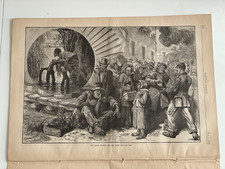
One of the most historically significant and visually powerful illustrations in the entire Harpers Weekly run for 1880 — a full-page before-and-after documentary of the Exoduster movement that cuts to the moral heart of the post-Reconstruction moment with a directness that is still arresting 145 years later. \"The Old Style and the New\" presents the contrast that defined everything: what Black life in the South had been — the plantation, the field, the bondage of slavery and its successor systems — and what the Exodusters were reaching toward in Kansas, in freedom, on their own land. This is not subtle journalism. It is not equivocal. It is a full-page argument, made in images, for the human dignity and historic agency of the tens of thousands of Black Americans who were walking away from the South toward a different life.
The Exoduster movement of 1879-1880 was one of the great mass migrations in American history — perhaps 40,000 to 60,000 African Americans leaving Mississippi, Louisiana, Texas, and the other redeemed Democratic states for Kansas and beyond, fleeing the violence, the debt peonage, the systematic disenfranchisement, and the terror of the post-Reconstruction South. The Senate had launched an investigation. The national press was consumed by the story. And Harpers Weekly had been documenting it with increasing intensity and clarity throughout the early months of 1880 — from Nasts front-page cartoons to this remarkable full-page documentary. For collectors of African American history, Reconstruction and post-Reconstruction history, the Exoduster movement, and the history of Black migration, this full page is an irreplaceable primary source document of the highest importance.⚔️ FULL PAGE — \"THE WEST POINT OUTRAGE — THE COURT OF INQUIRY IN SESSION\"
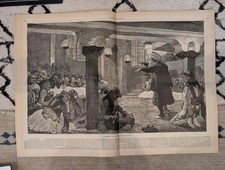
The third full page of this issue documents one of the most painful and consequential racial incidents in the history of the United States Military Academy — the court of inquiry convened to investigate the treatment of Johnson Whittaker, one of the very few Black cadets at West Point, who had been found bound and beaten in his room in April 1880 in what he reported as a racially motivated attack by fellow cadets. The \"West Point Outrage\" — as the press called it — had become a national controversy of the first order: Whittaker claimed he had been attacked and mutilated as a warning to leave the Academy, while the West Point establishment and much of the white press insisted he had staged the attack himself to avoid an academic examination. The court of inquiry depicted here was the official military response — a proceeding that would ultimately, in one of the great injustices of the Gilded Age, find against Whittaker and effectively end his military career despite the absence of credible evidence against him.
Whittaker had entered West Point in 1876, one of the first Black cadets following the Civil War, and had endured years of the systematic social exclusion — no white cadet would speak to him, room with him, or acknowledge his existence — that was the Academys unofficial policy toward its rare Black students. His experience was part of the same fabric of racial terror and institutional exclusion that was driving the Exodusters out of the South — just at a different level of American society and under military rather than civilian authority. That Harpers Weekly put this court of inquiry full page in the same issue as \"The Negro Exodus — The Old Style and the New\" was not accidental. The two illustrations speak to each other across the page with a clarity that the editors must have intended. For collectors of African American military history, West Point history, Reconstruction era history, and the history of racial justice in American institutions, this full page is a primary source document of exceptional importance.🔍 CONDITION & TRANSPARENCY 🔍
Completeness: Complete 16-page issue.
Authenticity: Guaranteed original printing from May 1, 1880 — not a reproduction.
Condition Report: Presents well for its 145-year age with natural toning to the newsprint consistent with paper of this era. The Hudson River Tunnel full page with five illustrations, the Negro Exodus full page, and the West Point court of inquiry full page are all clear and displayable. I have photographed every page — please review all images carefully and dont hesitate to ask for additional close-ups of any area before purchasing.📦 SHIPPING & PRESERVATION 📦
Housed in an acid-free archival folder with Mylar overlay to protect the 145-year-old newsprint
Flat-shipped with heavy-duty reinforcement to ensure safe arrival
Fully tracked for your peace of mindIn the same May week in 1880 — men were boring a tunnel under the Hudson River in compressed air, tens of thousands of Black Americans were walking to Kansas to be free, and a Black cadet at West Point was being put on trial for his own beating. Harpers Weekly put all three on a full page each and let American readers sit with the weight of it.🏷️ TAGS
1880 Harpers Weekly, Hudson River Tunnel History, PATH Train History, Hudson River Crossing 1880, Negro Exodus Old Style New Style, Exoduster Movement Primary Source, African American Exodus South 1880, West Point Outrage Johnson Whittaker, Whittaker West Point Court Inquiry, Black Cadet West Point History, Post Reconstruction African American History, African American Military History, Hudson Tunnel Engineering History, Antique Newspaper 1880, Harpers Weekly 1880, Gilded Age Race History Primary Source