When you click on links to various merchants on this site and make a purchase, this can result in this site earning a commission. Affiliate programs and affiliations include, but are not limited to, the eBay Partner Network.
📜 ABOUT THIS PIECE OF HISTORY 📜
The September 11, 1880 issue of Harpers Weekly is one of the most historically charged issues of the entire fall run — Thomas Nast delivers two full-page political cartoons including a devastating examination of Wade Hampton and the violent suppression of Black political rights in South Carolina, W.A. Rogers contributes one of the most moving and historically significant illustrations of the entire 1880 run in his full-page document of a settlers first home on the western frontier, Carlisle Cathedral fills the double-page centerfold with the atmospheric beauty of one of Englands most intimate medieval churches, and a view of Candahars citadel brings the Afghan frontier to American readers at a moment of intense British military engagement in Central Asia. This is an exceptional issue.🎨 FULL FRONT PAGE — THOMAS NAST: \"THE WIDOWS WANTS\"
Thomas Nast opens the issue with a front-page political cartoon of quiet but devastating moral force — \"The Widows Wants\" addressing one of the most fundamental and most ignored consequences of the post-Reconstruction political settlement: the condition of the widows and families of Black men who had been killed by the political violence that the Democratic redeemer governments had used to dismantle Reconstruction across the South. The widows wants were simple — safety, justice, the protection of law, the rights that the Constitutions 14th and 15th Amendments had promised and that the redeemer governments had systematically destroyed. Nasts front page makes that argument with the moral clarity and emotional directness that characterized his finest work on behalf of African American rights. A fully displayable and historically essential front page for collectors of Nasts work, Reconstruction history, and the history of racial justice in America.🎨 FULL PAGE — THOMAS NAST: \"WADE HAMPTONS DILEMMA\"
The second Thomas Nast full-page political cartoon of the issue is one of the most historically specific and important cartoons he produced in the entire 1880 campaign — \"Wade Hamptons Dilemma\" targeting the most celebrated and most dangerous of the Southern redeemer Democrats directly. Wade Hampton III — former Confederate cavalry general, governor of South Carolina, now the states senior senator — was the living symbol of the Redeemer South: the man who had led the Red Shirt campaign of 1876 that had used systematic paramilitary violence and fraud to overthrow the Reconstruction government of South Carolina and install Hampton as governor. Hampton represented the Democratic Partys Southern wing at its most powerful and most troubling — the man whose election had been purchased with terror now sitting in the United States Senate while his partys presidential candidate asked Northern voters to trust that all was well in the South.
Nasts \"Dilemma\" puts Hamptons contradiction on full display — the senator caught between the moderate face he presented to Northern audiences and the violent reality of how he and his Red Shirts had come to power. For collectors of Reconstruction history, South Carolina history, Wade Hampton history, and the history of racial violence in the post-Civil War South, this full page is a primary source document of exceptional historical importance.🌾 FULL PAGE — W.A. ROGERS: \"THE SETTLERS FIRST HOME IN THE FAR WEST\"
One of the most moving and historically significant full-page illustrations in the entire 1880 run — W.A. Rogerss magnificent documentary of a settlers first home on the western frontier, capturing one of the defining experiences of the American 19th century at its most raw and elemental. The settlers first home in the far west was almost invariably a dugout or a sod house — a structure cut from the earth itself, using the dense prairie sod as both building material and insulation against the extremes of the Great Plains climate — and Rogers documents it with the human observation and historical empathy that made his finest work genuinely remarkable.
In 1880 the great wave of Plains settlement was in full flood — the Homestead Act of 1862 was drawing hundreds of thousands of families onto the grasslands of Kansas, Nebraska, Dakota Territory, and beyond, and the experience of their first winter in a structure carved from the earth, surrounded by the vast flat emptiness of the prairie, was one of the most extraordinary and most testing in American history. Rogerss full page captures that moment — the family, the soddie, the landscape — with a documentary authenticity and emotional depth that makes it one of the great illustrations of the western settlement experience. An absolutely essential piece for collectors of frontier history, homestead history, Great Plains history, W.A. Rogers illustration, and the history of American westward expansion.🏛️ DOUBLE-PAGE CENTERFOLD — \"ENGLISH CHURCH ARCHITECTURE — CARLISLE CATHEDRAL\"
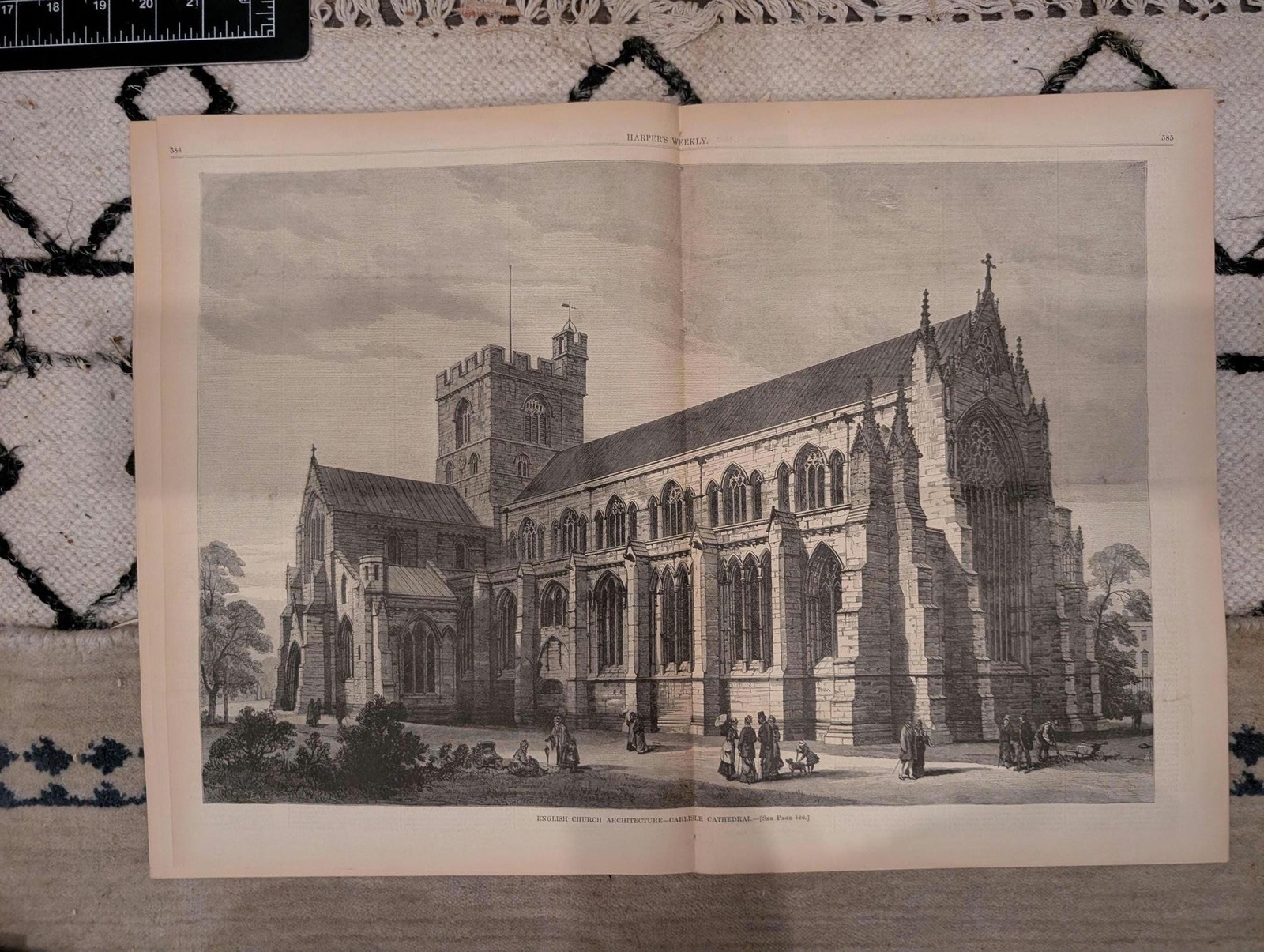
A magnificent double-page centerfold of Carlisle Cathedral — the intimate and atmospheric medieval cathedral of the ancient border city of Carlisle in the far northwest of England, a building of extraordinary historical complexity that wears its centuries of turbulent history — Scottish raids, English civil war, Cromwellian desecration — in every scarred stone. Carlisle Cathedral is the smallest of the English cathedrals but one of the most beautiful — its 14th-century east window, with its flowing Decorated Gothic tracery, is considered one of the finest examples of medieval stained glass in Britain. The double-page format gives the Harpers Weekly artist full scope to render Carlisles intimate scale and atmospheric richness with the architectural sensitivity and documentary precision that the cathedral series had consistently demonstrated throughout 1880. A stunning and fully displayable centerfold for collectors of English architectural history, Victorian travel illustration, and Gothic cathedral art.🏰 TWO-THIRDS PAGE — \"CANDAHAR — INTERIOR OF THE CITADEL\"
A historically significant and atmospherically striking two-thirds page illustration of the interior of the citadel at Kandahar — the great walled city in southern Afghanistan that had been at the center of the Second Anglo-Afghan War and was in 1880 under British military occupation following the Battle of Kandahar in September of that year, in which General Roberts had defeated Ayub Khan in one of the decisive engagements of the Victorian imperial wars. Kandahar in 1880 was one of the most discussed places in the world — the dispatch of General Robertss force on its famous march from Kabul to Kandahar had been followed with intense public interest in Britain and America alike, and this interior view of the citadel captures the physical reality of the place that had been the focus of so much military and political attention. A rare and historically important illustration for collectors of Afghan history, British imperial history, and the history of the Victorian Great Game in Central Asia.👤 FOUR QUARTER-PAGE PORTRAITS
Four quarter-page portraits round out the issues visual content — H.B. Bigelow, W.H. Bulkeley, Frederic A. Potts, and the late General Albert J. Myer. General Myer is the most historically significant of the four — the founder and first chief of the United States Army Signal Corps, the man who had developed the wigwag flag signaling system that both Union and Confederate armies had used during the Civil War, and whose subsequent development of the Weather Bureau as part of the Signal Corps had laid the foundation for what would become the National Weather Service. His death in 1880 marked the end of one of the most consequential military and scientific careers of the 19th century. A significant portrait for collectors of Signal Corps history, Weather Bureau history, and Civil War military history.🔍 CONDITION & TRANSPARENCY 🔍
Completeness: Complete 16-page issue with additional prints and related text.
Authenticity: Guaranteed original printing from September 11, 1880 — not a reproduction.
Condition Report: Described as in very good condition as shown. Natural toning to the newsprint consistent with age throughout. The Thomas Nast front page, the Nast Wade Hampton full page, the W.A. Rogers settler full page, the Carlisle Cathedral double-page centerfold, the Kandahar citadel two-thirds page, and all portrait pages are clear and displayable. I have photographed every page — please review all images carefully and dont hesitate to ask for additional close-ups of any area before purchasing.📦 SHIPPING & PRESERVATION 📦
Housed in an acid-free archival folder with Mylar overlay to protect the 145-year-old newsprint
Flat-shipped with heavy-duty reinforcement to ensure safe arrival of the centerfold
Fully tracked for your peace of mindIn September 1880 a settler family was cutting their first home out of the prairie earth, Wade Hampton was sitting in the Senate on the strength of Red Shirt violence, Carlisle Cathedral was filling the centerfold with eight centuries of border country stone, and Thomas Nast was keeping watch over the widows the Democratic Party preferred not to mention. What a paper. What a week.🏷️ TAGS
1880 Settler First Home Far West, WA Rogers Frontier Illustration, Homestead History Great Plains, Thomas Nast Wade Hampton, Wade Hampton South Carolina, Reconstruction Violence Primary Source, Carlisle Cathedral Victorian, English Gothic Architecture, Kandahar Citadel Afghanistan 1880, Anglo Afghan War 1880, General Albert Myer Signal Corps, Thomas Nast Widows Wants, Frontier Settlement History, Antique Newspaper 1880, Harpers Weekly 1880, Post Reconstruction