When you click on links to various merchants on this site and make a purchase, this can result in this site earning a commission. Affiliate programs and affiliations include, but are not limited to, the eBay Partner Network.
1907-9 antique LETTER LOT little rock ar C E TAYLOR mayor FAMILY louisville ky
SCROLL DOWN for MORE PHOTOS in DESCRIPTION
ClickHEREto view or search ANTIQUE.COTTAGE listings.
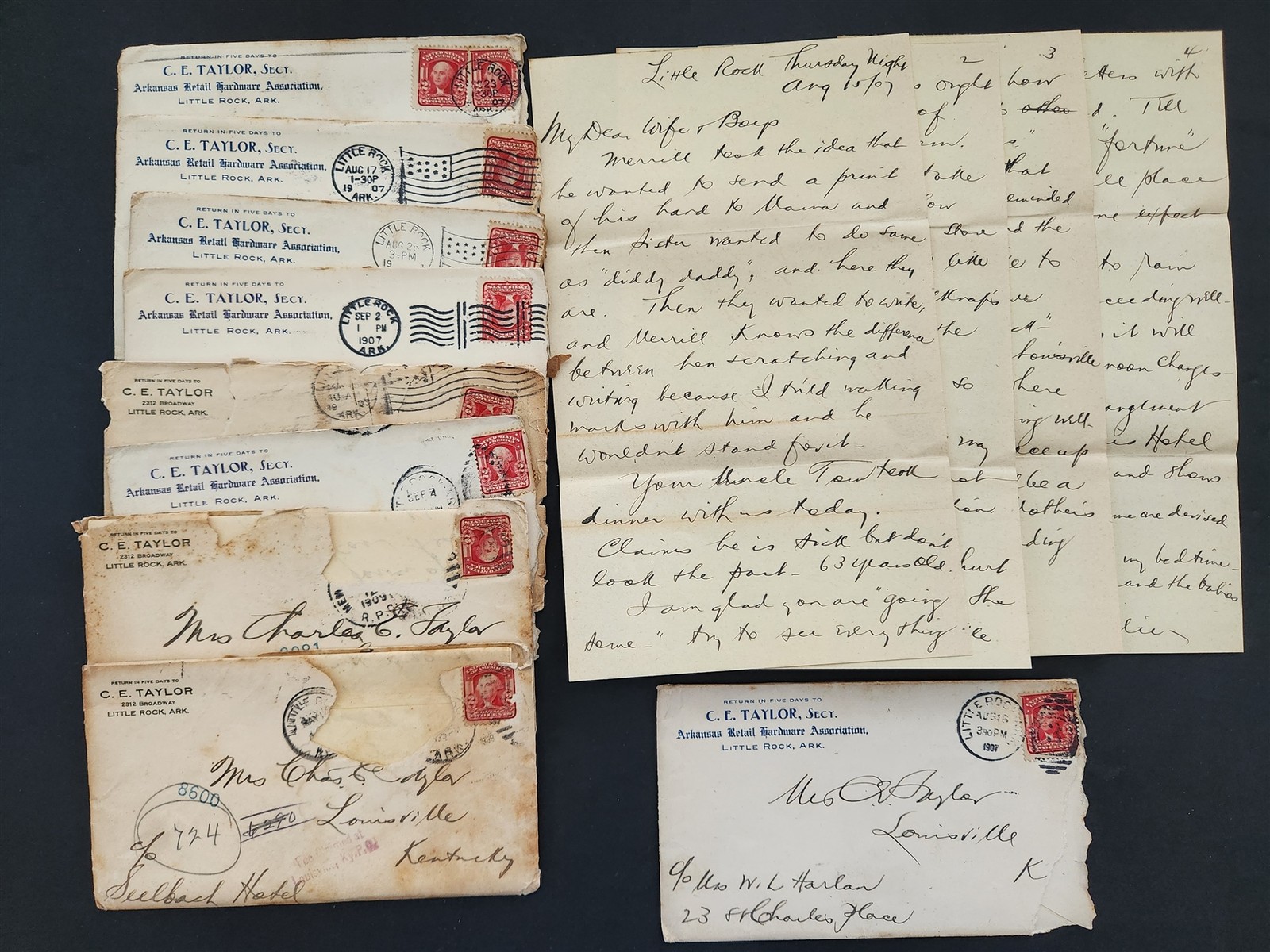
This listing is for the original vintage 9 piece letter lot shown fromCharles EdwardTaylor, who was mayer of Little Rock Arkansas, to his family of wife and children in Kentucky.
Letterheads are:
C. E. Taylor, Secy, Arkansas Retail Hardware Association
C. E. Taylor, 2312 Broadway, Little Rock, Ark
from internet research encyclopediaofarkansas:
Charles Edward Taylor (1868–1932)
Charles Edward Taylor, Progressive reform mayor of Little Rock (Pulaski County) from 1911 to 1919, brought a new sense of responsibility to city government and directed a wide range of reforms that transformed Little Rock from a nineteenth-century river town into a twentieth-century modern municipality.
Charles Taylor was born on September 15, 1868, in Austin, Mississippi, the son of William Arbuckle and Mary Perkins Taylor. During the mid-1870s, the Taylors moved to eastern Arkansas, where W. A. Taylor died. The family then moved to Little Rock when Charles was around twelve.
After attending Scott Street High School and taking a bookkeeping course at a local business school, Taylor went to work to help support his mother and sister. He clerked first at Fones Brothers Hardware, then traveled as a salesman for Dickinson Hardware Company, and, around 1906, became secretary-treasurer of the Arkansas Brick and Manufacturing Company. From 1902 to 1906, he served as secretary-treasurer of the Arkansas Retail Hardware Association.
Taylor married Belle Blackwood on October 15, 1895, and the couple had four children. An active member of Little Rock’s Second Baptist Church, Taylor served as Sunday school superintendent for sixteen years and was a member of many fraternal and community organizations.
When Taylor announced his candidacy for mayor in November of 1910, he had never held public office. Taylor’s chief opponent in the Democratic primary was John Tuohey, who had served as alderman for the past eight years and was viewed as the candidate of the old order, representing the conservative City Hall policies that some thought fostered corruption and hampered the city’s growth. Taylor ran as a reform candidate and was supported by the Young Men’s and the Traveling Men’s Good Government Clubs. He campaigned as an experienced businessman, not a politician, and promised more efficient, “business-like” government, city growth, expanded and improved city services, a healthier environment, and an improved moral climate—in general, “a bigger, better, cleaner and more progressive city.”
The election results showed Tuohey the winner by thirty-seven votes. Taylor challenged the count, charging that 250 illegal votes had been cast. Taylor’s challenge forced a run-off, and he won by 229 votes.
When Taylor took office in April 1911, he had three major priorities: ridding Little Rock of its “wide-open town” image, which he felt was neither healthy nor moral; improving public health, which was threatened at the time by a typhoid epidemic; and modernizing the fire department, which had been ineffective against several recent, devastating, downtown fires.
In tackling social problems such as gambling, drinking, and prostitution, Taylor believed, as did other progressives of the period, that these problems wasted human potential and that society had a responsibility to provide every person with the opportunity to become a healthy, productive citizen. He and his police chief, Fred Cogswell, strictly enforced the laws against gambling (with Taylor leading two raids himself), more closely regulated saloons before state prohibition went into effect in 1916, and, on the recommendation of his Vice Commission, ended the policy of toleration toward houses of prostitution by eliminating the “red light district” in Little Rock in 1913.
In his effort to improve public health, Taylor and the city council replaced the Board of Health with a full-fledged Health Department with the manpower and authority to supervise better the City Hospital and clean up unsanitary conditions in the city; instituted sanitary regulations and inspections of dairies, slaughterhouses, and other food supply services; began garbage collection and incineration; monitored drinking water; and expanded the sewer system. All of these contributed to a decrease in the number of deaths from typhoid, which dropped to seven in 1912 after averaging thirty per year in the three previous years, as well as a decrease of almost one-third in the overall death rate from diseases in general.
To modernize the fire department, Taylor replaced horse-drawn wagons with motorized pumps and vehicles, including an aerial truck, which were much more effective as downtown buildings grew taller and the population expanded. The city council also enacted comprehensive building, electrical, and plumbing codes with inspection provisions.
During four terms as mayor, Taylor added greatly to the city’s inventory of “modern” conveniences, such as paved streets, sewer lines, water mains, fire hydrants, and electric streetlights. His administration built a new Central Fire Station next to City Hall, as well as more neighborhood fire stations, and replaced the wooden bridge into Pulaski Heights with a concrete railway overpass. He promoted growth, annexing the community of Pulaski Heights in 1916 and advocating, unsuccessfully, a merger with North Little Rock (Pulaski County). His leadership was evident in the formation of the United Charities, a forerunner of the United Way, and in the Parkways Association plan to provide Little Rock with parks, parkways and shaded streets. He tried to implement plans for a badly needed new city hospital and for a convention center–like city auditorium, though neither of these nor the park plan was funded.
Taylor recognized that the chief obstacle to city improvements was the state constitution’s prohibition against cities issuing public improvement bonds, and he led three statewide campaigns for an amendment allowing such funding, but none were successful. As a result, Little Rock’s expenses from its modernization and expanded services, together with the loss of revenue from saloon licenses and from other social reforms, significantly increased the city’s debt, hampering its effort to finance further improvements and providing Taylor’s opponents with ammunition against him.
After eight years in office, Taylor decided to leave politics in 1919 and re-enter the business world. He was involved in the initial stages of the Curtis Motor Car Company in Little Rock and then an oil lease business in El Dorado (Union County), neither of which proved profitable. In 1923, he became secretary-manager of the Pine Bluff (Jefferson County) Chamber of Commerce and remained in that position until his retirement in 1930. Taylor died of a heart attack on January 11, 1932, in Pine Bluff. He is buried in Little Rock’s Oakland Cemetery.
For additional information:
Rimmer, Martha Williamson. “Progressivism Comes to Little Rock, The Election of 1911.” Pulaski County Historical Review 25 (September 1977): 49–60.
———. “Progressivism in Little Rock: The War Against Vice.” Pulaski County Historical Review 25 (December 1977): 65–72.
———. “Riverfront Park—A Progressive Vision.” Pulaski County Historical Review 31 (Spring 1983): 10–14.
———. “Little Rock’s Third Street Viaduct.” Pulaski County Historical Review 41 (Fall 1993): 72–73.
Authentic period piece related to family, historyor local heritage - well-suited for historical collections, genealogical /genealogy research, or museum acquisition.Vintage or Antique.
CONDITION: See listing description and photos.
- International buyers are responsible to pay VAT or other Taxes to their countries as required.
- collects and remits sales tax on behalf of several states.If you are a dealer, you can write to to file a form to become tax exempt.
LOC:
LOC2: PAPERBOXTALL10-TMKTK-F250508BTA150G
Powered by SixBit\'s eCommerce Solution