When you click on links to various merchants on this site and make a purchase, this can result in this site earning a commission. Affiliate programs and affiliations include, but are not limited to, the eBay Partner Network.
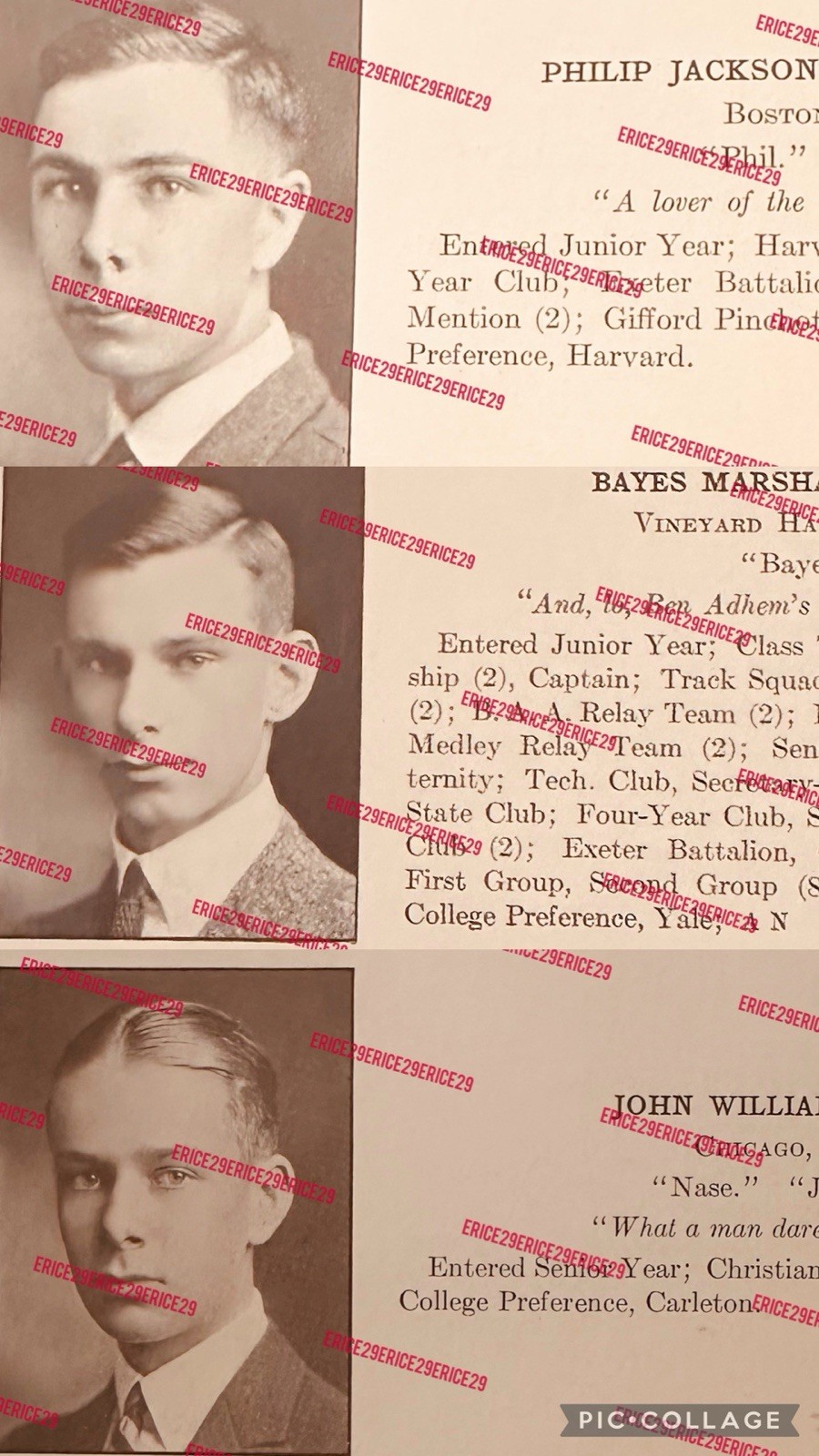
1922 Phillips Exeter Academy
Exeter, New Hampshire
The Pean Yearbook
Bayes Norton - 1924 Paris Olympics Sprinter
John Nason — president of Swarthmore College and later Carleton College
P. Jackson Darlington Jr. — prominent Harvard zoologist, entomologist and biogeographer; curator at Harvard’s Museum of Comparative Zoology and elected to the National Academy of Sciences.
8” x 10 3/4”
Hardcover
352 Pages
Pink Watermark will not appear on your yearbook
P. Jackson Darlington Jr. — prominent Harvard zoologist, entomologist and biogeographer; curator at Harvard’s Museum of Comparative Zoology and elected to the National Academy of Sciences. Records specifically state that he graduated from Exeter in 1922. American Academy of Arts and Sciences
John William Nason — president of Swarthmore College and later Carleton College. During WWII he helped relocate thousands of Japanese-American college students from internment camps into colleges. Exeter’s 1959 directory places him in the 1922 class. Swarthmore College Archives
Rhodes Scholar from Minnesota, John W. Nason (1905–2001) taught philosophy at Swarthmore during the 1930s before being appointed president at age 35. In addition to guiding Swarthmore during the difficult years of World War II and the rapid expansion of higher education in the late 1940s and early 1950s, he served on the committee that managed the program for conscientious objectors to the war.
Under his administration, the College cooperated with civil defense, Red Cross and first-aid training, and other nonmilitary support services in the war’s early years. It also moved to a year-round class schedule, which lasted for three years, to accelerate graduation for those who might be drafted. The College experienced further strain by the departure of a quarter of the faculty for war work.
Like Swain, Nason eventually accepted military troops on campus, including a Navy V-12 unit, which was interested in Swarthmore’s outstanding Engineering Department. In addition, 49 Chinese naval officers also came to campus for training and English language classes. Despite the Navy’s focus on the sciences, Swarthmore continued to push for a complete liberal arts education, recognizing the importance of well-educated people for a postwar society.
Nason’s contributions to higher education extended far beyond campus. As president of the National Japanese American Student Relocation Council, Nason helped liberate nearly 4,000 interned students from the War Relocation Authority’s camps and found places for them in 600 colleges and universities, including Swarthmore. He later referred to his efforts on behalf of Japanese-American students as the most important and satisfying of his life’s work. Swarthmore continued to show a commitment to intellectual freedom when Nason and the faculty formally expressed their support for “members of the University of California faculty who refused to sign the University’s loyalty oath,” calling it a “dangerous restraint on academic freedom.”
After the war, enrollment reached an all-time high of more than 1,000 students, and an additional dorm was purchased to respond to the overflow. Calls came from the student body to accept more students of color and more Jewish students. Ultimately, the Navy brought about the integration of the College’s student body with the enrollment of three black sailors. The size of the student body began to settle at about 1,000 while the number and quality of the applicants kept increasing, further establishing Swarthmore’s reputation for excellence.
After 13 years as Swarthmore’s president, Nason resigned to become president of the Foreign Policy Association. Under his leadership, the association served as a forum for public debate about foreign policy issues and resisted the attacks of Sen. Joseph R. McCarthy, who suspected any internationalist body of being sympathetic to communism. In addition, World Affairs Councils were established in many major American cities, and the public was encouraged to debate international issues under the association’s “Great Decisions” discussion programs. Nason later returned to Carleton College, his alma mater, and served as its fifth president for eight years, beginning in 1962.
Bayes Marshall Norton — American sprinter who competed in the 100 meters at the 1924 Paris Olympics.
Bayes Norton
Bayes Marshall Norton (September 23, 1903 – October 21, 1967) was an American sprint runner. In 1924 he finished second in the 200 m at the U.S. Olympic Trials and fifth at the 1924 Olympic Games. He won a Rhodes Scholarship and in the late 1920s ran for the University of Oxford. He later became a professor of chemistry at Kenyon College in Gambier, Ohio. As a government consultant he contributed to the Manhattan Project and to Rockets, Guns and Targets, an official U.S. Government history book on science during World War II.
Bayes Norton
Born
September 23, 1903
Vineyard Haven, Massachusetts, United States
Died
October 21, 1967 (aged 64)
Gambier, Ohio, United States
Education
Yale University, University of Oxford
Height
1.78 m (5 ft 10 in)
Weight
66 kg (146 m
Club
Yale Bulldogs, New Haven
University of Oxford AC
Achilles Club
Achievements and titles
Personal best
200 m – 21.8 (1924)
Phillips Exeter Academy
20 Main Street
Exeter, New Hampshire day boarding college preparatory
Motto
Latin: Non Sibi ("not for oneself")
Latin: Finis Origine Pendet ("The End Depends Upon the Beginning")
Greek: Χάριτι Θεοῦ ("By the Grace of God")
Religious 245 years ago
Founder
John Phillips
Elizabeth Phillips
Principal
William K. 2]
Average class size
12 students
Student to teacher ratio
6:1
Campus size
700 acres (280 ha)
Campus maroon and grey
Athletics
22 Interscholastic sports
62 Interscholastic teams
Athletics conference
NEPSAC
Team name
Big Red
Rival
Phillips Academy Exonian
Yearbook
Phillips Exeter Academy Notebook (PEAN)
Endowment
$1.65 billion (February 2, 2026)
School fees
Books & Supplies: $900[2]
Tuition
Boarding: $69,537
Day: $54,312
Affiliations
Eight Schools Association
G30 Schools
Ten Schools Admission houses the world's largest high school library. The academy admits students on a need-blind basis and offers free tuition to students with family incomes under $125,000. Its notable alumni include President Franklin Pierce, Senator Daniel Webster, over 35 U.S. congresspeople, six governors of U.S. states, Mark Zuckerberg, the founder of Facebook, three Medal of Honor recipients, and three Nobel Prize recipients.