When you click on links to various merchants on this site and make a purchase, this can result in this site earning a commission. Affiliate programs and affiliations include, but are not limited to, the eBay Partner Network.
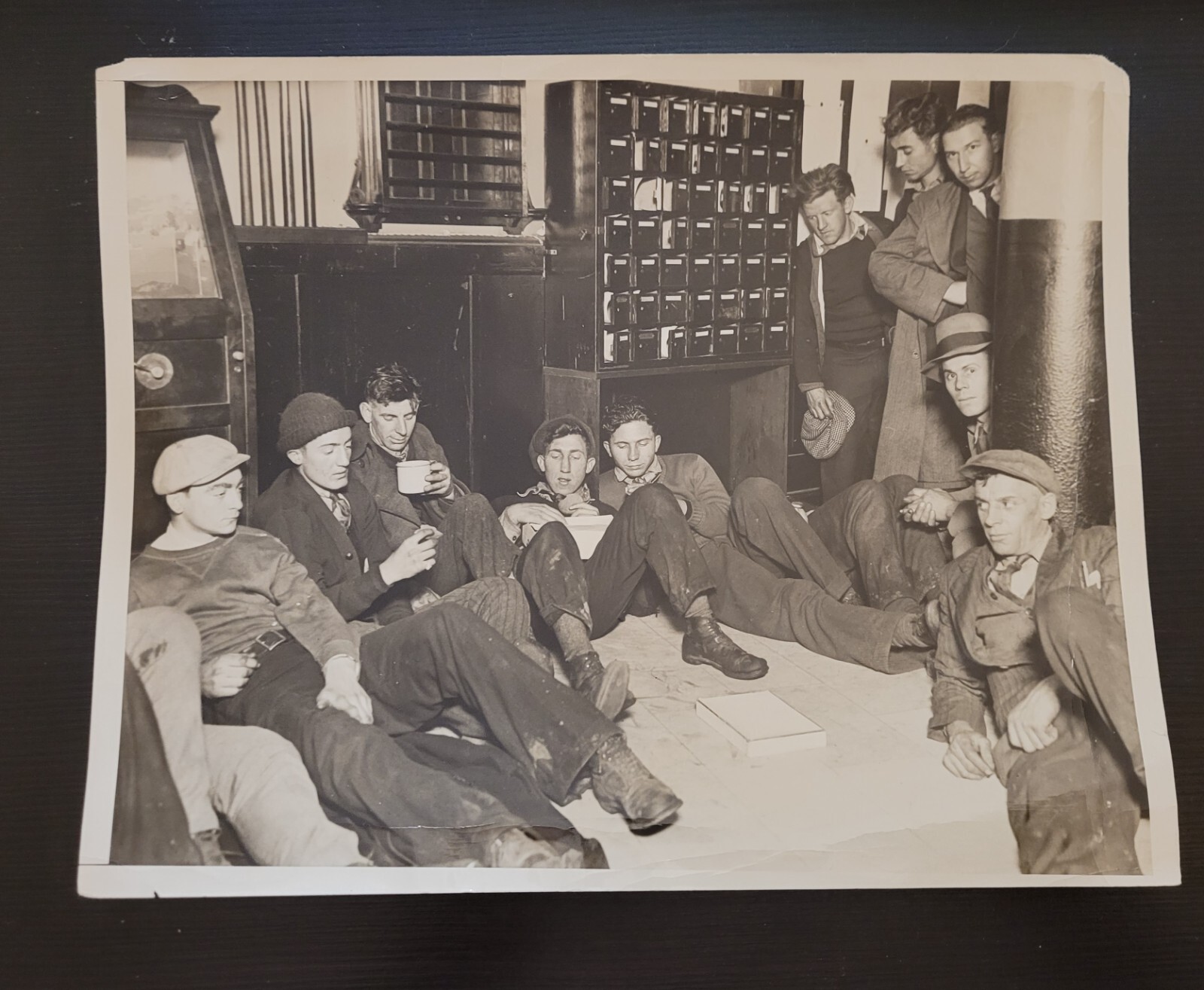
1932 GREAT DEPRESSION VINTAGE ORIGINAL PHOTO WASHNGTON, DC HOMELESS 8X10 INCHES RAREW 174282PARADE OF JOBLESS LED BY PRIEST ARRIVES IN CAPITALAn army of the unemployed, numbering more than 10,000 men,arrived in Washington, D4C., Late at night, danuary 6,To APPEAL FOR FEDERAL AID. THE HORDE OF JOBLESS MARCHERSwere led from Pittsburgh by the Rev, James 8. Cox, aRoman Catholic priest. This photo Shows Bome of the menEating in the National Guard Armory of Washington, D.C.,HeRE THEy WERE QUARTERED,Return at one toCREDIT LINE (ACME)A. Cleveland, O
______________________The Great Depression was a severe global economic downturn from 1929 to 1939. The period was characterized by high rates of unemployment and poverty; drastic reductions in liquidity, industrial production, and trade; and widespread bank and business failures around the world. The economic contagion began in 1929 in the United States, the largest economy in the world, with the devastating Wall Street stock market crash of October 1929 often considered the beginning of the Depression. Among the countries with the most unemployed were the U.S., the United Kingdom, and Germany.
The Depression was preceded by a period of industrial growth and social development known as the \"Roaring Twenties\". Much of the profit generated by the boom was invested in speculation, such as on the stock market, which resulted in growing wealth inequality. Banks were subject to minimal regulation under laissez-faire economic policies, resulting in loose lending and widespread debt. By 1929, declining spending had led to reductions in manufacturing output and rising unemployment. Share values continued to rise until the Wall Street crash, after which the slide continued for three years, accompanied by a loss of confidence in the financial system. By 1933, the unemployment rate in the U.S. had risen to 25%, about one-third of farmers had lost their land, and about half of its 25,000 banks had gone out of business. The U.S. federal government under President Herbert Hoover was unwilling to intervene heavily in the economy. In the 1932 presidential election, Hoover was defeated by Franklin D. Roosevelt, who from 1933 pursued a set of expansive New Deal programs in order to provide relief and create jobs. In Germany, which depended heavily on U.S. loans, the crisis caused unemployment to rise to nearly 30% and fueled political extremism, paving the way for Adolf Hitler\'s Nazi Party to rise to power in 1933.
Between 1929 and 1932, worldwide gross domestic product (GDP) fell by an estimated 15%; in the U.S., the Depression resulted in a 30% contraction in GDP.[1] Recovery varied greatly around the world. Some economies, such as the U.S., Germany and Japan started to recover by the mid-1930s; others, like France, did not return to pre-shock growth rates until later in the decade.[2] The Depression had devastating economic effects on both wealthy and poor countries: all experienced drops in personal income, prices (deflation), tax revenues, and profits. International trade fell by more than 50%, and unemployment in some countries rose as high as 33%.[3] Cities around the world, especially those dependent on heavy industry, were heavily affected. Construction virtually halted in many countries, and farming communities and rural areas suffered as crop prices fell by up to 60%.[4][5][6] Faced with plummeting demand and few job alternatives, areas dependent on primary sector industries suffered the most.[7] The outbreak of World War II in 1939 ended the Depression, as it stimulated factory production, providing jobs for women as militaries absorbed large numbers of young, unemployed men.
The precise causes for the Great Depression are disputed. One set of historians, for example, focuses on non-monetary economic causes. Among these, some regard the Wall Street crash itself as the main cause; others consider that the crash was a mere symptom of more general economic trends of the time, which had already been underway in the late 1920s.[3][8] A contrasting set of views, which rose to prominence in the later part of the 20th century,[9] ascribes a more prominent role to failures of monetary policy. According to those authors, while general economic trends can explain the emergence of the downturn, they fail to account for its severity and longevity; they argue that these were caused by the lack of an adequate response to the crises of liquidity that followed the initial economic shock of 1929 and the subsequent bank failures accompanied by a general collapse of the financial markets.[1]
Overview
The unemployment rate in the U.S. during 1910–60, with the years of the Great Depression (1929–39) highlighted
The Dow Jones Industrial Average, 1928–1930The economic picture at the beginning of the crisisAfter the Wall Street crash of 1929, when the Dow Jones Industrial Average dropped from 381 to 198 over the course of two months, optimism persisted for some time. The stock market rose in early 1930, with the Dow returning to 294 (pre-depression levels) in April 1930, before steadily declining for years, to a low of 41 in 1932.[10]
At the beginning, governments and businesses spent more in the first half of 1930 than in the corresponding period of the previous year. On the other hand, consumers, many of whom suffered severe losses in the stock market the previous year, cut expenditures by 10%. In addition, beginning in the mid-1930s, a severe drought ravaged the agricultural heartland of the U.S.[11]
Interest rates dropped to low levels by mid-1930, but expected deflation and the continuing reluctance of people to borrow meant that consumer spending and investment remained low.[12] By May 1930, automobile sales declined to below the levels of 1928. Prices, in general, began to decline, although wages held steady in 1930. Then a deflationary spiral started in 1931. Farmers faced a worse outlook; declining crop prices and a Great Plains drought crippled their economic outlook. At its peak, the Great Depression saw nearly 10% of all Great Plains farms change hands despite federal assistance.[13]
Beyond the United StatesAt first, the decline in the U.S. economy was the factor that triggered economic downturns in most other countries due to a decline in trade, capital movement, and global business confidence. Then, internal weaknesses or strengths in each country made conditions worse or better. For example, the U.K. economy, which experienced an economic downturn throughout most of the late 1920s, was less severely impacted by the shock of the depression than the U.S. By contrast, the German economy saw a similar decline in industrial output as that observed in the U.S.[14] Some economic historians attribute the differences in the rates of recovery and relative severity of the economic decline to whether particular countries had been able to effectively devaluate their currencies or not. This is supported by the contrast in how the crisis progressed in, e.g., Britain, Argentina and Brazil, all of which devalued their currencies early and returned to normal patterns of growth relatively rapidly and countries which stuck to the gold standard, such as France or Belgium.[15]
Frantic attempts by individual countries to shore up their economies through protectionist policies – such as the 1930 U.S. Smoot–Hawley Tariff Act and retaliatory tariffs in other countries – exacerbated the collapse in global trade, contributing to the depression.[16] By 1933, the economic decline pushed world trade to one third of its level compared to four years earlier.[17]
Change in economic indicators 1929–1932[18]United States United Kingdom France GermanyIndustrial production −46% −23% −24% −41%Wholesale prices −32% −33% −34% −29%Foreign trade −70% −60% −54% −61%Unemployment +607% +129% +214% +232%Course
Crowd gathering at the intersection of Wall Street and Broad Street after the 1929 crashOriginsWhile the precise causes for the occurrence of the Great depression are disputed and can be traced to both global and national phenomena, its immediate origins are most conveniently examined in the context of the U.S. economy, from which the initial crisis spread to the rest of the world.
In the aftermath of World War I, the Roaring Twenties brought considerable wealth to the United States and Western Europe.[19] Initially, the year 1929 dawned with good economic prospects: despite a minor crash on 25 March 1929, the market seemed to gradually improve through September. Stock prices began to slump in September, and were volatile at the end of the month.[20] A large sell-off of stocks began in mid-October. Finally, on 24 October, Black Thursday, the American stock market crashed 11% at the opening bell. Actions to stabilize the market failed, and on 28 October, Black Monday, the market crashed another 12%. The panic peaked the next day on Black Tuesday, when the market saw another 11% drop.[21][22] Thousands of investors were ruined, and billions of dollars had been lost; many stocks could not be sold at any price.[22] The market recovered 12% on Wednesday but by then significant damage had been done. Though the market entered a period of recovery from 14 November until 17 April 1930, the general situation had been a prolonged slump. From September 1929 to 8 July 1932, the market lost 85% of its value.[23]Crowds outside the Bank of United States in New York after its failure in 1931Despite the crash, the worst of the crisis did not reverberate around the world until after 1929. The crisis hit panic levels again in December 1930, with a bank run on the Bank of United States, a former privately run bank, bearing no relation to the U.S. government (not to be confused with the Federal Reserve). Unable to pay out to all of its creditors, the bank failed.[24][25] Among the 608 American banks that closed in November and December 1930, the Bank of United States accounted for a third of the total $550 million deposits lost and, with its closure, bank failures reached a critical mass.[26]
The Smoot–Hawley Act and the Breakdown of International TradeMain article: Smoot–Hawley Tariff Act
Willis C. Hawley (left) and Reed Smoot in April 1929, shortly before the Smoot–Hawley Tariff Act passed the House of RepresentativesIn an initial response to the crisis, the U.S. Congress passed the Smoot–Hawley Tariff Act on 17 June 1930. The Act was ostensibly aimed at protecting the American economy from foreign competition by imposing high tariffs on foreign imports. The consensus view among economists and economic historians (including Keynesians, Monetarists and Austrian economists) is that the passage of the Smoot–Hawley Tariff had, in fact, achieved an opposite effect to what was intended. It exacerbated the Great Depression[27] by preventing economic recovery after domestic production recovered, hampering the volume of trade; still there is disagreement as to the precise extent of the Act\'s influence.
In the popular view, the Smoot–Hawley Tariff was one of the leading causes of the depression.[28][29] In a 1995 survey of American economic historians, two-thirds agreed that the Smoot–Hawley Tariff Act at least worsened the Great Depression.[30] According to the U.S. Senate website, the Smoot–Hawley Tariff Act is among the most catastrophic acts in congressional history.[31]
Many economists have argued that the sharp decline in international trade after 1930 helped to worsen the depression, especially for countries significantly dependent on foreign trade. Most historians and economists blame the Act for worsening the depression by seriously reducing international trade and causing retaliatory tariffs in other countries. While foreign trade was a small part of overall economic activity in the U.S. and was concentrated in a few businesses like farming, it was a much larger factor in many other countries.[32] The average ad valorem (value based) rate of duties on dutiable imports for 1921–1925 was 25.9% but under the new tariff it jumped to 50% during 1931–1935. In dollar terms, American exports declined over the next four years from about $5.2 billion in 1929 to $1.7 billion in 1933; so, not only did the physical volume of exports fall, but also the prices fell by about 1⁄3 as written. Hardest hit were farm commodities such as wheat, cotton, tobacco, and lumber.[33]
Governments around the world took various steps into spending less money on foreign goods such as: \"imposing tariffs, import quotas, and exchange controls\". These restrictions triggered much tension among countries that had large amounts of bilateral trade, causing major export-import reductions during the depression. Not all governments enforced the same measures of protectionism. Some countries raised tariffs drastically and enforced severe restrictions on foreign exchange transactions, while other countries reduced \"trade and exchange restrictions only marginally\":[34]
\"Countries that remained on the gold standard, keeping currencies fixed, were more likely to restrict foreign trade.\" These countries \"resorted to protectionist policies to strengthen the balance of payments and limit gold losses.\" They hoped that these restrictions and depletions would hold the economic decline.[34]Countries that abandoned the gold standard allowed their currencies to depreciate which caused their balance of payments to strengthen. It also freed up monetary policy so that central banks could lower interest rates and act as lenders of last resort. They possessed the best policy instruments to fight the Depression and did not need protectionism.[34]\"The length and depth of a country\'s economic downturn and the timing and vigor of its recovery are related to how long it remained on the gold standard. Countries abandoning the gold standard relatively early experienced relatively mild recessions and early recoveries. In contrast, countries remaining on the gold standard experienced prolonged slumps.\"[34]The Gold Standard and the Spreading of Global DepressionThe gold standard was the primary transmission mechanism of the Great Depression. Even countries that did not face bank failures and a monetary contraction first-hand were forced to join the deflationary policy since higher interest rates in countries that performed a deflationary policy led to a gold outflow in countries with lower interest rates. Under the gold standard\'s price–specie flow mechanism, countries that lost gold but nevertheless wanted to maintain the gold standard had to permit their money supply to decrease and the domestic price level to decline (deflation).[35][36]
There is also consensus that protectionist policies, and primarily the passage of the Smoot–Hawley Tariff Act, helped to exacerbate, or even cause the Great Depression.[30]
Gold standard
The Depression in international perspective[37]Some economic studies have indicated that the rigidities of the gold standard not only spread the downturn worldwide, but also suspended gold convertibility (devaluing the currency in gold terms) that did the most to make recovery possible.[38]
Every major currency left the gold standard during the Great Depression. The UK was the first to do so. Facing speculative attacks on the pound and depleting gold reserves, in September 1931 the Bank of England ceased exchanging pound notes for gold and the pound was floated on foreign exchange markets. Japan and the Scandinavian countries followed in 1931. Other countries, such as Italy and the United States, remained on the gold standard into 1932 or 1933, while a few countries in the so-called \"gold bloc\", led by France and including Poland, Belgium and Switzerland, stayed on the standard until 1935–36.
According to later analysis, the earliness with which a country left the gold standard reliably predicted its economic recovery. For example, The UK and Scandinavia, which left the gold standard in 1931, recovered much earlier than France and Belgium, which remained on gold much longer. Countries such as China, which had a silver standard, almost avoided the depression entirely. The connection between leaving the gold standard as a strong predictor of that country\'s severity of its depression and the length of time of its recovery has been shown to be consistent for dozens of countries, including developing countries. This partly explains why the experience and length of the depression differed between regions and states around the world.[39]
German banking crisis of 1931 and British crisisThe financial crisis escalated out of control in mid-1931, starting with the collapse of the Credit Anstalt in Vienna in May.[40][41] This put heavy pressure on Germany, which was already in political turmoil. With the rise in violence of National Socialist (\'Nazi\') and Communist movements, as well as investor nervousness at harsh government financial policies,[42] investors withdrew their short-term money from Germany as confidence spiraled downward. The Reichsbank lost 150 million marks in the first week of June, 540 million in the second, and 150 million in two days, 19–20 June. Collapse was at hand. U.S. President Herbert Hoover called for a moratorium on payment of war reparations. This angered Paris, which depended on a steady flow of German payments, but it slowed the crisis down, and the moratorium was agreed to in July 1931. An International conference in London later in July produced no agreements but on 19 August a standstill agreement froze Germany\'s foreign liabilities for six months. Germany received emergency funding from private banks in New York as well as the Bank of International Settlements and the Bank of England. The funding only slowed the process. Industrial failures began in Germany, a major bank closed in July and a two-day holiday for all German banks was declared. Business failures were more frequent in July, and spread to Romania and Hungary. The crisis continued to get worse in Germany, bringing political upheaval that finally led to the coming to power of Hitler\'s Nazi regime in January 1933.[43]
The world financial crisis now began to overwhelm Britain; investors around the world started withdrawing their gold from London at the rate of £2.5 million per day.[44] Credits of £25 million each from the Bank of France and the Federal Reserve Bank of New York and an issue of £15 million fiduciary note slowed, but did not reverse, the British crisis. The financial crisis now caused a major political crisis in Britain in August 1931. With deficits mounting, the bankers demanded a balanced budget; the divided cabinet of Prime Minister Ramsay MacDonald\'s Labour government agreed; it proposed to raise taxes, cut spending, and most controversially, to cut unemployment benefits 20%. The attack on welfare was unacceptable to the Labour movement. MacDonald wanted to resign, but King George V insisted he remain and form an all-party coalition \"National Government\". The Conservative and Liberals parties signed on, along with a small cadre of Labour, but the vast majority of Labour leaders denounced MacDonald as a traitor for leading the new government. Britain went off the gold standard, and suffered relatively less than other major countries in the Great Depression. In the 1931 British election, the Labour Party was virtually destroyed, leaving MacDonald as prime minister for a largely Conservative coalition.[45][46]
Turning point and recovery
The overall course of the Depression in the United States, as reflected in per-capita GDP (average income per person) shown in constant year 2000 dollars, plus some of the key events of the period. Dotted red line = long-term trend 1920–1970.[47]In most countries of the world, recovery from the Great Depression began in 1933.[8] In the U.S., recovery began in early 1933,[8] but the U.S. did not return to 1929 GNP for over a decade and still had an unemployment rate of about 15% in 1940, albeit down from the high of 25% in 1933.
There is no consensus among economists regarding the motive force for the U.S. economic expansion that continued through most of the Roosevelt years (and the 1937 recession that interrupted it). The common view among most economists is that Roosevelt\'s New Deal policies either caused or accelerated the recovery, although his policies were never aggressive enough to bring the economy completely out of recession. Some economists have also called attention to the positive effects from expectations of reflation and rising nominal interest rates that Roosevelt\'s words and actions portended.[48][49] It was the rollback of those same reflationary policies that led to the interruption of a recession beginning in late 1937.[50][51] One contributing policy that reversed reflation was the Banking Act of 1935, which effectively raised reserve requirements, causing a monetary contraction that helped to thwart the recovery.[52] GDP returned to its upward trend in 1938.[47] A revisionist view among some economists holds that the New Deal prolonged the Great Depression, as they argue that National Industrial Recovery Act of 1933 and National Labor Relations Act of 1935 restricted competition and established price fixing.[53] John Maynard Keynes did not think that the New Deal under Roosevelt single-handedly ended the Great Depression: \"It is, it seems, politically impossible for a capitalistic democracy to organize expenditure on the scale necessary to make the grand experiments which would prove my case—except in war conditions.\"[54]
According to Christina Romer, the money supply growth caused by huge international gold inflows was a crucial source of the recovery of the United States economy, and that the economy showed little sign of self-correction. The gold inflows were partly due to devaluation of the U.S. dollar and partly due to deterioration of the political situation in Europe.[55] In their book, A Monetary History of the United States, Milton Friedman and Anna J. Schwartz also attributed the recovery to monetary factors, and contended that it was much slowed by poor management of money by the Federal Reserve System. Chairman of the Federal Reserve (2006–2014) Ben Bernanke agreed that monetary factors played important roles both in the worldwide economic decline and eventual recovery.[56] Bernanke also saw a strong role for institutional factors, particularly the rebuilding and restructuring of the financial system,[57] and pointed out that the Depression should be examined in an international perspective.[58]
Role of women and household economicsWomen\'s primary role was as housewives; without a steady flow of family income, their work became much harder in dealing with food and clothing and medical care. Birthrates fell everywhere, as children were postponed until families could financially support them. The average birthrate for 14 major countries fell 12% from 19.3 births per thousand population in 1930, to 17.0 in 1935.[59] In Canada, half of Roman Catholic women defied Church teachings and used contraception to postpone births.[60]
Among the few women in the labor force, layoffs were less common in the white-collar jobs and they were typically found in light manufacturing work. However, there was a widespread demand to limit families to one paid job, so that wives might lose employment if their husband was employed.[61][62][63] Across Britain, there was a tendency for married women to join the labor force, competing for part-time jobs especially.[64][65]
In France, very slow population growth, especially in comparison to Germany continued to be a serious issue in the 1930s. Support for increasing welfare programs during the depression included a focus on women in the family. The Conseil Supérieur de la Natalité campaigned for provisions enacted in the Code de la Famille (1939) that increased state assistance to families with children and required employers to protect the jobs of fathers, even if they were immigrants.[66]
In rural and small-town areas, women expanded their operation of vegetable gardens to include as much food production as possible. In the United States, agricultural organizations sponsored programs to teach housewives how to optimize their gardens and to raise poultry for meat and eggs.[67] Rural women made feed sack dresses and other items for themselves and their families and homes from feed sacks.[68] In American cities, African American women quiltmakers enlarged their activities, promoted collaboration, and trained neophytes. Quilts were created for practical use from various inexpensive materials and increased social interaction for women and promoted camaraderie and personal fulfillment.[69]
Oral history provides evidence for how housewives in a modern industrial city handled shortages of money and resources. Often they updated strategies their mothers used when they were growing up in poor families. Cheap foods were used, such as soups, beans and noodles. They purchased the cheapest cuts of meat—sometimes even horse meat—and recycled the Sunday roast into sandwiches and soups. They sewed and patched clothing, traded with their neighbors for outgrown items, and made do with colder homes. New furniture and appliances were postponed until better days. Many women also worked outside the home, or took boarders, did laundry for trade or cash, and did sewing for neighbors in exchange for something they could offer. Extended families used mutual aid—extra food, spare rooms, repair-work, cash loans—to help cousins and in-laws.[70]
In Japan, official government policy was deflationary and the opposite of Keynesian spending. Consequently, the government launched a campaign across the country to induce households to reduce their consumption, focusing attention on spending by housewives.[71]
In Germany, the government tried to reshape private household consumption under the Four-Year Plan of 1936 to achieve German economic self-sufficiency. The Nazi women\'s organizations, other propaganda agencies and the authorities all attempted to shape such consumption as economic self-sufficiency was needed to prepare for and to sustain the coming war. The organizations, propaganda agencies and authorities employed slogans that called up traditional values of thrift and healthy living. However, these efforts were only partly successful in changing the behavior of housewives.[72]
World War II and recovery
A female factory worker in 1942, Fort Worth, Texas. Women entered the workforce as men were drafted into the armed forces.The common view among economic historians is that the Great Depression ended with the advent of World War II. Many economists believe that government spending on the war caused or at least accelerated recovery from the Great Depression, though some consider that it did not play a very large role in the recovery, though it did help in reducing unemployment.[8][73][74][75]
The rearmament policies leading up to World War II helped stimulate the economies of Europe in 1937–1939. By 1937, unemployment in Britain had fallen to 1.5 million. The mobilization of manpower following the outbreak of war in 1939 ended unemployment.[76]
The American mobilization for World War II at the end of 1941 moved approximately 10 million people out of the civilian labor force and into the war.[77] This finally eliminated the last effects from the Great Depression and brought the U.S. unemployment rate down below 10%.[78]
World War II had a dramatic effect on many parts of the American economy.[79] Government-financed capital spending accounted for only 5% of the annual U.S. investment in industrial capital in 1940; by 1943, the government accounted for 67% of U.S. capital investment.[79] The massive war spending doubled economic growth rates, either masking the effects of the Depression or essentially ending the Depression. Businessmen ignored the mounting national debt and heavy new taxes, redoubling their efforts for greater output to take advantage of generous government contracts.[80]
CausesMain article: Causes of the Great DepressionAttempts to return to the Gold StandardSee also: Financial crisis of 1914During World War I many countries suspended their gold standard in varying ways. There was high inflation from WWI, and in the 1920s in the Weimar Republic, Austria, and throughout Europe. In the late 1920s there was a scramble to deflate prices to get the gold standard\'s conversation rates back on track to pre-WWI levels, by causing deflation and high unemployment through monetary policy. In 1933 FDR signed Executive Order 6102 and in 1934 signed the Gold Reserve Act.[81]
Gold Standard Policies by Country[82]Country Return to Gold Suspension of Gold Standard Foreign Exchange Control DevaluationAustralia April 1925 December 1929 — March 1930Austria April 1925 April 1933 October 1931 September 1931Belgium October 1926 — — March 1935Canada July 1926 October 1931 — September 1931Czechoslovakia April 1926 — September 1931 February 1934Denmark January 1927 September 1931 November 1931 September 1931Estonia January 1928 June 1933 November 1931 June 1933Finland January 1926 October 1931 — October 1931France August 1926 – June 1928 — — October 1936Germany September 1924 — July 1931 —Greece May 1928 April 1932 September 1931 April 1932Hungary April 1925 — July 1931 —Italy December 1927 — May 1934 October 1936Japan December 1930 December 1931 July 1932 December 1931Latvia August 1922 — October 1931 —Netherlands April 1925 — — October 1936Norway May 1928 September 1931 — September 1931New Zealand April 1925 September 1931 — April 1930Poland October 1927 — April 1936 October 1936Romania March 1927 – February 1929 — May 1932 —Sweden April 1924 September 1931 — September 1931Spain — — May 1931 —United Kingdom May 1925 September 1931 — September 1931United States June 1919 March 1933 March 1933 April 1933Keynesian vs Monetarist view
Money supply decreased considerably between Black Tuesday and the Bank Holiday in March 1933, when there were massive bank runs across the United States.CPI 1914–2022 Inflation Deflation M2 money supply increases Year/YearThe two classic competing economic theories of the Great Depression are the Keynesian (demand-driven) and the Monetarist explanation.[83] There are also various heterodox theories that downplay or reject the explanations of the Keynesians and monetarists. The consensus among demand-driven theories is that a large-scale loss of confidence led to a sudden reduction in consumption and investment spending. Once panic and deflation set in, many people believed they could avoid further losses by keeping clear of the markets. Holding money became profitable as prices dropped lower and a given amount of money bought ever more goods, exacerbating the drop in demand.[84] Monetarists believe that the Great Depression started as an ordinary recession, but the shrinking of the money supply greatly exacerbated the economic situation, causing a recession to descend into the Great Depression.[85]
Economists and economic historians are almost evenly split as to whether the traditional monetary explanation that monetary forces were the primary cause of the Great Depression is right, or the traditional Keynesian explanation that a fall in autonomous spending, particularly investment, is the primary explanation for the onset of the Great Depression.[86] Today there is also significant academic support for the debt deflation theory and the expectations hypothesis that – building on the monetary explanation of Milton Friedman and Anna Schwartz – add non-monetary explanations.[87][88]
There is a consensus that the Federal Reserve System should have cut short the process of monetary deflation and banking collapse, by expanding the money supply and acting as lender of last resort. If they had done this, the economic downturn would have been far less severe and much shorter.[89]
Mainstream explanations
U.S. industrial production, 1928–1939Modern mainstream economists see the reasons in
A money supply reduction (Monetarists) and therefore a banking crisis, reduction of credit, and bankruptcies.Insufficient demand from the private sector and insufficient fiscal spending (Keynesians).Passage of the Smoot–Hawley Tariff Act exacerbated what otherwise might have been a more \"standard\" recession (both Monetarists and Keynesians).[30]Insufficient spending, the money supply reduction, and debt on margin led to falling prices and further bankruptcies (Irving Fisher\'s debt deflation).
Monetarist view
The Great Depression in the U.S. from a monetary view. Real gross domestic product in 1996-Dollar (blue), price index (red), money supply M2 (green) and number of banks (grey). All data adjusted to 1929 = 100%.
Crowd at New York\'s American Union Bank during a bank run early in the Great DepressionThe monetarist explanation was given by American economists Milton Friedman and Anna J. Schwartz.[90] They argued that the Great Depression was caused by the banking crisis that caused one-third of all banks to vanish, a reduction of bank shareholder wealth and more importantly monetary contraction of 35%, which they called \"The Great Contraction\". This caused a price drop of 33% (deflation).[91] By not lowering interest rates, by not increasing the monetary base and by not injecting liquidity into the banking system to prevent it from crumbling, the Federal Reserve passively watched the transformation of a normal recession into the Great Depression. Friedman and Schwartz argued that the downward turn in the economy, starting with the stock market crash, would merely have been an ordinary recession if the Federal Reserve had taken aggressive action.[92][93] This view was endorsed in 2002 by Federal Reserve Governor Ben Bernanke in a speech honoring Friedman and Schwartz with this statement:
Let me end my talk by abusing slightly my status as an official representative of the Federal Reserve. I would like to say to Milton and Anna: Regarding the Great Depression, you\'re right. We did it. We\'re very sorry. But thanks to you, we won\'t do it again.
— Ben S. Bernanke[94][95]The Federal Reserve allowed some large public bank failures – particularly that of the New York Bank of United States – which produced panic and widespread runs on local banks, and the Federal Reserve sat idly by while banks collapsed. Friedman and Schwartz argued that, if the Fed had provided emergency lending to these key banks, or simply bought government bonds on the open market to provide liquidity and increase the quantity of money after the key banks fell, all the rest of the banks would not have fallen after the large ones did, and the money supply would not have fallen as far and as fast as it did.[96]
With significantly less money to go around, businesses could not get new loans and could not even get their old loans renewed, forcing many to stop investing. This interpretation blames the Federal Reserve for inaction, especially the New York branch.[97]
One reason why the Federal Reserve did not act to limit the decline of the money supply was the gold standard. At that time, the amount of credit the Federal Reserve could issue was limited by the Federal Reserve Act, which required 40% gold backing of Federal Reserve Notes issued. By the late 1920s, the Federal Reserve had almost hit the limit of allowable credit that could be backed by the gold in its possession. This credit was in the form of Federal Reserve demand notes.[98] A \"promise of gold\" is not as good as \"gold in the hand\", particularly when they only had enough gold to cover 40% of the Federal Reserve Notes outstanding. During the bank panics, a portion of those demand notes was redeemed for Federal Reserve gold. Since the Federal Reserve had hit its limit on allowable credit, any reduction in gold in its vaults had to be accompanied by a greater reduction in credit. On 5 April 1933, President Roosevelt signed Executive Order 6102 making the private ownership of gold certificates, coins and bullion illegal, reducing the pressure on Federal Reserve gold.[98]
Keynesian viewBritish economist John Maynard Keynes argued in The General Theory of Employment, Interest and Money that lower aggregate expenditures in the economy contributed to a massive decline in income and to employment that was well below the average. In such a situation, the economy reached equilibrium at low levels of economic activity and high unemployment.
Keynes\'s basic idea was simple: to keep people fully employed, governments have to run deficits when the economy is slowing, as the private sector would not invest enough to keep production at the normal level and bring the economy out of recession. Keynesian economists called on governments during times of economic crisis to pick up the slack by increasing government spending or cutting taxes.
As the Depression wore on, Franklin D. Roosevelt tried public works, farm subsidies, and other devices to restart the U.S. economy, but never completely gave up trying to balance the budget. According to the Keynesians, this improved the economy, but Roosevelt never spent enough to bring the economy out of recession until the start of World War II.[99]
Debt deflation
Irving Fisher argued that the predominant factor leading to the Great Depression was a vicious circle of deflation and growing over-indebtedness.[100] He outlined nine factors interacting with one another under conditions of debt and deflation to create the mechanics of boom to bust. The chain of events proceeded as follows:
Debt liquidation and distress sellingContraction of the money supply as bank loans are paid offA fall in the level of asset pricesA still greater fall in the net worth of businesses, precipitating bankruptciesA fall in profitsA reduction in output, in trade and in employmentPessimism and loss of confidenceHoarding of moneyA fall in nominal interest rates and a rise in deflation adjusted interest rates[100]During the Crash of 1929 preceding the Great Depression, margin requirements were only 10%.[101] Brokerage firms, in other words, would lend $9 for every $1 an investor had deposited. When the market fell, brokers called in these loans, which could not be paid back.[102] Banks began to fail as debtors defaulted on debt and depositors attempted to withdraw their deposits en masse, triggering multiple bank runs. Government guarantees and Federal Reserve banking regulations to prevent such panics were ineffective or not used. Bank failures led to the loss of billions of dollars in assets.[102]
Outstanding debts became heavier, because prices and incomes fell by 20–50% but the debts remained at the same dollar amount. After the panic of 1929 and during the first 10 months of 1930, 744 U.S. banks failed. (In all, 9,000 banks failed during the 1930s.) By April 1933, around $7 billion in deposits had been frozen in failed banks or those left unlicensed after the March Bank Holiday.[103] Bank failures snowballed as desperate bankers called in loans that borrowers did not have time or money to repay. With future profits looking poor, capital investment and construction slowed or completely ceased. In the face of bad loans and worsening future prospects, the surviving banks became even more conservative in their lending.[102] Banks built up their capital reserves and made fewer loans, which intensified deflationary pressures. A vicious cycle developed and the downward spiral accelerated.
The liquidation of debt could not keep up with the fall of prices that it caused. The mass effect of the stampede to liquidate increased the value of each dollar owed, relative to the value of declining asset holdings. The very effort of individuals to lessen their burden of debt effectively increased it. Paradoxically, the more the debtors paid, the more they owed.[100] This self-aggravating process turned a 1930 recession into a 1933 great depression.
Fisher\'s debt-deflation theory initially lacked mainstream influence because of the counter-argument that debt-deflation represented no more than a redistribution from one group (debtors) to another (creditors). Pure re-distributions should have no significant macroeconomic effects.
Building on both the monetary hypothesis of Milton Friedman and Anna Schwartz and the debt deflation hypothesis of Irving Fisher, Ben Bernanke developed an alternative way in which the financial crisis affected output. He builds on Fisher\'s argument that dramatic declines in the price level and nominal incomes lead to increasing real debt burdens, which in turn leads to debtor insolvency and consequently lowers aggregate demand; a further price level decline would then result in a debt deflationary spiral. According to Bernanke, a small decline in the price level simply reallocates wealth from debtors to creditors without doing damage to the economy. But when the deflation is severe, falling asset prices along with debtor bankruptcies lead to a decline in the nominal value of assets on bank balance sheets. Banks will react by tightening their credit conditions, which in turn leads to a credit crunch that seriously harms the economy. A credit crunch lowers investment and consumption, which results in declining aggregate demand and additionally contributes to the deflationary spiral.[104][105][106]
Expectations hypothesisSince economic mainstream turned to the new neoclassical synthesis, expectations are a central element of macroeconomic models. According to Peter Temin, Barry Wigmore, Gauti B. Eggertsson and Christina Romer, the key to recovery and to ending the Great Depression was brought about by a successful management of public expectations. The thesis is based on the observation that after years of deflation and a very severe recession important economic indicators turned positive in March 1933 when Franklin D. Roosevelt took office. Consumer prices turned from deflation to a mild inflation, industrial production bottomed out in March 1933, and investment doubled in 1933 with a turnaround in March 1933. There were no monetary forces to explain that turnaround. Money supply was still falling and short-term interest rates remained close to zero. Before March 1933, people expected further deflation and a recession so that even interest rates at zero did not stimulate investment. But when Roosevelt announced major regime changes, people began to expect inflation and an economic expansion. With these positive expectations, interest rates at zero began to stimulate investment just as they were expected to do. Roosevelt\'s fiscal and monetary policy regime change helped make his policy objectives credible. The expectation of higher future income and higher future inflation stimulated demand and investment. The analysis suggests that the elimination of the policy dogmas of the gold standard, a balanced budget in times of crisis and small government led endogenously to a large shift in expectation that accounts for about 70–80% of the recovery of output and prices from 1933 to 1937. If the regime change had not happened and the Hoover policy had continued, the economy would have continued its free fall in 1933, and output would have been 30% lower in 1937 than in 1933.[107][108][109]
The recession of 1937–1938, which slowed down economic recovery from the Great Depression, is explained by fears of the population that the moderate tightening of the monetary and fiscal policy in 1937 were first steps to a restoration of the pre-1933 policy regime.[110]
Common positionThere is common consensus among economists today that the government and the central bank should work to keep the interconnected macroeconomic aggregates of gross domestic product and money supply on a stable growth path. When threatened by expectations of a depression, central banks should expand liquidity in the banking system and the government should cut taxes and accelerate spending in order to prevent a collapse in money supply and aggregate demand.[111]
At the beginning of the Great Depression, most economists believed in Say\'s law and the equilibrating powers of the market, and failed to understand the severity of the Depression. Outright leave-it-alone liquidationism was a common position, and was universally held by Austrian School economists.[112] The liquidationist position held that a depression worked to liquidate failed businesses and investments that had been made obsolete by technological development – releasing factors of production (capital and labor) to be redeployed in other more productive sectors of the dynamic economy. They argued that even if self-adjustment of the economy caused mass bankruptcies, it was still the best course.[112]
Economists like Barry Eichengreen and J. Bradford DeLong note that President Herbert Hoover tried to keep the federal budget balanced until 1932, when he lost confidence in his Secretary of the Treasury Andrew Mellon and replaced him.[112][113][114] An increasingly common view among economic historians is that the adherence of many Federal Reserve policymakers to the liquidationist position led to disastrous consequences.[113] Unlike what liquidationists expected, a large proportion of the capital stock was not redeployed but vanished during the first years of the Great Depression. According to a study by Olivier Blanchard and Lawrence Summers, the recession caused a drop of net capital accumulation to pre-1924 levels by 1933.[115] Milton Friedman called leave-it-alone liquidationism \"dangerous nonsense\".[111] He wrote:
I think the Austrian business-cycle theory has done the world a great deal of harm. If you go back to the 1930s, which is a key point, here you had the Austrians sitting in London, Hayek and Lionel Robbins, and saying you just have to let the bottom drop out of the world. You\'ve just got to let it cure itself. You can\'t do anything about it. You will only make it worse. ... I think by encouraging that kind of do-nothing policy both in Britain and in the United States, they did harm.[113]
Heterodox theoriesAustrian SchoolTwo prominent theorists in the Austrian School on the Great Depression include Austrian economist Friedrich Hayek and American economist Murray Rothbard, who wrote America\'s Great Depression (1963). In their view, much like the monetarists, the Federal Reserve (created in 1913) shoulders much of the blame; however, unlike the Monetarists, they argue that the key cause of the Depression was the expansion of the money supply in the 1920s which led to an unsustainable credit-driven boom.[116]
In the Austrian view, it was this inflation of the money supply that led to an unsustainable boom in both asset prices (stocks and bonds) and capital goods. Therefore, by the time the Federal Reserve tightened in 1928 it was far too late to prevent an economic contraction.[116] In February 1929 Hayek published a paper predicting the Federal Reserve\'s actions would lead to a crisis starting in the stock and credit markets.[117]
According to Rothbard, the government support for failed enterprises and efforts to keep wages above their market values actually prolonged the Depression.[118] Unlike Rothbard, after 1970 Hayek believed that the Federal Reserve had further contributed to the problems of the Depression by permitting the money supply to shrink during the earliest years of the Depression.[119] However, during the Depression (in 1932[120] and in 1934)[120] Hayek had criticized both the Federal Reserve and the Bank of England for not taking a more contractionary stance.[120]
Hans Sennholz argued that most boom and busts that plagued the American economy, such as those in 1819–20, 1839–1843, 1857–1860, 1873–1878, 1893–1897, and 1920–21, were generated by government creating a boom through easy money and credit, which was soon followed by the inevitable bust.[121]
Ludwig von Mises wrote in the 1930s: \"Credit expansion cannot increase the supply of real goods. It merely brings about a rearrangement. It diverts capital investment away from the course prescribed by the state of economic wealth and market conditions. It causes production to pursue paths which it would not follow unless the economy were to acquire an increase in material goods. As a result, the upswing lacks a solid base. It is not real prosperity. It is illusory prosperity. It did not develop from an increase in economic wealth, i.e. the accumulation of savings made available for productive investment. Rather, it arose because the credit expansion created the illusion of such an increase. Sooner or later, it must become apparent that this economic situation is built on sand.\"[122][123]
MarxistMarxists generally argue that the Great Depression was the result of the inherent instability of the capitalist mode of production.[124] According to Forbes, \"The idea that capitalism caused the Great Depression was widely held among intellectuals and the general public for many decades.\"[125]
Inequality
Power farming displaces tenants from the land in the western dry cotton area. Childress County, Texas, 1938.Two economists of the 1920s, Waddill Catchings and William Trufant Foster, popularized a theory that influenced many policy makers, including Herbert Hoover, Henry A. Wallace, Paul Douglas, and Marriner Eccles. It held the economy produced more than it consumed, because the consumers did not have enough income. Thus the unequal distribution of wealth throughout the 1920s caused the Great Depression.[126][127]
According to this view, the root cause of the Great Depression was a global over-investment in heavy industry capacity compared to wages and earnings from independent businesses, such as farms. The proposed solution was for the government to pump money into the consumers\' pockets. That is, it must redistribute purchasing power, maintaining the industrial base, and re-inflating prices and wages to force as much of the inflationary increase in purchasing power into consumer spending. The economy was overbuilt, and new factories were not needed. Foster and Catchings recommended[128] federal and state governments to start large construction projects, a program followed by Hoover and Roosevelt.
Productivity shockIt cannot be emphasized too strongly that the [productivity, output, and employment] trends we are describing are long-time trends and were thoroughly evident before 1929. These trends are in nowise the result of the present depression, nor are they the result of the World War. On the contrary, the present depression is a collapse resulting from these long-term trends.
— M. King Hubbert[129]The first three decades of the 20th century saw economic output surge with electrification, mass production, and motorized farm machinery, and because of the rapid growth in productivity there was a lot of excess production capacity and the work week was being reduced. The dramatic rise in productivity of major industries in the U.S. and the effects of productivity on output, wages and the workweek are discussed by Spurgeon Bell in his book Productivity, Wages, and National Income (1940).[130]
Effects by country
This section needs additional citations for verification. Please help improve this article by adding citations to reliable sources in this section. Unsourced material may be challenged and removed. (May 2016) (Learn how and when to remove this message)
An impoverished American family living in a shanty, 1936The majority of countries set up relief programs and most underwent some sort of political upheaval, pushing them to the right. Many of the countries in Europe and Latin America, that were democracies, saw their democratic governments overthrown by some form of dictatorship or authoritarian rule, most famously in Germany in 1933. The Dominion of Newfoundland abandoned its autonomy within the British Empire, becoming the only region ever to voluntarily relinquish democracy. There, too, were severe impacts across the Middle East and North Africa, including economic decline which led to social unrest.[131][132]
Argentina[icon] This section needs expansion. You can help by making an edit request. (April 2024)Decline in foreign trade hit Argentina hard. The British decision to stop importing Argentine beef led to the signing of the Roca–Runciman Treaty, which preserved a quota in exchange for significant concessions to British exports. By 1935, the economy had recovered to 1929 levels, and the same year, the Central Bank of Argentina was formed.[133] However, the Great Depression was the last time when Argentina was one of the richer countries of the world, as it stopped growing in the decades thereafter, and became underdeveloped.[134]
AustraliaMain article: Great Depression in AustraliaAustralia\'s dependence on agricultural and industrial exports meant it was one of the hardest-hit developed countries.[135] Falling export demand and commodity prices placed massive downward pressures on wages. Unemployment reached a record high of 29% in 1932,[136] with incidents of civil unrest becoming common.[137] After 1932, an increase in wool and meat prices led to a gradual recovery.[138]
CanadaMain article: Great Depression in Canada
Unemployed men march in Toronto, Ontario, Canada.Harshly affected by both the global economic downturn and the Dust Bowl, Canadian industrial production had by 1932 fallen to only 58% of its 1929 figure, the second-lowest level in the world after the United States, and well behind countries such as Britain, which fell to only 83% of the 1929 level. Total national income fell to 56% of the 1929 level, again worse than any country apart from the United States. Unemployment reached 27% at the depth of the Depression in 1933.[139]
ChileMain article: Great Depression in ChileThe League of Nations labeled Chile the country hardest-hit by the Great Depression, because 80% of government revenue came from exports of copper and nitrates, which were in low demand. Chile initially felt the impact of the Great Depression in 1930, when GDP dropped 14%, mining income declined 27%, and export earnings fell 28%. By 1932, GDP had shrunk to less than half of what it had been in 1929, exacting a terrible toll in unemployment and business failures.
Influenced profoundly by the Great Depression, many government leaders promoted the development of local industry in an effort to insulate the economy from future external shocks. After six years of government austerity measures, which succeeded in reestablishing Chile\'s creditworthiness, Chileans elected to office during the 1938–58 period a succession of center and left-of-center governments interested in promoting economic growth through government intervention.
Prompted in part by the devastating 1939 Chillán earthquake, the Popular Front government of Pedro Aguirre Cerda created the Production Development Corporation (Corporación de Fomento de la Producción, CORFO) to encourage with subsidies and direct investments – an ambitious program of import substitution industrialization. Consequently, as in other Latin American countries, protectionism became an entrenched aspect of the Chilean economy.
ChinaMain article: Nanjing DecadeChina was largely unaffected by the Depression, mainly by having stuck to the Silver standard. However, the U.S. silver purchase act of 1934 created an intolerable demand on China\'s silver coins, and so, in the end, the silver standard was officially abandoned in 1935 in favor of the four Chinese national banks\'[which?] \"legal note\" issues. China and the British colony of Hong Kong, which followed suit in this regard in September 1935, would be the last to abandon the silver standard. In addition, the Nationalist Government also acted energetically to modernize the legal and penal systems, stabilize prices, amortize debts, reform the banking and currency systems, build railroads and highways, improve public health facilities, legislate against traffic in narcotics, and augment industrial and agricultural production. On 3 November 1935, the government instituted the fiat currency (fapi) reform, immediately stabilizing prices and also raising revenues for the government.
European African coloniesThe sharp fall in commodity prices and the steep decline in exports hurt the economies of the European colonies in Africa and Asia.[140][141] The agricultural sector was especially hard-hit. For example, sisal had recently become a major export crop in Kenya and Tanganyika. During the depression, it suffered severely from low prices and marketing problems that affected all colonial commodities in Africa. Sisal producers established centralized controls for the export of their fibre.[142] There was widespread unemployment and hardship among peasants, labourers, colonial auxiliaries, and artisans.[143] The budgets of colonial governments were cut, which forced the reduction in ongoing infrastructure projects, such as the building and upgrading of roads, ports, and communications.[144] The budget cuts delayed the schedule for creating systems of higher education.[145]
The depression severely hurt the export-based Belgian Congo economy because of the drop in international demand for raw materials and for agricultural products. For example, the price of peanuts fell from 125 to 25 centimes. In some areas, as in the Katanga mining region, employment declined by 70%. In the country as a whole, the wage labour force decreased by 72,000 people, and many men returned to their villages. In Leopoldville, the population decreased by 33% because of this labour migration.[146]
Political protests were not common. However, there was a growing demand, that the paternalistic claims be honored by colonial governments to respond vigorously. The theme was, that economic reforms were more urgently needed than political reforms.[147] French West Africa launched an extensive program of educational reform, in which \"rural schools\", designed to modernize agriculture, would stem the flow of under-employed farm workers to cities where unemployment was high. Students were trained in traditional arts, crafts, and farming techniques and were then expected to return to their own villages and towns.[148]
FranceMain article: Great Depression in France
Soup kitchen for the unemployed in Paris, 1932The crisis affected France a bit later than other countries, hitting hard around 1931.[149] While the 1920s grew at the very strong rate of 4.43% per year, the 1930s rate fell to only 0.63%.[150]
The depression was relatively mild: unemployment peaked under 5%, the fall in production was at most 20% below the 1929 output; there was no banking crisis.[151]
However, the depression had drastic effects on the local economy, and partly explains the February 6, 1934 riots and even more the formation of the Popular Front, led by SFIO socialist leader Léon Blum, which won the elections in 1936. Ultra-nationalist groups also saw increased popularity, though democracy prevailed into World War II.
France\'s relatively high degree of self-sufficiency meant the damage was considerably less than in neighbouring states like Germany.
GermanyMain article: Weimar Republic
Unemployed men in Hamburg, 1931The Great Depression hit Germany hard. The impact of the Wall Street Crash forced American banks to end the new loans that had been funding the repayments under the Dawes Plan and the Young Plan. The financial crisis escalated out of control in mid-1931, starting with the collapse of the Credit Anstalt in Vienna in May.[41] This put heavy pressure on Germany, which was already in political turmoil with the rise in violence of national socialist and communist movements, as well as with investor nervousness at harsh government financial policies,[42] investors withdrew their short-term money from Germany as confidence spiraled downward. The Reichsbank lost 150 million marks in the first week of June, 540 million in the second, and 150 million in two days, 19–20 June. Collapse was at hand. U.S. President Herbert Hoover called for a moratorium on payment of war reparations. This angered Paris, which depended on a steady flow of German payments, but it slowed the crisis down, and the moratorium was agreed to in July 1931. An international conference in London later in July produced no agreements, but on 19 August, a standstill agreement froze Germany\'s foreign liabilities for six months. Germany received emergency funding from private banks in New York as well as the Bank of International Settlements and the Bank of England. The funding only slowed the process. Industrial failures began in Germany, a major bank closed in July, and a two-day holiday for all German banks was declared. Business failures became more frequent in July, and spread to Romania and Hungary.[43]
In 1932, 90% of German reparation payments were cancelled (in the 1950s, Germany repaid all its missed reparations debts). Widespread unemployment reached 25%, as every sector was hurt. The government did not increase government spending to deal with Germany\'s growing crisis, as they were afraid, that a high-spending policy could lead to a return of the hyperinflation that had affected Germany in 1923. Germany\'s Weimar Republic was hit hard by the depression, as American loans to help rebuild the German economy now stopped.[152] The unemployment rate reached nearly 30% in 1932.[153]The devil operating a screw press against a workman, Nazi propaganda medal, obverse
The reverse of this medal supporting the German election Nazi campaigns of 1932The German political landscape was dramatically altered, leading to Adolf Hitler\'s rise to power. The Nazi Party rose from being peripheral to winning 18.3% of the vote in the September 1930 election, and the Communist Party also made gains, while moderate forces, like the Social Democratic Party, the Democratic Party, and the People\'s Party lost seats. The next two years were marked by increased street violence between Nazis and Communists, while governments under President Paul von Hindenburg increasingly relied on rule by decree, bypassing the Reichstag.[154] Hitler ran for the Presidency in 1932, and while he lost to the incumbent Hindenburg in the election, it marked a point during which both Nazi Party and the Communist parties rose in the years following the crash to altogether possess a Reichstag majority following the general election in July 1932.[153][155] Although the Nazis lost seats in November 1932 election, they remained the largest party, and Hitler was appointed as Chancellor the following January. The government formation deal was designed to give Hitler\'s conservative coalition partners many checks on his power, but over the next few months, the Nazis manoeuvred to consolidate a single-party dictatorship.[156]Adolf Hitler speaking in 1935Hitler followed an economic policy of autarky, creating a network of client states and economic allies in central Europe and Latin America. By cutting wages and taking control of labor unions, plus public works spending, unemployment fell significantly by 1935. Large-scale military spending played a major role in the recovery.[157] The policies had the effect of driving up the cost of food imports and depleting foreign currency reserves, leading to economic impasse by 1936. Nazi Germany faced a choice of either reversing course or pressing ahead with rearmament and autarky. Hitler chose the latter route, which, according to Ian Kershaw, \"could only be partially accomplished without territorial expansion\" and therefore war.[158][159]
GreeceMain article: Economic history of Greece and the Greek worldThe reverberations of the Great Depression hit Greece in 1932. The Bank of Greece tried to adopt deflationary policies to stave off the crises that were going on in other countries, but these largely failed. For a brief period, the drachma was pegged to the U.S. dollar, but this was unsustainable given the country\'s large trade deficit and the only long-term effects of this were Greece\'s foreign exchange reserves being almost totally wiped out in 1932. Remittances from abroad declined sharply, and the value of the drachma began to plummet from 77 drachmas to the dollar in March 1931 to 111 drachmas to the dollar in April 1931. This was especially harmful to Greece, as the country relied on imports from the UK, France, and the Middle East for many necessities. Greece went off the gold standard in April 1932, and declared a moratorium on all interest payments. The country also adopted protectionist policies, such as import quotas, which several European countries also did during the period.
Protectionist policies coupled with a weak drachma and the stifling of imports allowed the Greek industry to expand during the Great Depression. In 1939, the Greek industrial output was 179% that of 1928. These industries were for the most part \"built on sand\", as one report of the Bank of Greece put it, as without massive protection, they would not have been able to survive. Despite the global depression, Greece managed to suffer comparatively little, averaging an average growth rate of 3.5% from 1932 to 1939. The dictatorial regime of Ioannis Metaxas took over the Greek government in 1936, and economic growth was strong in the years leading up to the Second World War.
IcelandMain article: Economic history of IcelandIcelandic post-World War I prosperity came to an end with the outbreak of the Great Depression. The Depression hit Iceland hard, as the value of exports plummeted. The total value of Icelandic exports fell from 74 million kronur in 1929 to 48 million in 1932, and was not to rise again to the pre-1930 level until after 1939.[160] Government interference in the economy increased: \"Imports were regulated, trade with foreign currency was monopolized by state-owned banks, and loan capital was largely distributed by state-regulated funds\".[160] Due to the outbreak of the Spanish Civil War, which cut Iceland\'s exports of saltfish by half, the Depression lasted in Iceland until the outbreak of World War II (when prices for fish exports soared).[160]
IndiaMain article: Great Depression in IndiaHow much India was affected, has been hotly debated. Historians have argued, that the Great Depression slowed long-term industrial development.[161] Apart from two sectors – jute and coal – the economy was little-affected. However, there were major negative impacts on the jute industry, as world demand fell and prices plunged.[162] Otherwise, conditions were fairly stable. Local markets in agriculture and small-scale industry showed modest gains.[163]
IrelandMain article: Economic history of the Republic of IrelandFrank Barry and Mary E. Daly have argued that:
Ireland was a largely agrarian economy, trading almost exclusively with the UK at the time of the Great Depression. Beef and dairy products comprised the bulk of exports, and Ireland fared well relative to many other commodity producers, particularly in the early years of the article: Economic history of Italy
Unemployed outside a factory in Italy, October 1931
Benito Mussolini giving a speech at the Fiat Lingotto factory in Turin, 1932The Great Depression hit Italy very hard.[168] As industries came close to failure they were bought out by the banks in a largely illusionary bail-out—the assets used to fund the purchases were largely worthless. This led to a financial crisis peaking in 1932 and major government intervention. The Industrial Reconstruction Institute (IRI) was formed in January 1933 and took control of the bank-owned companies, suddenly giving Italy the largest state-owned industrial sector in Europe (excluding the USSR). IRI did rather well with its new responsibilities—restructuring, modernising and rationalising as much as it could. It was a significant factor in post-1945 development. But it took the Italian economy until 1935 to recover the manufacturing levels of 1930—a position that was only 60% better than that of 1913.[169][170]
JapanThe Great Depression did not strongly affect Japan. The Japanese economy shrank by 8% during 1929–31. Japan\'s Finance Minister Takahashi Korekiyo was the first to implement what have come to be identified as Keynesian economic policies: first, by large fiscal stimulus involving deficit spending; and second, by devaluing the currency. Takahashi used the Bank of Japan to sterilize the deficit spending and minimize resulting inflationary pressures. Econometric studies have identified the fiscal stimulus as especially effective.[171]
The devaluation of the currency had an immediate effect. Japanese textiles began to displace British textiles in export markets. The deficit spending proved to be most profound and went into the purchase of munitions for the armed forces. By 1933, Japan was already out of the depression. By 1934, Takahashi realized that the economy was in danger of overheating, and to avoid inflation, moved to reduce the deficit spending that went towards armaments and munitions.
This resulted in a strong and swift negative reaction from nationalists, especially those in the army, culminating in his assassination in the course of the February 26 Incident. This had a chilling effect on all civilian bureaucrats in the Japanese government. From 1934, the military\'s dominance of the government continued to grow. Instead of reducing deficit spending, the government introduced price controls and rationing schemes that reduced, but did not eliminate inflation, which remained a problem until the end of World War II.
The deficit spending had a transformative effect on Japan. Japan\'s industrial production doubled during the 1930s. Further, in 1929 the list of the largest firms in Japan was dominated by light industries, especially textile companies (many of Japan\'s automakers, such as Toyota, have their roots in the textile industry). By 1940 light industry had been displaced by heavy industry as the largest firms inside the Japanese economy.[172]
Latin AmericaMain article: Great Depression in Latin AmericaBecause of high levels of U.S. investment in Latin American economies, they were severely damaged by the Depression. Within the region, Chile, Bolivia and Peru were particularly badly affected.[173]
Before the 1929 crisis, links between the world economy and Latin American economies had been established through American and British investment in Latin American exports to the world. As a result, Latin Americans export industries felt the depression quickly. World prices for commodities such as wheat, coffee and copper plunged. Exports from all of Latin America to the U.S. fell in value from $1.2 billion in 1929 to $335 million in 1933, rising to $660 million in 1940.
But on the other hand, the depression led the area governments to develop new local industries and expand consumption and production. Following the example of the New Deal, governments in the area approved regulations and created or improved welfare institutions that helped millions of new industrial workers to achieve a better standard of living.
NetherlandsMain article: Great Depression in the Netherlands
A line of unemployed people in Amsterdam, 1933From roughly 1931 to 1937, the Netherlands suffered a deep and exceptionally long depression. This depression was partly caused by the after-effects of the American stock-market crash of 1929, and partly by internal factors in the Netherlands. Government policy, especially the very late dropping of the Gold Standard, played a role in prolonging the depression. The Great Depression in the Netherlands led to some political instability and riots, and can be linked to the rise of the Dutch fascist political party NSB. The depression in the Netherlands eased off somewhat at the end of 1936, when the government finally dropped the Gold Standard, but real economic stability did not return until after World War II.[174]
New ZealandMain article: History of New Zealand § Great DepressionNew Zealand was especially vulnerable to worldwide depression, as it relied almost entirely on agricultural exports to the United Kingdom for its economy. The drop in exports led to a lack of disposable income from the farmers, who were the mainstay of the local economy. Jobs disappeared and wages plummeted, leaving people desperate and charities unable to cope. Work relief schemes were the only government support available to the unemployed, the rate of which by the early 1930s was officially around 15%, but unofficially nearly twice that level (official figures excluded Māori and women). In 1932, riots occurred among the unemployed in three of the country\'s main cities (Auckland, Dunedin, and Wellington). Many were arrested or injured through the tough official handling of these riots by police and volunteer \"special constables\".[175]
Persia[icon] This section needs expansion. You can help by making an edit request. (April 2024)In Iran, then known as the Imperial State of Persia, the Great Depression had negative impacts on its exports. In 1933 a new concession was signed with the Anglo-Persian Oil Company.[176]
PolandMain article: Second Polish Republic § EconomyPoland was affected by the Great Depression longer and stronger than other countries due to inadequate economic response of the government and the pre-existing economic circumstances of the country. At that time, Poland was under the authoritarian rule of Sanacja, whose leader, Józef Piłsudski, was opposed to leaving the gold standard until his death in 1935. As a result, Poland was unable to perform a more active monetary and budget policy. Additionally, Poland was a relatively young country that emerged merely 10 years earlier after being partitioned between German, Russian, and the Austro-Hungarian Empires for over a century. Prior to independence, the Russian part exported 91% of its exports to Russia proper, while the German part exported 68% to Germany proper. After independence, these markets were largely lost, as Russia transformed into USSR that was mostly a closed economy, and Germany was in a tariff war with Poland throughout the 1920s.[177]
Industrial production fell significantly: in 1932 hard coal production was down 27% compared to 1928, steel production was down 61%, and iron ore production noted an 89% decrease.[178] On the other hand, electrotechnical, leather, and paper industries noted marginal increases in production output. Overall, industrial production decreased by 41%.[179] A distinct feature of the Great Depression in Poland was the de-concentration of industry, as larger conglomerates were less flexible and paid their workers more than smaller ones.
Unemployment rate rose significantly (up to 43%) while nominal wages fell by 51% in 1933 and 56% in 1934, relative to 1928. However, real wages fell less due to the government\'s policy of decreasing cost of living, particularly food expenditures (food prices were down by 65% in 1935 compared to 1928 price levels). Material conditions deprivation led to strikes, some of them violent or violently pacified – like in Sanok (March of the Hungry in Sanok [pl] 6 March 1930), Lesko county (Lesko uprising 21 June – 9 July 1932) and Zawiercie (Bloody Friday (1930) [pl] 18 April 1930).
To adapt to the crisis, Polish government employed deflation methods such as high interest rates, credit limits and budget austerity to keep a fixed exchange rate with currencies tied to the gold standard. Only in late 1932 did the government effect a plan to fight the economic crisis.[180] Part of the plan was mass public works scheme, employing up to 100,000 people in 1935.[178] After Piłsudski\'s death, in 1936 the gold standard regime was relaxed, and launching the development of the Central Industrial Region kicked off the economy, to over 10% annual growth rate in the 1936–1938 period.
PortugalMain article: Economic history of PortugalAlready under the rule of a dictatorial junta, the Ditadura Nacional, Portugal suffered no turbulent political effects of the Depression, although António de Oliveira Salazar, already appointed Minister of Finance in 1928 greatly expanded his powers and in 1932 rose to Prime Minister of Portugal to found the Estado Novo, an authoritarian corporatist dictatorship. With the budget balanced in 1929, the effects of the depression were relaxed through harsh measures towards budget balance and autarky, causing social discontent but stability and, eventually, an impressive economic growth.[181]
Puerto RicoIn the years immediately preceding the depression, negative developments in the island and world economies perpetuated an unsustainable cycle of subsistence for many Puerto Rican workers. The 1920s brought a dramatic drop in Puerto Rico\'s two primary exports, raw sugar and coffee, due to a devastating hurricane in 1928 and the plummeting demand from global markets in the latter half of the decade. 1930 unemployment on the island was roughly 36% and by 1933 Puerto Rico\'s per capita income dropped 30% (by comparison, unemployment in the United States in 1930 was approximately 8% reaching a height of 25% in 1933).[182][183] To provide relief and economic reform, the United States government and Puerto Rican politicians such as Carlos Chardon and Luis Muñoz Marín created and administered first the Puerto Rico Emergency Relief Administration (PRERA) 1933 and then in 1935, the Puerto Rico Reconstruction Administration (PRRA).[184]
RomaniaMain article: Great Depression in RomaniaRomania was also affected by the Great Depression.[185][186]
South AfricaMain article: Great Depression in South AfricaAs world trade slumped, demand for South African agricultural and mineral exports fell drastically. The Carnegie Commission on Poor Whites had concluded in 1931 that nearly one-third of Afrikaners lived as paupers. The social discomfort caused by the depression was a contributing factor in the 1933 split between the \"gesuiwerde\" (purified) and \"smelter\" (fusionist) factions within the National Party and the National Party\'s subsequent fusion with the South African Party.[187][188] Unemployment programs were begun that focused primarily on the white population.[189]
Soviet UnionThe Soviet Union was the only major socialist state in the world and had very little international trade. Its economy was not tied to the rest of the world and was mostly unaffected by the Great Depression.[190]
At the time of the Depression, the Soviet economy was growing steadily, fuelled by intensive investment in heavy industry. The apparent economic success of the Soviet Union at a time when the capitalist world was in crisis led many Western intellectuals to view the Soviet system favorably. Jennifer Burns wrote:
As the Great Depression ground on and unemployment soared, intellectuals began unfavorably comparing their faltering capitalist economy to Russian Communism. Karl Marx had predicted that capitalism would fall under the weight of its own contradictions, and now with the economic crisis gripping the West, his predictions seem to be coming true. By contrast Russia seemed an emblematic modern nation, making the staggering leap from a feudal past to an industrial future with ease.[191]
The early years of the Great Depression caused mass immigration to the Soviet Union, including 10,000 to 15,000 from Finland and thousands more from Poland, Sweden, Germany, and other nearby countries. The Kremlin was at first happy to help these immigrants settle, believing that they were victims of capitalism who had come to help the Soviet cause. However, by 1933, the worst of the Depression had come to an end in many countries, and word had been received that illegal migrants to the Soviet Union were being sent to Siberia.[citation needed] These factors caused immigration to the Soviet Union to slow significantly, and roughly a tenth of Finnish migrants returned to Finland, either legally or illegally.[192]
SpainMain article: Economic history of SpainSpain had a relatively isolated economy, with high protective tariffs and was not one of the main countries affected by the Depression. The banking system held up well, as did agriculture.[193]
By far the most serious negative impact came after 1936 from the heavy destruction of infrastructure and manpower by the civil war, 1936–39. Many talented workers were forced into permanent exile. By staying neutral in the Second World War, and selling to both sides[clarification needed], the economy avoided further disasters.[194]
SwedenMain article: Economy of SwedenBy the 1930s, Sweden had what America\'s Life magazine called in 1938 the \"world\'s highest standard of living\". Sweden was also the first country worldwide to recover completely from the Great Depression. Taking place amid a short-lived government and a less-than-a-decade old Swedish democracy, events such as those surrounding Ivar Kreuger (who eventually committed suicide) remain infamous in Swedish history. The Social Democrats under Per Albin Hansson formed their first long-lived government in 1932 based on strong interventionist and welfare state policies, monopolizing the office of Prime Minister until 1976 with the sole and short-lived exception of Axel Pehrsson-Bramstorp\'s \"summer cabinet\" in 1936. During forty years of hegemony, it was the most successful political party in the history of Western liberal democracy.[195]
ThailandIn Thailand, then known as the Kingdom of Siam, the Great Depression contributed to the end of the absolute monarchy of King Rama VII in the Siamese revolution of 1932.[196]
Turkey[icon] This section needs expansion. You can help by making an edit request. (April 2024)The Great Depression came at a time when the relatively newly-established Turkish state was still reforming its economic policy following the end of the Ottoman era. As the depression began, the country\'s trade deficits saw an increase and the Turkish lira significantly lost value. Turkey\'s economy was predominantly agrarian, thus the fall in demand which caused a fall in export prices of many goods affected the country\'s economy badly. As a result of the depression, the government, which had been following increasingly more liberal economic policies up until then, started opting for more statist policies.[197]
United KingdomMain articles: Great Depression in the United Kingdom and Interwar Britain
Unemployed people in front of a workhouse in London, 1930The world depression broke at a time when the United Kingdom had still not fully recovered from the effects of the First World War more than a decade earlier. The country was driven off the gold standard in 1931.
The world financial crisis began to overwhelm Britain in 1931; investors around the world started withdrawing their gold from London at the rate of £2.5 million per day.[44] Credits of £25 million each from the Bank of France and the Federal Reserve Bank of New York and an issue of £15 million fiduciary note slowed, but did not reverse the British crisis. The financial crisis now caused a major political crisis in Britain in August 1931. With deficits mounting, the bankers demanded a balanced budget; the divided cabinet of Prime Minister Ramsay MacDonald\'s Labour government agreed; it proposed to raise taxes, cut spending and most controversially, to cut unemployment benefits by 20%. The attack on welfare was totally unacceptable to the Labour movement. MacDonald wanted to resign, but King George V insisted he remain and form an all-party coalition \"National Government\". The Conservative and Liberals parties signed on, along with a small cadre of Labour, but the vast majority of Labour leaders denounced MacDonald as a traitor for leading the new government. Britain went off the gold standard, and suffered relatively less than other major countries in the Great Depression. In the 1931 British election, the Labour Party was virtually destroyed, leaving MacDonald as prime minister for a largely Conservative coalition.[198][46]
The effects on the northern industrial areas of Britain were immediate and devastating, as demand for traditional industrial products collapsed. By the end of 1930 unemployment had more than doubled from 1 million to 2.5 million (20% of the insured workforce), and exports had fallen in value by 50%. In 1933, 30% of Glaswegians were unemployed due to the severe decline in heavy industry. In some towns and cities in the north east, unemployment reached as high as 70% as shipbuilding fell by 90%.[199] The National Hunger March of September–October 1932 was the largest[200] of a series of hunger marches in Britain in the 1920s and 1930s. About 200,000 unemployed men were sent to the work camps, which continued in operation until 1939.[201]
In the less industrial Midlands and Southern England, the effects were short-lived and the later 1930s were a prosperous time. Growth in modern manufacture of electrical goods and a boom in the motor car industry was helped by a growing southern population and an expanding middle class. Agriculture also saw a boom during this period.[202]
United StatesMain articles: Great Depression in the United States and The New Deal
Unemployed men standing in line outside a depression soup kitchen in Chicago, 1931Hoover\'s first measures to combat the depression were based on encouraging businesses not to reduce their workforce or cut wages but businesses had little choice: wages were reduced, workers were laid off, and investments postponed.[203][204]
In June 1930, Congress approved the Smoot–Hawley Tariff Act which raised tariffs on thousands of imported items. The intent of the Act was to encourage the purchase of American-made products by increasing the cost of imported goods, while raising revenue for the federal government and protecting farmers. Most countries that traded with the U.S. increased tariffs on American-made goods in retaliation, reducing international trade, and worsening the Depression.[205]
In 1931, Hoover urged bankers to set up the National Credit Corporation[206] so that big banks could help failing banks survive. But bankers were reluctant to invest in failing banks, and the National Credit Corporation did almost nothing to address the problem.[207]Burning shacks on the Anacostia flats, Washington, D.C., put up by the Bonus Army (World War I veterans) after the marchers with their wives and children were driven out by the regular Army by order of President Hoover, 1932[208]By 1932, unemployment had reached 23.6%, peaking in early 1933 at 25%.[209] Those released from prison during this period had an especially difficult time finding employment given the stigma of their criminal records, which often led to recidivism out of economic desperation.[210] Drought persisted in the agricultural heartland, businesses and families defaulted on record numbers of loans, and more than 5,000 banks had failed.[211] Hundreds of thousands of Americans found themselves homeless, and began congregating in shanty towns – dubbed \"Hoovervilles\" – that began to appear across the country.[212] In response, President Hoover and Congress approved the Federal Home Loan Bank Act, to spur new home construction, and reduce foreclosures. The final attempt of the Hoover Administration to stimulate the economy was the passage of the Emergency Relief and Construction Act (ERA) which included funds for public works programs such as dams and the creation of the Reconstruction Finance Corporation (RFC) in 1932. The Reconstruction Finance Corporation was a Federal agency with the authority to lend up to $2 billion to rescue banks and restore confidence in financial institutions. But $2 billion was not enough to save all the banks, and bank runs and bank failures continued.[203] Quarter by quarter the economy went downhill, as prices, profits and employment fell, leading to the political realignment in 1932 that brought to power Franklin Delano Roosevelt.Buried machinery in a barn lot; South Dakota, May 1936. The Dust Bowl on the Great Plains coincided with the Great Depression.[213]Shortly after President Franklin Delano Roosevelt was inaugurated in 1933, drought and erosion combined to cause the Dust Bowl, shifting hundreds of thousands of displaced persons off their farms in the Midwest. From his inauguration onward, Roosevelt argued that restructuring of the economy would be needed to prevent another depression or avoid prolonging the current one. New Deal programs sought to stimulate demand and provide work and relief for the impoverished through increased government spending and the institution of financial reforms.
During a \"bank holiday\" that lasted five days, the Emergency Banking Act was signed into law. It provided for a system of reopening sound banks under Treasury supervision, with federal loans available if needed. The Securities Act of 1933 comprehensively regulated the securities industry. This was followed by the Securities Exchange Act of 1934 which created the Securities and Exchange Commission. Although amended, key provisions of both Acts are still in force. Federal insurance of bank deposits was provided by the FDIC, and the Glass–Steagall Act.
The Agricultural Adjustment Act provided incentives to cut farm production in order to raise farming prices. The National Recovery Administration (NRA) made a number of sweeping changes to the American economy. It forced businesses to work with government to set price codes through the NRA to fight deflationary \"cut-throat competition\" by the setting of minimum prices and wages, labor standards, and competitive conditions in all industries. It encouraged unions that would raise wages, to increase the purchasing power of the working class. The NRA was deemed unconstitutional by the Supreme Court of the United States in 1935.CCC workers constructing drainage culvert, 1933. Over 3 million unemployed young men were taken out of the cities and placed into 2,600+ work camps managed by the CCC.[214]These reforms, together with several other relief and recovery measures, are called the First New Deal. Economic stimulus was attempted through a new alphabet soup of agencies set up in 1933 and 1934 and previously extant agencies such as the Reconstruction Finance Corporation. By 1935, the \"Second New Deal\" added Social Security (which was later considerably extended through the Fair Deal), a jobs program for the unemployed (the Works Progress Administration, WPA) and, through the National Labor Relations Board, a strong stimulus to the growth of labor unions. In 1929, federal expenditures constituted only 3% of the GDP. The national debt as a proportion of GNP rose under Hoover from 20% to 40%. Roosevelt kept it at 40% until the war began, when it soared to 128%.
By 1936, the main economic indicators had regained the levels of the late 1920s, except for unemployment, which remained high at 11%, although this was considerably lower than the 25% unemployment rate seen in 1933. In the spring of 1937, American industrial production exceeded that of 1929 and remained level until June 1937. In June 1937, the Roosevelt administration cut spending and increased taxation in an attempt to balance the federal budget.[215] The American economy then took a sharp downturn, lasting for 13 months through most of 1938. Industrial production fell almost 30% within a few months and production of durable goods fell even faster. Unemployment jumped from 14.3% in 1937 to 19.0% in 1938, rising from 5 million to more than 12 million in early 1938.[216] Manufacturing output fell by 37% from the 1937 peak and was back to 1934 levels.[217]The WPA employed 2–3 million at unskilled labor.Producers reduced their expenditures on durable goods, and inventories declined, but personal income was only 15% lower than it had been at the peak in 1937. As unemployment rose, consumers\' expenditures declined, leading to further cutbacks in production. By May 1938 retail sales began to increase, employment improved, and industrial production turned up after June 1938.[218] After the recovery from the Recession of 1937–38, conservatives were able to form a bipartisan conservative coalition to stop further expansion of the New Deal and, when unemployment dropped to 2% in the early 1940s, they abolished WPA, CCC and the PWA relief programs. Social Security remained in place.
Between 1933 and 1939, federal expenditure tripled, and Roosevelt\'s critics charged that he was turning America into a socialist state.[219] The Great Depression was a main factor in the implementation of social democracy and planned economies in European countries after World War II (see Marshall Plan). Keynesianism generally remained the most influential economic school in the United States and in parts of Europe until the periods between the 1970s and the 1980s, when Milton Friedman and other neoliberal economists formulated and propagated the newly created theories of neoliberalism and incorporated them into the Chicago School of Economics as an alternative approach to the study of economics. Neoliberalism went on to challenge the dominance of the Keynesian school of Economics in the mainstream academia and policy-making in the United States, having reached its peak in popularity in the election of the presidency of Ronald Reagan in the United States, and Margaret Thatcher in the United Kingdom.[220]
LiteratureAnd the great owners, who must lose their land in an upheaval, the great owners with access to history, with eyes to read history and to know the great fact: when property accumulates in too few hands it is taken away. And that companion fact: when a majority of the people are hungry and cold they will take by force what they need. And the little screaming fact that sounds through all history: repression works only to strengthen and knit the repressed.
–John Steinbeck, The Grapes of Wrath[221]The Great Depression has been the subject of much writing, as authors have sought to evaluate an era that caused both financial and emotional trauma. Perhaps the most noteworthy and famous novel written on the subject is The Grapes of Wrath, published in 1939 and written by John Steinbeck, who was awarded the Pulitzer Prize for the work, and in 1962 was awarded the Nobel Prize for literature. The novel focuses on a poor family of sharecroppers who are forced from their home as drought, economic hardship, and changes in the agricultural industry occur during the Great Depression. Steinbeck\'s Of Mice and Men is another important novella about a journey during the Great Depression. Additionally, Harper Lee\'s To Kill a Mockingbird is set during the Great Depression. Margaret Atwood\'s Booker prize-winning The Blind Assassin is likewise set in the Great Depression, centering on a privileged socialite\'s love affair with a Marxist revolutionary. The era spurred the resurgence of social realism, practiced by many who started their writing careers on relief programs, especially the Federal Writers\' Project in the U.S.[222][223][224][225] Nonfiction works from this time also capture important themes. The 1933 memoir Prison Days and Nights by Victor Folke Nelson provides insight into criminal justice ramifications of the Great Depression, especially in regard to patterns of recidivism due to lack of economic opportunity.[210]
A number of works for younger audiences are also set during the Great Depression, among them the Kit Kittredge series of American Girl books written by Valerie Tripp and illustrated by Walter Rane, released to tie in with the dolls and playsets sold by the company. The stories, which take place during the early to mid 1930s in Cincinnati, focuses on the changes brought by the Depression to the titular character\'s family and how the Kittredges dealt with it.[226] A theatrical adaptation of the series entitled Kit Kittredge: An American Girl was later released in 2008 to positive reviews.[227][228] Similarly, Christmas After All, part of the Dear America series of books for older girls, take place in 1930s Indianapolis; while Kit Kittredge is told in a third-person viewpoint, Christmas After All is in the form of a fictional journal as told by the protagonist Minnie Swift as she recounts her experiences during the era, especially when her family takes in an orphan cousin from Texas.[229]
NamingFurther information: Economic depressionThe term \"The Great Depression\" is most frequently attributed to British economist Lionel Robbins, whose 1934 book The Great Depression is credited with formalizing the phrase,[230] though Hoover is widely credited with popularizing the term,[230][231] informally referring to the downturn as a depression, with such uses as \"Economic depression cannot be cured by legislative action or executive pronouncement\" (December 1930, Message to Congress), and \"I need not recount to you that the world is passing through a great depression\" (1931).Black Friday, 9 May 1873, Vienna Stock Exchange. The Panic of 1873 and Long Depression followed.The term \"depression\" to refer to an economic downturn dates to the 19th century, when it was used by varied Americans and British politicians and economists. The first major American economic crisis, the Panic of 1819, was described by then-president James Monroe as \"a depression\",[230] and the most recent economic crisis, the Depression of 1920–21, had been referred to as a \"depression\" by then-president Calvin Coolidge.
Financial crises were traditionally referred to as \"panics\", most recently the major Panic of 1907, and the minor Panic of 1910–11, though the 1929 crisis was called \"The Crash\", and the term \"panic\" has since fallen out of use. At the time of the Great Depression, the term \"The Great Depression\" was already used to refer to the period 1873–96 (in the United Kingdom), or more narrowly 1873–79 (in the United States), which has retroactively been renamed the Long Depression.[232]
Other \"great depressions\"The collapse of the Soviet Union, and the breakdown of economic ties which followed, led to a severe economic crisis and catastrophic fall in the standards of living in the 1990s in post-Soviet states and the former Eastern Bloc,[233][234] which was even worse than the Great Depression.[235][236] Even before Russia\'s financial crisis of 1998, Russia\'s GDP was half of what it had been in the early 1990s.[236]
Comparison with the Great RecessionMain article: Comparisons between the Great Recession and the Great DepressionThe worldwide economic decline after 2008 has been compared to the 1930s.[237][238][239][240][241]
The causes of the Great Recession seem similar to the Great Depression, but significant differences exist. The then-chairman of the Federal Reserve, Ben Bernanke, had extensively studied the Great Depression as part of his doctoral work at MIT, and implemented policies to manipulate the money supply and interest rates in ways that were not done in the 1930s. Bernanke\'s policies will undoubtedly be analyzed and scrutinized in the years to come, as economists debate the wisdom of his choices. In 2011, one journalist contrasted the Great Depression of the 1930s as opposed to the late-2000s recession.[242]
If we contrast the 1930s with the Crash of 2008 where gold went through the roof, it is clear that the U.S. dollar on the gold standard was a completely different animal in comparison to the fiat free-floating U.S. dollar currency we have today. Both currencies in 1929 and 2008 were the U.S. dollar, but analogously it is as if one was a Saber-toothed tiger and the other is a Bengal tiger; they are two completely different animals. Where we have experienced inflation since the Crash of 2008, the situation was much different in the 1930s when deflation set in. Unlike the deflation of the early 1930s, the U.S. economy currently appears to be in a \"liquidity trap\", or a situation where monetary policy is unable to stimulate an economy back to health.
In terms of the stock market, nearly three years after the 1929 crash, the DJIA dropped 8.4% on 12 August 1932. Where we have experienced great volatility with large intraday swings in the past two months, in 2011, we have not experienced any record-shattering daily percentage drops to the tune of the 1930s. Where many of us may have that \'30s feeling, in light of the DJIA, the CPI, and the national unemployment rate, we are simply not living in the \'30s. Some individuals may feel as if we are living in a depression, but for many others the current global financial crisis simply does not feel like a depression akin to the 1930s.
1928 and 1929 were the times in the 20th century that the wealth gap reached such skewed extremes;[243] half the unemployed had been out of work for over six months, something that was not repeated until the late-2000s recession. 2007 and 2008 eventually saw the world reach new levels of wealth gap inequality that rivalled the years of 1928 and 1929.
See alsoicon Economy portal 1920s portal 1930s portalCauses of the Great DepressionCities in the Great DepressionEntertainment during the Great DepressionList of Depression-era outlawsTimeline of the Great DepressionGeneralCauses of World War IICauses of World War IEconomic collapseInternational relations (1919–1939)Interwar FranceInvoluntary unemploymentList of economic crises
The causes of the Great Depression in the early 20th century in the United States have been extensively discussed by economists and remain a matter of active debate.[1] They are part of the larger debate about economic crises and recessions. The specific economic events that took place during the Great Depression are well established.
There was an initial stock market crash that triggered a \"panic sell-off\" of assets. This was followed by a deflation in asset and commodity prices, dramatic drops in demand and the total quantity of money in the economy, and disruption of trade, ultimately resulting in widespread unemployment (over 13 million people were unemployed by 1932) and impoverishment. However, economists and historians have not reached a consensus on the causal relationships between various events and government economic policies in causing or ameliorating the Depression.
Current mainstream theories may be broadly classified into two main points of view. The first are the demand-driven theories, from Keynesian and institutional economists who argue that the depression was caused by a widespread loss of confidence that led to drastically lower investment and persistent underconsumption. The demand-driven theories argue that the financial crisis following the 1929 crash led to a sudden and persistent reduction in consumption and investment spending, causing the depression that followed.[2] Once panic and deflation set in, many people believed they could avoid further losses by keeping clear of the markets. Holding money therefore became profitable as prices dropped lower and a given amount of money bought ever more goods, exacerbating the drop in demand.
Second, there are the monetarists, who believe that the Great Depression started as an ordinary recession, but that significant policy mistakes by monetary authorities (especially the Federal Reserve) caused a shrinking of the money supply which greatly exacerbated the economic situation, causing a recession to descend into the Great Depression.[3] Related to this explanation are those who point to debt deflation causing those who borrow to owe ever more in real terms.
There are also several various heterodox theories that reject the explanations of the Keynesians and monetarists. Some new classical macroeconomists have argued that various labor market policies imposed at the start caused the length and severity of the Great Depression.
Trying to return to the Gold StandardSee also: Financial crisis of 1914, World War I reparations, Herbert Hoover gold mining engineerDuring World War I many countries suspended their gold standard in varying ways. There was high inflation from WWI, and in the 1920s in the Weimar Republic, Austria, and throughout Europe. In the late 1920s there was a scramble to deflate prices to get the gold standard\'s conversion rates back on track to pre-WWI levels, by causing deflation and high unemployment through tight monetary policy. In 1933 FDR signed Executive Order 6102 and in 1934 signed the Gold Reserve Act.[4]
Gold Standard Policies by Country[5]Country Return to Gold Suspension of Gold Standard Foreign Exchange Control DevaluationAustralia April 1925 December 1929 — March 1930Austria April 1925 April 1933 October 1931 September 1931Belgium October 1926 — — March 1935Canada July 1926 October 1931 — September 1931Czechoslovakia April 1926 — September 1931 February 1934Denmark January 1927 September 1931 November 1931 September 1931Estonia January 1928 June 1933 November 1931 June 1933Finland January 1926 October 1931 — October 1931France August 1926-June 1928 — — October 1936Germany September 1924 — July 1931 —Greece May 1928 April 1932 September 1931 April 1932Hungary April 1925 — July 1931 —Italy December 1927 — May 1934 October 1936Japan December 1930 December 1931 July 1932 December 1931Latvia August 1922 — October 1931 —Netherlands April 1925 — — October 1936Norway May 1928 September 1931 — September 1931New Zealand April 1925 September 1931 — April 1930Poland October 1927 — April 1936 October 1936Romania March 1927-February 1929 — May 1932 —Sweden April 1924 September 1931 — September 1931Spain — — May 1931 —United Kingdom May 1925 September 1931 — September 1931United States June 1919 March 1933 March 1933 April 1933General theoretical reasoningThe two classical competing theories of the Great Depression are the Keynesian (demand-driven) and the monetarist explanation. There are also various heterodox theories that downplay or reject the explanations of the Keynesians and monetarists.
Economists and economic historians are almost evenly split as to whether the traditional monetary explanation that monetary forces were the primary cause of the Great Depression is right, or the traditional Keynesian explanation that a fall in autonomous spending, particularly investment, is the primary explanation for the onset of the Great Depression.[6] Today the controversy is of lesser importance since there is mainstream support for the debt deflation theory and the expectations hypothesis that building on the monetary explanation of Milton Friedman and Anna Schwartz add non-monetary explanations.
There is consensus that the Federal Reserve System should have cut short the process of monetary deflation and banking collapse. If the Federal Reserve System had done that, the economic downturn would have been far less severe and much shorter.[7]
Mainstream theoriesKeynesianMain article: Keynesian economicsIn his book The General Theory of Employment, Interest and Money (1936), British economist John Maynard Keynes introduced concepts that were intended to help explain the Great Depression. He argued that there are reasons that the self-correcting mechanisms that many economists claimed should work during a downturn might not work.
One argument for a non-interventionist policy during a recession was that if consumption fell due to savings, the savings would cause the rate of interest to fall. According to the classical economists, lower interest rates would lead to increased investment spending and demand would remain constant. However, Keynes argues that there are good reasons that investment does not necessarily increase in response to a fall in the interest rate. Businesses make investments based on expectations of profit. Therefore, if a fall in consumption appears to be long-term, businesses analyzing trends will lower expectations of future sales. Therefore, the last thing they are interested in doing is investing in increasing future production, even if lower interest rates make capital inexpensive. In that case, the economy can be thrown into a general slump due to a decline in consumption.[8] According to Keynes, this self-reinforcing dynamic is what occurred to an extreme degree during the Depression, where bankruptcies were common and investment, which requires a degree of optimism, was very unlikely to occur. This view is often characterized by economists as being in opposition to Say\'s law.
The idea that reduced capital investment was a cause of the depression is a central theme in secular stagnation theory.
Keynes argued that if the national government spent more money to help the economy to recover the money normally spent by consumers and business firms, then unemployment rates would fall. The solution was for the Federal Reserve System to \"create new money for the national government to borrow and spend\" and to cut taxes rather than raising them, in order for consumers to spend more, and other beneficial factors.[9] Hoover chose to do the opposite of what Keynes thought to be the solution and allowed the federal government to raise taxes exceedingly to reduce the budget shortage brought about by the depression. Keynes proclaimed that more workers could be employed by decreasing interest rates, encouraging firms to borrow more money and make more products. Employment would prevent the government from having to spend any more money by increasing the amount that consumers would spend. Keynes\' theory was then confirmed by the length of the Great Depression within the United States and the constant unemployment rate. Employment rates began to rise in preparation for World War II by increasing government spending. \"In light of these developments, the Keynesian explanation of the Great Depression was increasingly accepted by economists, historians, and politicians\".[9]
MonetaristMain article: Monetarism
The Great Depression in a monetary view.In their 1963 book A Monetary History of the United States, 1867–1960, Milton Friedman and Anna Schwartz laid out their case for a different explanation of the Great Depression. Essentially, the Great Depression, in their view, was caused by the fall of the money supply. Friedman and Schwartz write: \"From the cyclical peak in August 1929 to a cyclical trough in March 1933, the stock of money fell by over a third.\" The result was what Friedman and Schwartz called \"The Great Contraction\"[10] — a period of falling income, prices, and employment caused by the choking effects of a restricted money supply. Friedman and Schwartz argue that people wanted to hold more money than the Federal Reserve was supplying. As a result, people hoarded money by consuming less. This caused a contraction in employment and production since prices were not flexible enough to immediately fall. The Fed\'s failure was in not realizing what was happening and not taking corrective action.[11] In a speech honoring Friedman and Schwartz, Ben Bernanke stated:
\"Let me end my talk by abusing slightly my status as an official representative of the Federal Reserve. I would like to say to Milton and Anna: Regarding the Great Depression, you\'re right. We did it. We\'re very sorry. But thanks to you, we won\'t do it again.\"[12][13]— Ben S. Bernanke
After the Depression, the primary explanations of it tended to ignore the importance of the money supply. However, in the monetarist view, the Depression was \"in fact a tragic testimonial to the importance of monetary forces\".[14] In their view, the failure of the Federal Reserve to deal with the Depression was not a sign that monetary policy was impotent, but that the Federal Reserve implemented the wrong policies. They did not claim the Fed caused the depression, only that it failed to use policies that might have stopped a recession from turning into a depression.
Before the Great Depression, the U.S. economy had already experienced a number of depressions. These depressions were often set off by banking crisis, the most significant occurring in 1873, 1893, 1901, and 1907.[15] Before the 1913 establishment of the Federal Reserve, the banking system had dealt with these crises in the U.S. (such as in the Panic of 1907) by suspending the convertibility of deposits into currency. Starting in 1893, there were growing efforts by financial institutions and business men to intervene during these crises, providing liquidity to banks that were suffering runs. During the banking panic of 1907, an ad hoc coalition assembled by J. P. Morgan successfully intervened in this way, thereby cutting off the panic, which was likely the reason why the depression that would normally have followed a banking panic did not happen this time. A call by some for a government version of this solution resulted in the establishment of the Federal Reserve.[16]
But in 1929–32, the Federal Reserve did not act to provide liquidity to banks suffering bank runs. In fact, its policy contributed to the banking crisis by permitting a sudden contraction of the money supply. During the Roaring Twenties, the central bank had set as its primary goal \"price stability\", in part because the governor of the New York Federal Reserve, Benjamin Strong, was a disciple of Irving Fisher, a tremendously popular economist who popularized stable prices as a monetary goal. It had kept the number of dollars at such an amount that prices of goods in society appeared stable. In 1928, Strong died, and with his death this policy ended, to be replaced with a real bills doctrine requiring that all currency or securities have material goods backing them. This policy permitted the U.S. money supply to fall by over a third from 1929 to 1933.[17]
When this money shortage caused runs on banks, the Fed maintained its true bills policy, refusing to lend money to the banks in the way that had cut short the 1907 panic, instead allowing each to suffer a catastrophic run and fail entirely. This policy resulted in a series of bank failures in which one-third of all banks vanished.[18] According to Ben Bernanke, the subsequent credit crunches led to waves of bankruptcies.[19] Friedman said that if a policy similar to 1907 had been followed during the banking panic at the end of 1930, perhaps this would have stopped the vicious circle of the forced liquidation of assets at depressed prices. Consequently, the banking panics of 1931, 1932, and 1933 might not have happened, just as suspension of convertibility in 1893 and 1907 had quickly ended the liquidity crises at the time.\"[20]
Monetarist explanations had been rejected in Samuelson\'s work Economics, writing: \"Today few economists regard Federal Reserve monetary policy as a panacea for controlling the business cycle. Purely monetary factors are considered to be as much symptoms as causes, albeit symptoms with aggravating effects that should not be completely neglected.\"[21] According to Keynesian economist Paul Krugman, the work of Friedman and Schwartz became dominant among mainstream economists by the 1980s but should be reconsidered in light of Japan\'s Lost Decade of the 1990s.[22] The role of monetary policy in financial crises is in active debate regarding the financial crisis of 2007–2008; see Causes of the Great Recession.
Additional modern nonmonetary explanationsThe monetary explanation has two weaknesses. First, it is not able to explain why the demand for money was falling more rapidly than the supply during the initial downturn in 1930–31.[23] Second, it is not able to explain why in March 1933 a recovery took place although short term interest rates remained close to zero and the money supply was still falling. These questions are addressed by modern explanations that build on the monetary explanation of Milton Friedman and Anna Schwartz but add non-monetary explanations.
Debt deflationCrowd at New York\'s American Union Bank during a bank run early in the Great Depression.
Crowd gathering on Wall Street after the 1929 crash.Main article: Debt deflationTotal debt to GDP levels in the U.S. reached a high of just under 300 per cent by the time of the Depression. This level of debt was not exceeded again until near the end of the 20th century.[24]
Jerome (1934) gives an unattributed quote about finance conditions that allowed the great industrial expansion of the post-W.W.I period:
Probably never before in this country had such a volume of funds been available at such low rates for such a long period.[25]
Furthermore, Jerome says that the volume of new capital issues increased at a 7.7% compounded annual rate from 1922 to 1929 at a time when the Standard Statistics Co.\'s index of 60 high grade bonds yielded from 4.98% in 1923 to 4.47% in 1927.
There was also a real estate and housing bubble in the 1920s, especially in Florida, which burst in 1925. Alvin Hansen stated that housing construction during the 1920s decade exceeded population growth by 25 per cent.[26] See also: Florida land boom of the 1920s: Statistics kept by Cook County, Illinois show over 1 million vacant plots for homes in the Chicago area, despite only 950,000 plots being occupied, the result of Chicago\'s explosive population growth in combination with a real estate bubble.
Irving Fisher argued the predominant factor leading to the Great Depression was over-indebtedness and deflation. Fisher tied loose credit to over-indebtedness, which fueled speculation and asset bubbles.[27] He then outlined nine factors interacting with one another under conditions of debt and deflation to create the mechanics of boom to bust. The chain of events proceeded as follows:
Debt liquidation and distress sellingContraction of the money supply as bank loans are paid offA fall in the level of asset pricesA still greater fall in the net worths of business, precipitating bankruptciesA fall in profitsA reduction in output, in trade and in employment.Pessimism and loss of confidenceHoarding of moneyA fall in nominal interest rates and a rise in deflation adjusted interest rates.[27]During the Wall Street Crash of 1929 preceding the Great Depression, margin requirements were only 10%.[28] Brokerage firms, in other words, would lend $90 for every $10 an investor had deposited. When the market fell, brokers called in these loans, which could not be paid back. Banks began to fail as debtors defaulted on debt and depositors attempted to withdraw their deposits en masse, triggering multiple bank runs. Government guarantees and Federal Reserve banking regulations to prevent such panics were ineffective or not used. Bank failures led to the loss of billions of dollars in assets.[29]
Outstanding debts became heavier, because prices and incomes fell by 20–50% but the debts remained at the same dollar amount. After the panic of 1929, and during the first 10 months of 1930, 744 U.S. banks failed. (In all, 9,000 banks failed during the 1930s.) By April 1933, around $7 billion in deposits had been frozen in failed banks or those left unlicensed after the March Bank Holiday.[30]
Bank failures snowballed as desperate bankers called in loans, which the borrowers did not have time or money to repay. With future profits looking poor, capital investment and construction slowed or completely ceased. In the face of bad loans and worsening future prospects, the surviving banks became even more conservative in their lending.[29] Banks built up their capital reserves and made fewer loans, which intensified deflationary pressures. A vicious cycle developed and the downward spiral accelerated.
The liquidation of debt could not keep up with the fall of prices it caused. The mass effect of the stampede to liquidate increased the value of each dollar owed, relative to the value of declining asset holdings. The very effort of individuals to lessen their burden of debt effectively increased it. Paradoxically, the more the debtors paid, the more they owed.[27] This self-aggravating process turned a 1930 recession into a 1933 depression.
Fisher\'s debt-deflation theory initially lacked mainstream influence because of the counter-argument that debt-deflation represented no more than a redistribution from one group (debtors) to another (creditors). Pure re-distributions should have no significant macroeconomic effects.
Building on both the monetary hypothesis of Milton Friedman and Anna Schwartz as well as the debt deflation hypothesis of Irving Fisher, Ben Bernanke developed an alternative way in which the financial crisis affected output. He builds on Fisher\'s argument that dramatic declines in the price level and nominal incomes lead to increasing real debt burdens which in turn leads to debtor insolvency and consequently leads to lowered aggregate demand, a further decline in the price level then results in a debt deflationary spiral. According to Bernanke, a small decline in the price level simply reallocates wealth from debtors to creditors without doing damage to the economy. But when the deflation is severe falling asset prices along with debtor bankruptcies lead to a decline in the nominal value of assets on bank balance sheets. Banks will react by tightening their credit conditions, that in turn leads to a credit crunch which does serious harm to the economy. A credit crunch lowers investment and consumption and results in declining aggregate demand which additionally contributes to the deflationary spiral.[31][32][33]
Economist Steve Keen revived the debt-reset theory after he accurately predicted the 2008 recession based on his analysis of the Great Depression, and recently[when?] advised Congress to engage in debt-forgiveness or direct payments to citizens in order to avoid future financial events.[34] Some people support the debt-reset theory.[35][36]
Expectations hypothesisExpectations have been a central element of macroeconomic models since the economic mainstream accepted the new neoclassical synthesis. While not rejecting that it was inadequate demand that sustained the depression, according to Peter Temin, Barry Wigmore, Gauti B. Eggertsson and Christina Romer the key to recovery and the end of the Great Depression was the successful management of public expectations. This thesis is based on the observation that after years of deflation and a very severe recession, important economic indicators turned positive in March 1933, just as Franklin D. Roosevelt took office. Consumer prices turned from deflation to a mild inflation, industrial production bottomed out in March 1933, investment doubled in 1933 with a turnaround in March 1933. There were no monetary forces to explain that turnaround. Money supply was still falling and short term interest rates remained close to zero. Before March 1933, people expected a further deflation and recession so that even interest rates at zero did not stimulate investment. But when Roosevelt announced major regime changes people began to expect inflation and an economic expansion. With those expectations, interest rates at zero began to stimulate investment as planned. Roosevelt\'s fiscal and monetary policy regime change helped to make his policy objectives credible. The expectation of higher future income and higher future inflation stimulated demand and investments. The analysis suggests that the elimination of the policy dogmas of the gold standard, a balanced budget in times of crises and small government led to a large shift in expectation that accounts for about 70–80 percent of the recovery of output and prices from 1933 to 1937. If the regime change had not happened and the Hoover policy had continued, the economy would have continued its free fall in 1933, and output would have been 30 percent lower in 1937 than in 1933.[37][38][39]
The recession of 1937–38, which slowed down economic recovery from the Great Depression, is explained by fears of the population that the moderate tightening of the monetary and fiscal policy in 1937 would be first steps to a restoration of the pre March 1933 policy regime.[40]
Heterodox theoriesAustrian SchoolMain article: Austrian SchoolAustrian economists argue that the Great Depression was the inevitable outcome of the monetary policies of the Federal Reserve during the 1920s. The central bank\'s policy was an \"easy credit policy\" which led to an unsustainable credit-driven boom. The inflation of the money supply during this period led to an unsustainable boom in both asset prices (stocks and bonds) and capital goods. By the time the Federal Reserve belatedly tightened monetary policy in 1928, it was too late to avoid a significant economic contraction.[41] Austrians argue that government intervention after the crash of 1929 delayed the market\'s adjustment and made the road to complete recovery more difficult.[42][43]
Acceptance of the Austrian explanation of what primarily caused the Great Depression is compatible with either acceptance or denial of the monetarist explanation. Austrian economist Murray Rothbard, who wrote America\'s Great Depression (1963), rejected the monetarist explanation. He criticized Milton Friedman\'s assertion that the central bank failed to sufficiently increase the supply of money, claiming instead that the Federal Reserve did pursue an inflationary policy when, in 1932, it purchased $1.1 billion of government securities, which raised its total holding to $1.8 billion. Rothbard says that despite the central bank\'s policies, \"total bank reserves only rose by $212 million, while the total money supply fell by $3 billion\". The reason for this, he argues, is that the American populace lost faith in the banking system and began hoarding more cash, a factor very much beyond the control of the Central Bank. The potential for a run on the banks caused local bankers to be more conservative in lending out their reserves, which, according to Rothbard\'s argument, was the cause of the Federal Reserve\'s inability to inflate.[44]
Friedrich Hayek had criticised the Federal Reserve and the Bank of England in the 1930s for not taking a more contractionary stance.[45] However, in 1975, Hayek admitted that he made a mistake in the 1930s in not opposing the Central Bank\'s deflationary policy and stated the reason why he had been ambivalent: \"At that time I believed that a process of deflation of some short duration might break the rigidity of wages which I thought was incompatible with a functioning economy.[46] In 1978, he made it clear that he agreed with the point of view of the monetarists, saying, \"I agree with Milton Friedman that once the Crash had occurred, the Federal Reserve System pursued a silly deflationary policy\", and that he was as opposed to deflation as he was to inflation.[47] Concordantly, economist Lawrence White argues that the business cycle theory of Hayek is inconsistent with a monetary policy which permits a severe contraction of the money supply.
Marxian[icon] This section needs expansion. You can help by adding to it. (April 2017)See also: Marxian criticisms of capitalismMarxists generally argue that the Great Depression was the result of the inherent instability of the capitalist mode of production.[48] According to Forbes, \"The idea that capitalism caused the Great Depression was widely held among intellectuals and the general public for many decades.\"[49]
Specific theories of causeNon-debt deflationIn addition to the debt deflation there was a component of productivity deflation that had been occurring since The Great Deflation of the last quarter of the 19th century.[50] There may have also been a continuation of the correction to the sharp inflation caused by World War I.
Oil prices reached their all-time low in the early 1930s as production began from the East Texas Oil Field, the largest field ever found in the lower 48 states. With the oil market oversupplied prices locally fell to below ten cents per barrel.[51]
Productivity or technology shockIn the first three decades of the 20th century productivity and economic output surged due in part to electrification, mass production and the increasing motorization of transportation and farm machinery. Electrification and mass production techniques such as Fordism permanently lowered the demand for labor relative to economic output.[52][53] By the late 1920s the resultant rapid growth in productivity and investment in manufacturing meant there was a considerable excess production capacity.[54]
Sometime after the peak of the business cycle in 1923, more workers were displaced by productivity improvements than growth in the employment market could meet, causing unemployment to slowly rise after 1925.[52][55] Also, the work week fell slightly in the decade prior to the depression.[56][57][58] Wages did not keep up with productivity growth, which led to the problem of underconsumption.[52]
Henry Ford and Edward A. Filene were among prominent businessmen who were concerned with overproduction and underconsumption. Ford doubled wages of his workers in 1914. The over-production problem was also discussed in Congress, with Senator Reed Smoot proposing an import tariff, which became the Smoot–Hawley Tariff Act. The Smoot–Hawley Tariff was enacted in June 1930. The tariff was misguided because the U.S. had been running a trade account surplus during the 1920s.[52]
Another effect of rapid technological change was that after 1910 the rate of capital investment slowed, primarily due to reduced investment in business structures.[53]
The depression led to additional large numbers of plant closings.[25]
It cannot be emphasized too strongly that the [productivity, output and employment] trends we are describing are long-time trends and were thoroughly evident prior to 1929. These trends are in nowise the result of the present depression, nor are they the result of the World War. On the contrary, the present depression is a collapse resulting from these long-term trends. — M. King Hubbert[59]
In the book Mechanization in Industry, whose publication was sponsored by the National Bureau of Economic Research, Jerome (1934) noted that whether mechanization tends to increase output or displace labor depends on the elasticity of demand for the product.[25] In addition, reduced costs of production were not always passed on to consumers. It was further noted that agriculture was adversely affected by the reduced need for animal feed as horses and mules were displaced by inanimate sources of power following World War I. As a related point, Jerome also notes that the term \"technological unemployment\" was being used to describe the labor situation during the depression.[25]
Some portion of the increased unemployment which characterized the post-War years in the United States may be attributed to the mechanization of industries producing commodities of inelastic demand. — Fredrick C. Wells, 1934[25]
The dramatic rise in productivity of major industries in the U. S. and the effects of productivity on output, wages and the work week are discussed by a Brookings Institution sponsored book.[50]
Corporations decided to lay off workers and reduced the amount of raw materials they purchased to manufacture their products. This decision was made to cut the production of goods because of the amount of products that were not being sold.[9]
Joseph Stiglitz and Bruce Greenwald suggested that it was a productivity-shock in agriculture, through fertilizers, mechanization and improved seed, that caused the drop in agricultural product prices. Farmers were forced off the land, further adding to the excess labor supply.[60]
The prices of agricultural products began to decline after W.W.I and eventually many farmers were forced out of business, causing the failure of hundreds of small rural banks. Agricultural productivity resulting from tractors, fertilizers, and hybrid corn was only part of the problem; the other problem was the change over from horses and mules to internal combustion transportation. The horse and mule population began declining after W.W.I, freeing up enormous quantities of land previously used for animal feed.[25][61][62]
The rise of the internal combustion engine and increasing numbers of motorcars and buses also halted the growth of electric street railways.[63]
The years 1929 to 1941 had the highest total factor productivity growth in the history of the U. S., largely due to the productivity increases in public utilities, transportation and trade.[64]
Disparities in wealth and incomeEconomists such as Waddill Catchings, William Trufant Foster, Rexford Tugwell, Adolph Berle (and later John Kenneth Galbraith), popularized a theory that had some influence on Franklin D. Roosevelt.[65] This theory held that the economy produced more goods than consumers could purchase, because the consumers did not have enough income.[66][67][68] According to this view, in the 1920s wages had increased at a lower rate than productivity growth, which had been high. Most of the benefit of the increased productivity went into profits, which went into the stock market bubble rather than into consumer purchases. Thus workers did not have enough income to absorb the large amount of capacity that had been added.[52]
According to this view, the root cause of the Great Depression was a global overinvestment while the level of wages and earnings from independent businesses fell short of creating enough purchasing power. It was argued that government should intervene by an increased taxation of the rich to help make income more equal. With the increased revenue the government could create public works to increase employment and \'kick start\' the economy. In the U.S.A. the economic policies had been quite the opposite until 1932. The Revenue Act of 1932 and public works programmes introduced in Hoover\'s last year as president and taken up by Roosevelt, created some redistribution of purchasing power.[68][69]
The stock market crash made it evident that banking systems Americans were relying on were not dependable. Americans looked towards insubstantial banking units for their own liquidity supply. As the economy began to fail, these banks were no longer able to support those who depended on their assets – they did not hold as much power as the larger banks. During the depression, \"three waves of bank failures shook the economy.\"[70] The first wave came just when the economy was heading in the direction of recovery at the end of 1930 and the beginning of 1931. The second wave of bank failures occurred \"after the Federal Reserve System raised the rediscount rate to stanch an outflow of gold\"[70] around the end of 1931. The last wave, which began in the middle of 1932, was the worst and most devastating, continuing \"almost to the point of a total breakdown of the banking system in the winter of 1932–1933\".[70] The reserve banks led the United States into an even deeper depression between 1931 and 1933, due to their failure to appreciate and put to use the powers they withheld – capable of creating money – as well as the \"inappropriate monetary policies pursued by them during these years\".[70]
Gold Standard systemMain article: Gold standardAccording to the gold standard theory of the Depression, the Depression was largely caused by the decision of most western nations after World War I to return to the gold standard at the pre-war gold price. Monetary policy, according to this view, was thereby put into a deflationary setting that would over the next decade slowly grind away at the health of many European economies.[71]
This post-war policy was preceded by an inflationary policy during World War I, when many European nations abandoned the gold standard, forced[citation needed] by the enormous costs of the war. This resulted in inflation because the supply of new money that was created was spent on war, not on investments in productivity to increase aggregate supply that would have neutralized inflation. The view is that the quantity of new money introduced largely determines the inflation rate, and therefore, the cure to inflation is to reduce the amount of new currency created for purposes that are destructive or wasteful, and do not lead to economic growth.
After the war, when America and the nations of Europe went back on the gold standard, most nations decided to return to the gold standard at the pre-war price. When the United Kingdom, for example, passed the Gold Standard Act of 1925, thereby returning Britain to the gold standard, the critical decision was made to set the new price of the Pound Sterling at parity with the pre-war price even though the pound was then trading on the foreign exchange market at a much lower price. At the time, this action was criticized by John Maynard Keynes and others, who argued that in so doing, they were forcing a revaluation of wages without any tendency to equilibrium. Keynes\' criticism of Chancellor of the Exchequer Winston Churchill\'s form of the return to the gold standard implicitly compared it to the consequences of the Treaty of Versailles.
One of the reasons for setting the currencies at parity with the pre-war price was the prevailing opinion at that time that deflation was not a danger, while inflation, particularly the inflation in the Weimar Republic, was an unbearable danger. Another reason was that those who had loaned in nominal amounts hoped to recover the same value in gold that they had lent.[citation needed] Because of the World War I reparations that Germany had to pay France, Germany began a credit-fueled period of growth in order to export and sell enough goods abroad to gain gold to pay the reparations. The U.S., as the world\'s gold sink, loaned money to Germany to stabilize its currency, which allowed it to access additional credit[72] to spur the growth needed to pay back France, and France to pay back loans to the U.K. and the U.S. The loan and a reparations schedule were codified in the Dawes Plan.
In some cases, deflation can be hard on sectors of the economy such as agriculture, if they are deeply in debt at high interest rates and are unable to refinance, or that are dependent upon loans to finance capital goods when low interest rates are not available. Deflation erodes the price of commodities while increasing the real liability of debt. Deflation is beneficial to those with assets in cash, and to those who wish to invest or purchase assets or loan money.
More recent research, by economists such as Temin, Ben Bernanke, and Barry Eichengreen, has focused on the constraints policy makers were under at the time of the Depression. In this view, the constraints of the inter-war gold standard magnified the initial economic shock and were a significant obstacle to any actions that would ameliorate the growing Depression. According to them, the initial destabilizing shock may have originated with the Wall Street Crash of 1929 in the U.S., but it was the gold standard system that transmitted the problem to the rest of the world.[73]
According to their conclusions, during a time of crisis, policy makers may have wanted to loosen monetary and fiscal policy, but such action would threaten the countries\' ability to maintain their obligation to exchange gold at its contractual rate. The gold standard required countries to maintain high interest rates to attract international investors who bought foreign assets with gold. Therefore, governments had their hands tied as the economies collapsed, unless they abandoned their currency\'s link to gold. Fixing the exchange rate of all countries on the gold standard ensured that the market for foreign exchange can only equilibrate through interest rates. As the Depression worsened, many countries started to abandon the gold standard, and those that abandoned it earlier suffered less from deflation and tended to recover more quickly.[74]
Richard Timberlake, economist of the free banking school and protégé of Milton Friedman, specifically addressed this stance in his paper Gold Standards and the Real Bills Doctrine in U.S. Monetary Policy, wherein he argued that the Federal Reserve actually had plenty of lee-way under the gold standard, as had been demonstrated by the price stability policy of New York Fed governor Benjamin Strong, between 1923 and 1928. But when Strong died in late 1928, the faction that took over dominance of the Fed advocated a real bills doctrine, where all money had to be represented by physical goods. This policy, forcing a 30% deflation of the dollar that inevitably damaged the U.S. economy, is stated by Timberlake as being arbitrary and avoidable, the existing gold standard having been capable of continuing without it:
This shift in control was decisive. In accordance with the precedent Strong had set in promoting a stable price level policy without heed to any golden fetters, real bills proponents could proceed equally unconstrained in implementing their policy ideal. System policy in 1928–29 consequently shifted from price level stabilization to passive real bills. \"The\" gold standard remained where it had been—nothing but formal window dressing waiting for an opportune time to reappear.[75]Financial institution structures
New York stock market indexEconomic historians (especially Friedman and Schwartz) emphasize the importance of numerous bank failures. The failures were mostly in rural America. Structural weaknesses in the rural economy made local banks highly vulnerable. Farmers, already deeply in debt, saw farm prices plummet in the late 1920s and their implicit real interest rates on loans skyrocket.
Their land was already over-mortgaged (as a result of the 1919 bubble in land prices), and crop prices were too low to allow them to pay off what they owed. Small banks, especially those tied to the agricultural economy, were in constant crisis in the 1920s with their customers defaulting on loans because of the sudden rise in real interest rates; there was a steady stream of failures among these smaller banks throughout the decade.
The city banks also suffered from structural weaknesses that made them vulnerable to a shock. Some of the nation\'s largest banks were failing to maintain adequate reserves and were investing heavily in the stock market or making risky loans. Loans to Germany and Latin America by New York City banks were especially risky. In other words, the banking system was not well prepared to absorb the shock of a major recession.
Economists have argued that a liquidity trap might have contributed to bank failures.[76]
Economists and historians debate how much responsibility to assign the Wall Street Crash of 1929. The timing was right; the magnitude of the shock to expectations of future prosperity was high. Most analysts believe the market in 1928–29 was a \"bubble\" with prices far higher than justified by fundamentals. Economists agree that somehow it shared some blame, but how much no one has estimated. Milton Friedman concluded, \"I don\'t doubt for a moment that the collapse of the stock market in 1929 played a role in the initial recession\".[77]
But the idea of owning government bonds initially became ideal to investors when Liberty Loan drives encouraged this possession in America during World War I. This strive for dominion persisted into the 1920s. After World War I, the United States became the world\'s creditor and was depended upon by many foreign nations. \"Governments from around the globe looked to Wall Street for loans\".[78] Investors then started to depend on these loans for further investments. Chief counsel of the Senate Bank Committee, Ferdinand Pecora, disclosed that National City executives were also dependent on loans from a special bank fund as a safety net for their stock losses while American banker Albert H. Wiggin, \"made millions selling short his own bank shares\".[78]
Economist David Hume stated that the economy became imbalanced as the recession spread on an international scale. The cost of goods remained too high for too long during a time where there was less international trade. Policies set in selected countries to \"maintain the value of their currency\" resulted in an outcome of bank failures.[79] Governments that continued to follow the gold standard were led into bank failure, meaning that it was the governments and central bankers that contributed as a stepping stool into the depression.
The debate has three sides: one group says the crash caused the depression by drastically lowering expectations about the future and by removing large sums of investment capital; a second group says the economy was slipping since summer 1929 and the crash ratified it; the third group says that in either scenario the crash could not have caused more than a recession. There was a brief recovery in the market into April 1930, but prices then started falling steadily again from there, not reaching a final bottom until July 1932. This was the largest long-term U.S. market decline by any measure. To move from a recession in 1930 to a deep depression in 1931–32, entirely different factors had to be in play.[80]
ProtectionismMain article: ProtectionismProtectionism, such as the American Smoot–Hawley Tariff Act, is often indicated as a cause of the Great Depression, with countries enacting protectionist policies yielding a beggar thy neighbor result.[81][82] The Smoot–Hawley Tariff Act was especially harmful to agriculture because it caused farmers to default on their loans. This event may have worsened or even caused the ensuing bank runs in the Midwest and West that caused the collapse of the banking system. A petition signed by over 1,000 economists was presented to the U.S. government warning that the Smoot–Hawley Tariff Act would bring disastrous economic repercussions; however, this did not stop the act from being signed into law.
Governments around the world took various steps into spending less money on foreign goods such as: \"imposing tariffs, import quotas, and exchange controls\". These restrictions formed a lot of tension between trade nations, causing a major deduction during the depression. Not all countries enforced the same measures of protectionism. Some countries raised tariffs drastically and enforced severe restrictions on foreign exchange transactions, while other countries condensed \"trade and exchange restrictions only marginally\":[83]
\"Countries that remained on the gold standard, keeping currencies fixed, were more likely to restrict foreign trade.\" These countries \"resorted to protectionist policies to strengthen the balance of payments and limit gold losses\". They hoped that these restrictions and depletions would hold the economic decline.[83]Countries that abandoned the gold standard, allowed their currencies to depreciate which caused their Balance of payments to strengthen. It also freed up monetary policy so that central banks could lower interest rates and act as lenders of last resort. They possessed the best policy instruments to fight the Depression and did not need protectionism.[83]\"The length and depth of a country\'s economic downturn and the timing and vigor of its recovery is related to how long it remained on the gold standard. Countries abandoning the gold standard relatively early experienced relatively mild recessions and early recoveries. In contrast, countries remaining on the gold standard experienced prolonged slumps.\"[83]In a 1995 survey of American economic historians, two-thirds agreed that the Smoot-Hawley tariff act at least worsened the Great Depression.[84] However, many economists believe that the Smoot-Hawley tariff act was not a major contributor to the great depression. Economist Paul Krugman holds that, \"Where protectionism really mattered was in preventing a recovery in trade when production recovered\". He cites a report by Barry Eichengreen and Douglas Irwin: Figure 1 in that report shows trade and production dropping together from 1929 to 1932, but production increasing faster than trade from 1932 to 1937. The authors argue that adherence to the gold standard forced many countries to resort to tariffs, when instead they should have devalued their currencies.[85] Peter Temin argues that contrary the popular argument, the contractionary effect of the tariff was small. He notes that exports were 7 percent of GNP in 1929, they fell by 1.5 percent of 1929 GNP in the next two years and the fall was offset by the increase in domestic demand from tariff.[86]
International debt structure
This section needs additional citations for verification. Please help improve this article by adding citations to reliable sources in this section. Unsourced material may be challenged and removed. (June 2015) (Learn how and when to remove this message)When the war came to an end in 1918, all European nations that had been allied with the U.S. owed large sums of money to American banks, sums much too large to be repaid out of their shattered treasuries. This is one reason why the Allies had insisted (to the consternation of Woodrow Wilson) on reparation payments from Germany and Austria-Hungary. Reparations, they believed, would provide them with a way to pay off their own debts. However, the German Empire and Austria-Hungary were themselves in deep economic trouble after the war; they were no more able to pay the reparations than the Allies to pay their debts.
The debtor nations put strong pressure on the U.S. in the 1920s to forgive the debts, or at least reduce them. The American government refused. Instead, U.S. banks began making large loans to the nations of Europe. Thus, debts (and reparations) were being paid only by augmenting old debts and piling up new ones. In the late 1920s, and particularly after the American economy began to weaken after 1929, the European nations found it much more difficult to borrow money from the U.S. At the same time, high U.S. tariffs were making it much more difficult for them to sell their goods in U.S. markets. Without any source of revenue from foreign exchange to repay their loans, they began to default.
Beginning late in the 1920s, European demand for U.S. goods began to decline. That was partly because European industry and agriculture were becoming more productive, and partly because some European nations (most notably Weimar Germany) were suffering serious financial crises and could not afford to buy goods overseas. However, the central issue causing the destabilization of the European economy in the late 1920s was the international debt structure that had emerged in the aftermath of World War I.
The high tariff walls such as the Smoot–Hawley Tariff Act critically impeded the payment of war debts. As a result of high U.S. tariffs, only a sort of cycle kept the reparations and war-debt payments going. During the 1920s, the former allies paid the war-debt installments to the U.S. chiefly with funds obtained from German reparations payments, and Germany was able to make those payments only because of large private loans from the U.S. and Britain. Similarly, U.S. investments abroad provided the dollars, which alone made it possible for foreign nations to buy U.S. exports.
The Smoot–Hawley Tariff Act was instituted by Senator Reed Smoot and Representative Willis C. Hawley, and signed into law by President Hoover, to raise taxes on American imports by about 20 percent during June 1930. This tax, which added to already shrinking income and overproduction in the U.S., only benefitted Americans in having to spend less on foreign goods. In contrast, European trading nations frowned upon this tax increase, particularly since the \"United States was an international creditor and exports to the U.S. market were already declining\".[83] In response to the Smoot–Hawley Tariff Act, some of America\'s primary producers and largest trading partner, Canada, chose to seek retribution by increasing the financial value of imported goods favoured by the Americans.
In the scramble for liquidity that followed the 1929 stock market crash, funds flowed back from Europe to America, and Europe\'s fragile economies crumbled.
By 1931, the world was reeling from the worst depression of recent memory, and the entire structure of reparations and war debts collapsed.
Population dynamicsIn 1939, prominent economist Alvin Hansen discussed the decline in population growth in relation to the Depression.[87] The same idea was discussed in a 1978 journal article by Clarence Barber, an economist at the University of Manitoba. Using \"a form of the Harrod model\" to analyze the Depression, Barber states:
In such a model, one would look for the origins of a serious depression in conditions which produced a decline in Harrod\'s natural rate of growth, more specifically, in a decline in the rate of population and labour force growth and in the rate of growth of productivity or technical progress, to a level below the warranted rate of growth.[88]
Barber says, while there is \"no clear evidence\" of a decline in \"the rate of growth of productivity\" during the 1920s, there is \"clear evidence\" the population growth rate began to decline during that same period. He argues the decline in population growth rate may have caused a decline in \"the natural rate of growth\" which was significant enough to cause a serious depression.[88]
Barber says a decline in the population growth rate is likely to affect the demand for housing, and claims this is apparently what happened during the 1920s. He concludes:
the rapid and very large decline in the rate of growth of non-farm households was clearly the major reason for the decline that occurred in residential construction in the United States from 1926 on. And this decline, as Bolch and Pilgrim have claimed, may well have been the most important single factor in turning the 1929 downturn into a major depression.[89]
The decline in housing construction that can be attributed to demographics has been estimated to range from 28% in 1933 to 38% in 1940.[90]
Among the causes of the decline in the population growth rate during the 1920s were a declining birth rate after 1910[91] and reduced immigration. The decline in immigration was largely the result of legislation in the 1920s placing greater restrictions on immigration. In 1921, Congress passed the Emergency Quota Act, followed by the Immigration Act of 1924.
Factors that majorly contributed to the failing of the economy since 1925, was a decrease in both residential and non-residential buildings being constructed. It was the debt as a result of the war, fewer families being formed, and an imbalance of mortgage payments and loans in 1928–29, that mainly contributed to the decline in the number of houses being built. This caused the population growth rate to decelerate.[clarification needed] Though non-residential units continued to be built \"at a high rate throughout the decade\", the demand for such units was actually very low.[70]
Role of economic policyCalvin Coolidge (1923–29)Main article: Presidency of Calvin CoolidgeThere is an ongoing debate between historians as to what extent President Calvin Coolidge\'s laissez-faire hands-off attitude contributed to the Great Depression. Despite a growing rate of bank failures, he did not heed voices that predicted the lack of banking regulation as potentially dangerous. He did not listen to members of Congress warning that stock speculation had gone too far and he ignored criticisms that workers did not participate sufficiently in the prosperity of the Roaring Twenties.[92]
Leave-it-alone liquidationism (1929–33)Main article: Presidency of Herbert HooverOverview
The Great Depression in an international context.From the point of view of today\'s mainstream schools of economic thought, government should strive to keep some broad nominal aggregate on a stable growth path (for proponents of new classical macroeconomics and monetarism, the measure is the nominal money supply; for Keynesian economists it is the nominal aggregate demand itself). During a depression the central bank should pour liquidity into the banking system and the government should cut taxes and accelerate spending in order to keep the nominal money stock and total nominal demand from collapsing.[93]
The United States government and the Federal Reserve did not do that during the 1929‑32 slide into the Great Depression[93] The existence of \"liquidationism\" played a key part in motivating public policy decisions not to fight the gathering Great Depression. An increasingly common view among economic historians is that the adherence of some Federal Reserve policymakers to the liquidationist thesis led to disastrous consequences.[94] Regarding the policies of President Hoover, economists Barry Eichengreen and J. Bradford DeLong point out that the Hoover administration\'s fiscal policy was guided by liquidationist economists and policy makers, as Hoover tried to keep the federal budget balanced until 1932, when Hoover lost confidence in his Secretary of the Treasury Andrew Mellon and replaced him.[95][93][96] Hoover wrote in his memoirs he did not side with the liquidationists, but took the side of those in his cabinet with \"economic responsibility\", his Secretary of Commerce Robert P. Lamont and Secretary of Agriculture Arthur M. Hyde, who advised the President to \"use the powers of government to cushion the situation\".[97] But at the same time he kept Andrew Mellon as Secretary of the Treasury until February 1932. It was during 1932 that Hoover began to support more aggressive measures to combat the Depression.[98] In his memoirs, President Hoover wrote bitterly about members of his Cabinet who had advised inaction during the downslide into the Great Depression:
The leave-it-alone liquidationists headed by Secretary of the Treasury Mellon ... felt that government must keep its hands off and let the slump liquidate itself. Mr. Mellon had only one formula: \"Liquidate labor, liquidate stocks, liquidate the farmers, liquidate real estate ... It will purge the rottenness out of the system. High costs of living and high living will come down. People will work harder, live a more moral life. Values will be adjusted, and enterprising people will pick up the wrecks from less competent people.\"[93]
Before the Keynesian Revolution, such a liquidationist theory was a common position for economists to take and was held and advanced by economists like Friedrich Hayek, Lionel Robbins, Joseph Schumpeter, Seymour E. Harris and others.[96] According to the liquidationists a depression is good medicine. The function of a depression is to liquidate failed investments and businesses that have been made obsolete by technological development in order to release factors of production (capital and labor) from unproductive uses. These can then be redeployed in other sectors of the technologically dynamic economy. They asserted that deflationary policy minimized the duration of the Depression of 1920–21 by tolerating liquidation which subsequently created economic growth later in the decade. They pushed for deflationary policies (which were already executed in 1921) which – in their opinion – would assist the release of capital and labor from unproductive activities to lay the groundwork for a new economic boom. The liquidationists argued that even if self-adjustment of the economy took mass bankruptcies, then so be it.[96] Postponing the liquidation process would only magnify the social costs. Schumpeter wrote that it[93]
... leads us to believe that recovery is sound only if it does come of itself. For any revival which is merely due to artificial stimulus leaves part of the work of depressions undone and adds, to an undigested remnant of maladjustment, new maladjustment of its own which has to be liquidated in turn, thus threatening business with another (worse) crisis ahead.
Despite liquidationist expectations, a large proportion of the capital stock was not redeployed and vanished during the first years of the Great Depression. According to a study by Olivier Blanchard and Lawrence Summers, the recession caused a drop of net capital accumulation to pre-1924 levels by 1933.[93]
CriticismEconomists such as John Maynard Keynes and Milton Friedman suggested that the do-nothing policy prescription which resulted from the liquidationist theory contributed to deepening the Great Depression.[95] With the rhetoric of ridicule, Keynes tried to discredit the liquidationist view in presenting Hayek, Robbins and Schumpeter as
...austere and puritanical souls [who] regard [the Great Depression] ... as an inevitable and a desirable nemesis on so much \"overexpansion\" as they call it ... It would, they feel, be a victory for the mammon of unrighteousness if so much prosperity was not subsequently balanced by universal bankruptcy. We need, they say, what they politely call a \'prolonged liquidation\' to put us right. The liquidation, they tell us, is not yet complete. But in time it will be. And when sufficient time has elapsed for the completion of the liquidation, all will be well with us again...
Milton Friedman stated that at the University of Chicago such \"dangerous nonsense\" was never taught and that he understood why at Harvard University —where such nonsense was taught— bright young economists rejected their teachers\' macroeconomics, and become Keynesians.[93] He wrote:
I think the Austrian business-cycle theory has done the world a great deal of harm. If you go back to the 1930s, which is a key point, here you had the Austrians sitting in London, Hayek and Lionel Robbins, and saying you just have to let the bottom drop out of the world. You\'ve just got to let it cure itself. You can\'t do anything about it. You will only make it worse [...] I think by encouraging that kind of do-nothing policy both in Britain and in the United States, they did harm.[95]
Economist Lawrence White, while acknowledging that Hayek and Robbins did not actively oppose the deflationary policy of the early 1930s, nevertheless challenges the argument of Milton Friedman, J. Bradford DeLong et al. that Hayek was a proponent of liquidationism. White argues that the business cycle theory of Hayek and Robbins (which later developed into Austrian business cycle theory in its present-day form) was actually not consistent with a monetary policy which permitted a severe contraction of the money supply. Nevertheless, White says that at the time of the Great Depression Hayek \"expressed ambivalence about the shrinking nominal income and sharp deflation in 1929–32\".[99] In a talk in 1975, Hayek admitted the mistake he made over forty years earlier in not opposing the Central Bank\'s deflationary policy and stated the reason why he had been \"ambivalent\": \"At that time I believed that a process of deflation of some short duration might break the rigidity of wages which I thought was incompatible with a functioning economy.\"[46] 1979 Hayek strongly criticized the Fed\'s contractionary monetary policy early in the Depression and its failure to offer banks liquidity:
I agree with Milton Friedman that once the Crash had occurred, the Federal Reserve System pursued a silly deflationary policy. I am not only against inflation but I am also against deflation. So, once again, a badly programmed monetary policy prolonged the depression.[47]Unemployment rate in the US 1910–60, with the years of the Great Depression (1929–39) highlighted; accurate data begins in 1939, represented by a blue line.Economic policyHistorians gave Hoover credit for working tirelessly to combat the depression and noted that he left government prematurely aged. But his policies are rated as simply not far-reaching enough to address the Great Depression. He was prepared to do something, but nowhere near enough.[100] Hoover was no exponent of laissez-faire. But his principal philosophies were voluntarism, self-help, and rugged individualism. He refused direct federal intervention. He believed that government should do more than his immediate predecessors (Warren G. Harding, Calvin Coolidge) believed. But he was not willing to go as far as Franklin D. Roosevelt later did. Therefore, he is described as the \"first of the new presidents\" and \"the last of the old\".[101]
Hoover\'s first measures were based on voluntarism by businesses not to reduce their workforce or cut wages. But businesses had little choice and wages were reduced, workers were laid off, and investments postponed. The Hoover administration extended over $100 million in emergency farm loans and some $915 million in public works projects between 1930 and 1932. Hoover urged bankers to set up the National Credit Corporation so that big banks could help failing banks survive. But bankers were reluctant to invest in failing banks, and the National Credit Corporation did almost nothing to address the problem.[102][103] In 1932 Hoover reluctantly established the Reconstruction Finance Corporation, a Federal agency with the authority to lend up to $2 billion to rescue banks and restore confidence in financial institutions. But $2 billion was not enough to save all the banks, and bank runs and bank failures continued.[104]
Federal spending
Federal spending in millions of dollars (1910–60). The time period of the Hoover administration, the New Deal and World War II are highlighted.J. Bradford DeLong explained that Hoover would have been a budget cutter in normal times and continuously wanted to balance the budget. Hoover held the line against powerful political forces that sought to increase government spending after the Depression began for fully two and a half years. During the first two years of the Depression (1929 and 1930) Hoover actually achieved budget surpluses of about 0.8% of gross domestic product (GDP). In 1931, when the recession significantly worsened and GDP declined by 15%, the federal budget had only a small deficit of 0.6% of GDP. It was not until 1932 (when GDP declined by 27% compared to 1929-level) that Hoover pushed for measures (Reconstruction Finance Corporation, Federal Home Loan Bank Act, direct loans to fund state Depression relief programs) that increased spending. But at the same time he pushed for the Revenue Act of 1932 that massively increased taxes in order to balance the budget again.[98]
Uncertainty was a major factor, argued by several economists, that contributed to the worsening and length of the depression. It was also said to be responsible \"for the initial decline in consumption that marks the\" beginning of the Great Depression by economists Paul R. Flacco and Randall E. Parker. Economist Ludwig Lachmann argues that it was pessimism that prevented the recovery and worsening of the depression[105] President Hoover is said to have been blinded from what was right in front of him.
Economist James Duesenberry argues economic imbalance was not only a result of World War I, but also of the structural changes made during the first quarter of the Twentieth Century. He also states the branches of the nation\'s economy became smaller, there was not much demand for housing, and the stock market crash \"had a more direct impact on consumption than any previous financial panic\".[106]
Economist William A. Lewis describes the conflict between America and its primary producers:
Misfortunes [of the 1930s] were due principally to the fact that the production of primary commodities after the war was somewhat in excess of demand. It was this which, by keeping the terms of trade unfavourable to primary producers, kept the trade in manufactures so low, to the detriment of some countries as the United Kingdom, even in the twenties, and it was this which pulled the world economy down in the early thirties....If primary commodity markets had not been so insecure the crisis of 1929 would not have become a great depression....It was the violent fall of prices that was deflationary.[107][page needed]
The stock market crash was not the first sign of the Great Depression. \"Long before the crash, community banks were failing at the rate of one per day\".[78] It was the development of the Federal Reserve System that misled investors in the 1920s into relying on federal banks as a safety net. They were encouraged to continue buying stocks and to overlook any of the fluctuations. Economist Roger Babson tried to warn the investors of the deficiency to come, but was ridiculed even as the economy began to deteriorate during the summer of 1929. While England and Germany struggled under the strain on gold currencies after the war, economists were blinded by an unsustainable \'new economy\' they sought to be considerably stable and successful.[78]
Since the United States decided to no longer comply with the gold standard, \"the value of the dollar could change freely from day to day\".[79] Although this imbalance on an international scale led to crisis, the economy within the nation remained stable.
The depression then affected all nations on an international scale. \"The German mark collapsed when the chancellor put domestic politics ahead of sensible finance; the bank of England abandoned the gold standard after a subsequent speculative attack; and the U.S. Federal Reserve raised its discount rate dramatically in October 1931 to preserve the value of the dollar\".[79] The Federal Reserve drove the American economy into an even deeper depression.
Tax policyIn 1929 the Hoover administration responded to the economic crises by temporarily lowering income tax rates and the corporate tax rate.[108] At the beginning of 1931, tax returns showed a tremendous decline in income due to the economic downturn. Income tax receipts were 40% less than in 1930. At the same time government spending proved to be a lot greater than estimated.[108] As a result, the budget deficit increased tremendously. While Secretary of the Treasury Andrew Mellon urged to increase taxes, Hoover had no desire to do so since 1932 was an election year.[109] In December 1931, hopes that the economic downturn would come to an end vanished since all economic indicators pointed to a continuing downward trend.[110] On January 7, 1932, Andrew Mellon announced that the Hoover administration would end a further increase in public debt by raising taxes.[111] On June 6, 1932, the Revenue Act of 1932 was signed into law.
Franklin D. Roosevelt (1933–45)Main article: Presidency of Franklin D. Roosevelt, first and second terms
USA GDP annual pattern and long-term trend, 1920–40, in billions of constant dollars.Roosevelt won the 1932 presidential election promising to promote recovery.[112] He enacted a series of programs, including Social Security, banking reform, and suspension of the gold standard, collectively known as the New Deal.
The majority of historians and economists argue the New Deal was beneficial to recovery. In a survey of economic historians conducted by Robert Whaples, professor of economics at Wake Forest University, anonymous questionnaires were sent to members of the Economic History Association. Members were asked to either disagree, agree, or agree with provisos with the statement that read: \"Taken as a whole, government policies of the New Deal served to lengthen and deepen the Great Depression.\" While only 6% of economic historians who worked in the history department of their universities agreed with the statement, 27% of those that work in the economics department agreed. Almost an identical percent of the two groups (21% and 22%) agreed with the statement \"with provisos\", while 74% of those who worked in the history department, and 51% in the economics department, disagreed with the statement outright.[84]
Arguments for key to recoveryAccording to Peter Temin, Barry Wigmore, Gauti B. Eggertsson and Christina Romer the biggest primary impact of the New Deal on the economy and the key to recovery and to end the Great Depression was brought about by a successful management of public expectations. Before the first New Deal measures people expected a contractionary economic situation (recession, deflation) to persist. Roosevelt\'s fiscal and monetary policy regime change helped to make his policy objectives credible. Expectations changed towards an expansionary development (economic growth, inflation). The expectation of higher future income and higher future inflation stimulated demand and investments. The analysis suggests that the elimination of the policy dogmas of the gold standard, balanced budget and small government led to a large shift in expectation that accounts for about 70–80 percent of the recovery of output and prices from 1933 to 1937. If the regime change would not have happened and the Hoover policy would have continued, the economy would have continued its free fall in 1933, and output would have been 30 percent lower in 1937 than in 1933.[37][38]
Arguments for prolongation of the Great DepressionIn the new classical macroeconomics view of the Great Depression large negative shocks caused the 1929–33 downturn – including monetary shocks, productivity shocks, and banking shocks – but those developments become positive after 1933 due to monetary and banking reform policies. According to the model Cole-Ohanian impose, the main culprits for the prolonged depression were labor frictions and productivity/efficiency frictions (perhaps, to a lesser extent). Financial frictions are unlikely to have caused the prolonged slump.[113][114]
In the Cole-Ohanian model there is a slower than normal recovery which they explain by New Deal policies which they evaluated as tending towards monopoly and distribution of wealth. The key economic paper looking at these diagnostic sources in relation to the Great Depression is Cole and Ohanian\'s work. Cole-Ohanian point at two policies of New Deal: the National Industrial Recovery Act and National Labor Relations Act (NLRA), the latter strengthening NIRA\'s labor provision. According to Cole-Ohanian New Deal policies created cartelization, high wages, and high prices in at least manufacturing and some energy and mining industries. Roosevelts policies against the severity of the Depression like the NIRA, a \"code of fair competition\" for each industry were aimed to reduce cutthroat competition in a period of severe deflation, which was seen as the cause for lowered demand and employment. The NIRA suspended antitrust laws and permitted collusion in some sectors provided that industry raised wages above clearing level and accepted collective bargaining with labor unions. The effects of cartelization can be seen as the basic effect of monopoly. The given corporation produces too little, charges too high of a price, and under-employs labor. Likewise, an increase in the power of unions creates a situation similar to monopoly. Wages are too high for the union members, so the corporation employs fewer people and, produces less output. Cole-Ohanian show that 60% of the difference between the trend and realized output is due to cartelization and unions.[113] Chari, Kehoe, McGrattan also present a nice exposition that\'s in line with Cole-Ohanian.[114]
This type of analysis has numerous counterarguments including the applicability of the equilibrium business cycle to the Great Depression.[115]
See alsoGreat ContractionCriticism of the Federal ReservePolitical philosophyTimeline of the Great Depression
The initial economic collapse which resulted in the Great Depression can be divided into two parts: 1929 to mid-1931, and then mid-1931 to 1933. The initial decline lasted from mid-1929 to mid-1931. During this time, most people believed that the decline was merely a bad recession, worse than the recessions that occurred in 1923 and 1927, but not as bad as the Depression of 1920–1921. Economic forecasters throughout 1930 optimistically predicted an economic rebound come 1931, and felt vindicated by a stock market rally in the spring of 1930.[1]
The stock market crash in the first few weeks had a limited direct effect on the broader economy, as only 16% of the U.S. population was invested in the market in any form. But thousands of investors and banks lost money when 10% of invested wealth was lost almost overnight, with prospect of further losses. The crash created uncertainty in people\'s minds about the future of the economy. This distrust in future income reduced consumption expenditure. As demand for commodities decreased, so did their prices.[2] However, many banks that had engaged in risky investments in the stock market, and/or had lent money to individuals engaged in trading, suffered balance sheet losses that reduced their capital ratios. Mounting losses from further stock market declines and a worsening macro-economy would further strain the banking system. Over $34 million in wealth would be lost from the collapses in leverage investment products in 1929 offered by Goldman Sachs alone.
An increasing number of bank failures in late-1930 interrupted the process of credit creation and reduced the money supply, harming consumption. After a second round of banking panics in mid-1931, there was a major change in people\'s expectations about the future of the economy.[2] This fear of reduced future income coupled with the Federal Reserve\'s deflationary monetary policy resulted in a deflationary spiral that cratered consumer spending, business investment, and industrial production. This further depressed the economy until Roosevelt stepped into office in 1933 and ended the gold standard, thereby ending the deflationary policy.[3]
A true understanding of the Great Depression requires not only knowledge of the U.S. monetary system but also the implications of the gold standard on its participatory nations. The gold standard made the involved nations interdependent on each other\'s policies. Due to a fixed exchange rate, the only way to affect the demand for gold was through interest rates. For example, if interest rates were high in one country, then investors would have no reason to exchange currency for gold and the gold reserves would remain stable. However, if interest rates were low in a different country then its investors would elect to move their funds abroad where interest rates were higher. In order to stop this from happening, each nation within the gold standard union had no choice but to raise its interest rates in correspondence with its fellow nation.[3] This interconnectivity of deflationary policy amongst so many nations resulted in the prolongation of the greatest economic downturn.[4]
This article focuses on the economic milestones, with some mention of the political and social impact of the depression on nations and classes in a global context.
1929January – June: the Roaring Twenties continue unabated. The combined net profits of 536 manufacturing and trading companies showed a 36.6% increase over the same period in 1928, with steel production leading the way. Retail sales, construction starts, and railroad revenues set record after record. Stocks continue to make record gains. An enormous surplus of wheat from 1928 drives down wheat prices, straining commodity markets and farmers\' incomes. Unemployment hovers around a robust 4%. US nominal GDP is $105 billion (it would not reach this level again until 1941).
March 25: a mini-stock market crash occurs after the Federal Reserve warns of excessive speculation. However, the mini-crash was averted two days later when National City Bank pumped $25 million in credit into the stock market.
Summer: Consumer spending and industrial production begin to stagnate. The Federal Reserve continues with its plan to raise interest rates from 4% in mid-1928 to 6% by mid-1929 in an attempt to combat speculative behavior.
June 15: the Agricultural Marketing Act of 1929 is signed into law, providing some $100 million in emergency loans to struggling farmers.
May–September: The stock market makes almost entirely uninterrupted gains, gaining 20% over this period.
August: a minor recession begins, two months before the Stock Market Crash. Steel production and automobile & house sales notably decline, construction stagnates, and consumer debt was reaching dangerous levels on account of easy credit. Over $8.5 billion of margin loans for stocks were outstanding, worth more than all currency circulating in the United States at the time.
September 3: The Dow Jones Industrial Average peaks at 381.17. The stock market would not regain this peak until November 23, 1954.
September 20: The London Stock Exchange crashes after the collapse of Hatry Group on charges of fraud and forgery. £24 million in value is wiped out. The collapse shakes the confidence of American investors in the security of overseas investments.
October 24: Wall Street Crash of 1929 begins. Stocks lose over 11% of their value upon the opening bell.
October 25–27: Brief recovery on the market.
October 29: \'Black Tuesday\'. The New York Stock Exchange collapses, the Dow Jones closing down over 12%.
October 30: one day recovery
November 1: The Federal Reserve begins lowering the discount rate from its 6% level.
November 13: The stock market bottoms out at 198.60, followed by a bear market that would last until April 1930. Commodity prices, however, continue to decline steeply.
1930Year: recession deepens. US GDP contracts by 8.5% and nominal GDP falls to $92 billion. Prices decline slightly but wages hold relatively steady. US annual inflation rate is −6.4%. Unemployment reaches 9%. 1,350 banks fail.
April 17: Dow reaches a secondary closing peak (i.e., bear market rally) of 294.07, followed by a long stagnation until a severe decline began in April 1931. This peak matches early-1929 levels, but is 30% below the September 1929 peak.
May: Automobile sales fall below 1928 levels.
June 17: Smoot-Hawley Tariff Act passed, placing more stress on the weakening global economy, primarily through the collapse in trade of agricultural products, which strained banks that had lent heavily to farmers. Further decreases in trade of manufactured products led to layoffs and reduced corporate profits, weakening the economy. General consensus among economists is that the Smoot-Hawley Act did not cause the Depression, but did worsen it and stunted recovery efforts after 1933. Exports declined from $5.2 billion in 1929 to just $1.7 billion in 1933.
September – December: First major round of U.S. bank failures. Some $550 million in deposits are lost. Over 300 banks failed in December alone.
September 14: The 1930 German federal election is held, with strong gains for the Nazis, who become the second-largest party in the Reichstag, and the Communists. The parties constituting the incumbent pro-democratic Weimar Coalition suffer catastrophic losses.
November: Caldwell & Company, a major conglomerate offering banking, insurance, and brokerage services in the Southern United States, collapses and triggered a cascading effect of bank runs on smaller banks in Tennessee and Kentucky. The collapse generates national headlines, contributing to the contagion of fear regarding the banking system.
December: The Federal Reserve\'s federal funds rate reaches 2%, a then-record low.
December: Bank of United States (a private bank in New York City) collapses. The bank had over $160 million in deposits and was the fourth largest bank in the United States at the time, and its failure is widely considered to be the moment when the banking collapse in the United States hit a critical mass, sparking a nationwide run on the banking system that was a major contributor to the deflationary spiral of 1931–1933.[5]
1931
Unemployed men outside a soup kitchen in Depression-era Chicago, Illinois, the US, 1931.Year: 2,294 banks went down with nearly $1.7 billion in deposits. 28,285 businesses failed for a daily rate of 133 failures in 1931. Unemployment rises to 16%. US nominal GDP falls to $77 billion, and growth is −8.5%. Annual inflation is −9.3%.
May 11: Creditanstalt, Austria\'s premier bank with major stakes across a variety of industries, becomes insolvent after being forced to assume liabilities from three other insolvent banks, triggering a cascading effect of bank failures across Central Europe. Creditanstalt represented 16% of Austria\'s GDP, and could not find another institution to guarantee liquidity. 140 million Austrian schillings were lost. The collapse of Creditanstalt caused the Bank of France, the National Bank of Belgium, the Netherlands Bank, and the Swiss National Bank to begin a run on the U.S. dollar for their gold reserves, and forced the Federal Reserve to raise interest rates from 1.5% to 3.5% to maintain the gold standards, which in turn contributed to the deepening of the Depression and the second round of banking failures in the U.S. during the summer of 1931.[6]
May: The Federal Reserve\'s federal funds rate bottoms out at 1.5%.
May–June: Second major round of U.S. bank failures and worsening economic situation contributes to permanent change in people\'s expectation of the economy. This run was centered on bank in Chicago, which suffered from real estate loan defaults. Of the 193 state-chartered banks in the Chicago area in 1929, only 35 would survive to the end of 1933.[7] Chicago area banks engaged heavily in real estate lending between 1923 and 1929, and banks that had greater exposure to the real estate bust were very likely to fail. The deflationary spiral that began earlier in the year rapidly and severely intensifies
June–July: German banking crisis. The Reichsbank loses 840 million marks in less than 3 weeks as investors pull out short-term deposits. Germany\'s second largest bank, Danatbank, becomes insolvent on July 13. Two day bank holiday is declared. Industry suffers a catastrophic collapse. The Hoover Moratorium is issued June 20, suspending reparation payments from Germany to stabilize the country. Although private banks in New York City and the Bank of England begin emergency lending to Germany, the banking crisis spills over into Hungary and Romania, and the collapse of the economy paves the way for Adolf Hitler\'s rise in the July 1932 and March 1933 German federal elections. The contagion also puts increasing pressure on the United Kingdom.
August – Deepening deficits and demands for a balanced budget lead to Ramsay MacDonald\'s Labour government raising taxes by £24 million and cutting spending by £96 million, most controversial was the 20% cut to unemployment benefits (a sum of £64 million). The U.K.\'s public debt at the time was 180% of GDP, mostly left over from the expenses of World War I. Public outrage would lead to the Labour Party being virtually destroyed in the October 1931 election.
September 21: Britain leaves the gold standard, and the pound sterling depreciates by 25%. Despite warning of disaster, the departure proves beneficial to the British economy, as exports become more competitive. Additionally, the Bank of England was now free to engage in money creation, and reduced interest rates from 6.00% to 2.00%. Norway and Sweden follow on the 27th, Denmark on the 29th, and Finland on October 12. All four would later join the Sterling Area in 1933 by pegging their currencies to the British Pound. The Nordic countries were, like the United Kingdom, also able to switch to an inflationary monetary policy, allowing economic growth to return and unemployment to fall from 1931 onwards, much earlier than other countries who still clung to the gold standard.[8]
October 27: the United Kingdom General election, 1931 takes place, destroying the Labour Party and delivering a landslide victory to the Conservative Party.
September – October: Substantial amount of dollar assets (primarily Federal Reserve Notes) are converted to gold in the US by European central banks seeking to cover losses from the panic that had been sweeping Europe since the collapse of CreditAnstalt. In response, the Federal Reserve increases the federal funds rate from 1.50% to 3.50% to stabilize the dollar, but this only worsens the Depression as banks are further strained. The New York Federal Reserve Bank had loaned $150 million in gold (some 240 tons) to European central banks, and the wisdom of this was questioned as European countries rapidly abandoned the gold standard. As deflation intensified, real interest rates were magnified and rewarded those who held onto money, thus contributing to the deflationary spiral.
1932Year: Unemployment rises to 23%, GDP growth is −13%, annual inflation rate is −11%, 1,700 banks fail. US nominal GDP falls to $60 billion. Over 13 million in the U.S. are unemployed and 3.5 million in the U.K.
January 22 – the Reconstruction Finance Corporation is created to lend $2 billion to troubled financial institutions that were not part of the Federal Reserve System that were solvent in the long-run. By 1941, the RFC would lend out some $9.5 billion to banks, railroads, and mortgage associations, as well as state and local governments.
April – June: Federal Reserve conducts open market transactions, increasing the money supply by $1 billion.
Summer 1932: Majority of foreign trade restrictions take effect, from Smoot-Hawley in the United States and Imperial Preference in the British Empire. The Import Duties Act 1932 passed in the United Kingdom imposes an initial tariff of 10% on most imports, but this rate is quickly raised to a range of rates from 15% to 33% shortly after the Act is passed.
June 6 – The Revenue Act of 1932 is signed into law, raising taxes on personal income, corporate income, and sales taxes on various goods.
July: U.S. government discontinues open market operations.
July 8: The Dow Jones Industrial Index bottoms out at 41.22, the lowest level recorded in the 20th century and representing an 89% loss from its peak in September 1929.
July 31: The German federal election, July 1932 is held, and the Nazi Party, led by Adolf Hitler, becomes the largest party in the Reichstag (but lacks a majority). For the first time, the combined strength of the Communists and Nazis means that there is an anti-democratic majority in Germany.
November 6: The German federal election, November 1932, the last free and fair all-German election until 1990, is held. A minor setback for the Nazi Party, a campaign of mass violence and intimidation would begin in the run up to the next election in March 1933. Nonetheless, the anti-democratic majority between the Communists and Nazis is narrowly maintained. Hitler is later appointed Chancellor of Germany by President Paul von Hindenburg, and would use the Reichstag fire as a pretext to declare a state of emergency in Germany expanding his powers.
November 8: 1932 United States elections: Franklin D. Roosevelt elected 32nd President of the United States in a landslide, the Democratic Party wins massive majorities in both chambers of Congress.
1933Year: The inflation rate turns positive, at 1% annually. Quarterly GDP growth turns positive by summer, but overall annual rate is −1.3% growth. Unemployment peaks at 25%. 2 million are homeless. Industrial production is half of what it was in 1929. US nominal GDP bottoms out at $57 billion (down from $105 billion in 1929)
February 14: Michigan becomes the first state in the U.S. to declare an indefinite bank holiday, in an attempt to stem the impending collapse of First National Bank of Detroit and the Guardian National Bank of Commerce, the two largest banks in Detroit. First National and Guardian National were threatened with failure if the Ford Motor Company made good on its desire to withdraw all of its deposits in the two banks; Ford needed the cash to cover its $75 million loss in 1932. At this time, over 80% of Detroit\'s manufacturing capacity laid idle, and over 400,000 people were unemployed. Michigan\'s bank holiday set off a contagion of fear across the country, and by March 6 an additional 37 states would declare indefinite bank holidays.[9]
March 4: Franklin D. Roosevelt is inaugurated as President.
March 5 – The German federal election, March 1933 is held. The Nazi Party would win a narrow majority of seats, though only in coalition with the German National People\'s Party (DNVP). Though this would be the last free election before World War II, it is not considered to be a fair election, as the Nazi Party\'s paramilitary organizations waged a campaign of violence, censorship, intimidation, and harassment against all parties that opposed them with state support. Surveillance of voting was conducted on the day of the election itself.
March 6 – Executive Order 2009 suspends all banking activity for one week, in response to renewed stress on major New York City banks that threatened another round of bank failures and further deepening of the Depression.[10] By this time, 38 states had declared bank holidays.
March 9- The Emergency Banking Act was enacted, which enabled a restructuring of the banking system. Over 4,000 banks with $3.6 billion in deposits that were deemed irreparably insolvent were closed forever, but by March 15, banks controlling some 90% of the nation\'s banking activities were back in business. By the end of March, over $1.1 billion in hoarded cash was deposited into the banking system.[11] These new deposits saved cash-starved banks and helped restart the money creation process after years of credit contraction.
March 20 – The controversial Economy Act of 1933 is signed into law, slashing $243 million in government salaries and pensions, and veterans\' benefits. Despite the economic crisis, supermajorities of American economists, policymakers, and the general public believed that the federal government needed to balance the budget and avoid deficit spending, to avoid putting further strain on the bond market which would negatively affect government borrowing costs, banks, corporations, and foreign investors. From 1929 to 1933, the total debt owed by the U.S. government rose from $16.9 billion to over $23 billion. This \"Economy\" Act was designed to reduce government outlays and assuage fears about government debt and deficits.
March 31 – The Civilian Conservation Corps, a public works relief program, is created. It would last until 1942 and is an icon of the New Deal programs.
April 5 – Executive Order 6102 of President Franklin D. Roosevelt issued, forofferding hoarding of gold coin, bullion, and certificates, effective from May 1, 1933
May 12 – the Agricultural Adjustment Act is enacted, designed to boost agricultural prices by reducing surpluses.
May 27 – the Securities Act of 1933 is enacted, requiring the registration of all sales and purchases of financial securities, as well as the disclosure of critical financial information about the firms involved. The U.S. Securities and Exchange Commission was established the following year, which helped combat insider trading and reducing transaction risk.
June 16 - the 1933 Banking Act is enacted, establishing the Federal Deposit Insurance Corporation (FDIC), creating the Federal Open Market Committee, and separating commercial banking from investment banking with Glass–Steagall legislation.
July – Federal Reserve industrial production index rebounds to 85.5, a 57% increase over the 54.3 recorded in March 1933
November 8 – the Civil Works Administration is created, which would employ over 4 million people and distribute over $400 million in funds for work programs through its end on March 31, 1934, when it would be replaced by the more permanent Works Progress Administration
December 5 – Prohibition is repealed at the national level. 18 states continue with state-level prohibition. The end of Prohibition hurts organized crime, allows legal employment in alcoholic drink production, and increases state tax revenues.
See also1930sCauses of the Great DepressionGreat ContractionInterwar period, worldwideInternational relations (1919–1939)Timeline of the 20th century, since 1900Timeline of events preceding World War IIEvents preceding World War II in EuropeEvents preceding World War II in Asia
Washington, D.C., formally the District of Columbia and commonly known as Washington or D.C., is the capital city and federal district of the United States. The city is on the Potomac River, across from Virginia, and shares land borders with Maryland to its north and east. It was named after George Washington, the first president of the United States. The district is named for Columbia, the female personification of the nation.
The U.S. Constitution in 1789 called for the creation of a federal district under the exclusive jurisdiction of the U.S. Congress. As such, Washington, D.C., is not part of any state, and is not one itself. The Residence Act, adopted on July 16, 1790, approved the creation of the capital district along the Potomac River. The city was founded in 1791, and the 6th Congress held the first session in the unfinished Capitol Building in 1800 after the capital moved from Philadelphia. In 1801, the District of Columbia, formerly part of Maryland and Virginia and including the existing settlements of Georgetown and Alexandria, was officially recognized as the federal district; initially, the city was a separate settlement within the larger district. In 1846, Congress reduced the size of the district when it returned the land originally ceded by Virginia, including the city of Alexandria. In 1871, it created a single municipality for the district. There have been several unsuccessful efforts to make the district into a state since the 1880s; a statehood bill passed the House of Representatives in 2021 but was not adopted by the U.S. Senate. To become law it would have to be passed by the Senate and signed by president; it would have renamed the city Washington, Douglass Commonwealth and shrunk the Federal District to about the size of the National Mall.
Designed in 1791 by Pierre Charles L\'Enfant, the city is divided into quadrants, which are centered around the Capitol Building and include 131 neighborhoods. As of the 2020 census, the city had a population of 689,545.[3] Commuters from the city\'s Maryland and Virginia suburbs raise the city\'s daytime population to more than one million during the workweek.[12] The Washington metropolitan area, which includes parts of Maryland, Virginia, and West Virginia, is the country\'s seventh-largest metropolitan area, with a 2023 population of 6.3 million residents.[6] A locally elected mayor and 13-member council have governed the district since 1973, though Congress retains the power to overturn local laws. Washington, D.C. residents do not have voting representation in Congress, but elect a single non-voting congressional delegate to the U.S. House of Representatives. The city\'s voters choose three presidential electors in accordance with the Twenty-third Amendment, passed in 1961.
Washington, D.C. anchors the southern end of the Northeast megalopolis. As the seat of the U.S. federal government, the city is an important world political capital.[13] The city hosts the buildings that house federal government headquarters, including the White House, the Capitol, the Supreme Court Building, and multiple federal departments and agencies. The city is home to many national monuments and museums, located most prominently on or around the National Mall, including the Jefferson Memorial, the Lincoln Memorial, and the Washington Monument. It hosts 177 foreign embassies and serves as the headquarters for the World Bank, the International Monetary Fund, the Organization of American States, and other international organizations. Home to many of the nation\'s largest industry associations, non-profit organizations, and think tanks, D.C. is known as a lobbying hub, with K Street as the industry center.[14] The city had 20.7 million domestic visitors[15] and 1.2 million international visitors, ranking seventh among U.S. cities as of 2022.[16]
HistoryMain article: History of Washington, D.C.For a chronological guide, see Timeline of Washington, D.C.The Algonquian-speaking Piscataway people, also known as the Conoy, inhabited the lands around the Potomac River and present-day Washington, D.C., when Europeans first arrived and colonized the region in the early 17th century. The Nacotchtank, also called the Nacostines by Catholic missionaries, maintained settlements around the Anacostia River in present-day Washington, D.C. Conflicts with European colonists and neighboring tribes ultimately displaced the Piscataway people, some of whom established a new settlement in 1699 near Point of Rocks, Maryland.[17]
Founding
The United States Congress began assembling in the new United States Capitol in 1800 after the nation\'s capital was moved from Philadelphia.Nine cities served as capitals to the Continental Congress and under the Articles of Confederation. New York City was the first capital upon the adoption of the Constitution, succeeded by Philadelphia, which was capital from 1790 to 1800.[18]
On October 6, 1783, after the capital was forced by the Pennsylvania Mutiny of 1783 to move to Princeton, Congress resolved to consider a new location for it.[19] The following day, Elbridge Gerry of Massachusetts moved \"that buildings for the use of Congress be erected on the banks of the Delaware near Trenton, or of the Potomac, near Georgetown, provided a suitable district can be procured on one of the rivers as aforesaid, for a federal town\".[20]
In Federalist No. 43, published January 23, 1788, James Madison argued that the new federal government would need authority over a national capital to provide for its own maintenance and safety.[21] The Pennsylvania Mutiny of 1783 emphasized the need for the national government not to rely on any state for its own security.[22]
Article One, Section Eight of the Constitution permits the establishment of a \"District (not exceeding ten miles square) as may, by cession of particular states, and the acceptance of Congress, become the seat of the government of the United States\".[23] However, the constitution does not specify a location for the capital. In the Compromise of 1790, Madison, Alexander Hamilton, and Thomas Jefferson agreed that the federal government would pay each state\'s remaining Revolutionary War debts in exchange for establishing the new national capital in the Southern United States.[24][a]
On July 9, 1790, Congress passed the Residence Act, which approved the creation of a national capital on the Potomac River. Under the Residence Act, the exact location was to be selected by President George Washington, who signed the bill into law on July 16, 1790. Formed from land donated by Maryland and Virginia, the initial shape of the federal district was a square measuring 10 miles (16 km) on each side and totaling 100 square miles (259 km2).[25][b]
Two pre-existing settlements were included in the territory, the port of Georgetown, founded in 1751,[26] and the port city of Alexandria, Virginia, founded in 1749.[27] In 1791 and 1792, a team led by Andrew Ellicott, including Ellicott\'s brothers Joseph and Benjamin and African American astronomer Benjamin Banneker, whose parents had been enslaved, surveyed the borders of the federal district and placed boundary stones at every mile point; many of these stones are still standing.[28][29] Both Maryland and Virginia were slave states, and slavery existed in the District from its founding. The building of Washington likely relied in significant part on slave labor, and slave receipts have been found for the White House, Capitol Building, and establishment of Georgetown University. The city became an important slave market and a center of the nation\'s internal slave trade.[30][31]
After its survey, the new federal city was constructed on the north bank of the Potomac River, to the east of Georgetown centered on Capitol Hill. On September 9, 1791, three commissioners overseeing the capital\'s construction named the city in honor of President Washington. The same day, the federal district was named Columbia, a feminine form of Columbus, which was a poetic name for the United States commonly used at that time.[32][33] Congress held its first session there on November 17, 1800.[34]
Congress passed the District of Columbia Organic Act of 1801, which officially organized the district and placed the entire territory under the exclusive control of the federal government. The area within the district was organized into two counties, the County of Washington to the east and north of the Potomac and the County of Alexandria to the west and south.[35] After the Act\'s passage, citizens in the district were no longer considered residents of Maryland or Virginia, which ended their representation in Congress.[36]
Burning during War of 1812Main article: Burning of Washington
After their victory at the Battle of Bladensburg in 1814, the British Army burned the White House and other buildings during a one-day occupation of Washington, D.C.On August 24, 1814, during the War of 1812, British forces invaded and occupied the city after defeating an American force at Bladensburg. In retaliation for acts of destruction by American troops in the Canadas, the British set fire to government buildings in the city, gutting the United States Capitol, the Treasury Building, and the White House in what became known as the burning of Washington. However, a storm forced the British to evacuate the city after just 24 hours.[37] Most government buildings were repaired quickly, but the Capitol, which was largely under construction at the time, would not be completed in its current form until 1868.[38]
Retrocession and the Civil WarMain articles: District of Columbia retrocession and Washington, D.C., in the American Civil War
The U.S. Capitol dome was under construction during Lincoln\'s first inauguration on March 4, 1861, five weeks before the start of the American Civil War.In the 1830s, the district\'s southern territory of Alexandria declined economically, due in part to its neglect by Congress.[39] Alexandria was a major market in the domestic slave trade and pro-slavery residents feared that abolitionists in Congress would end slavery in the district. Alexandria\'s citizens petitioned Virginia to retake the land it had donated to form the district, a process known as retrocession.[40]
The Virginia General Assembly voted in February 1846, to accept the return of Alexandria. On July 9, 1846, Congress went further, agreeing to return all territory that Virginia had ceded to the district during its formation. This left the district\'s area consisting only of the portion originally donated by Maryland.[39] Confirming the fears of pro-slavery Alexandrians, the Compromise of 1850 outlawed the slave trade in the district, although not slavery itself.[41]
The outbreak of the American Civil War in 1861 led to the expansion of the federal government and notable growth in the city\'s population, including a large influx of freed slaves.[42] President Abraham Lincoln signed the Compensated Emancipation Act in 1862, which ended slavery in the district, freeing about 3,100 slaves in the district nine months before the Emancipation Proclamation.[43] In 1868, Congress granted the district\'s African American male residents the right to vote in municipal elections.[42]
Growth and redevelopmentSee also: City Beautiful movement
The Eisenhower Executive Office Building, built between 1871 and 1888, was the world\'s largest office building until 1943, when it was surpassed by The Pentagon.By 1870, the district\'s population had grown 75% in a decade to nearly 132,000 people,[44] yet the city still lacked paved roads and basic sanitation. Some members of Congress suggested moving the capital farther west, but President Ulysses S. Grant refused to consider the proposal.[45]
In the Organic Act of 1871, Congress repealed the individual charters of the cities of Washington and Georgetown, abolished Washington County, and created a new territorial government for the whole District of Columbia.[46] These steps made \"the city of Washington...legally indistinguishable from the District of Columbia.\"[47]
In 1873, President Grant appointed Alexander Robey Shepherd as Governor of the District of Columbia. Shepherd authorized large projects that modernized the city but bankrupted its government. In 1874, Congress replaced the territorial government with an appointed three-member board of commissioners.[48]
In 1888, the city\'s first motorized streetcars began service. Their introduction generated growth in areas of the district beyond the City of Washington\'s original boundaries, leading to an expansion of the district over the next few decades.[49] Georgetown\'s street grid and other administrative details were formally merged with those of the City of Washington in 1895.[50] However, the city had poor housing and strained public works, leading it to become the first city in the nation to undergo urban renewal projects as part of the City Beautiful movement in the early 20th century.[51]
The City Beautiful movement built heavily upon the already-implemented L\'Enfant Plan, with the new McMillan Plan leading urban development in the city throughout the movement. Much of the old Victorian Mall was replaced with modern Neoclassical and Beaux-Arts architecture; these designs are still prevalent in the city\'s governmental buildings today.
Increased federal spending under the New Deal in the 1930s led to the construction of new government buildings, memorials, and museums in the district,[52] though the chairman of the House Subcommittee on District Appropriations, Ross A. Collins of Mississippi, justified cuts to funds for welfare and education for local residents by saying that \"my constituents wouldn\'t stand for spending money on niggers.\"[53]
World War II led to an expansion of federal employees in the city;[54] by 1950, the district\'s population reached its peak of 802,178 residents.[44]
Civil rights and home rule eraSee also: 1968 Washington, D.C., riots and District of Columbia home rule
The March on Washington at the Lincoln Memorial Reflecting Pool on August 28, 1963The Twenty-third Amendment to the United States Constitution was ratified in 1961, granting the district three votes in the Electoral College for the election of president and vice president, but still not affording the city\'s residents representation in Congress.[55]
After the assassination of civil rights leader Martin Luther King Jr. on April 4, 1968, riots broke out in the city, primarily in the U Street, 14th Street, 7th Street, and H Street corridors, which were predominantly black residential and commercial areas. The riots raged for three days until more than 13,600 federal troops and Washington, D.C., Army National Guardsmen stopped the violence. Many stores and other buildings were burned, and rebuilding from the riots was not completed until the late 1990s.[56]
In 1973, Congress enacted the District of Columbia Home Rule Act providing for an elected mayor and 13-member council for the district.[57] In 1975, Walter Washington became the district\'s first elected and first black mayor.[58]
Statehood movementMain article: District of Columbia statehood movementSince the 1980s, the D.C. statehood movement has grown in prominence. In 2016, a referendum on D.C. statehood resulted in an 85% support among Washington, D.C., voters for it to become the nation\'s 51st state. In March 2017, the city\'s congressional delegate Eleanor Holmes Norton introduced a bill for statehood. Reintroduced in 2019 and 2021 as the Washington, D.C., Admission Act, the U.S. House of Representatives passed it in April 2021.[citation needed] After not progressing in the Senate, the statehood bill was introduced again in January 2023.[59] The bill would have made D.C. into a state with one representative and two senators, with the name Washington, Douglass Commonwealth (thus keeping the same abbreviation Washington, D.C.).[60] The legalities, reasons, and impact of statehood have been heavily debated in the 2020s.[61]
GeographyMain article: Geography of Washington, D.C.
The Washington Monument viewed from the Tidal Basin during the National Cherry Blossom Festival in April 2018
Washington, D.C. is located on the north side of the Potomac River. It is bordered on three sides by Maryland and by Northern Virginia to its southwest.Washington, D.C., is located in the Mid-Atlantic region of the U.S. East Coast. The city has a total area of 68.34 square miles (177 km2), of which 61.05 square miles (158.1 km2) is land and 7.29 square miles (18.9 km2) (10.67%) is water.[62] The district is bordered by Montgomery County, Maryland, to the northwest; Prince George\'s County, Maryland, to the east; Arlington County, Virginia, to the west; and Alexandria, Virginia, to the south.
The south bank of the Potomac River forms the district\'s border with Virginia and has two major tributaries, the Anacostia River and Rock Creek.[63] Tiber Creek, a natural watercourse that once passed through the National Mall, was fully enclosed underground during the 1870s.[64] The creek also formed a portion of the now-filled Washington City Canal, which allowed passage through the city to the Anacostia River from 1815 until the 1850s.[65] The Chesapeake and Ohio Canal starts in Georgetown and was used during the 19th century to bypass the Little Falls of the Potomac River, located at the northwest edge of the city at the Atlantic Seaboard fall line.[66]
The highest natural elevation in the district is 409 feet (125 m) above sea level at Fort Reno Park in upper northwest Washington, D.C.[67] The lowest point is sea level at the Potomac River.[68] The geographic center of Washington is near the intersection of 4th and L streets NW.[69][70][71]
The district has 7,464 acres (30.21 km2) of parkland, about 19% of the city\'s total area, the second-highest among high-density U.S. cities after Philadelphia.[72] The city\'s sizable parkland was a factor in the city being ranked as third in the nation for park access and quality in the 2018 ParkScore ranking of the park systems of the nation\'s 100 most populous cities, according to Trust for Public Land, a non-profit organization.[73]
The National Park Service manages most of the 9,122 acres (36.92 km2) of city land owned by the U.S. government.[74] Rock Creek Park is a 1,754-acre (7.10 km2) urban forest in Northwest Washington, which extends 9.3 miles (15.0 km) through a stream valley that bisects the city. Established in 1890, it is the country\'s fourth-oldest national park and is home to a variety of plant and animal species, including raccoon, deer, owls, and coyotes.[75] Other National Park Service properties include the Chesapeake and Ohio Canal National Historical Park, the National Mall and Memorial Parks, Theodore Roosevelt Island, Columbia Island, Fort Dupont Park, Meridian Hill Park, Kenilworth Park and Aquatic Gardens, and Anacostia Park.[76] The District of Columbia Department of Parks and Recreation maintains the city\'s 900 acres (3.6 km2) of athletic fields and playgrounds, 40 swimming pools, and 68 recreation centers.[77] The U.S. Department of Agriculture operates the 446-acre (1.80 km2) United States National Arboretum in Northeast Washington, D.C.[78]
ClimateSee also: Climate change in Washington, D.C.
The U.S. Capitol during the February 5–6, 2010 North American blizzardWashington\'s climate is humid subtropical (Köppen: Cfa), or oceanic (Trewartha: Do bordering Cf downtown).[79][80] Winters are cool to cold with some snow of varying intensity, while summers are hot and humid. The district is in plant hardiness zone 8a near downtown, and zone 7b elsewhere in the city.[81][82]
Summers are hot and humid with a July daily average of 79.8 °F (26.6 °C) and average daily relative humidity around 66%, which can cause moderate personal discomfort. Heat indices regularly approach 100 °F (38 °C) at the height of summer.[83] The combination of heat and humidity in the summer brings very frequent thunderstorms, some of which occasionally produce tornadoes in the area.[84]
Blizzards affect Washington once every four to six years on average. The most violent storms, known as nor\'easters, often impact large regions of the East Coast.[85] From January 27 to 28, 1922, the city officially received 28 inches (71 cm) of snowfall, the largest snowstorm since official measurements began in 1885.[86] According to notes kept at the time, the city received between 30 and 36 inches (76 and 91 cm) from a snowstorm in January 1772.[87]
Hurricanes or their remnants occasionally impact the area in late summer and early fall. However, they usually are weak by the time they reach Washington, partly due to the city\'s inland location.[88] Flooding of the Potomac River, however, caused by a combination of high tide, storm surge, and runoff, has been known to cause extensive property damage in the Georgetown neighborhood of the city.[89] Precipitation occurs throughout the year.[90]
The highest recorded temperature was 106 °F (41 °C) on August 6, 1918, and on July 20, 1930.[91] The lowest recorded temperature was −15 °F (−26 °C) on February 11, 1899, right before the Great Blizzard of 1899.[85] During a typical year, the city averages about 37 days at or above 90 °F (32 °C) and 64 nights at or below the freezing mark (32 °F or 0 °C).[92] On average, the first day with a minimum at or below freezing is November 18 and the last day is March 27.[93][94]
vteClimate data for Washington, D.C. (Reagan National Airport), 1991−2020 normals,[c] extremes 1872−present[d]CityscapeSee also: Streets and highways of Washington, D.C.; Neighborhoods in Washington, D.C.; and List of tallest buildings in Washington, D.C.
The L\'Enfant Plan for the city, developed in 1791 by Pierre Charles L\'Enfant
In 1830, the Chesapeake and Ohio Canal was extended to Georgetown.
An aerial view of Northwest Washington, D.C. in June 2018Washington, D.C., was a planned city, and many of the city\'s street grids were developed in that initial plan. In 1791, President George Washington commissioned Pierre Charles L\'Enfant, a French-born military engineer and artist, to design the new capital. He enlisted the help of Isaac Roberdeau, Étienne Sulpice Hallet and Scottish surveyor Alexander Ralston to help lay out the city plan.[98] The L\'Enfant Plan featured broad streets and avenues radiating out from rectangles, providing room for open space and landscaping.[99]
L\'Enfant was also provided a roll of maps by Thomas Jefferson depicting Frankfurt, Amsterdam, Strasbourg, Paris, Orleans, Bordeaux, Lyon, Marseille, Turin, and Milan.[100] L\'Enfant\'s design also envisioned a garden-lined grand avenue about 1 mile (1.6 km) long and 400 feet (120 m) wide in an area that is now the National Mall inspired by the grounds at Versailles and Tuileries Gardens.[101] In March 1792, President Washington dismissed L\'Enfant due to conflicts with the three commissioners appointed to supervise the capital\'s construction. Andrew Ellicott, who worked with L\'Enfant in surveying the city, was then tasked with completing its design. Though Ellicott revised the original L\'Enfant plans, including changing some street patterns, L\'Enfant is still credited with the city\'s overall design.[102]
By the early 20th century, however, L\'Enfant\'s vision of a grand national capital was marred by slums and randomly placed buildings in the city, including a railroad station on the National Mall. Congress formed a special committee charged with beautifying Washington\'s ceremonial core.[51] What became known as the McMillan Plan was finalized in 1901 and included relandscaping the Capitol grounds and the National Mall, clearing slums, and establishing a new citywide park system. The plan is thought to have largely preserved L\'Enfant\'s intended design for the city.[99]
By law, the city\'s skyline is low and sprawling. The federal Height of Buildings Act of 1910 prohibits buildings with height exceeding the width of the adjacent street plus 20 feet (6.1 m).[103] Despite popular belief, no law has ever limited buildings to the height of the United States Capitol or the 555-foot (169 m) Washington Monument,[71] which remains the district\'s tallest structure. City leaders have cited the height restriction as a primary reason that the district has limited affordable housing and its metro area has suburban sprawl and traffic problems.[103] Washington, D.C., still has a relatively high homelessness rate, despite its high living standard compared to many American cities.[104]
Washington, D.C., is divided into four quadrants of unequal area: Northwest (NW), Northeast (NE), Southeast (SE), and Southwest (SW). The axes bounding the quadrants radiate from the U.S. Capitol.[105] All road names include the quadrant abbreviation to indicate their location. House numbers generally correspond with the number of blocks away from the Capitol. Most streets are set out in a grid pattern with east–west streets named with letters (e.g., C Street SW), north–south streets with numbers (e.g., 4th Street NW), and diagonal avenues, many of which are named after states.[105]
The City of Washington was bordered on the north by Boundary Street (renamed Florida Avenue in 1890), Rock Creek to the west, and the Anacostia River to the east.[49][99] Washington, D.C.\'s street grid was extended, where possible, throughout the district starting in 1888.[106] Georgetown\'s streets were renamed in 1895.[50] Some streets are particularly noteworthy, including Pennsylvania Avenue, which connects the White House to the Capitol; and K Street, which houses the offices of many lobbying groups.[107] Constitution Avenue and Independence Avenue, located on the north and south sides of the National Mall, respectively, are home to many of Washington\'s iconic museums, including many Smithsonian Institution buildings and the National Archives Building. Washington hosts 177 foreign embassies; these maintain nearly 300 buildings and more than 1,600 residential properties, many of which are on a section of Massachusetts Avenue informally known as Embassy Row.[108]
Selection of neighborhoods in Washington, HillCapitol HillChinatownChinatownColumbia HeightsColumbia HeightsDupont CircleDupont CircleEdgewoodEdgewoodLogan CircleLogan CircleNavy YardNavy YardArchitectureMain article: Architecture of Washington, D.C.
The Jefferson Memorial and many of the city\'s other major monuments are built in the Neoclassical style.The architecture of Washington, D.C., varies greatly and is generally popular among tourists and locals. In 2007, six of the top ten buildings in the American Institute of Architects\' ranking of America\'s Favorite Architecture were in the city:[109] the White House, Washington National Cathedral, the Jefferson Memorial, the United States Capitol, the Lincoln Memorial, and the Vietnam Veterans Memorial. The neoclassical, Georgian, Gothic, and Modern styles are reflected among these six structures and many other prominent edifices in the city.[citation needed]
Many government buildings, monuments, and museums along the National Mall and surrounding areas are heavily inspired by classical Roman and Greek architecture. The designs of the White House, the U.S. Capitol, Supreme Court Building, Washington Monument, National Gallery of Art, Lincoln Memorial, and Jefferson Memorial are all heavily drawn from these classical architectural movements and feature large pediments, domes, columns in classical order, and heavy stone walls. Notable exceptions to the city\'s classical-style architecture include buildings constructed in the French Second Empire style, including the Eisenhower Executive Office Building, and the modernist Watergate complex.[110] The Thomas Jefferson Building, the main Library of Congress building, and the historic Willard Hotel are built in Beaux-Arts style, popular throughout the world in the late nineteenth and early twentieth centuries.[111][112] Meridian Hill Park contains a cascading waterfall with Italian Renaissance-style architecture.[113]Contemporary architecture at CityCenterDC in DowntownModern, Postmodern, contemporary, and other non-classical architectural styles are also seen in the city. The National Museum of African American History and Culture deeply contrasts the stone-based neoclassical buildings on the National Mall with a design that combines modern engineering with heavy inspiration from African art.[114] The interior of the Washington Metro stations and the Hirshhorn Museum and Sculpture Garden are designed with strong influence from the 20th-century Brutalism movement.[115] The Smithsonian Institution Building is built of Seneca red sandstone in the Norman Revival style.[116] The Old Post Office building, located on Pennsylvania Avenue and completed in 1899, was the first building in the city to have a steel frame structure and the first to use electrical wiring in its design.[117]
Notable contemporary residential buildings, restaurants, shops, and office buildings in the city include the Wharf on the Southwest Waterfront, Navy Yard along the Anacostia River, and CityCenterDC in Downtown. The Wharf has seen the construction of several high-rise office and residential buildings overlooking the Potomac River. Additionally, restaurants, bars, and shops have been opened at street level. Many of these buildings have a modern glass exterior and heavy curvature.[118][119] CityCenterDC is home to Palmer Alley, a pedestrian-only walkway, and houses several apartment buildings, restaurants, and luxury-brand storefronts with streamlined glass and metal facades.[120]Victorian houses in Dupont CircleOutside Downtown D.C., architectural styles are more varied. Historic buildings are designed primarily in the Queen Anne, Châteauesque, Richardsonian Romanesque, Georgian Revival, Beaux-Arts, and a variety of Victorian styles.[citation needed] Rowhouses are prominent in areas developed after the Civil War and typically follow Federal and late Victorian designs.[121] Georgetown\'s Old Stone House, built in 1765, is the oldest-standing building in the city.[122] Founded in 1789, Georgetown University features a mix of Romanesque and Gothic Revival architecture.[110] The Ronald Reagan Building is the largest building in the district with a total area of about 3.1 million square feet (288,000 m2).[123] Washington Union Station is designed in a combination of architectural styles. Its Great Hall has elaborate gold leaf designs along the ceilings and the hall includes several decorative classical-style statues.[124]
DemographicsMain article: Demographics of Washington, D.C.Historical populationCensus Pop. Note %±1800 8,144 —1810 15,471 90.0%1820 23,336 50.8%1830 30,261 29.7%1840 33,745 11.5%1850 51,687 53.2%1860 75,080 45.3%1870 131,700 75.4%1880 177,624 34.9%1890 230,392 29.7%1900 278,718 21.0%1910 331,069 18.8%1920 437,571 32.2%1930 486,869 11.3%1940 663,091 36.2%1950 802,178 21.0%1960 763,956 −4.8%1970 756,510 −1.0%1980 638,333 −15.6%1990 606,900 −4.9%2000 572,059 −5.7%2010 601,723 5.2%2020 689,545 14.6%2024 (est.) 702,250 [4] 1.8%Source:[44][125][126][e] Note:[f]2010–2020[3]Demographic profile 2020[128] 2010[129] 1990[130] 1970[130] 1940[130]White 39.6% 38.5% 29.6% 27.7% 71.5%—Non-Hispanic whites 38.0% 34.8% 27.4% 26.5%[g] 71.4%Black or African American 41.4% 50.7% 65.8% 71.1% 28.2%Hispanic or Latino (of any race) 11.3% 9.1% 5.4% 2.1%[g] 0.1%Asian 4.8% 3.5% 1.8% 0.6% 0.2%The U.S. Census Bureau estimates that the district\'s population was 705,749 as of July 2019, up more than 100,000 people since the 2010 United States Census. When measured decade-over-decade, this shows growth since 2000, following a half-century of population decline.[131] Washington was the 24th-most populous place in the United States as of 2010.[132] According to data from 2010, commuters from the suburbs boost the district\'s daytime population past one million.[133] If the district were a state, it would rank 49th in population, ahead of Vermont and Wyoming.[134]Map of racial distribution in the Washington metropolitan area, according to the 2010 U.S. census; each dot represents 25 people: White, Black, Asian, Hispanic or Other (yellow)The Washington metropolitan area, which includes the district and surrounding suburbs, is the sixth-largest metropolitan area in the U.S., with an estimated six million residents as of 2016.[135] When the Washington area is included with Baltimore and its suburbs, it forms the vast Washington–Baltimore combined statistical area. With a population exceeding 9.8 million residents in 2020, it is the third-largest combined statistical area in the country.[136]
According to Department of Housing and Development\'s Annual Homeless Assessment Report in 2022, there were an estimated 4,410 homeless people in Washington, D.C.[137][138]
According to 2020 Census Bureau data, the population of Washington, D.C., was 41.4% Black or African American, 39.6% White (37.9% non-Hispanic White), 4.9% Asian, 0.5% American Indian or Alaska Native, 0.1% Native Hawaiian or Other Pacific Islander, and 5.4% Some Other Race. Individuals from two or more races made up 8.1% of the population. Hispanics of any race made up 11.3% of the district\'s population.[125]The city\'s African American population has declined since the 1968 riots.Washington, D.C. has had a relatively large African American population since the city\'s foundation.[139] African American residents composed about 30% of the district\'s total population between 1800 and 1940.[44] The black population reached a peak of 70% by 1970 and has since declined as African Americans moved to the surrounding suburbs. Partly as a result of gentrification, there was a 31.4% increase in the non-Hispanic white population and an 11.5% decrease in the black population between 2000 and 2010.[140] According to a study by the National Community Reinvestment Coalition, D.C. has experienced more \"intense\" gentrification than any other American city, with 40% of neighborhoods gentrified.[141]
As of 2010, about 17% of Washington, D.C. residents were age 18 or younger, which is lower than the U.S. average of 24%. However, at 34 years old, the district had the lowest median age compared to the 50 states as of 2010.[142] As of 2010, there were an estimated 81,734 immigrants living in Washington, D.C.[143] Major sources of immigration include El Salvador, Ethiopia, Mexico, Guatemala, and China, with a concentration of Salvadorans in the Mount Pleasant neighborhood.[144]
As of 2010, there were 4,822 same-sex couples in the city, about 2% of total households, according to Williams Institute.[145] Legislation authorizing same-sex marriage passed in 2009, and the district began issuing marriage licenses to same-sex couples in March 2010.[146]
Notable religious buildings in Washington, D.C.Left to right from the top: The Basilica of the National Shrine of the Immaculate Conception; the Islamic Center of Washington; the Sixth & I Historic Synagogue; and St. John\'s Episcopal ChurchAs of 2007, about one-third of Washington, D.C., residents were functionally illiterate, more than the national rate of about one in five. The city\'s relatively high illiteracy rate is attributed in part to immigrants who are not proficient in English.[147] As of 2011, 85% of D.C. residents age 5 and older spoke English at home as a primary language.[148] Half of residents had at least a four-year college degree in 2006.[143] In 2017, the median household income in D.C. was $77,649;[149] also in 2017, D.C. residents had a personal income per capita of $50,832 (higher than any of the 50 states).[149][150] However, 19% of residents were below the poverty level in 2005, higher than any state except Mississippi. In 2019, the poverty rate stood at 14.7%.[151][h][153]
As of 2010, more than 90% of Washington, D.C., residents had health insurance coverage, the second-highest rate in the nation. This is due in part to city programs that help provide insurance to low-income individuals who do not qualify for other types of coverage.[154][better source needed] A 2009 report found that at least three percent of Washington, D.C., residents have HIV or AIDS, which the Centers for Disease Control and Prevention (CDC) characterizes as a \"generalized and severe\" epidemic.[155]
As of 2020, according to the Association of Statisticians of American Religious Bodies, 56% of the city\'s residents were adherents[i] of a religious body. The largest tradition represented was Evangelical Protestantism (15% of total population), followed by Catholicism (12%), Black Protestantism (10%), Mainline Protestantism (10%), Judaism (3%), Orthodox Christianity (2%), Buddhism (1%), and Islam (1%), with several other groups numbering less than 1%. Mainline Protestants were the largest group in 2010, Catholics in 2000, and Black Protestants in 1990.[156] The city is populated with many religious buildings, including the Washington National Cathedral, the Basilica of the National Shrine of the Immaculate Conception, which comprises the largest Catholic church building in the United States, and the Islamic Center of Washington, which was the largest mosque in the Western Hemisphere when opened in 1957. St. John\'s Episcopal Church, located off Lafayette Square, has held services for every U.S. president since James Madison. The Sixth & I Historic Synagogue, built in 1908, is a synagogue located in the Chinatown section of the city. The Washington D.C. Temple is a large Mormon temple located just outside the city in Kensington, Maryland. Viewable from the Capital Beltway, the temple is the tallest Mormon temple in existence and the third-largest by square footage.[157][158]
EconomyMain article: Economy of the Washington metropolitan area
The Eccles Building on Constitution Avenue, home of the Federal Reserve, the central bank of the United StatesAs of 2023, the Washington metropolitan area, including the District of Columbia as well as parts of Virginia, Maryland, and West Virginia, was one of the nation\'s largest metropolitan economies. Its growing and diversified economy has an increasing percentage of professional and business service jobs in addition to more traditional jobs rooted in tourism, entertainment, and government.[159][obsolete source]
Between 2009 and 2016, gross domestic product per capita in Washington, D.C., consistently ranked at the very top among U.S. states.[160] In 2016, at $160,472, its GDP per capita was almost three times greater than that of Massachusetts, which was ranked second in the nation (see List of U.S. states and territories by GDP).[160] As of 2022, the metropolitan statistical area\'s unemployment rate was 3.1%, ranking 171 out of the 389 metropolitan areas as defined by the U.S. Bureau of Economic Analysis.[161] The District of Columbia itself had an unemployment rate of 4.6% during the same time period.[162] In 2019, Washington, D.C., had the highest median household income in the U.S. at $92,266.[163]
According to the District\'s comprehensive annual financial reports, the top employers by number of employees in 2022 included Georgetown University, Children\'s National Medical Center, Washington Hospital Center, George Washington University, American University, Georgetown University Hospital, Booz Allen & Hamilton, Insperity PEO Services, Universal Protection Service, Howard University, Medstar Medical Group, George Washington University Hospital, Catholic University of America, and Sibley Memorial Hospital.[164]
Federal governmentMain article: Federal government of the United States
Federal Triangle, a historic hub of executive departments of the U.S. federal governmentAs of July 2022, 25% of people employed in Washington, D.C., were employed by the federal government.[165] Many of the region\'s residents are employed by companies and organizations that do work for the federal government, seek to influence federal policy, or are otherwise related to its work, including law firms, defense contractors, civilian contractors, nonprofit organizations, lobbying firms, trade unions, industry trade groups, and professional associations, many of which have their headquarters in or near the city for proximity to the federal government.[citation needed]
Diplomacy
The French ambassador\'s residence in the Sheridan-Kalorama Historic DistrictAs the national capital, Washington, D.C. hosts about 185 foreign missions, including embassies, ambassador\'s residences, and international cultural centers.[166] Many are concentrated along a stretch of Massachusetts Avenue known informally as Embassy Row.[167] Washington, D.C. is one of the most culturally diverse cities in the world; it hosts a number of internationally themed festivals and events, often in collaboration with foreign missions or delegations.[citation needed] The city government maintains an Office of International Affairs to liaise with the diplomatic community and foreign delegations.[168]
Research and non-profit organizationsSee also: Category:Non-profit organizations based in Washington, D.C.
A panel discussion at the American Enterprise Institute, one of the city\'s many think tanksWashington, D.C., is a leading center for national and international research organizations, especially think tanks engaged in public policy.[169] As of 2020, 8% of the country\'s think tanks are based in the city, including many of the largest and most widely cited,[170] including the Carnegie Endowment for International Peace, Center for Strategic and International Studies, Peterson Institute for International Economics, The Heritage Foundation, and Urban Institute.[171]
Washington, D.C. is home to many non-profit organizations that engage with issues of domestic and global importance by conducting advanced research, running programs, or public advocacy. Among these organizations are the UN Foundation, Human Rights Campaign, Amnesty International, and the National Endowment for Democracy.[172] Major medical research institutions include the MedStar Washington Hospital Center and the Children\'s National Medical Center.[173]
The city is the country\'s primary location for international development firms, many of which contract with the D.C.-based United States Agency for International Development (USAID), the U.S. federal government\'s aid agency. The American Red Cross, a humanitarian agency focused on emergency relief, is also based in the city.[174]
Private sectorSee also: Category:Companies based in Washington, D.C. and Washington metropolitan area § Primary industriesAccording to statistics compiled in 2011, four of the largest 500 companies in the country were based in Washington, D.C.[175] In the 2023 Global Financial Centres Index, Washington was ranked as having the 8th most competitive financial center in the world, and fourth most competitive in the United States (after New York City, San Francisco, and Los Angeles).[176] Among the largest companies based in Washington, D.C., are Fannie Mae, Amtrak, Danaher Corporation, FTI Consulting, and Hogan Lovells.[177][better source needed]
Tourism
The World War II Memorial, one of many popular tourist sites located on the National MallTourism is the city\'s second-largest industry, after the federal government. In 2012, some 18.9 million visitors contributed an estimated $4.8 billion to the local economy.[178] In 2019, the city saw 24.6 million tourists, including 1.8 million from foreign countries, who collectively spent $8.15 billion during their stay.[179] Tourism helps many of the region\'s other industries, such as lodging, food and beverage, entertainment, shopping, and transportation.[179]
The city and the larger Washington metropolitan area have an array of attractions for tourists, including monuments, memorials, museums, sports events, and trails. Within the city, the National Mall serves as the center of the tourism industry. It is there that many of the city\'s museums and monuments are located. Adjacent to the mall sits the Tidal Basin, where several major national memorials and monuments are located, including the popular Jefferson Memorial. Washington Union Station is a popular tourist spot with its multitude of restaurants and shops.[citation needed]
CultureMain article: Culture of Washington, D.C.Symbols of District of ColumbiaSlogan Federal CityLiving insigniaBird Wood ThrushCrustacean Hay\'s Spring amphipodFish American shadFlower American Beauty roseMammal Little brown batTree Scarlet OakInanimate insigniaBeverage Rickey[180]Dance Hand dancingDinosaur CapitalsaurusFood CherryRock Potomac bluestoneRoute markerDistrict of Columbia Route 295 markerState quarterquarter dollar coinReleased in 2009ArtsMain article: Theater in Washington, D.C.
A performance of Moulin Rouge! at the Kennedy Center for the Performing ArtsWashington, D.C., is a national center for the arts, home to several concert halls and theaters. The John F. Kennedy Center for the Performing Arts is home to the National Symphony Orchestra, the Washington National Opera, and the Washington Ballet. The Kennedy Center Honors are awarded each year to those in the performing arts who have contributed greatly to the cultural life of the United States. This ceremony is often attended by the sitting U.S. president and other dignitaries and celebrities.[181] The Kennedy Center also awards the annual Mark Twain Prize for American Humor.[182]
The historic Ford\'s Theatre, the site of the assassination of President Abraham Lincoln on April 14, 1865, continues to function as a theatre and as a museum.[183]
The Marine Barracks near Capitol Hill houses the United States Marine Band; founded in 1798, it is the country\'s oldest professional musical organization.[184] American march composer and Washington-native John Philip Sousa led the Marine Band from 1880 until 1892.[185] Founded in 1925, the United States Navy Band has its headquarters at the Washington Navy Yard and performs at official events and public concerts around the city.[186]
Founded in 1950, Arena Stage achieved national attention and spurred growth in the city\'s independent theater movement that now includes organizations such as the Shakespeare Theatre Company, Woolly Mammoth Theatre Company, and the Studio Theatre.[187] Arena Stage reopened after a renovation and expansion in the city\'s emerging Southwest waterfront area in 2010.[188] The GALA Hispanic Theatre, now housed in the historic Tivoli Theatre in Columbia Heights, was founded in 1976 and is a National Center for the Latino Performing Arts.[189]
Other performing arts spaces in the city include the Andrew W. Mellon Auditorium in Federal Triangle, the Atlas Performing Arts Center on H Street, the Carter Barron Amphitheater in Rock Creek Park, Constitution Hall in Downtown, the Keegan Theatre in Dupont Circle, the Lisner Auditorium in Foggy Bottom, the Sylvan Theater on the National Mall, and the Warner Theatre in Penn Quarter.[citation needed] The National Theatre in Downtown D.C. is the second-oldest continuously operating theater in the United States, having first opened in 1835.[190]
The U Street Corridor in Northwest D.C., once known as \"Washington\'s Black Broadway\", is home to institutions like Howard Theatre and Lincoln Theatre, which hosted music legends such as Washington-native Duke Ellington, John Coltrane, and Miles Davis.[191] Just east of U Street is Shaw, which also served as a major cultural center during the jazz age. Intersecting with U Street is Fourteenth Street, which was an extension of the U Street cultural corridor during the 1920s through the 1960s. The collection of Fourteenth Street, U Street, and Shaw was the location of the Black Renaissance in D.C., which was part of the larger Harlem Renaissance. Today, the area starting at Fourteenth Street downtown going north through U Street and east to Shaw boasts a high concentration of bars, restaurants, and theaters, and is among the city\'s most notable cultural and artistic areas.[citation needed]
The Washington D.C. Area Film Critics Association (WAFCA), a group of more than 65 film critics, holds an annual awards ceremony.[192]
MusicMain article: Music of Washington, D.C.
Chuck Brown performing go-go musicColumbia Records, a major music record label in the US, was founded in Washington, D.C. in 1889.[193]: 105
The city grew into being one of America\'s most important music cities in the early jazz age. Duke Ellington, among the most prominent jazz composers and musicians of his time, was born and raised in Washington, and began his music career in the city. The center of the city\'s jazz scene during those years was U street and Shaw. Among the city\'s major jazz locations were the Lincoln Theatre and the Howard Theatre.[194]
Washington has its own native music genre called go-go; a post-funk, percussion-driven flavor of rhythm and blues that was popularized in the late 1970s by D.C. band leader Chuck Brown.[195]
The district is an important center for indie culture and music in the United States. The DC-based label Dischord Records, formed by Ian MacKaye, frontman of Fugazi, was one of the most crucial independent labels in the genesis of 1980s punk and eventually indie rock in the 1990s.[196] Modern alternative and indie music venues like The Black Cat and the 9:30 Club bring popular acts to the U Street area.[197] The hardcore punk scene in the city, known as D.C. hardcore, is an important genre of D.C.\'s contemporary music scene. Starting in the 1970s and flourishing in the Adams Morgan neighborhood, it is considered to be one of the most influential punk music movements in the country.[198]
CuisineSee also: List of Michelin starred restaurants in Washington, D.C.
Beyaynetu served at Das Ethiopian Cuisine on 28th Street Northwest, one of the city\'s Ethiopian cuisine restaurantsWashington, D.C., is rich in fine and casual dining; some consider it among the country\'s best cities for dining.[199] The city has a diverse range of restaurants, including a wide variety of international cuisines. The city\'s Chinatown, for example, has more than a dozen Chinese-style restaurants. The city also has many Middle Eastern, European, African, Asian, and Latin American cuisine options.[citation needed] D.C. is known as one of the best cities in the world for Ethiopian cuisine, due largely to Ethiopian immigrants who arrived in the 20th century.[200] A part of the Shaw neighborhood in central D.C. is known as \"Little Ethiopia\" and has a high concentration of Ethiopian restaurants and shops.[201] The diversity of cuisine is also reflected in the city\'s many food trucks, which are particularly heavily concentrated along the National Mall, which has few other dining options.[citation needed]
Among the most notable Washington, D.C.-born foods is the half-smoke, a half-beef, half-pork sausage placed in a hotdog-style bun and topped with onion, chili, and cheese.[202] The city is also the birthplace of mumbo sauce, a condiment similar to barbecue sauce but sweeter in flavor, often used on meat and french fries.[203][204] Washington, D.C. is known for popularizing the jumbo slice pizza, a large New York-style pizza[205][206][207] with roots in the Adams Morgan neighborhood.[208]Ben\'s Chili Bowl on U Street, known for its half-smoke, a historic staple of the city\'s cuisineAmong the city\'s signature restaurants is Ben\'s Chili Bowl, located on U Street since its founding in 1958. The restaurant rose to prominence as a peaceful escape during the violent 1968 race riots in the city. Famous for its chili dogs and half-smokes, it has been visited by numerous presidents and celebrities over the years.[209] The Georgetown Cupcake bakery became famous through its appearance on the reality T.V. show DC Cupcakes. Another culinary hotspot is Union Market in Northeast D.C., a former farmer\'s market and wholesale that now houses a large, gourmet food hall.[210]
As of 2024, 25 restaurants (including one in Virginia, The Inn at Little Washington) have received stars in the D.C. Michelin Guide.[211] This represents the most starred restaurants per capita for any U.S. city, and the third-most in the world.[212] Several celebrity chefs have opened restaurants in the city, including José Andrés,[213] Kwame Onwuachi,[214] Gordon Ramsay,[215][216] and previously Michel Richard.[217]
MuseumsSee also: List of museums in Washington, D.C.
The National Museum of Natural History, the third-most visited museum in the U.S. in 2023, with 4.4 million visitors
The National Gallery of Art, the fourth-most visited art museum in the United States in 2023 with nearly four million visitorsWashington, D.C. is home to several of the country\'s and world\'s most visited museums. In 2022, the National Museum of Natural History and the National Gallery of Art were the two most visited museums in the country. Overall, Washington had eight of the 28 most visited museums in the U.S. in 2022. That year, the National Museum of Natural History was the fifth-most-visited museum in the world; the National Gallery of Art was the eleventh.[218]
Smithsonian museumsSee also: List of Smithsonian museumsThe Smithsonian Institution, an educational foundation chartered by Congress in 1846 and the world\'s largest research and museum complex, is responsible for maintaining most of the city\'s official museums and galleries.[219] The U.S. government partially funds the Smithsonian, and its collections are open to the public free of charge.[220] The Smithsonian\'s locations had a combined total of 30 million visits in 2013. The most visited museum is the National Museum of Natural History on the National Mall.[221] Other Smithsonian Institution museums and galleries on the Mall include the National Air and Space Museum; the National Museum of African Art; the National Museum of American History; the National Museum of the American Indian; the Sackler and Freer galleries, which focus on Asian art and culture; the Hirshhorn Museum and Sculpture Garden; the Arts and Industries Building; the S. Dillon Ripley Center; and the Smithsonian Institution Building, which serves as the institution\'s headquarters.[222]
The Smithsonian American Art Museum and the National Portrait Gallery are housed in the Old Patent Office Building near Washington\'s Chinatown.[223] Renwick Gallery is part of the Smithsonian American Art Museum and is located in a separate building near the White House. Other Smithsonian museums and galleries include Anacostia Community Museum in Southeast Washington, the National Postal Museum near Washington Union Station, and the National Zoo in Woodley Park.[222]
Other museums
The National Building MuseumThe National Gallery of Art is on the National Mall near the Capitol and features American and European artworks. The U.S. government owns the gallery and its collections. However, they are not a part of the Smithsonian Institution.[224] The National Building Museum, which occupies the former Pension Building near Judiciary Square, was chartered by Congress and hosts exhibits on architecture, urban planning, and design.[225] The Botanic Garden is a botanical garden and museum operated by the U.S. Congress that is open to the public.[226]
There are several private art museums in Washington, D.C., that house major collections and exhibits open to the public, such as the National Museum of Women in the Arts and The Phillips Collection in Dupont Circle, the first museum of modern art in the United States.[227] Other private museums in Washington include the O Street Museum, the International Spy Museum, the National Geographic Society Museum, and the Museum of the Bible. The United States Holocaust Memorial Museum near the National Mall maintains exhibits, documentation, and artifacts related to the Holocaust.[228]
LandmarksSee also: List of National Historic Landmarks in Washington, D.C. and National Register of Historic Places listings in Washington, D.C.National Mall and Tidal Basin
National Mall, a landscaped park extending from the Lincoln Memorial to the United States Capitol
The Vietnam Veterans Memorial, a two-acre (8,100 m2) site featuring two black granite walls engraved with the names of those service members who died or remain missing in the Vietnam War designed by Maya Lin, was initially controversial for its lack of heroic iconography, a departure from earlier memorial designs.The National Mall is a park near Downtown Washington that stretches nearly two miles from the Lincoln Memorial to the United States Capitol. The mall often hosts political protests, concerts, festivals, and presidential inaugurations. The Capitol grounds host the National Memorial Day Concert, held each Memorial Day, and A Capitol Fourth, a concert held each Independence Day. Both concerts are broadcast across the country on PBS. In the evening on the Fourth of July, the park hosts a large fireworks show.[229]
The Washington Monument and the Jefferson Pier are near the center of the mall, south of the White House. Directly northwest of the Washington Monument is Constitution Gardens, which includes a garden, park, pond, and a memorial to the signers of the United States Declaration of Independence.[230] Just north of Constitution Gardens is the Lockkeeper\'s House, which is the second-oldest building on the mall after the White House. The house is operated by the National Park Service (NPS) and is open to the public. Also on the mall is the National World War II Memorial at the east end of the Lincoln Memorial Reflecting Pool; the Korean War Veterans Memorial; and the Vietnam Veterans Memorial.[231]
South of the mall is the Tidal Basin, a human-made reservoir surrounded by pedestrian paths lined by Japanese cherry trees. Every spring, millions of cherry blossoms bloom, attracting visitors from across the world as part of the annual National Cherry Blossom Festival.[232] The Franklin Delano Roosevelt Memorial, George Mason Memorial, Jefferson Memorial, Martin Luther King Jr. Memorial, and the District of Columbia War Memorial are around the Tidal Basin.[231]
Other landmarks
Protesters in front of the U.S. Supreme Court Building in June 2022Numerous historic landmarks are located outside the National Mall. Among these are the Old Post Office,[233] the Treasury Building,[234] Old Patent Office Building,[235] the National Cathedral,[236] the Basilica of the National Shrine of the Immaculate Conception,[237] the National World War I Memorial,[238] the Frederick Douglass National Historic Site,[239] Lincoln\'s Cottage,[240] the Dwight D. Eisenhower Memorial, and the United States Navy Memorial.[241] The Octagon House, which was the building that President James Madison and his administration moved into following the burning of the White House during the War of 1812, is now a historic museum and popular tourist destination.[242]
The National Archives is headquartered in a building just north of the National Mall and houses thousands of documents important to American history, including the Declaration of Independence, the Constitution, and the Bill of Rights.[243] Located in three buildings on Capitol Hill, the Library of Congress is the largest library complex in the world with a collection of more than 147 million books, manuscripts, and other materials.[244] The United States Supreme Court is located immediately north of the Library of Congress. The United States Supreme Court Building was completed in 1935; before then, the court held sessions in the Old Senate Chamber of the Capitol.[245]
Chinatown, located just north of the National Mall, houses Capital One Arena, which serves as the home arena to the Washington Capitals of the National Hockey League and the Washington Wizards of the National Basketball Association, and serves as the city\'s primary indoor entertainment arena. Chinatown includes several Chinese restaurants and shops. The Friendship Archway is one of the largest Chinese ceremonial archways outside of China and bears the Chinese characters for \"Chinatown\" below its roof.[246]
The Southwest Waterfront along the Potomac River has been redeveloped in recent years and now serves as a popular cultural center. The Wharf, as it is called, contains the city\'s historic Maine Avenue Fish Market. This is the oldest fish market currently in operation in the entire United States.[247] The Wharf also has many hotels, residential buildings, restaurants, shops, parks, piers, docks and marinas, and live music venues.[118][119]
As a result of its central role in United States history, the District of Columbia has many sites listed on the National Register of Historic Places.[citation needed]
Parks
Rock Creek Park, the city\'s largest park, stretches across Northwest.
The Cascading Waterfall at Meridian Hill Park in Meridian HillThere are many parks, gardens, squares, and circles throughout Washington. The city has 683 parks and greenspaces, comprising almost a quarter of its land area.[248] Consequently, 99% of residents live within a 10-minute walk of a park.[249] According to the nonprofit Trust for Public Land, Washington ranked first among the 100 largest U.S. cities for its public parks, based on indicators such as accessibility, the share of land reserved for parks, and the amount invested in green spaces.[249]
Rock Creek Park, located in Northwest D.C., is the largest park in the city and is administered by the National Park Service.[250] Located on the northern side of the White House, Lafayette Square is a historic public square. Named after the Marquis de Lafayette, a Frenchman who served as a commander during the American Revolutionary War, the square has been the site of many protests, marches, and speeches. The houses bordering Lafayette Square have served as the home to many notable figures, such as First Lady Dolley Madison and Abraham Lincoln\'s Secretary of State William H. Seward, who was stabbed by an intruder in his Lafayette Square house on the evening of President Lincoln\'s assassination.[251] Located next to the square and on Pennsylvania Avenue across from the White House is the Blair House, which serves as the primary state guest house for the U.S. president.[252]
There are several river islands in Washington, D.C., including Theodore Roosevelt Island in the Potomac River, which hosts the Theodore Roosevelt National Memorial and a number of trails.[253] Columbia Island, also in the Potomac, is home to the Lyndon Baines Johnson Memorial Grove, the Navy – Merchant Marine Memorial, and a marina. Kingman Island, in the Anacostia River, is home to Langston Golf Course and a public park with trails.[254]
West Potomac Park includes the parkland that extends south of the Lincoln Memorial Reflecting Pool, from the Lincoln Memorial to the grounds of the Washington Monument. The park is the site of several national landmarks including the Korean War Veterans Memorial, Jefferson Memorial, Franklin Delano Roosevelt Memorial, George Mason Memorial, and the Martin Luther King Jr. Memorial.[255]
Other parks, gardens, and squares include Dumbarton Oaks, Meridian Hill Park, the Yards, Anacostia Park, Lincoln Park, Kenilworth Park and Aquatic Gardens, Franklin Square, McPherson Square, Farragut Square, and Chesapeake and Ohio Canal National Historical Park.[256] There are a large number of traffic circles and circle parks in Washington, D.C., including Dupont Circle, Logan Circle, Scott Circle, Sheridan Circle, Thomas Circle, Washington Circle, and others.[citation needed]
The United States National Arboretum is a dense arboretum in Northeast D.C. filled with gardens and trails. Its most notable landmark is the National Capitol Columns monument.[257]
SportsMain article: Sports in Washington, D.C.
Capital One Arena in the city\'s Chinatown section hosts the Washington Capitals, an NHL team (pictured), and the Washington Wizards, an NBA team
With over 30,000 participants as of 2024, the annual Marine Corps Marathon, held annually in October in Washington, D.C. and Arlington County, is the largest non-prize money marathon in the country.[258]Washington, D.C. is one of 13 cities in the United States with teams from the primary four major professional men\'s sports and is home to two major professional women\'s teams.[259] The Washington Nationals of Major League Baseball are the most popular sports team in the District, as of 2019.[260] They play at Nationals Park, which opened in 2008. The Washington Commanders of the National Football League play at Northwest Stadium in nearby Landover, Maryland. The Washington Wizards of the National Basketball Association and the Washington Capitals of the National Hockey League play at Capital One Arena in the city\'s Penn Quarter neighborhood. The Washington Mystics of the Women\'s National Basketball Association play at Entertainment and Sports Arena. D.C. United of Major League Soccer and the Washington Spirit of the National Women\'s Soccer League play at Audi Field.[citation needed]
The city\'s teams have won a combined 14 professional league championships over their respective histories. The Washington Commanders (named the Washington Redskins until 2020), have won two NFL Championships and three Super Bowls;[261] D.C. United has won four;[262] and the Washington Wizards, then named the Washington Bullets, Washington Capitals, Washington Mystics, Washington Nationals, and Washington Spirit have each won a single championship.[263][264]
Other professional and semi-professional teams in Washington, D.C. include DC Defenders of the XFL, Old Glory DC of Major League Rugby, the Washington Kastles of World TeamTennis, and the D.C. Divas of the Independent Women\'s Football League. The William H.G. FitzGerald Tennis Center in Rock Creek Park hosts the Washington Open, a joint men\'s ATP Tour 500- and women\'s WTA Tour 500-level tennis tournament, every summer in late July and early August. Washington, D.C. has two major annual marathon races, the Marine Corps Marathon, held every autumn, and the Rock \'n\' Roll USA Marathon, held each spring. The Marine Corps Marathon began in 1976 and is sometimes called \"The People\'s Marathon\" because it is the largest marathon that does not offer prize money to participants.[265]
The district\'s four NCAA Division I teams are the American Eagles of American University, George Washington Revolutionaries of George Washington University, the Georgetown Hoyas of Georgetown University, and the Howard Bison and Lady Bison of Howard University. The Georgetown men\'s basketball team is the most notable and also plays at Capital One Arena. Washington, D.C. area\'s regional sports television network is Monumental Sports Network, and was known as NBC Sports Washington until September 2023.[266]
City governmentMain article: Government of the District of ColumbiaPoliticsMain article: Elections in the District of ColumbiaSee also: District of Columbia home rule and List of District of Columbia symbols
The John A. Wilson Building on Pennsylvania Avenue, headquarters for much of the Government of the District of Columbia, including the offices of the mayor and D.C. CouncilArticle One, Section Eight of the United States Constitution grants the United States Congress \"exclusive jurisdiction\" over the city. The district did not have an elected local government until the passage of the 1973 Home Rule Act. The Act devolved certain Congressional powers to an elected mayor and the thirteen-member Council of the District of Columbia. However, Congress retains the right to review and overturn laws created by the council and intervene in local affairs.[267] Washington, D.C., is overwhelmingly Democratic, having voted for the Democratic presidential candidate solidly since it was granted electoral votes in 1964.[268]
Each of the city\'s eight wards elects a single member of the council and residents elect four at-large members to represent the district as a whole. The council chair is also elected at-large.[269] There are 37 Advisory Neighborhood Commissions (ANCs) elected by small neighborhood districts. ANCs can issue recommendations on all issues that affect residents; government agencies take their advice under careful consideration.[270] The attorney general of the District of Columbia is elected to a four-year term.[271]
Washington, D.C., observes all federal holidays and also celebrates Emancipation Day on April 16, which commemorates the end of slavery in the district.[43] The flag of Washington, D.C., was adopted in 1938 and is a variation on George Washington\'s family coat of arms.[272]
Washington, D.C., has been a member state of the Unrepresented Nations and Peoples Organization (UNPO) since 2015.[273]
The idiom \"Inside the Beltway\" is a reference used by media to describe discussions of national political issues inside of Washington, by way of geographical demarcation regarding the region within the Capital\'s Beltway, Interstate 495, the city\'s highway loop (beltway) constructed in 1964. The phrase is used as a title for a number of political columns and news items by publications like The Washington Times.[274]
Budgetary issues
Muriel Bowser, the city\'s mayor since 2015The mayor and council set local taxes and a budget, which Congress must approve. The Government Accountability Office and other analysts have estimated that the city\'s high percentage of tax-exempt property and the Congressional prohibition of commuter taxes create a structural deficit in the district\'s local budget of anywhere between $470 million and over $1 billion per year. Congress typically provides additional grants for federal programs such as Medicaid and the operation of the local justice system; however, analysts claim that the payments do not fully resolve the imbalance.[275][276]
The city\'s local government, particularly during the mayoralty of Marion Barry, has been criticized for mismanagement and waste.[277] During his administration in 1989, Washington Monthly magazine labeled the district \"the worst city government in America\".[278] In 1995, at the start of Barry\'s fourth term, Congress created the District of Columbia Financial Control Board to oversee all municipal spending.[279] Mayor Anthony Williams won election in 1998 and oversaw a period of urban renewal and budget surpluses.[citation needed]
The district regained control over its finances in 2001 and the oversight board\'s operations were suspended.[280]
The district has a federally funded \"Emergency Planning and Security Fund\" to cover security related to visits by foreign leaders and diplomats, presidential inaugurations, protests, and terrorism concerns. During the Trump administration, the fund has run with a deficit. Trump\'s January 2017 inauguration cost the city $27 million; of that, $7 million was never repaid to the fund. Trump\'s 2019 Independence Day event, \"A Salute to America\", cost six times more than Independence Day events in past years.[281]
HomelessnessThe city passed a law that requires shelter to be provided to everyone in need when the temperature drops below freezing.[282] Since D.C. does not have enough shelter units available, every winter it books hotel rooms in the suburbs with an average cost of around $100 for a night. According to the D.C. Department of Human Services, during the winter of 2012 the city spent $2,544,454 on putting homeless families in hotels,[283] and budgeted $3.2 million on hotel beds in 2013.[284]
Federal voting rightsSee also: District of Columbia voting rights; Political party strength in Washington, D.C.; and District of Columbia federal voting rights
The city\'s license plate, which calls for an end to taxation without representation
The Washington Monument (forefront) and White House (center) in September 2003. Since 1961, the city\'s residents can vote for the U.S. president and vice president, who also serves as President of the Senate.
The Abraham Lincoln Statue at the Lincoln Memorial in September 2016Congress controlled the Federal District from its establishment, and did not make a provision for federal representation of the people living there. That changed in 1961, when the 23rd amendment was ratified by the states, and Washington, D.C. was granted three electoral college votes in each presidential election. In 1978 another amendment was passed but not ratified by the states to grant D.C. congressional representation. In 2021, a bill to make D.C. a state passed the House of Representatives but not Senate. Congress has the power to add a state, but an amendment must be ratified by the states.
Washington, D.C. is not a state and therefore has no federal voting representation in Congress. The city\'s residents elect a non-voting delegate to the House of Representatives (D.C. at-large), who may sit on committees, participate in debate, and introduce legislation, but cannot vote on the House floor. The district has no official representation in the United States Senate. Neither chamber seats the district\'s elected \"shadow\" representative or senators. Unlike residents of U.S. territories such as Puerto Rico or Guam, which also have non-voting delegates, D.C. residents are subject to all federal taxes.[285] In the financial year 2012, D.C. residents and businesses paid $20.7 billion in federal taxes, more than the taxes collected from 19 states and the highest federal taxes per capita.[286]
A 2005 poll found that 78% of Americans did not know residents of Washington, D.C., have less representation in Congress than residents of the 50 states.[287] Efforts to raise awareness about the issue have included campaigns by grassroots organizations and featuring the city\'s unofficial motto, \"End Taxation Without Representation\", on D.C. vehicle license plates.[288] There is evidence of nationwide approval for D.C. voting rights; various polls indicate that 61 to 82% of Americans believe D.C. should have voting representation in Congress.[287][289]
Opponents to federal voting rights for Washington, D.C., propose that the Founding Fathers never intended for district residents to have a vote in Congress since the Constitution makes clear that representation must come from the states. Those opposed to making the District of Columbia a state say such a move would destroy the notion of a separate national capital and that statehood would unfairly grant Senate representation to a single city.[290]
The District was granted presidential voting rights by the 23rd Amendment in 1961.[291] The 23rd Amendment was ratified which granted the people of the Washington, D.C., the right to vote for the president. This was done by giving them electoral college votes they would get if they were a state, but it must be no more than the least a state has; this works out to three electoral college votes. The amendment reads, \".. A number of electors of President and Vice President equal to the whole number of Senators and Representatives in Congress to which the District would be entitled if it were a State, but in no event more than the least populous State\".[292] The 23rd Amendment could complicate statehood, because it would apply even if the federal district was shrunk, and undoing the amendment requires another amendment.[61] Congress must operate from a district it controls, but it can be no larger than ten miles on a side; the 2021 statehood bill got around this by proposing the federal district be shrunk to an area roughly the size of the national mall.[61]
In 2021, Senator Joe Manchin made known his non-support of the D.C. Statehood bill that had passed the House of Representatives, and suggested that D.C. could instead be given statehood by constitutional amendment.[293] He was concerned about complications from the 23rd amendment and said the bill would likely end up in court, adding that the correct way was to propose a constitutional amendment and let the nation vote on it.[293]
In 1978, the District of Columbia Voting Rights Amendment was passed, which would have granted D.C. Congressional representation, but it expired in 1986 without being ratified into law.[294]
In 2021, a bill was introduced to congress for retroceding the district to Maryland.[295] The idea was that by returning the area to Maryland, the residents would have normal State representation.[296]
EducationSee also: District of Columbia Public Schools and List of parochial and private schools in Washington, D.C.
Duke Ellington School of the Arts, a public magnet school in the cityDistrict of Columbia Public Schools (DCPS), the sole public school district in the city,[297] operates the city\'s 123 public schools.[298] The number of students in DCPS steadily decreased for 39 years until 2009. In the 2010–11 school year, 46,191 students were enrolled in the public school system.[299] DCPS has one of the highest-cost, yet lowest-performing school systems in the country, in terms of both infrastructure and student achievement.[300] Mayor Adrian Fenty\'s administration made sweeping changes to the system by closing schools, replacing teachers, firing principals, and using private education firms to aid curriculum development.[301]
The District of Columbia Public Charter School Board monitors the 52 public charter schools in the city.[302] Due to the perceived problems with the traditional public school system, enrollment in public charter schools had by 2007 steadily increased.[303] As of 2010, D.C., charter schools had a total enrollment of about 32,000, a 9% increase from the prior year.[299] The district is also home to 92 private schools, which enrolled approximately 18,000 students in 2008.[304]
Higher educationSee also: List of colleges and universities in Washington, D.C.
Georgetown University, founded in 1789, the city\'s oldest universityThe University of the District of Columbia (UDC) is a public land-grant university providing undergraduate and graduate education.[305] Federally chartered universities include American University (AU), Gallaudet University, George Washington University (GWU), Georgetown University (GU), and Howard University (HU). Other private universities include the Catholic University of America (CUA), the Johns Hopkins University Paul H. Nitze School of Advanced International Studies (SAIS), and Trinity Washington University. The Corcoran College of Art and Design, the oldest art school in the capital, was absorbed into the George Washington University in 2014, now serving as its college of arts.[306]
The city\'s medical research institutions include Washington Hospital Center and Children\'s National Medical Center. The city is home to three medical schools and associated teaching hospitals: George Washington, Georgetown, and Howard D.C., has dozens of public and private libraries and library systems, including the District of Columbia Public Library system.[citation needed] Folger Shakespeare Library, a research library and museum located in the Capitol Hill neighborhood, houses the world\'s largest collection of material related to William Shakespeare.[308]
Library of CongressMain article: Library of Congress
The Library of Congress, the world\'s largest library with more than 173 million items[j]The Library of Congress is the research library that officially serves the United States Congress and is the de facto national library of the United States. It is a complex of three buildings: Thomas Jefferson Building, John Adams Building and James Madison Memorial Building, all located in the Capitol Hill neighborhood. The Jefferson Building houses the library\'s reading room, a copy of the Gutenberg Bible, Thomas Jefferson\'s original library, and several museum exhibits.[citation needed]
District of Columbia Public LibraryMain article: District of Columbia Public LibraryThe District of Columbia Public Library operates 26 neighborhood locations including the landmark Martin Luther King Jr. Memorial Library.[310]
MediaMain article: Media in Washington, D.C.See also: List of newspapers in Washington, D.C.; List of films set in Washington, D.C.; and List of television shows set in Washington, D.C.
One Franklin Square in Downtown houses the headquarters of The Washington Post, the nation\'s third-largest newspaper by circulation as of 2023Washington, D.C., is a prominent center for national and international media. The Washington Post, founded in 1877, is the city\'s most-read local daily newspaper[citation needed] and one of the preeminent newspapers in the United States.[311] It had the sixth-highest readership of all news dailies in the country in 2011.[312] The Post previously also published the Spanish-language newspaper El Tiempo Latino, which it sold to El Planeta Media in 2016.[313]
The Washington Times is a general interest daily newspaper and popular among conservatives.[314] The alternative weekly Washington City Paper, with a circulation of 47,000, is also based in the city and has a substantial readership in the Washington area.[315][316]
The Atlantic magazine, which has covered politics, international affairs, and cultural issues since 1857, was previously headquartered at the Watergate complex but is now headquartered in a building at the Wharf in Washington.[317]
Several community and specialty papers focus on neighborhood and cultural issues, including the weekly Washington Blade and Metro Weekly, which focus on LGBT issues; the Washington Informer and The Washington Afro American, which highlight topics of interest to the black community; and neighborhood newspapers published by The Current Newspapers. Congressional Quarterly, The Hill, Politico, and Roll Call newspapers focus exclusively on issues related to Congress and the federal government. Other publications based in Washington include the National Geographic magazine and political publications such as The Washington Examiner, The New Republic, and Washington Monthly.[318] USA Today, which is the largest newspaper in the country as measured by circulation, is headquartered in nearby Tysons, Virginia.[319][320]CNN reporting from the city during the 2016 U.S. presidential electionThe Washington metropolitan area is the ninth-largest television media market in the nation, with two million homes, representing approximately 2% of the country\'s television market.[321] Several media companies and cable television channels have their headquarters in the area, including C-SPAN, Radio One, the National Geographic Channel, Smithsonian Networks, National Public Radio (NPR), Travel Channel (in Chevy Chase, Maryland), Discovery Communications (in Silver Spring, Maryland), and PBS (in Arlington County, Virginia). The headquarters of Voice of America, the U.S. government\'s international news service, is near the Capitol in Southwest Washington, D.C.[322]
The city is served by two local NPR affiliates, WAMU and article: Transportation in Washington, D.C.Streets and highwaysMain article: Streets and highways of Washington, D.C.See also: List of circles in Washington, D.C.
Pennsylvania Avenue, one of the city\'s most prominent streets, connects the U.S. Capitol and White House.There are 1,500 miles (2,400 km) of streets, parkways, and avenues in the district.[324] Due to the freeway revolts of the 1960s, much of the proposed interstate highway system through the middle of Washington was never built. Interstate 95 (I-95), the nation\'s major east coast highway, therefore bends around the district to form the eastern portion of the Capital Beltway. A portion of the proposed highway funding was directed to the region\'s public transportation infrastructure instead.[325] The interstate highways that continue into Washington, including I-66 and I-395, both terminate shortly after entering the city.[326]
According to a 2010 study, Washington-area commuters spent 70 hours a year in traffic delays, which tied with Chicago for having the nation\'s worst road congestion.[327] However, 37% of Washington-area commuters take public transportation to work, the second-highest rate in the country.[328] An additional 12% of D.C. commuters walked to work, 6% carpooled, and 3% traveled by bicycle in 2010.[329]
CyclingFurther information: Capital Bikeshare
A Capital Bikeshare rental station near McPherson SquareIn May 2022, the city celebrated the expansion of its bike lane network to 104 miles (167 km), a 60 percent increase from 2015. Of those miles, 24 miles (39 km) were protected bike lanes. It also boasted 62 miles (100 km) of bike trails.[330] As of March 2023, the city has 108 miles (174 km) of bike lanes, with 30 miles (48 km) of them protected bike lanes.[331]
D.C. is part of the regional Capital Bikeshare program. Started in 2010, it is one of the largest bicycle sharing systems in the country. As of February 2024, the program had 6,372 bicycles and 395 stations.[332] A preceding SmartBike DC pilot program had begun in 2008.[333]
WalkabilityA 2021 study by Walk Score ranked Washington, D.C. the fifth-most walkable city in the country. According to the study, the most walkable neighborhoods are U Street, Dupont Circle, and Mount Vernon Square.[334] In 2013, the Washington Metropolitan Area had the eighth lowest percentage of workers who commuted by private automobile (75.7 percent), with 8 percent of area workers traveling via rail transit.[335]
River crossingsSee also: List of crossings of the Potomac River and List of bridges on the National Register of Historic Places in Washington, D.C.
Memorial Bridge connects the city across the Potomac River with Arlington, Virginia.There are multiple transportation methods to cross the city\'s two rivers, the Potomac River and the Anacostia River. There are numerous bridges that take cars, trains, pedestrians, and bikers across the rivers. Among these are Arlington Memorial Bridge, the 14th Street Bridges, Francis Scott Key Bridge, Theodore Roosevelt Bridge, Woodrow Wilson Bridge, and Frederick Douglass Bridge.[336]
There are also ferries and water cruises that cross the Potomac River. One of these is the Potomac Water Taxi, operated by Hornblower Cruises, which goes between the Georgetown Waterfront, the Wharf, the Old Town Alexandria Waterfront, and National Harbor.[337]
RailSee also: List of railroads in Washington, D.C.
Washington Metro, the second-busiest rapid rail system in the U.S. based on average weekday ridership, is known for its iconic vaulted ceilingsThe Washington Metropolitan Area Transit Authority (WMATA) operates the Washington Metro, the city\'s rapid transit rail system. The system serves Washington, D.C. and its Maryland and Northern Virginia suburbs. Metro opened on March 27, 1976, and consists of six lines (each one color coded), 98 stations, and 129 miles (208 km) of track.[338] Metro is the second-busiest rapid transit system in the country and fifth-busiest in North America.[339] It operates mostly as a deep-level subway in more densely populated parts of the D.C. metropolitan area (including most of the District itself), while most of the suburban tracks are at surface level or elevated. Metro is known for its iconic brutalist-style vaulted ceilings in the interior stations. It is also known for having long escalators in some of its underground stations. The longest single-tier escalator in the Western Hemisphere, spanning 230 feet (70 m), is located at Metro\'s Wheaton station in Maryland.[340]
Washington Union Station is the city\'s main train station and serves approximately 70,000 people each day. It is Amtrak\'s second-busiest station with 4.6 million passengers annually and is the southern terminus for the Northeast Corridor, which carries long-distance and regional services to New York Penn Station and points in New England. As of 2023, Union Station is the ninth-busiest rail station in the nation and tenth-busiest in North America.[citation needed]
Maryland\'s MARC and Virginia\'s VRE commuter trains and the Metrorail Red Line also provide service into Union Station.[341] Following renovations in 2011, Union Station became Washington\'s primary intercity bus transit center.[342]
Although Washington, D.C. was known throughout the 19th and early- to mid-20th centuries for its streetcars, these lines were dismantled in the 1960s. In 2016, however, the city brought back a streetcar line, DC Streetcar, which is a single line system in Northeast Washington, D.C., along H Street and Benning Road, known as the H Street/Benning Road Line.[343]
BusMain article: Metrobus (Washington, D.C.)
Metrobus, operated by the Washington Metropolitan Area Transit AuthorityTwo main public bus systems operate in Washington, D.C. Metrobus, operated by the Washington Metropolitan Area Transit Authority (WMATA), is the primary public bus system in Washington, D.C. Serving more than 400,000 riders each weekday, it is one of the nation\'s largest bus systems by annual ridership.[344] The city also operates its own DC Circulator bus system, which connects commercial and touristic areas within central Washington.[345] The DC Circulator costs only $1 to ride and is composed of six distinct routes that cover central D.C. and suburban Rosslyn, Virginia. The DC Circulator is run via a public-private partnership between the District of Columbia Department of Transportation, WMATA, and DC Surface Transit, Inc. (DCST). The bus system services each stop approximately every 10 minutes.[346]
Many other public bus systems operate in the various jurisdictions of the Washington region outside of the city in suburban Maryland and Virginia. Among these are the Fairfax Connector in Fairfax County, Virginia; DASH in Alexandria, Virginia; and TheBus in Prince George\'s County, Maryland.[347] There are also numerous commuter buses that residents of the wider Washington region take to commute into the city for work or other events. Among these are the Loudoun County Transit Commuter Bus and the Maryland Transit Administration Commuter Bus.[348]
The city also has several bus lines used by tourists and others visiting the city, including Big Bus Tours, Old Town Trolley Tours, and DC Trails. Many tourists also arrive via charter buses.[citation needed]
AirSee also: Aviation in Washington, D.C.; List of airports serving Washington, D.C.; and List of heliports in Washington, D.C.
Reagan Washington National Airport in Arlington, Virginia is the closest airport to the city among the three major Washington metropolitan area airports.Three major airports serve the district, though none are within the city\'s borders. Two of these major airports are located in suburban Northern Virginia and one in suburban Maryland. The closest is Ronald Reagan Washington National Airport, which is located in Arlington County, Virginia, just across the Potomac River about 5 miles (8 km) from downtown Washington, D.C. This airport provides primarily domestic flights and has the lowest number of passengers of the three airports in the region. The busiest by number of total passengers is Baltimore/Washington International Airport (BWI), located in Anne Arundel County, Maryland about 30 miles (48 km) northeast of the city.[349] The busiest by international flights and the largest by land size and amount of facilities is Washington Dulles International Airport, located in Dulles, Virginia, about 24 miles (39 km) west of the city.[350] Dulles has the most international passenger traffic of any airport in the Mid-Atlantic outside the New York metropolitan area, including approximately 90% of the international passenger traffic in the Washington-Baltimore region.[351] Each of these three airports also serves as a hub for a major American airline: Reagan National Airport is a hub for American Airlines,[352] Dulles is a major hub for United Airlines and Star Alliance partners,[353] and BWI is an operating base for Southwest Airlines.[354] In 2018, the Washington, D.C. area was the 18th-busiest airport system in the world by passenger traffic, accumulating over 74 million passengers between its three main commercial airports; by 2022 it had climbed to 13th-busiest for passenger traffic, even though passenger numbers decreased to less than 69 million.[citation needed]
The President of the United States does not use any of these airports for travel. Instead, the U.S. president typically travels by Marine One from the South Lawn of the White House to Joint Base Andrews in suburban Maryland. From there, he takes Air Force One to his destination.[355]
Utilities
The Blue Plains Advanced Wastewater Treatment Plant in D.C. is the largest advanced wastewater treatment facility in the world.[356]The District of Columbia Water and Sewer Authority, also known as WASA or D.C. Water, is an independent authority of the Washington, D.C., government that provides drinking water and wastewater collection in the city. WASA purchases water from the historic Washington Aqueduct, which is operated by the Army Corps of Engineers. The water, sourced from the Potomac River, is treated and stored in the city\'s Dalecarlia, Georgetown, and McMillan reservoirs. The aqueduct provides drinking water for a total of 1.1 million people in the district and Virginia, including Arlington, Falls Church, and a portion of Fairfax County.[357] The authority also provides sewage treatment services for an additional 1.6 million people in four surrounding Maryland and Virginia counties.[358]
Pepco is the city\'s electric utility and services 793,000 customers in the district and suburban Maryland.[359] An 1889 law prohibits overhead wires within much of the historic City of Washington. As a result, all power lines and telecommunication cables are located underground in downtown Washington, and traffic signals are placed at the edge of the street.[360] A 2013 plan would bury an additional 60 miles (97 km) of primary power lines throughout the district.[361]
Washington Gas is the city\'s natural gas utility and serves more than a million customers in the district and its suburbs. Incorporated by Congress in 1848, the company installed the city\'s first gas lights in the Capitol, White House, and along Pennsylvania Avenue.[362]
Crime and policeMain article: Crime in Washington, D.C.See also: List of law enforcement agencies in the District of Columbia
Washington, D.C., police on Harley-Davidson motorcycles escorting the March for Life protest on Constitution Avenue in January 2018Washington has historically endured high crime, particularly violent offences. The city was once described as the \"murder capital\" of the United States during the early 1990s.[363] The number of murders peaked in 1991 at 479, but then began to decline,[364] reaching a historic low of 88 in 2012, the lowest total since 1961.[365] In 2016, the district\'s Metropolitan Police Department tallied 135 homicides, a 53% increase from 2012 but a 17% decrease from 2015.[366] By 2019, citywide reports of both property and violent crimes declined from their most recent highs in the mid-1990s.[367][better source needed] However, both 2021 and 2022 saw over 200 homicides each, reflecting an upward trends from prior decades.[368] In 2023, D.C. recorded 274 homicides, a 20-year high and the fifth-highest murder rate among the nation\'s largest cities.[369]
Many D.C. residents began to press the city government for refusing to prosecute nearly 70% of arrested offenders in 2022. After months of criticism, the rate of unprosecuted cases dropped to 56% by October 2023—albeit still higher than nine of the past 10 years and almost twice what it was in 2013.[370] In February 2024, the Council of the District of Columbia passed a major bill meant to reduce crime in the city by introducing harsher penalties for arrested offenders.[371] Rising crime and gang activities contributed to some local businesses leaving the city.[372][373]
According to a 2018 report, 67,000 residents, or about 10% of the population, are ex-convicts.[374] An estimated 2,000–2,500 offenders return to the city from prison every year.[375]
On June 26, 2008, the Supreme Court of the United States held in District of Columbia v. Heller that the city\'s 1976 handgun ban violated the right to keep and bear arms as protected under the Second Amendment.[376] However, the ruling does not prohibit all forms of gun control; laws requiring firearm registration remain in place, as does the city\'s assault weapon ban.[377]
In addition to the Metropolitan Police Department, several federal law enforcement agencies have jurisdiction in the city, including the U.S. Park Police, founded in 1791.[378]
D.C. National GuardSee also: Posse Comitatus ActBecause the D.C. National Guard serves a federal district, the president of the United States—and not city officials—has power to deploy it. The president also has the power to take over the police force in emergency situations.[379]
Sister citiesWashington, D.C., has fifteen official sister city agreements. Each of the listed cities is a national capital except for Sunderland, which includes the town of Washington, the ancestral home of George Washington\'s family.[380] Paris and Rome are each formally recognized as a partner city due to their special one sister city policy.[381] Listed in the order each agreement was first established,