

|
Site Categories |
|
Featured Items |

Poodle, Spaghetti Trim, Ucagco


|
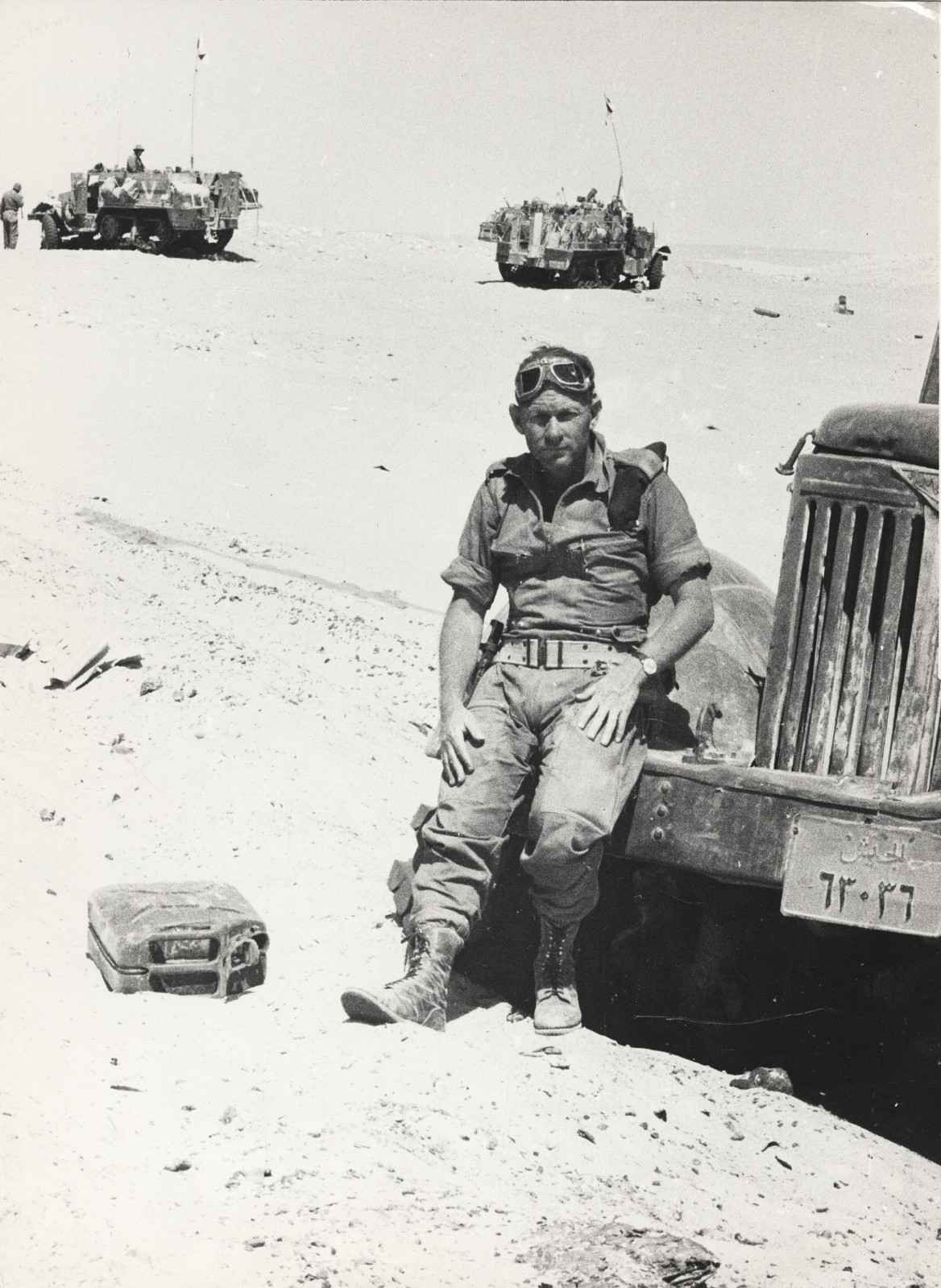
1967 Israeli Col. Bren Adan, Six-Day War Photograph by EYTAN YERUSHALMI For Sale

When you click on links to various merchants on this site and make a purchase, this can result in this site earning a commission. Affiliate programs and affiliations include, but are not limited to, the eBay Partner Network.

1967 Israeli Col. Bren Adan, Six-Day War Photograph by EYTAN YERUSHALMI:
$150.00
DATE: 1967PHOTOGRAPHER: Eytan Jerushalmi (see bio below)SUBJECT: The Six Day War (see info below)PROCESS: Silver GelatinSIZE:7\" x 9.5\"CONDITION: See photosSHIPPING: Shipping cost is non-negotiable, please consider it when offerding/buying.COMBINED SHIPPING: Yes, I do combine shipping. Additional shipping per item is 20% of the lower shipping cost [For example, if 2 items are purchased that have a $30 and $10 shipping cost each, the combined shipping cost becomes $32 for the 2 items]. If offerding/buying more than 1 item, please wait for an invoice with combined shipping before Jerushalmi was an Israeli photojournalist and combat photographer who played a significant role in documenting the nation\'s military and social history. Born in 1934, he began his professional career in the 1950s, working for various Israeli publications and eventually gaining international recognition through his association with agencies such as Magnum Photos. His photographic style was characterized by a focus on the human condition, often capturing the candid emotions of individuals amidst the backdrop of national upheaval. Throughout his life, he was dedicated to preserving the visual history of Israel, producing a vast body of work that spans several decades of conflict and development.During the Six-Day War in 1967, Jerushalmi served as a combat photographer embedded with the Israel Defense Forces. He was assigned to the 31st Armored Division commanded by Major General Avraham Yoffe during the campaign in the Sinai Peninsula. Jerushalmi followed the division\'s rapid movement across the desert, documenting the strategic capture of key passes and the push toward the Suez Canal. His photographs from this period are noted for their immediacy and for providing an intimate view of the conflict, featuring both the high-stakes decisions of military leadership and the daily realities faced by the troops on the ground. These images became a vital part of the visual record of the 1967 victory and were widely published, helping to define the public\'s perception of the Sinai front. Jerushalmi continued to work as a photographer until his death in 2010, leaving a legacy as one of the country\'s most important visual Six-Day War, also known as the 1967 Arab–Israeli war, was fought between June 5 and June 10, 1967, between Israel and a coalition of Arab states, primarily Egypt, Syria, and Jordan, within the context of the Arab–Israeli conflict. In the war, Israel captured and occupied the West Bank, including East Jerusalem, from Jordan, the Gaza Strip and the Sinai Peninsula from Egypt, and the Golan Heights from Syria. Military hostilities broke out amid poor relations between Israel and its Arab neighbors, who had been observing the 1949 Armistice Agreements signed at the end of the First Arab–Israeli War. In 1956, regional tensions over the Straits of Tiran escalated in what became known as the Suez Crisis, when Israel invaded Egypt over the Egyptian closure of maritime passageways to Israeli shipping, ultimately resulting in the re-opening of the Straits of Tiran to Israel and the deployment of the United Nations Emergency Force along the Egypt–Israel border.In the months prior to the outbreak of the war in June 1967, tensions again became dangerously heightened. Israel reiterated its post-1956 position that another Egyptian closure of the Straits of Tiran to Israeli shipping would be a definite casus belli. In May 1967, Egyptian president Gamal Abdel Nasser announced that the Straits of Tiran would again be closed to Israeli vessels. He subsequently mobilized the Egyptian military into defensive lines along the border with Israel and ordered the immediate withdrawal of all United Nations Emergency Force personnel. On June 5, 1967, as the emergency force was in the process of leaving the zone, Israel launched a series of airstrikes against Egyptian airfields and other facilities in what is known as Operation Focus. Egyptian forces were caught by surprise, and nearly all of Egypt\'s military aerial assets were destroyed, giving Israel air supremacy. Simultaneously, the Israeli military launched a ground offensive into Egypt\'s Sinai Peninsula as well as the Egyptian-occupied Gaza Strip. After some initial resistance, Nasser ordered an evacuation of the Sinai Peninsula; by the sixth day of the conflict, Israel had occupied the entire Sinai Peninsula.Jordan, which had entered into a defense pact with Egypt just a week before the war began, did not take on an all-out offensive role against Israel but launched attacks against Israeli forces to slow Israel\'s advance. On the fifth day, Syria joined the war by shelling Israeli positions in the north. Egypt and Jordan agreed to a ceasefire on June 8, and Syria on June 9, and it was signed with Israel on June 11. The Six-Day War resulted in more than 15,000 Arab fatalities, while Israel suffered fewer than 1,000. Alongside the combatant casualties were the deaths of 20 Israeli civilians killed in Arab forces air strikes on Jerusalem, 15 UN peacekeepers killed by Israeli strikes in the Sinai at the outset of the war, and 34 US personnel killed in the USS Liberty incident in which Israeli air forces struck a United States Navy technical research ship.At the time of the cessation of hostilities, Israel had occupied the Golan Heights from Syria, the West Bank including East Jerusalem from Jordan, and the Sinai Peninsula and the Gaza Strip from Egypt. The displacement of civilian populations as a result of the war would have long-term consequences, as around 280,000 to 325,000 Palestinians and 100,000 Syrians fled or were expelled from the West Bank and the Golan Heights, respectively. Nasser resigned in shame after Israel\'s victory but was later reinstated following a series of protests across Egypt. In the aftermath of the conflict, Egypt closed the Suez Canal from 1967 to 1975.Before the war, Israeli pilots and ground crews had trained extensively in rapid refitting of aircraft returning from sorties, enabling a single aircraft to sortie up to four times a day, as opposed to the norm in Arab air forces of one or two sorties per day. This enabled the Israeli Air Force to send several attack waves against Egyptian airfields on the first day of the war, overwhelming the Egyptian Air Force and allowing the Israeli Air Force to knock out other Arab air forces on the same day. Pilots were extensively schooled about their targets, memorized layouts in detail, and rehearsed the operation multiple times on dummy runways in total secrecy. The Egyptians had constructed fortified defenses in the Sinai, based on the assumption that an attack would come along the few roads leading through the desert rather than through the difficult desert terrain. The Israelis chose not to risk attacking the Egyptian defenses head-on and instead surprised them from an unexpected direction. On the eve of the war, Israel believed it could win a war in three to four days, while the United States and Britain estimated it would take seven to ten days.The Israeli army had a total strength of 264,000, including reservists. Against Jordan\'s forces on the West Bank, Israel deployed about 40,000 troops and 200 tanks across five brigades. Egypt massed approximately 100,000 of its 160,000 troops in the Sinai, including all seven of its divisions. These forces had 950 tanks, 1,100 armored personnel carriers, and more than 1,000 artillery pieces. Syria\'s army had a total strength of 75,000 and was deployed along the border with Israel, though it was considered less prepared due to internal military purges and uprisings. The Jordanian Armed Forces included 11 brigades totaling 55,000 troops, with nine brigades deployed in the West Bank.
|
|
Related Items:
1967 Israeli Col. Bren Adan, Six-Day War Photograph by EYTAN YERUSHALMI $150.00
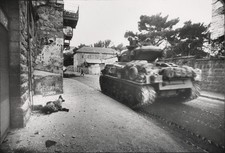
1967 Israeli Tank and Fallen Soldier, East Jerusalem Photograph by MICHA BAR-AM $500.00
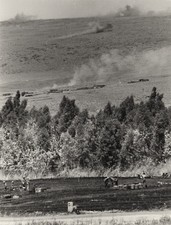
1967 Israeli War, Mortars Shelling Syrian Outposts Photograph by MAGNUM PHOTOS $120.00
|
|
|
Shopping Cart  |

|
Recently Viewed |
|
Latest Items |
|
Facebook |
Secure Websites

|
