When you click on links to various merchants on this site and make a purchase, this can result in this site earning a commission. Affiliate programs and affiliations include, but are not limited to, the eBay Partner Network.
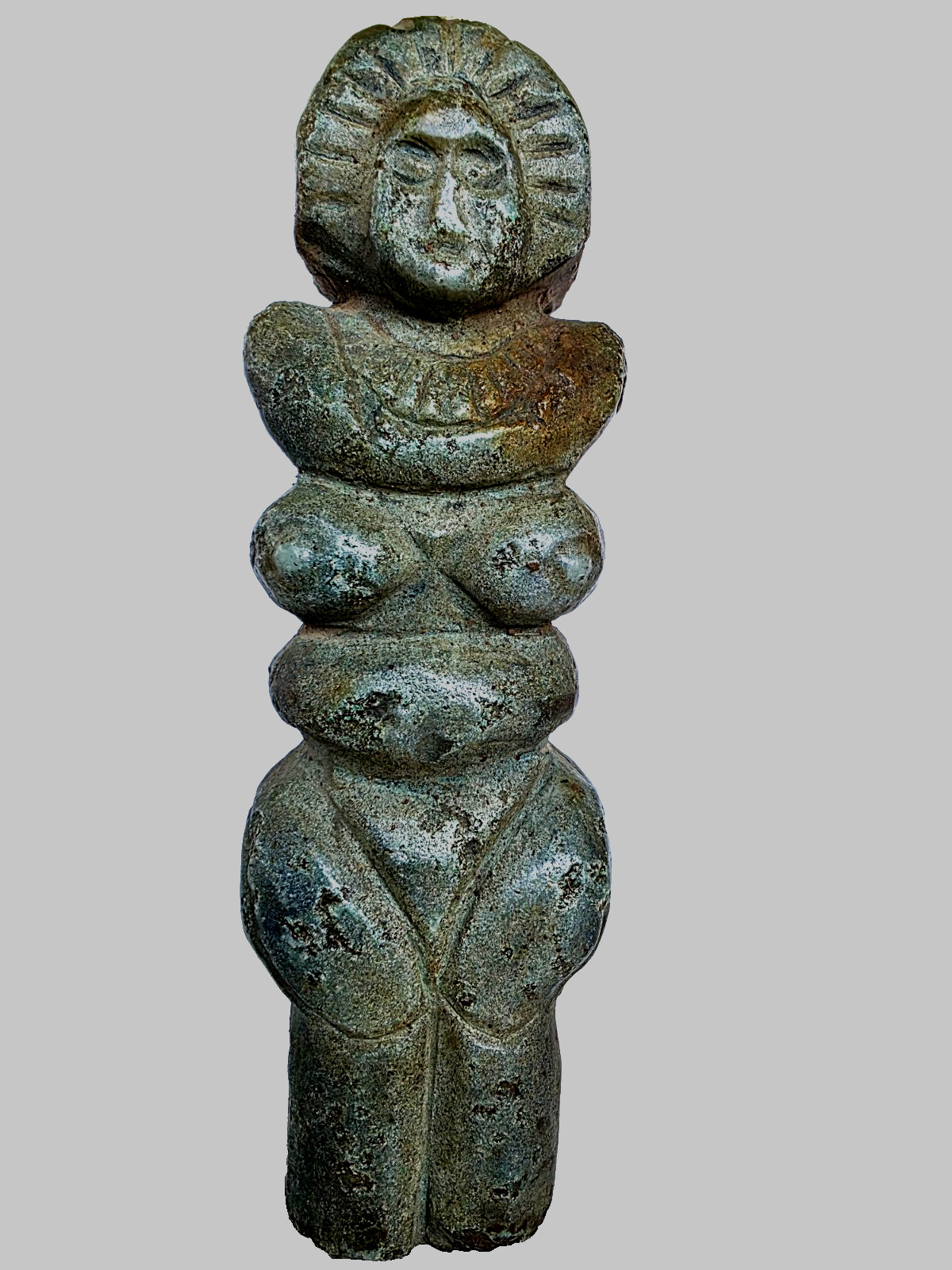
3000 BC Ancient Neolithic, Prehistoric Carved Stone Statue Mother Goddess Idol
STORAGE METHOD : Please do not clean under any circumstances with water or a damp cloth( there is a risk of damaging the patina ). Store in a dry place and in a roomfree from moisture. Protect from impacts with hard objects to avoid damagingthe surfaces and patina. Clean and polish with a soft DRY cotton cloth.
VERY LARGE HEAVY MASSIVE SOLID
The product is a prehistoric carved stone statue of a Mother Goddess idol from the Ancient Neolithic era, dating back to 3000 BC. This unique piece is 100% natural and carved from stone, making it a one-of-a-kind piece with a lifetime warranty for authenticity. It comes with a Certificate of Authenticity and has been expertly evaluated for its uniqueness, adding to its value as a rare and authentic collectible from Greece. The intricate craftsmanship and multi-color design make it a striking decorative piece for any collector or enthusiast of ancient artifacts.
Expertise of the materials ( EXPERT EVALUATION CONTROL NUMBER : 3785070) :PURE NATURAL SOLID CARVEDSTONE( It is NOT CASTstone) with authentic GENUINE OLD PATINA
MUSEUM GRADE RESTORED
GUARANTEES: We give for buyer a100%lifetime warrantyfortheuniquenessof thisartifactONE OF A KINDEXTREMELYUNIQUE.
Odds are you'llnever see another come up for sale !!!
CERTIFICATEOF AUTHENTICITY ( COA ) :Below in the listing description, for your convenience and security, is a CERTIFICATE OF AUTHENTICITY ( COA) AVAILABLE.
How to obtaina COA - Please print the description and photos( Photos of your choice ), from the listing if desired (laminate) and apply theprinted documents and Photos to the item.
TheAuthenticity of our items is guaranteed and protectedby our 100% buyer satisfaction guarantee as well as a guaranteed one hundredpercent opportunity to return the item and receive a full refund of the amountyou purchased it for, according to policies.
CERTIFICATE OF AUTHENTICITY ( COA ) NUMBER : 3785066
1. Expertise ofthe materials ( EXPERT EVALUATION CONTROLNUMBER : 3785066):PURE NATURAL SOLID CARVEDSTONE( Itis NOT CASTstone) with authentic GENUINE OLD PATINA
2. MEASUREMENTS& WEIGHT : Weight852grams : Height195millimeters
3. Condition : Extremely Fine - Museum grade restored
4. GUARANTEES : We give forbuyer a 100% lifetime warranty for the uniqueness of this artifact ONE OF A KIND EXTREMELY UNIQUE.
The UNIQUE FIGUREis presented in its unaltered condition, with detailing of the featuresclearly visible, a relatively smooth surface, and a naturally aged patina, deepcovered in molted variations of hues and colours as maintained. If you examinethe enlarged photos of thisstatue, you'll see that it has been meticulously crafted with stunningdetails. I'm confident that you'll be 100% satisfied with this sculpture, which is not only a beautiful work ofart but also great antiquities. Thank you for considering our offerings, and welook forward to serving you !!! At our shop, we take pride in offering a uniquecollection of Ancient Artifacts of diverse cultures from different eras thatare truly one-of-a-kind. Many of these items are quite old and rare, and once they are sold, wemay not be able to find another one to replace it. That's why we believe thatwhoever possesses one of these special statuescan be considered to have true pride. Weunderstand that our customers are discerning collectors who appreciate thevalue and significance of these rare artifacts. That's why we make every effortto ensure that our collection is authentic and of the highest quality. Webelieve that owning one of these statuesis not just a matter of acquiring abeautiful object, but also of connecting with a rich cultural tradition thatspans centuries. So if you're looking for a truly unique sculpture to add to your collection - you are in theright place ! Our inventory represents time-tested investment quality itemswith everlasting decorative beauty. We look forward to your business andappreciate any reasonable offers. All of our curated items are vetted andguaranteed authentic and as described. We only deals in original antiques andnever reproductions. 100% Customer Satisfaction Guaranteed - We are extremelyconfident that all items presented from our collection are genuine antiques.
Prehistory, sometimes referred to as pre-literary history, is the period of human history between the first known use of stone tools by hominins c. 3.3 million years ago and the beginning of recorded history with the invention of writing systems. The use of symbols, marks, and images appears very early among humans, but the earliest known writing systems appeared c. 5,200 years ago. The adoption of writing across the globe has been a slow process, so that the end of prehistory occurred at different times in different places, and the term is less often used in discussing societies where prehistory ended relatively recently. The period when a culture is written about by others, but has not developed its own writing system, is often known as the protohistory of the culture. Human prehistory differs from history not only in terms of its chronology, but in the way it deals with the activities of archaeological cultures rather than named nations or individuals. Restricted to material processes, remains, and artefacts rather than written records, prehistory is anonymous. Because of this, reference terms that prehistorians use, such as "Neanderthal" or "Iron Age", are modern labels with definitions sometimes subject to debate. In most cases however, and in particular as one goes back further in time, these assigned labels are the only way of distinguishing groups of prehistoric peoples and conveying information about them in the present. By definition, there are no written records from human prehistory, which can only be known from material archaeological and anthropological evidence: prehistoric materials and human remains. These were at first understood by the collection of folklore and by analogy with pre-literate societies observed in modern times.
The Neolithic or New Stone Age (from Greek νέος néos 'new' and λίθος líthos 'stone') is an archaeological period, the final division of the Stone Age in Mesopotamia, Asia, Europe and Africa (c. 10,000 BC to c. 2,000 BC). It saw the Neolithic Revolution, a wide-ranging set of developments that appear to have arisen independently in several parts of the world. This "Neolithic package" included the introduction of farming, domestication of animals, and change from a hunter-gatherer lifestyle to one of settlement. The term 'Neolithic' was coined by John Lubbock in 1865 as a refinement of the three-age system. The Neolithic began about 12,000 years ago, when farming appeared in the Epipalaeolithic Near East and Mesopotamia, and later in other parts of the world. It lasted in the Near East until the transitional period of the Chalcolithic (Copper Age) from about 6,500 years ago (4500 BC), marked by the development of metallurgy, leading up to the Bronze Age and Iron Age. In other places, the Neolithic followed the Mesolithic (Middle Stone Age) and then lasted until later. In Ancient Egypt, the Neolithic lasted until the Protodynastic period, c. 3150 BC. In China, it lasted until circa 2000 BC with the rise of the pre-Shang Erlitou culture, as it did in Scandinavia.In southeast Europe agrarian societies first appeared in the 7th millennium BC, attested by one of the earliest farming sites of Europe, discovered in Vashtëmi, southeastern Albania and dating back to 6500 BC. In most of Western Europe in followed over the next two thousand years, but in some parts of Northwest Europe it is much later, lasting just under 3,000 years from c. 4500 BC–1700 BC. Recent advances in archaeogenetics have confirmed that the spread of agriculture from the Middle East to Europe was strongly correlated with the migration of early farmers from Anatolia about 9,000 years ago, and was not just a cultural exchange. Anthropomorphic figurines have been found in the Balkans from 6000 BC, and in Central Europe by around 5800 BC (La Hoguette). Among the earliest cultural complexes of this area are the Sesklo culture in Thessaly, which later expanded in the Balkans giving rise to Starčevo-Körös (Cris), Linearbandkeramik, and Vinča. Through a combination of cultural diffusion and migration of peoples, the Neolithic traditions spread west and northwards to reach northwestern Europe by around 4500 BC. The Vinča culture may have created the earliest system of writing, the Vinča signs, though archaeologist Shan Winn believes they most likely represented pictograms and ideograms rather than a truly developed form of writing. The Cucuteni-Trypillian culture built enormous settlements in Romania, Moldova and Ukraine from 5300 to 2300 BC. The megalithic temple complexes of Ġgantija on the Mediterranean island of Gozo (in the Maltese archipelago) and of Mnajdra (Malta) are notable for their gigantic Neolithic structures, the oldest of which date back to around 3600 BC. The Hypogeum of Ħal-Saflieni, Paola, Malta, is a subterranean structure excavated around 2500 BC; originally a sanctuary, it became a necropolis, the only prehistoric underground temple in the world, and shows a degree of artistry in stone sculpture unique in prehistory to the Maltese islands. After 2500 BC, these islands were depopulated for several decades until the arrival of a new influx of Bronze Age immigrants, a culture that cremated its dead and introduced smaller megalithic structures called dolmens to Malta. In most cases there are small chambers here, with the cover made of a large slab placed on upright stones. They are claimed to belong to a population different from that which built the previous megalithic temples. It is presumed the population arrived from Sicily because of the similarity of Maltese dolmens to some small constructions found there. With some exceptions, population levels rose rapidly at the beginning of the Neolithic until they reached the carrying capacity. This was followed by a population crash of "enormous magnitude" after 5000 BC, with levels remaining low during the next 1,500 years. Populations began to rise after 3500 BC, with further dips and rises occurring between 3000 and 2500 BC but varying in date between regions. Around this time is the Neolithic decline, when populations collapsed across most of Europe, possibly caused by climatic conditions, plague, or mass migration.
A mother goddess is a major goddess characterized as a mother or progenitor, either as an embodiment of motherhood and fertility or fulfilling the cosmological role of a creator- and/or destroyer-figure, typically associated the Earth, sky, and/or the life-giving bounties thereof in a maternal relation with humanity or other gods. When equated in this lattermost function with the earth or the natural world, such goddesses are sometimes referred to as the Mother Earth or Earth Mother, deity in various animistic or pantheistic religions. The earth goddess is archetypally the wife or feminine counterpart of the Sky Father or Father Heaven, particularly in theologies derived from the Proto-Indo-European sphere (i.e. from Dheghom and Dyeus). In some polytheistic cultures, such as the Ancient Egyptian religion which narrates the cosmic egg myth, the sky is instead seen as the Heavenly Mother or Sky Mother as in Nut and Hathor, and the earth god is regarded as the male, paternal, and terrestrial partner, as in Osiris or Geb who hatched out of the maternal cosmic egg.There is difference of opinion between the academic and the popular conception of the term Mother goddess. The popular view is mainly driven by the Goddess movement and reads that primitive societies initially were matriarchal, worshipping a sovereign, nurturing, motherly earth goddess. This was based upon the nineteenth-century ideas of unilineal evolution of Johann Jakob Bachofen. According to the academic view, however, both Bachofen and the modern Goddess theories are a projection of contemporary world views on ancient myths, rather than attempting to understand the mentalité of that time. Often this is accompanied by a desire for a lost civilization from a bygone era that would have been just, peaceful, and wise. However, it is highly unlikely that such a civilization ever existed. For a long time, feminist authors claimed that these peaceful, matriarchal agrarian societies were exterminated or subjugated by nomadic, patriarchal warrior tribes. An important contribution to this was that of archaeologist Marija Gimbutas. Her work in this field has been questioned. Among feminist archaeologists this vision is nowadays also considered highly controversial. Since the 1960s, especially in popular culture, the alleged worship of the mother goddess and the social position that women in prehistoric societies supposedly assumed, were linked. This made the debate a political one. According to the goddess movement, the current male-dominated society should return to the egalitarian matriarchy of earlier times (though a matriarchy is not an egalitarian society, but a female-dominated one). That this form of society ever existed was supposedly supported by many figurines that were found. In academic circles, this prehistoric matriarchy is considered unlikely. Firstly, worshiping a mother goddess does not necessarily mean that women ruled society. In addition, the figurines can also portray ordinary women or goddesses, and it is unclear whether there really ever was a mother goddess
Dear buyers, please keep in mind that we are dealing with ancient and antique items.You should not expect ancient and antique items to be as brand new ones. Theyalways have some degree of wearing. Please, take care to examine the photos andread descriptions. Thank you.
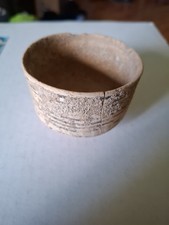
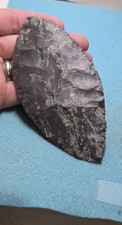
The photos are part of the descriptionin this Listing !!! Dear Customers, you will receiveexactly the same item which you see on the pictures, not similar or other.Please read the description carefully and review the photos. All items, which Isell, are captured with high - photographic equipment and the photos, which Iinsert in my sales, are with high resolution. The photos are absolutelyclear and the potential buyer can truly identify the item, which purchased.Photos are not further processed by specialized software! Upon purchase myitem, you will receive exactly the same item which you saw on the photo !!! Thepictures in listing are CLEAR with opportunities ZOOM for expansion + VIDEO sothat you can perfectly identify all the details of item !
RETURNS : IF YOU HAVE ANY REASON TO DOUBTA ITEM THAT YOU HAVE PURCHASED, YOU MAY RETURN IT WITHIN 14 DAYS !!!
Thank you foryour time, I wish you successful and happy days.