When you click on links to various merchants on this site and make a purchase, this can result in this site earning a commission. Affiliate programs and affiliations include, but are not limited to, the eBay Partner Network.
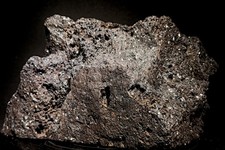
The Sweet Treat for I\'ve got today, a truly massive, one-of-a-kind, 11.5-pound specimen of shimmering Specular Hematite (Specularite) directly from the legendary—and long-depleted—Pilot Knob mine in the St. Francois Mountains of Missouri. Measuring a staggering 9\" x 5.5\" x 5\", this old-stock monster features a breathtaking, highly reflective micaceous structure that catches the light like a galaxy of crushed diamonds.
This is not a modern surface find. This specimen was acquired directly from a descendant of a Pilot Knob miner, carrying with it a direct bloodline to the early days of American industry.
Forged in Fire: A 1.5 Billion-Year-Old Story
Long before the dinosaurs, roughly 1.5 billion years ago during the Precambrian era, the American Midwest was a violent landscape of towering volcanoes. Massive caldera eruptions blanketed the region in thick ash and rhyolite. Deep within the earth, superheated, iron-rich hydrothermal fluids surged upward through the fractures in the rock. As these boiling fluids cooled, they deposited pure iron oxide, crystallizing into the glittering, metallic flakes of specularite you see in this very rock. This heavy, dense stone is the frozen echo of ancient, unimaginable geological violence.
The Iron That Built (and Fought For) America
Fast forward to the mid-19th century. Pilot Knob, Missouri, became the beating heart of the American industrial boom. Mined heavily starting in 1848, the incredibly rich iron ore from this mountain helped build the railroads expanding the nation westward. It was backbreaking, perilous work done by hardened miners who carved the ore from the earth by hand and black powder.
But the mountain\'s greatest drama came in the autumn of 1864.
As the Civil War raged, Pilot Knob became a crucial strategic prize. On September 27, 1864, Confederate General Sterling Price marched an army of 12,000 men into the valley, intent on capturing the iron-rich region and its massive stockpiles. Standing in his way was a vastly outnumbered Union force inside the hexagonal earthen walls of Fort Davidson, built literally in the shadow of Pilot Knob.
The resulting Battle of Fort Davidson was one of the bloodiest engagements in the state. Cannon fire shook the very ground this ore was pulled from, and the valley was enveloped in gunsmoke and carnage. The miners dropped their pickaxes and took up rifles. When you hold this 11.5-pound specimen, you are holding a piece of the very mountain that forces bled and died over to control.
Today, the old Pilot Knob workings are silent, flooded, and strictly off-limits. Spectacular old-stock pieces of this magnitude, complete with family provenance to the historic mining operations, simply do not surface anymore.
Dimensions: 9\" x 5.5\" x 5\"
Weight: 11.5 lbs (Heavy, dense, solid iron ore)
Condition: Natural, raw, highly reflective, old-estate piece.
Pilot Knob Missouri, Specular Hematite, Specularite, Iron Ore, Historic Mineral Specimen, Civil War relic, Battle of Fort Davidson, St Francois Mountains, Precambrian rock, Volcanic hydrothermal, Old Stock Minerals, Estate Crystal, Massive Hematite, Glittering Hematite, Micaceous Hematite, Native Iron, Raw Iron Ore, Geology specimen, Earth Science, Mineralogy, Missouri geology, Mining history, Antique mining, Railroad history, Sterling Price, Iron Mountain, Healing crystal, Grounding stone, Root chakra, Metaphysical stone, Display specimen, Museum quality mineral, Giant crystal, 11 pound mineral, Rock hound, Cabinet specimen, Decor rock, Natural art, American history.