When you click on links to various merchants on this site and make a purchase, this can result in this site earning a commission. Affiliate programs and affiliations include, but are not limited to, the eBay Partner Network.
A SPECTACULAR SURVIVOR FROM FRONTIER-ERA KENTUCKY
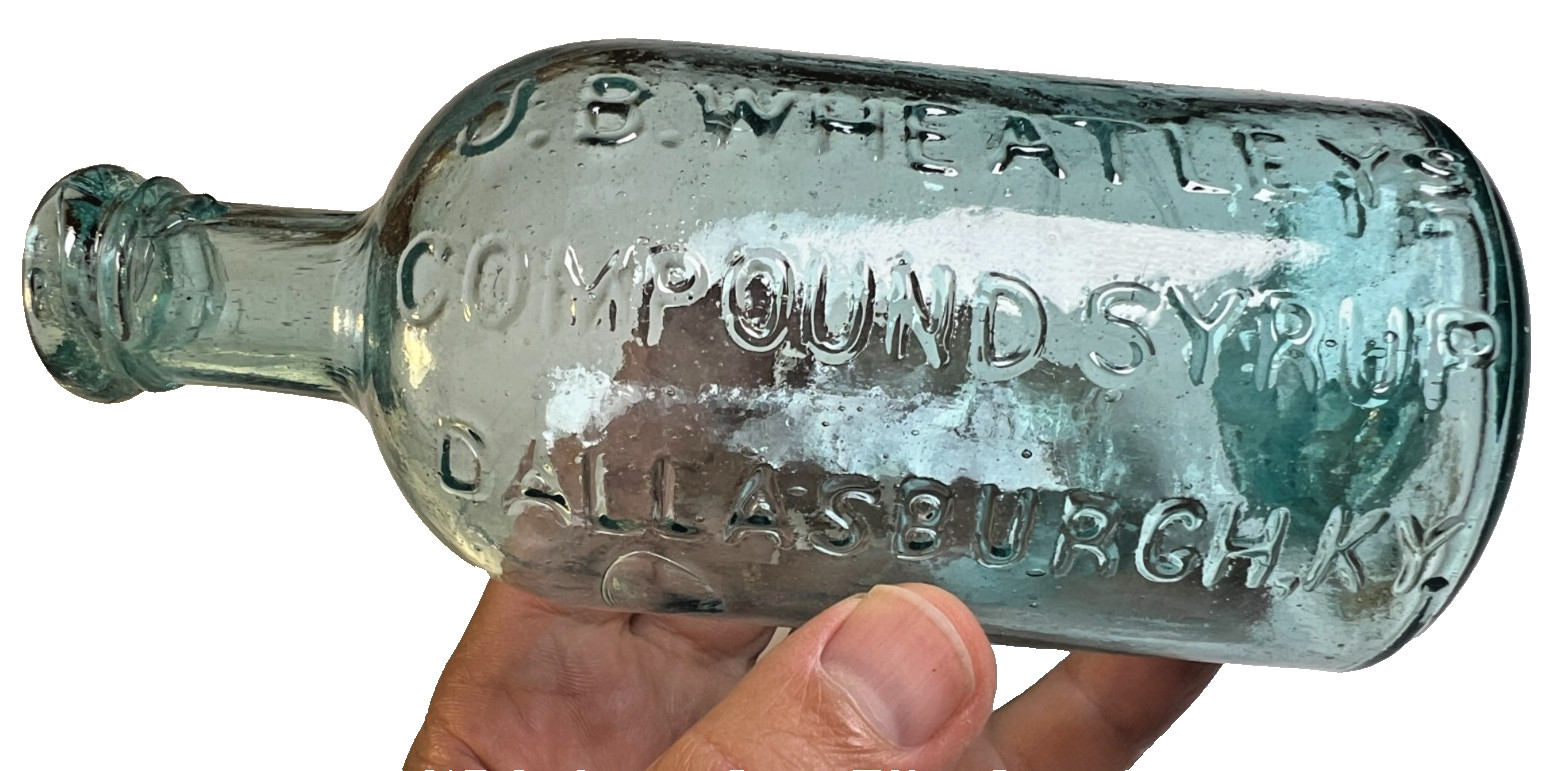
Some early bottles are collected for their embossing. Others are collected for their color, pontil or crude manufacture. This remarkable J. B. Wheatley bottle delivers all of it.
Blown approximately 165–175 years ago, it is positively alive with early glassmaking character: darker aqua color, swirling glass, tiny seed bubbles, a dramatic oversized bubble below the embossing, twisting through the neck, an extremely crude applied top and a huge, deeply recessed open pontil scar.
Best of all, it has survived in virtually miraculous condition.
This is not merely an old medicine bottle—it is a beautifully preserved piece of rural Kentucky history from the years immediately preceding the Civil War.
EMBOSSING
The cylindrical body is boldly embossed:
J. B. WHEATLEY’S
COMPOUND SYRUP
DALLASBURGH KY
The embossing is strong, crisp and easily readable.
DATE: CIRCA 1850–1858
This bottle can be placed with unusual confidence in the early to mid-1850s, approximately 1850–1858.
Dallasburg, Kentucky was incorporated in 1850, and its post office operated under the Dallasburg name from 1850 until 1863. The community was subsequently known as Wheatley, reportedly taking its later name from the Wheatley family.
The bottle’s enormous open pontil, hand-applied double-collar top, crude neck and heavily textured glass also point toward manufacture during the earlier portion of that period. Open-pontil medicine bottles were rapidly disappearing as American bottle production became increasingly standardized during the late 1850s.
A date of approximately 1850–1858 therefore fits both the town history and the bottle’s distinctly early method of manufacture.
PLACE: DALLASBURG, OWEN COUNTY, KENTUCKY
Dallasburg—also historically spelled Dallasburgh—was a small Owen County community located approximately nine miles northwest of Owenton and about 30 miles northeast of Frankfort.
The modern community is known as Wheatley, Kentucky.
This was never a large manufacturing city. It was a small rural crossroads community surrounded by farms, woodland and the rolling hills of northern Kentucky. That modest origin is part of the bottle’s appeal. It represents a named medicine produced and marketed by a country doctor in a community whose population was far too small to leave behind large quantities of advertising glass.
WHO WAS J. B. WHEATLEY?
J. B. Wheatley was Jonathan B. Wheatley, identified in bottle references as a country doctor practicing in the Dallasburg area.
In the middle of the 19th century, a rural physician frequently served a much broader role than a modern doctor. He might travel by horseback or wagon to visit patients, prepare his own medicinal compounds, dispense remedies directly and offer proprietary preparations carrying his personal name.
Wheatley’s name was permanently molded into the bottle itself. This transformed the container into a piece of advertising that continued promoting both the medicine and its maker for as long as the bottle remained in a household.
The later renaming of Dallasburg as Wheatley suggests that the family became closely associated with the identity of the community.
WHAT DID IT CONTAIN?
This bottle originally held J. B. Wheatley’s Compound Syrup, a proprietary liquid medicine advertised for the treatment of chills and fever.
“Chills and fever” was a broad 19th-century description most often associated with recurring fever, shaking chills and malaria-like illnesses. Such complaints were common in areas with standing water, river bottoms and seasonal mosquito activity, although the medical connection to mosquitoes was not yet understood.
The exact surviving ingredient formula has not been confirmed. It should therefore not be assumed that the syrup contained any one particular drug. Proprietary medicines of the period were commonly made as sweetened liquid mixtures incorporating botanical extracts, alcohol or other medicinal ingredients, but Wheatley’s specific recipe remains uncertain.
The heavy glass bottle itself was the retail package. It would likely have been sealed with a cork and accompanied by a paper label giving directions, claimed benefits and dosage information. That label has disappeared, as nearly all paper medicine labels from this period have, but the permanent embossing still identifies the maker, product and community.
HOW WHEATLEY MARKETED HIS MEDICINE
This bottle comes from the early age of American proprietary or “patent” medicine advertising.
The term did not necessarily mean that a medicine had actually been patented. It generally described a prepared remedy sold under a distinctive name or associated with a particular physician or proprietor.
Before radio, television and modern drugstores, makers promoted their remedies through:
• Newspaper advertisements
• Handbills and broadsides
• Printed wrappers and paper labels
• Testimonials from satisfied customers
• Traveling agents and local merchants
• Word-of-mouth recommendations
• The maker’s name embossed directly into the bottle
Embossed glass was especially effective. Even after its contents were consumed, the bottle could remain in a kitchen, pantry, barn or household cupboard for years. Every time it was handled, the raised lettering repeated the maker’s name and product.
For a country doctor serving a small Kentucky community, putting “J. B. WHEATLEY’S” and “DALLASBURGH KY” directly into the mold was a confident and expensive form of permanent advertising.
LIFE IN DALLASBURG DURING THE 1850s
When this bottle was made, Dallasburg was a newly incorporated rural Kentucky community rather than a developed city.
Most families in Owen County lived on farms or in small settlements. Daily life revolved around agriculture, livestock, household production, churches, general stores and the county courthouse. Roads were often rough and seasonal travel could be slow. A journey that takes minutes today might then have required hours by horse, wagon or on foot.
Homes were illuminated by candles or oil lamps. Water came from wells, springs and cisterns. Food was grown, hunted, preserved, smoked or traded locally. Clothing and household goods were routinely repaired rather than discarded.
Illness could be particularly frightening. There were no antibiotics, no germ theory in ordinary medical practice, and no modern laboratory testing. A rural doctor might need to diagnose and treat a patient many miles from the nearest town using only the medicines and instruments he carried with him.
A bottle of Wheatley’s Compound Syrup would have been a meaningful household possession—not decorative glass, but a medicine purchased with the hope of easing fever and chills in an era when both could become life-threatening.
Once emptied, a sturdy bottle like this was rarely thrown away. It might be reused for another medicine, flavoring, household liquid or homemade remedy. That culture of reuse is one reason some early bottles survived, although very few escaped chips and damage as completely as this example.
WHAT WAS HAPPENING LOCALLY?
The 1850s were a formative decade for Dallasburg and Owen County.
Dallasburg was formally incorporated and received its post office in 1850, giving the small settlement a stronger civic identity and a direct connection with regional commerce and communication.
Elsewhere in Owen County, improvements to navigation on the Kentucky River allowed packet boats traveling between Frankfort and Louisville to stop at river communities including Monterey, Moxley and Gratz. These boats carried passengers, mail, manufactured goods and news into what had previously been relatively isolated areas.
In 1857–1858, Owen County constructed an impressive new Greek Revival courthouse in Owenton. The building represented the growth and increasing organization of county government during precisely the period in which Wheatley’s medicine was being sold.
Dallasburg itself remained small, but events in Frankfort, Louisville and Cincinnati would have reached its residents through newspapers, postal deliveries, river traffic and travelers passing through local stores and taverns.
AMERICA DURING THIS BOTTLE’S ERA
Nationally, these were extraordinarily consequential years.
The Compromise of 1850 attempted to contain the growing conflict over slavery and the admission of new states. The decade also brought the Kansas–Nebraska Act, violent conflict in “Bleeding Kansas,” the Dred Scott decision and increasingly bitter national division.
Kentucky occupied a particularly complicated position. It was a slave state with strong economic and family connections to both North and South. When the Civil War began in 1861, Kentucky initially attempted neutrality before ultimately remaining in the Union.
This bottle was most likely manufactured while those tensions were building—but before the war transformed daily life throughout Kentucky.
At the same time, railroads, steamboats, newspapers and expanding postal service were connecting rural Americans to a rapidly changing national economy. Wheatley’s embossed medicine bottle belongs to that transitional world: locally made and locally identified, yet sold using the increasingly sophisticated branding and packaging methods of a growing consumer marketplace.
EXCEPTIONAL EARLY GLASS CHARACTER
This bottle is an absolute showcase of hand-blown manufacture.
Notable features include:
• Beautiful darker aqua glass
• Huge, deeply recessed open pontil scar
• Extremely crude hand-applied double-collar top
• Heavy drips and excess glass around the lip
• Visible twists through the neck
• Strong swirling and flowing textures
• Numerous tiny seed bubbles throughout
• One unusually large bubble immediately below the embossing
• Crisp, prominent lettering
• Wonderful irregularity from nearly every viewing angle
The applied top is especially appealing. It retains abundant excess glass and wonderfully uneven drips left by the glassworker. The neck twists slightly beneath it, producing an unmistakably handmade appearance.
The enormous open pontil is equally impressive. It is deep, bold and immediately visible—exactly the sort of primitive base character collectors hope to find on an early medicine bottle.
No two bottles made this way were truly identical. The bubbles, swirls, pontil and dripping top are not flaws; they are the individual fingerprints of its 6 1/4 inches tall.
CONDITION
Attic mint—quite possibly the finest example you will encounter.
Bright, clean and shiny with exceptional display presence.
No nicks, no chips, no cracks, no dings and no haze.
The large bubble below the embossing, tiny seed bubbles, glass swirls, neck twists, pontil roughness and heavy drips around the applied top are all original manufacturing characteristics. They are precisely what give this bottle its extraordinary personality and collector appeal.
The embossing remains crisp and prominent. The applied top is perfect, and the huge open pontil is completely intact.
Considering its age, crude manufacture and enormous pontil scar, its preservation is remarkable.
A TRUE CHARACTER BOTTLE
The J. B. Wheatley’s Compound Syrup bottle is a recognized Kentucky pontiled medicine, but examples vary dramatically in quality.
This specimen stands far above the ordinary because of its darker color, bold embossing, massive open pontil, extremely crude applied top, twisting neck, heavily seeded glass, large display bubble and truly outstanding condition.
It is the final example from the group I have owned—and unquestionably the best.
A museum-worthy piece of early Kentucky medicine advertising and an exceptional addition to an advanced collection of pontiled medicines, crude aqua glass, Civil War-era Americana or Kentucky bottles.
Please examine all photographs closely, as they form an important part of the description.