When you click on links to various merchants on this site and make a purchase, this can result in this site earning a commission. Affiliate programs and affiliations include, but are not limited to, the eBay Partner Network.
Identification & date
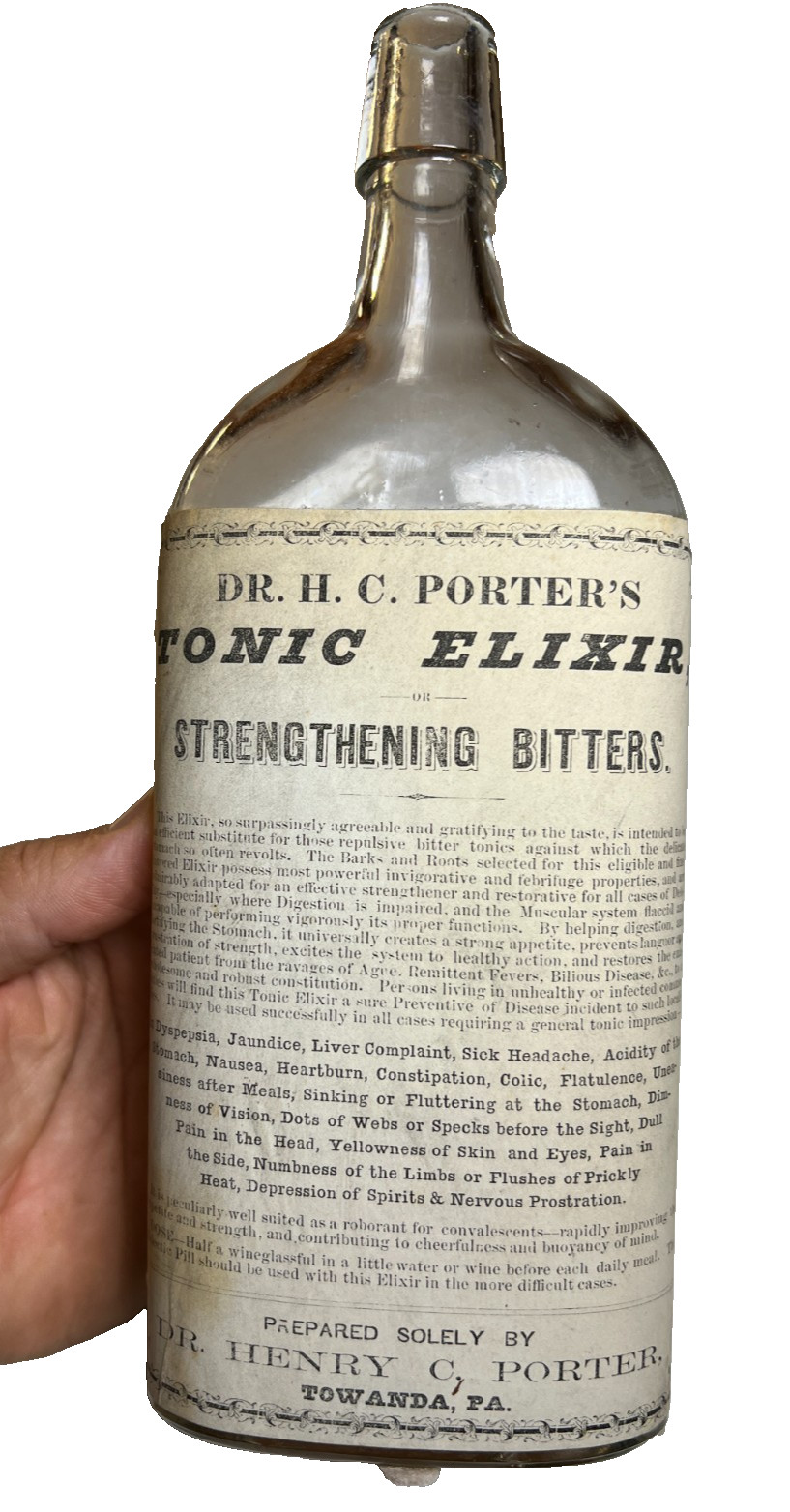
Dr. H. C. Porter’s Tonic Elixir, or Strengthening Bitters
Maker: Dr. Henry C. Porter
Place: Towanda, Bradford County, Pennsylvania
Height: 9 1/8 inches
Bottle: Clear/flint glass, rectangular flask-style medicine bottle, pinched/pin-head style finish
Date: circa 1875–1880; I would catalog it c.1878
The bottle construction, pin-head finish, typography, elaborate border, medical language, and—especially—the designation of Henry C. Porter alone rather than H. C. Porter & Son all point strongly to the later 1870s.
Porter was not simply a fictitious patent-medicine name. Surviving material identifies H. C. Porter as a Towanda druggist and physician, and later surviving products include both human and veterinary preparations.
The label
The main wording is exceptionally legible. From your photographs I can transcribe it substantially as follows; brackets indicate portions obscured by curvature or too faint for me to guarantee every word:
DR. H. C. PORTER’S
TONIC ELIXIR,
— OR —
STRENGTHENING BITTERS.
This Elixir, so surpassingly agreeable and gratifying to the taste, is intended as an efficient substitute for those repulsive bitter tonics against which the delicate stomach so often revolts. The Barks and Roots selected for this eligible and flavored Elixir possess most powerful invigorative and febrifuge properties, and are admirably adapted for an effective strengthener and restorative for all cases of Debility—especially where Digestion is impaired, and the Muscular system flaccid and incapable of performing vigorously its proper functions. By helping digestion, and fortifying the Stomach, it universally creates a strong appetite, prevents languor and prostration of strength, excites the system to healthy action, and restores the emaciated patient from the ravages of Ague, Remittent Fevers, Bilious Disease, &c., to a wholesome and robust constitution. Persons living in unhealthy or infected communities will find this Tonic Elixir a sure Preventive of Disease incident to such localities. It may be used successfully in all cases requiring a general tonic impression—
In Dyspepsia, Jaundice, Liver Complaint, Sick Headache, Acidity of the Stomach, Nausea, Heartburn, Constipation, Colic, Flatulence, Uneasiness after Meals, Sinking or Fluttering at the Stomach, Dimness of Vision, Dots of Webs or Specks before the Sight, Dull Pain in the Head, Yellowness of Skin and Eyes, Pain in the Side, Numbness of the Limbs or Flushes of Prickly Heat, Depression of Spirits & Nervous Prostration.
It is peculiarly well suited as a roborant for convalescents—rapidly improving the appetite and strength, and contributing to cheerfulness and buoyancy of mind.
DOSE—Half a wineglassful in a little water or wine before each daily meal. The Eclectic Pill should be used with this Elixir in the more difficult cases.
PREPARED SOLELY BY
DR. HENRY C. PORTER,
TOWANDA, PA.
That is a fantastic label from a social-history standpoint. It essentially gives you the complete sales pitch right on the bottle.
What was actually in it?
Porter calls it a “flavored Elixir” made from selected “Barks and Roots” having “invigorative and febrifuge properties.”
“Febrifuge” meant something intended to reduce or combat fever. “Roborant” meant a strengthening or restorative medicine.
The exact formula isn't stated on this label, so I wouldn't invent one. But preparations of this type in the 1870s commonly used bitter botanical extracts dissolved in an alcohol/water vehicle, sometimes sweetened and flavored to make them palatable.
And the label makes a very deliberate marketing point: Porter says his elixir tastes better than the “repulsive bitter tonics” that upset delicate stomachs.
In other words: all the medicinal punch of bitters, without tasting quite so much like punishment.
The marketing is especially interesting
Porter was selling one bottle as a remedy for an astonishing range of complaints: dyspepsia, jaundice, liver trouble, headache, nausea, heartburn, constipation, colic, gas, visual disturbances, weakness, “depression of spirits,” nervous prostration, fever recovery and general debility.
He even claimed that people in “unhealthy or infected communities” could use it as a preventative of disease.
That's classic pre–Pure Food and Drug Act American medicine. There was essentially no federal requirement that Porter prove those therapeutic claims before selling the product.
Another clever feature is the instruction:
“The Eclectic Pill should be used with this Elixir in the more difficult cases.”
That's cross-selling, 1870s style. Buy the tonic—and if you're really sick, buy Porter's pills too.
Later surviving Porter material shows the business expanding into additional preparations, including veterinary remedies such as Horse and Cattle Powder and Old Reliable Heave Powders, under the Dr. H. C. Porter & Son name.
Life around 1878
This bottle comes from a fascinating technological transition.
Technology: America was becoming interconnected at astonishing speed. Railroads and telegraph lines had transformed commerce, but electric lighting was still experimental. Edison demonstrated a practical incandescent-light system around the end of this decade. Most Towanda households still relied on kerosene lamps, wood or coal heat, handwritten correspondence and horse transportation. The telephone had only been patented in 1876.
Medicine: Germ theory was gaining credibility, but American medicine was still a mixture of emerging science, traditional botanical medicine, proprietary remedies and competing medical schools. Antibiotics were decades away. Physicians had limited treatments for infectious disease, and tonics, bitters, liver pills, blood purifiers and patent medicines occupied an enormous market.
Porter's references to “ague,” “bilious disease,” “nervous prostration,” “debility” and a “general tonic impression” are wonderfully characteristic of 19th-century medicine.
Politics: Rutherford B. Hayes became president in 1877 following the bitterly disputed Hayes–Tilden election. Reconstruction was ending, railroad corporations had become enormously powerful, labor unrest was growing, and the Great Railroad Strike of 1877 became the first major nationwide labor uprising in U.S. history.
Towanda itself was a prosperous regional center along the Susquehanna, benefiting from northeastern Pennsylvania's lumber, agriculture, coal-region commerce and railroad connections. A physician/druggist in a county-seat town like Towanda could sell locally while also distributing proprietary preparations much farther afield.
Rarity
I'd rate this scarce to rare in this configuration.
The plain bottle itself isn't what creates the value. It's the combination of:
original oversized label + early Henry C. Porter-only branding + Towanda, PA origin + excellent readability + large 9 1/8" size + intact glass.
Loose Porter labels do survive; one antiques database even records groups of unused late-1800s Dr. H. C. Porter & Son medicine labels, which tells us the firm's printed ephemera survived in some quantity. But an original period label still attached to its large medicine bottle is considerably more desirable.
Condition
Excellent antique condition. Original oversized paper label remains remarkably complete and highly legible, with expected age toning, scattered staining, wrinkles/creases and minor edge wear. Glass has some mineralization on the rear/back shoulder, largely concealed behind the oversized front label. No chips and no cracks. Please review photographs closely for the label's condition.