When you click on links to various merchants on this site and make a purchase, this can result in this site earning a commission. Affiliate programs and affiliations include, but are not limited to, the eBay Partner Network.
🐺 What Made a Cigar Box Snarl Right Back at You?
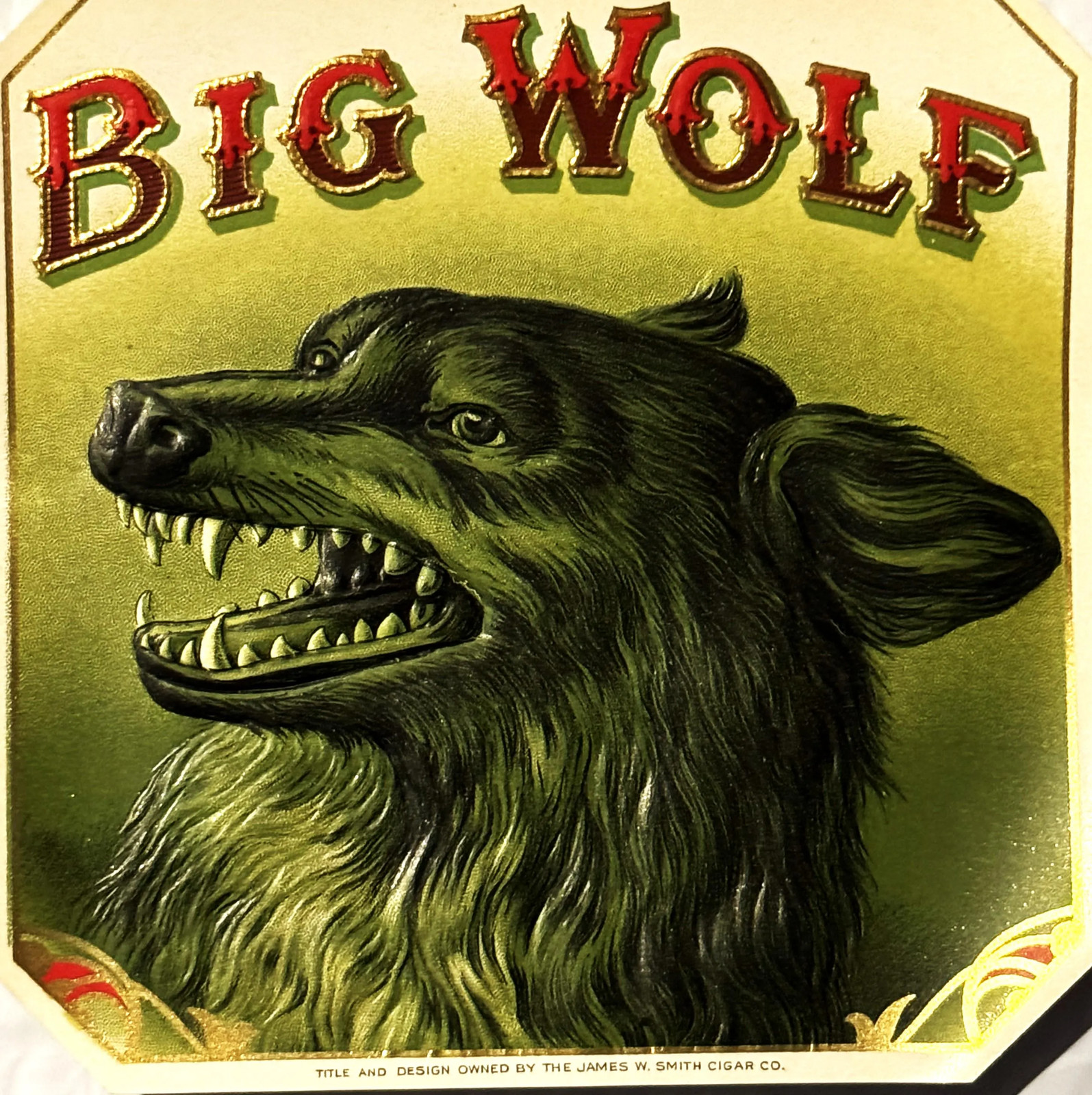
Long before radio jingles and billboards, the cigar box itself had to do every bit of the selling. A man standing at a tobacconist\'s counter wasn\'t reading reviews or comparing brands online — he was looking at what was right in front of him on the shelf, and the label had about two seconds to make its case.Nothing on that shelf made its case quite like a wolf with its jaws thrown open and a full set of ivory fangs bared straight at the customer. This label doesn\'t ask for your attention politely. It lunges for it, the same way it must have lunged for the eye of every passerby who caught sight of it more than a century of American commerce ago.
This is an antique Big Wolf cigar label, its title and design owned outright by the James W.Smith Cigar Co., exactly as the imprint along the bottom edge states in its own words: \"Title and Design Owned by the James W. Smith Cigar Co.\" It was produced as a chromolithograph — the layered color-printing process that gave cigar box art its depth and richness — and finished with genuine gold foil stamping and embossing, raised detailing you can trace along the lettering and the wolf\'s outline.The palette is bold and unmistakable: forest green and inky black shading the wolf\'s head and heavy coat, blood-red lettering rimmed in gold announcing the brand overhead, all of it set against a warm cream field. Look closely and you\'ll notice the artist didn\'t stop at one wolf — a second head looms in shadow just behind the first, ears raised, giving the whole composition a theatrical, storybook menace that a single snarling face alone couldn\'t quite achieve.The label is die-cut into an octagonal shape measuring 4.5 x 4.5 inches, a compact, near-square format typical of the labels made to dress the lid of a cigar box. This piece survives as New Old Stock (NOS) — printed, embossed, and set aside, part of the enormous surplus of label stock that lithography houses turned out for brands across the early twentieth century.
🐺 The Big Wolf Brand — Storybook Menace as Salesmanship
Cigar brand names of this era rarely bothered with subtlety, and Big Wolf is a perfect example of the house style.The imagery here draws unmistakably on the fairy-tale wolf every child of the era would have recognized instantly — the same fireside villain from Red Riding Hood and the Three Little Pigs, borrowed wholesale and put to work selling tobacco. That\'s not an accident of one overeager artist; it\'s the whole playbook of turn-of-the-century cigar branding.Eagles for patriotism, generals for authority, exotic beauties for allure, prizefighters for grit — and fearsome animals pulled straight out of folklore for brands that wanted a customer to feel, without reading a single word of copy, that what was inside the box had some bite to it. A wolf snarling off a cigar box lid was shorthand for strength and boldness, dressed up in a shape every customer already carried in his memory from childhood.
🏭 James W.Smith Cigar Co. — A Name the Trade Nearly Forgot
Here\'s where I\'ll be straight with you, because that\'s always been my approach with a piece like this. Pinning down exactly where the James W. Smith Cigar Co. operated has proven surprisingly difficult. Small cigar manufacturers by the thousands dotted the American landscape in this period, many of them modest operations that registered a brand name, ordered up artwork from a lithography house, filled a few thousand boxes, and left barely a paper trail behind them once the business folded or was absorbed by a larger competitor.The James W. Smith Cigar Co. appears to be one of these — real enough to commission this striking artwork and register the Big Wolf title as its own property, but not large enough, or not documented well enough, to leave behind a company history, a founder\'s biography, or even a confirmed home city in the records that survive today.
What we do know for certain is how a label like this one fit into the broader life of a cigar box.Boxes of this era were \"dressed\" with a whole family of matched pieces cut from the same artwork: a large outer face label meant for the lid, a smaller sealing label known in the trade as a nail tag, and an inner top sheet that lay directly over the cigars themselves once the lid was lifted. A brand like Big Wolf would have commissioned all of these pieces together from its lithographer, giving every box a cohesive, theatrical presentation from the moment a customer\'s hand touched it.
🚂 The Cigar Country That Surrounded a Brand Like This
Even without a confirmed headquarters for James W.Smith Cigar Co., it\'s worth understanding the world this label was born into, because it\'s a genuinely remarkable chapter of American industrial history. Pennsylvania, in particular, was a cigar-manufacturing powerhouse in this era — by 1879, cigar tobacco production in the state had reached nearly 37 million pounds, making it the third-largest tobacco-growing state in the country.Small factories proliferated by the thousands across towns large and small, each one registering its own brand names and commissioning its own artwork, exactly the model that gave the world a brand like Big Wolf.
One town in particular, Red Lion in York County, Pennsylvania, became so thoroughly identified with cigars that old-timers there still talk about it with genuine pride.Local legend has it that almost as soon as the borough was incorporated in 1880 and the railroad established a depot there, a cigar factory opened its doors and never really stopped — by the 1920s, Red Lion\'s cigar factories employed some two thousand men and women, paid out nearly three million dollars in annual wages, and turned out more than two hundred million cigars a year, an astonishing output for a small Pennsylvania town.Whether James W. Smith Cigar Co. had any connection to Red Lion, or to a similarly documented cigar-trade partnership in nearby Allentown involving a man of a very similar name, isn\'t something I can confirm from the records available to me — but it\'s the kind of cigar country this brand very plausibly grew up in, and it\'s a piece of Pennsylvania\'s industrial folklore worth preserving whether or not this particular company\'s own address is ever tracked down.
📜 A Craft That Didn\'t Survive the Century
Brands like Big Wolf belonged to a business model — small factory, proprietary brand name, elaborately illustrated packaging — that gradually gave way over the following decades to industry consolidation, the rising popularity of cigarettes, and the economic contraction of the Depression years.Lebanon County, Pennsylvania offers one documented example of just how sharply the trade fell off: in 1927 its cigar trade employed 560 people and produced goods worth over $1.2 million, yet by later accounts the industry had all but vanished from the county, never to return at anything like its former scale. That broader collapse of the small-factory cigar trade is exactly why so few labels like this one survive uncut, unused, and in their original printed state — most were pasted onto boxes, opened, emptied, and discarded generations ago.A surviving sheet like this, held back from ever going to work on an actual box, is a genuine window into a printing craft and a marketing style that simply doesn\'t get made anymore.
🖼️ Display Ideas
- 🐺 Frame it solo under glass to let that gold-stamped lettering and the wolf\'s fierce green-black coat really catch the light
- 🚬 Pair it with other antique cigar box labels for a themed gallery wall celebrating early American tobacco advertising
- 🏛️ Set it in a shadow box alongside other Americana ephemera from the same general era for a curated ad-art vignette
- 📚 Prop it on a bookshelf or mantel near vintage fairy-tale volumes, playing off its own storybook-wolf imagery
- 🖋️ Mat and frame it for a study, office, or den where its bold color and drama can anchor a wall
- 🎁 Give it as a conversation-piece gift to a collector of advertising art, folklore imagery, or trade ephemera
🎁 Who Collects These
Cigar label collectors — sometimes called vaphilists in the hobby\'s own lingo — actively seek out labels exactly like this one, prizing embossed and gold-stamped examples above flat-printed labels for the depth and craftsmanship the extra process demanded.Beyond that dedicated niche, this label appeals just as strongly to collectors of general American advertising art, folk-art and folklore imagery collectors drawn to its storybook wolf, and anyone building out a broader Americana or ephemera collection who wants a single striking, colorful centerpiece. It\'s also a natural pull for anyone with a personal fondness for wolves, wildlife art, or fairy-tale iconography rendered in an unexpected commercial context.
❓ FAQ
Is this a genuine antique piece, or a modern reproduction?
This is an original antique chromolithographed cigar label, produced with genuine gold foil embossing consistent with early twentieth-century cigar packaging craft — not a modern print or reproduction.
What does \"New Old Stock\" mean here?
It means this label was printed and finished decades ago but never went to work on an actual box of cigars.It has simply been held in inventory ever since, surviving as printed rather than as a label that lived out its working life pasted to packaging.
Exactly how old is it?
No manufacture date or tax-stamp marking on the piece itself is legible enough to confirm an exact year.Based on the printing style and embossing technique, it belongs to the broader window running from the early 1900s through the 1930s — the golden era of elaborate, gold-stamped chromolithographed cigar art — but any more precise date would be more than I can honestly promise you.
Where was the James W.Smith Cigar Co. located?
I haven\'t been able to confirm a headquarters city for this company from available records. Small proprietary cigar brands of this era very often left little documentary trail once the business closed or was absorbed elsewhere, and this appears to be one of them.
What\'s the significance of the wolf artwork?
It draws on the familiar \"big bad wolf\" of fairy-tale tradition, a storybook villain every customer of the era would have recognized on sight — repurposed here as a bold, unmissable emblem of strength for a cigar brand looking to grab attention on a crowded shelf.
What size is the label?
It measures 4.5 x 4.5 inches, die-cut into an octagonal shape — a compact, near-square format that matches a standard outer face label sized for a cigar box lid.
How was a label like this actually used on a cigar box?
Labels of this kind were produced as a coordinated set for a single box: a large outer face label for the lid, a smaller sealing label called a nail tag, and an inner top sheet laid over the cigars themselves.This particular sheet is the outer face label from that set.