When you click on links to various merchants on this site and make a purchase, this can result in this site earning a commission. Affiliate programs and affiliations include, but are not limited to, the eBay Partner Network.
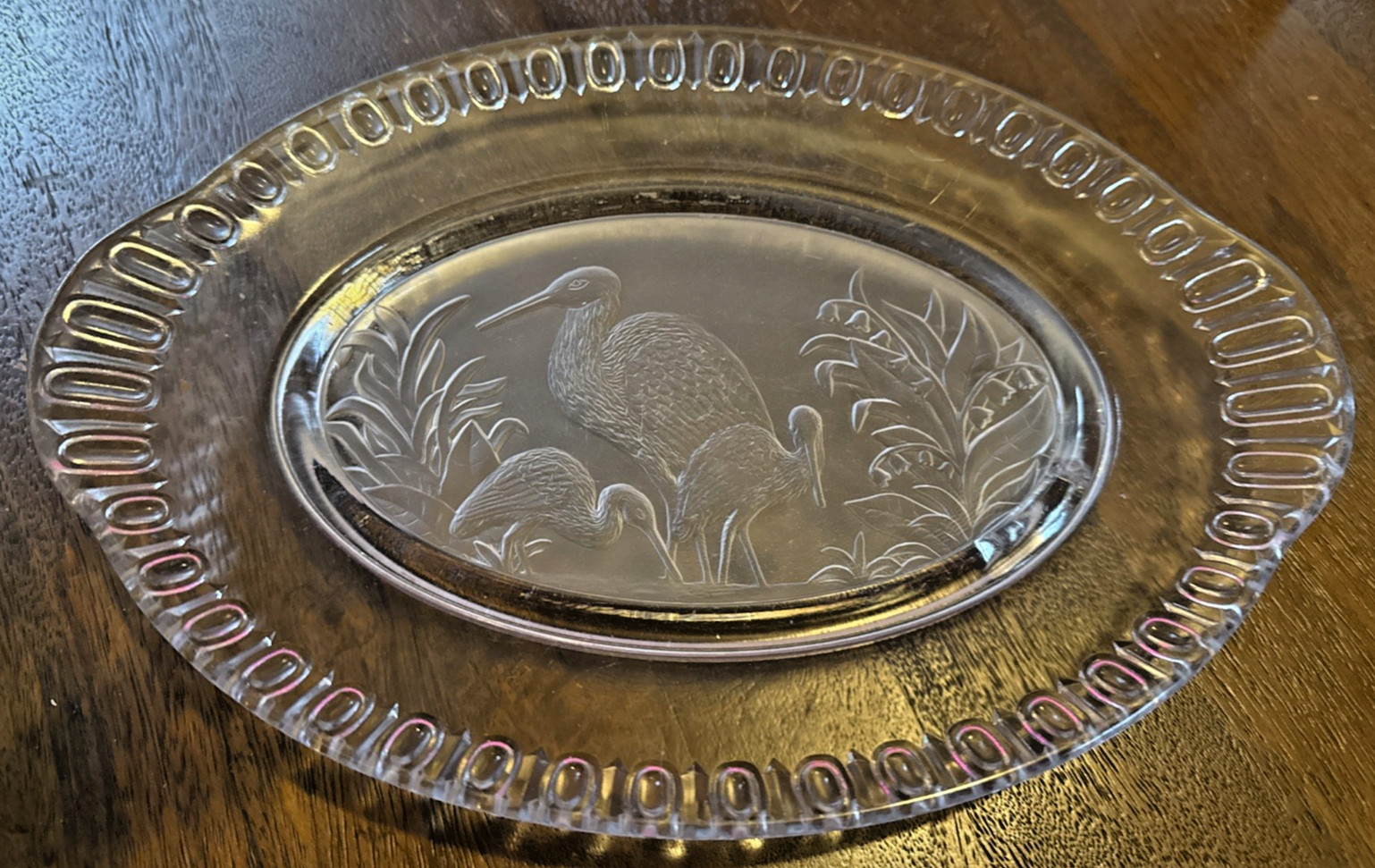
Antique EAPG Iowa City Flint Glass Bread Plate Frosted Stork pattern(AKA Frosted Crane)
This Antique EAPG Iowa City Flint Glass Bread Plate features a beautiful frosted stork and crane pattern, typical of the Victorian era. The oval shape and clear color make it a versatile piece suitable for all occasions. Measuring 12 inches in diameter by 8 in., this vintage collector plate was produced by the Iowa City Flint Glass Co. in 1881-82, showcasing the craftsmanship of the time period. Made of flint glass using a fused glass technique, this piece captures the intricate design and cultural significance of American Victorian style.
The Frosted Stork pattern(AKA Frosted Crane)isone of the characteristic Iowa City pattern pieces depicting long legged fowl, variously called Storks, Herons, or Cranes. Many of the bread plates or platters in different patterns were produced with both the oval and bar borders & handles and a floral or plain border.
The Iowa City Glass Works – 1880-1882.
TheIowa City Flint Glass Manufacturing Companywas incorporated onApril 30, 1880, by a group of ten investors –Ezekiel Clark, W. H. Brainard, J. R. Coulter, Tulloss and Company, E. Shepherd, Samuel J. Hess, E. H. Tracker, L. Y. Parker, A. J. Tucker, andJ. H. Leighton. Leighton – who hailed from West Virginia – was appointed President of the corporation, served as superintendent/manager of the factory, while also adding his skills as a highly-trained glassblower.
J.H. Leightonwas born in Boston, Massachusetts in 1849, and at age 8, moved with his family to Wheeling, West Virginia, where his father opened the New England Glass Works. Here, J.H. grew up learning every aspect of the glass business, opening, for a short time (1874), his own shop before relocating to Martin’s Ferry, Ohio, where he became the head of operations with the Excelsior Glass Works. In 1878, J.H. came west to Iowa, settling first in Keota (Keokuk County), where he opened Keota Glass. When that business proved to be less profitable than he had hoped, Leighton closed the plant in 1879 – moving all the machinery and many of his employees to Iowa City – where he partnered with a team of willing investors – openingIowa City Flint Glass Manufacturing Companyin 1880.
Without a doubt,Iowa City Glass Works (ICGW)had its unique themes, Patterns ran heavily into bird and animal motifs—dogs, cats, rabbits, horses, deer, elephants, cows, sheep, storks or cranes, and small birds.