When you click on links to various merchants on this site and make a purchase, this can result in this site earning a commission. Affiliate programs and affiliations include, but are not limited to, the eBay Partner Network.
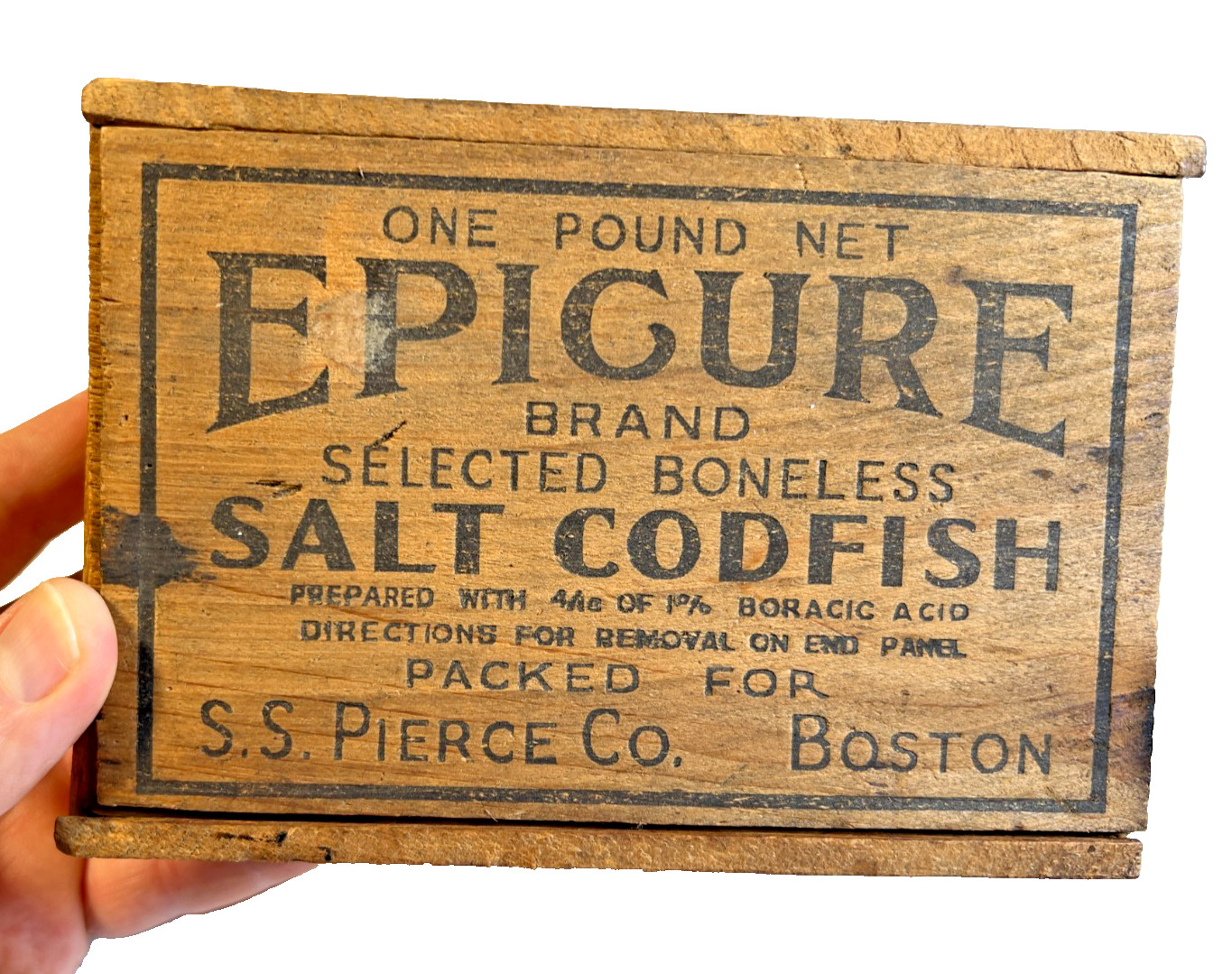
Original EPICURE brand selected boneless salt codfish box, packed for S.S. Pierce Co., Boston.
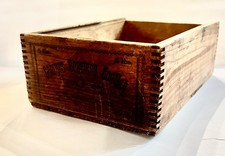
All wood construction with finger-jointed corners, sliding lid, and stenciled advertising and cooking instructions on the end panel.
Dimensions: 6" L × 4" W × 2 1/8" T
Net weight originally: One pound
Dating (with confidence)
Circa 1890s–1910s
Here’s why that range fits:
S.S. Pierce Co. branding in this format is most commonly late 19th to very early 20th century
Wooden food boxes for retail dry goods largely disappear by WWI as paperboard and tins take over
The printed instruction text (“To freshen: soak in cold water…”) reflects a time when prepared foods still assumed home processing
Use of boracic acid (boric acid) as a preservative points to pre-1920 regulation norms
This comfortably puts it Victorian into early Edwardian Boston.
Why this box is especially appealing
Epicure branding – S.S. Pierce’s premium private label
Clear, bold stencil on the lid panel (excellent for display)
Instructional end panel text intact – collectors love readable food directions
Authentic wear and patina – no sanding, no over-cleaning, no nonsense
Compact size = perfect shelf piece, shadow box, or New England kitchen vignette
This is exactly the sort of object that once lived in a Beacon Hill pantry… then somehow dodged the landfill for 120+ years.
Condition
Structurally solid overall
Top interior lip / stop that catches the sliding lid is broken/missing (noted and visible)
Lid still slides, but does not “catch” or stop as originally intended
General age wear, darkening, minor scuffs—all consistent and appropriate
No modern repairs observed
Nothing hidden. Nothing sugar-coated. (Unlike the codfish.)
Historical context
At the turn of the century, salt cod was a staple protein in New England—cheap, shelf-stable, and endlessly adaptable. These one-pound boxes were sold through higher-end grocers like S.S. Pierce, whose customers expected quality even in something as humble as dried fish. This box once held food destined for chowders, fish cakes, and Friday suppers—long before refrigeration made us lazy.