When you click on links to various merchants on this site and make a purchase, this can result in this site earning a commission. Affiliate programs and affiliations include, but are not limited to, the eBay Partner Network.
Antique Fairbanks & Neale Boston Soda Bottle
Howard Street, Boston, Massachusetts | c. 1875–1885
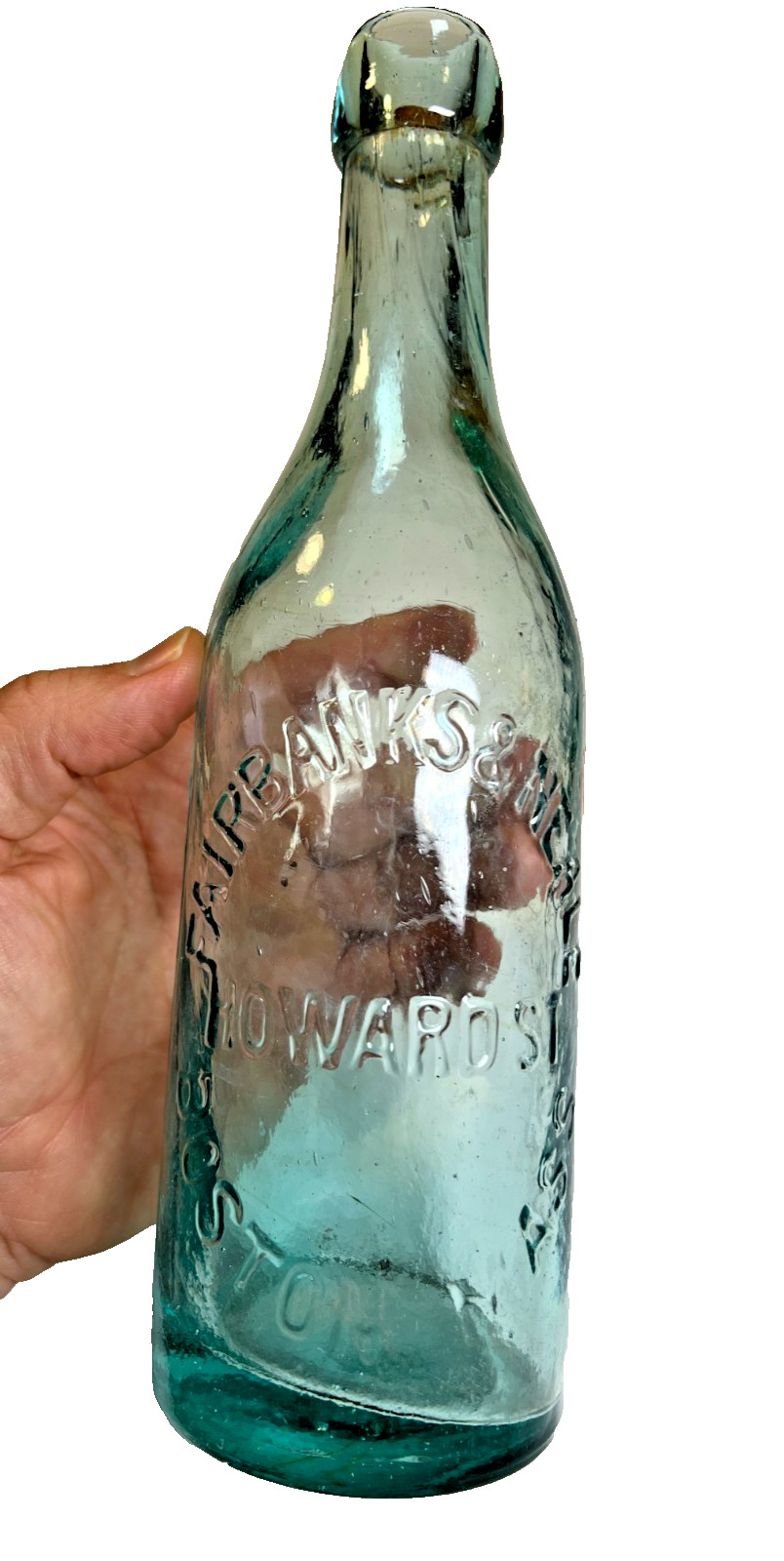
Offered here is an authentic 19th-century Boston soda bottle embossed FAIRBANKS & NEALE / HOWARD ST / BOSTON, standing 9.5 inches tall and blown in a beautiful deep aqua glass. This is a hand-blown, applied blob-top soda, made during the height of America’s early carbonated beverage era—well before crown caps, Hutchinson stoppers, or machine-made uniformity.
What It Contained
During the 1870s–1880s, sodas were not just refreshments—they were medicinal tonics. Bottlers like Fairbanks & Neale produced:
Carbonated mineral water
Fruit-flavored sodas (lemon, sarsaparilla, ginger)
Mild medicinal waters believed to aid digestion and vitality
Carbonation itself was considered therapeutic. Many consumers drank soda daily for health reasons, often prescribed by doctors or pharmacists. These bottles would have been returned, refilled, and reused, carried in heavy wire crates that explain the faint rust transfer visible around the neck.
Physical Characteristics & Manufacture
This bottle shows textbook early hand-blown characteristics:
Applied blob top with a soft, “still-warm” appearance
Elongated twist striations in the neck, a beautiful hallmark of hand tooling
Crude, uneven base—notably thicker on one side than the other
Smooth base with a faint mold ring, consistent with late 19th-century manufacture
Rich aqua glass with natural waviness and subtle inclusions
The faint interior ring visible on the backside is not a contents line, but rather a manufacturing artifact from uneven cooling and glass density—exactly the kind of imperfection collectors expect (and appreciate) in bottles of this age.
Condition
Overall condition is very good for a Boston soda approaching 150 years old.
Life in Boston When This Bottle Was Made
This bottle dates to a fascinating moment in American history:
Ulysses S. Grant, Rutherford B. Hayes, and James A. Garfield occupied the White House during this general period
Boston streets were crowded with horse-drawn wagons, gas lamps, and iron storefronts
Ice was harvested from New England ponds and rivers to keep beverages cold
Telegraph lines crisscrossed the city, but electricity was still experimental
Germ theory was only beginning to influence medicine
Howard Street sat within Boston’s industrial and commercial core—close to warehouses, docks, and dense residential neighborhoods. Bottlers like Fairbanks & Neale served a rapidly growing urban population hungry for modern conveniences and “scientific” refreshments.