When you click on links to various merchants on this site and make a purchase, this can result in this site earning a commission. Affiliate programs and affiliations include, but are not limited to, the eBay Partner Network.
c.1850s G.P.O.B. General Post Office Open Pontil Bottle — Early Government Utility Glass
Long before telephones or instant communication, the postal system carried the weight of the modern world. Every contract, newspaper, personal letter, and government order moved by hand through vast sorting offices lit by gaslight — and on those desks sat working bottles like this one.
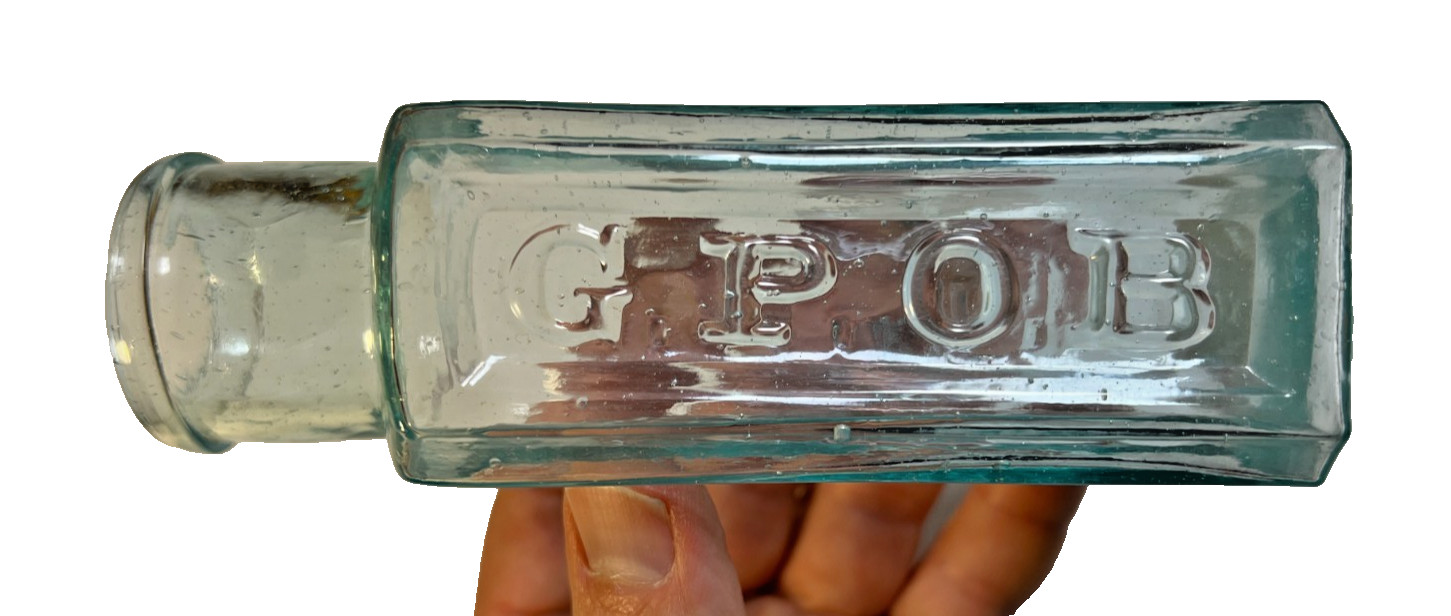
Offered here is a beautiful mid-19th century aqua glass bottle boldly embossed G.P.O.B., widely understood to denote General Post Office property, produced during the great expansion of the British postal system in the 1850s.
Standing 5⅛ inches tall, this is a classic early hand-made example featuring:
Condition is excellent — no chips or cracks, with outstanding shelf presence and character.
Why the G.P.O.B. Mark Matters
Unlike commercial medicine bottles covered in product advertising, this example carries only institutional initials. In the mid-1800s the General Post Office operated one of the largest bureaucratic systems in the world, supplying thousands of depots with standardized equipment.
Durable, reusable items were commonly marked as government property for inventory control. Rather than branding contents, markings identified ownership and object type. The additional letter following G.P.O. is best understood as a classification suffix — indicating the bottle itself as departmental equipment rather than a disposable commodity.
Consumables such as paper or ink were used up and rarely marked, but bottles were refilled and reused repeatedly, making clear identification practical and necessary.
The secondary initials on the opposite panel (CCW) likely reference a contractor / supplier, while the prominent G.P.O.B. embossing firmly anchors the bottle in postal service use.
How Victorian government marking actually worked
The British General Post Office (GPO) was one of the largest administrative organizations on earth by the 1850s. They managed:
mail
telegraph systems
equipment depots
stationery supply
chemical stores
uniforms and tools
To control inventory, departments used abbreviation + object designation markings on durable goods.
You see this across surviving artifacts:
tools stamped with department initials
locks, lanterns, scales, and mailbags marked with service abbreviations
glass, ceramics, and metalware marked for institutional ownership
The goal wasn’t branding — it was property control.
Did they really add a letter like “B” for Bottle?
Yes — and not just in postal contexts.
Victorian institutional marking commonly used:
Examples from various British services include suffixes meaning:
They weren’t standardized nationally — each procurement office had some freedom — but the pattern is historically normal.
Imagine It in Use
Picture a busy sorting office around 1855. Rail mail sacks arrive hourly. Clerks stand at long wooden counters addressing ledgers, sealing envelopes, and preparing outgoing correspondence bound for cities across Britain and beyond. Ink, adhesive, or sealing solutions were kept close at hand in sturdy bottles meant for constant daily use — tools of communication rather than decoration.
This was infrastructure glass — handled, refilled, and relied upon as the world became newly connected.
Life When This Bottle Was Made
When this bottle was blown:
The Uniform Penny Post had recently transformed communication, allowing ordinary people to send letters affordably for the first time.
Railroads and steamships were shrinking travel and accelerating mail delivery.
The electric telegraph was emerging alongside traditional post, beginning the first communications revolution.
Medicine was shifting from folk remedies toward chemical science, though antiseptic surgery was still years away.
Queen Victoria presided over rapid industrial growth that reshaped daily life across Europe and America.
Objects like this quietly supported that transformation.
A superb open pontil survivor with strong embossing and authentic mid-Victorian character — an excellent addition to any early glass, postal history, or institutional antique collection.
Most likely contents: mucilage (envelope adhesive)
That’s the best-supported practical answer.
Why mucilage fits better than anything else
1. Bottle size
At about 5⅛\" tall, this is a small desk-scale container — not bulk storage and not medicine distribution size. It matches containers meant to sit within arm’s reach of a clerk.
2. Narrow mouth + rolled lip
Designed for controlled pouring or dipping, not drinking or dosing. Adhesive and ink bottles commonly used this finish to reduce spills.
3. Institutional embossing
A reusable supply item makes sense. Mucilage bottles were refilled constantly in offices and needed to remain government property.
4. Postal workflow reality
By the 1850s, the Penny Post caused an explosion in mail volume. Workers were:
Large sorting offices consumed adhesive continuously.
Why NOT ink (less likely)
Ink is often suggested, but:
Ink bottles more commonly have wider mouths for dipping pens.
Ink containers were frequently replaceable consumables rather than tracked property.
Ink stains interiors heavily — many surviving GPOB bottles show cleaner interiors consistent with adhesive or solution storage.
(Not impossible — just second place.)
The practical mental picture
A postal clerk around 1855 isn’t delicately dosing medicine — he’s processing hundreds of letters per shift. A small, sturdy, refillable bottle of adhesive sitting beside ledgers and stacks of envelopes makes operational sense.
So if forced to rank:
Mucilage / envelope adhesive — most likely
Writing ink — plausible
General office chemical — possible
Medicine — unlikely
Where “percha oil” came from?!1) Confusion with gutta-percha
- Gutta-percha was a rubbery plant-derived material used heavily by the GPO for:
- insulating telegraph wires
- waterproofing cables
Collectors saw “GPO” + “weird old material” and made the leap:
“Ah—must be something to do with gutta-percha… maybe an oil?”
Problem:
Gutta-percha wasn’t stored or used as a liquid oil in office bottles like this.
2) The word “mucilage” confused people
Victorian labels often said things like:
- “Adhesive preparation”
- sometimes nothing at all
To modern ears, that sounds vague… even chemical-ish.
So over time:
- “mucilage” → “some kind of compound” → “maybe industrial” → “percha oil?”
Classic telephone-game effect.
3) Early dealer catalogs (the real culprit)
In the mid-20th century, some antique dealers and bottle guides:
- guessed at contents
- or used fancier-sounding terms to boost appeal
“Percha oil” sounds:
- rarer
- more industrial
- more valuable
…and it stuck. Once it appeared in print, it propagated like a Victorian rumor mill.
4) Shape misinterpretation
These bottles:
- are small
- rectangular
- sometimes thick glass
That looks more “chemical reagent” than “office glue” to modern eyes.
But historically:
desk bottles often looked exactly like this
Reality check
There’s no solid historical documentation showing:
- GPO distributing “percha oil” in these bottles
- or using such bottles for telegraph material processing
There is strong evidence they were:
- desk-use glue bottles in postal offices
Why the myth won’t die
Because it’s a perfect storm:
- sounds exotic
- vaguely connected to real GPO tech (gutta-percha cables)
- repeated in listings for decades
Bottom line
Your bottle is:
A genuine 19th-century British GPO mucilage (glue) bottle
Not:
a mysterious Victorian “percha oil” vessel from a telegraph lab
Though to be fair—“postal glue bottle” just doesn’t have the same Indiana Jones energy.