When you click on links to various merchants on this site and make a purchase, this can result in this site earning a commission. Affiliate programs and affiliations include, but are not limited to, the eBay Partner Network.
Bibelotslondon Ltd is a UK registered company based in London Bridge dealing in ephemera and curiosities from Britain and around the world. Our diverse inventory is carefully chosen and constantly evolving. We work very hard to offer the highest quality works at competitive prices. Our inventory is listed online, and we strive to keep our website completely up to date, so our customers can easily check availability. We believe in offering clients items that are unique and rare for aficionados of the antique and collector\'s world.Bibelot is a late nineteenth century word derived from the French word bel ‘beautiful’, meaning a small item of beauty, curiosity or interest.The word ephemera is derived from the sixteenth century Greek word ephmera meaning a printed or hand written paper not meant to be retained for a long period of time.
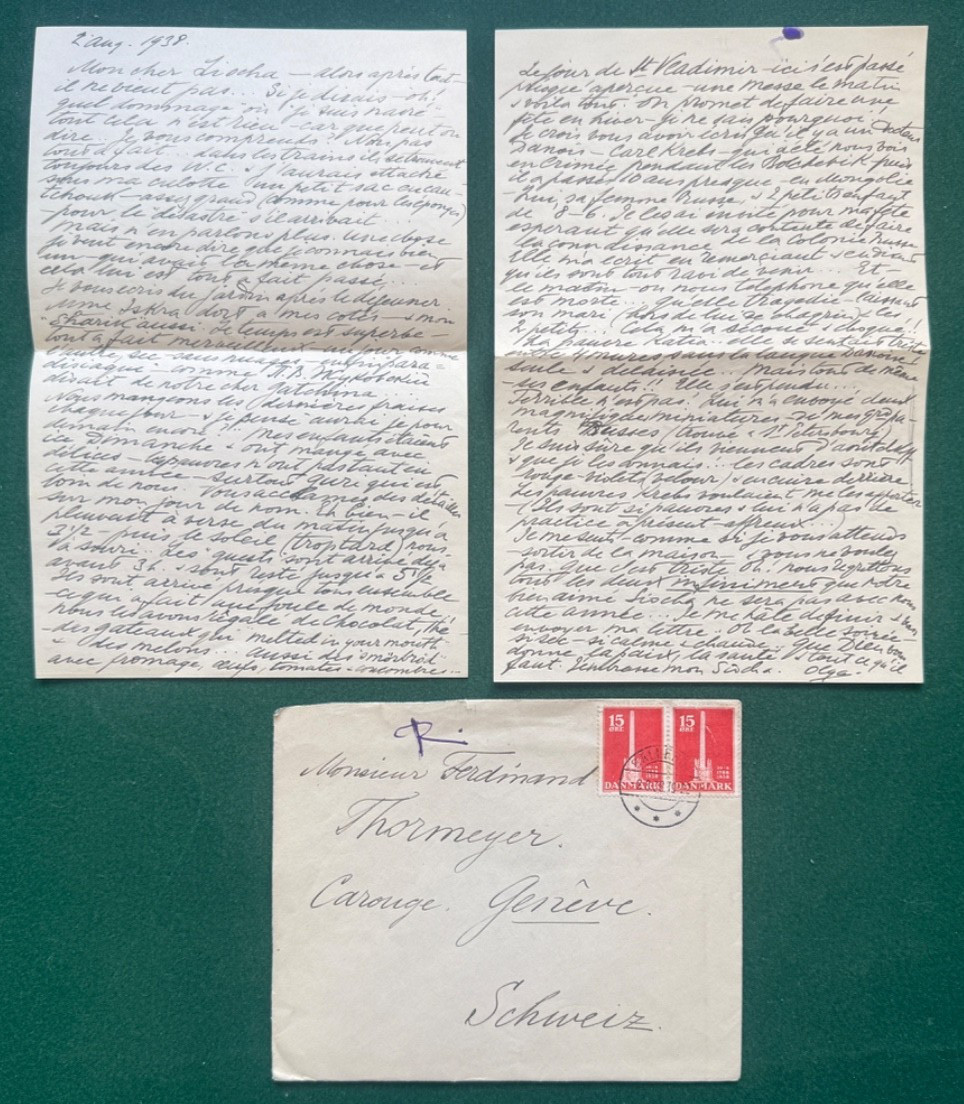
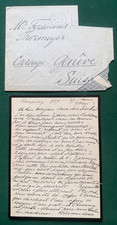
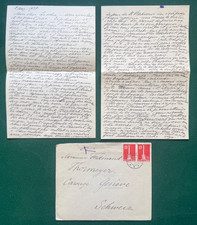
Fine antique signed letter from Grand Duchess Olga Alexandrovna (1882-1960), dated 2nd August 1938 addressed to her beloved former tutor Ferdinand Thormeyer (1858-1944), known as Siocha, a rather humorous start discussing the difficulty of no toilets on a train when someone like Siocha who is unwell and needs to use the lavatory, she continues comparingthe weather to Gatchina, discussing her children and their daily activities, her painting, her cousin Missy from Romania, visitors to her home, and being given two miniatures of her Russian grandparents which she believed were originally housed in the Anichkov Palace, it is accompanied by its original envelope.
\"My dear Siocha,
So, after all, he is not coming… If I were to say, “Oh, what a pity,” or “I am heartbroken,” none of that would express it—for what can one say? I understand you. No, not entirely… On trains there ought always to be lavatories. I would have fastened beneath my bloomers a little rubber bag—large enough, like those used for sponges—to relieve oneself into… But let us speak of it no more. One thing I can tell you is that I know very well a man to whom this trouble no longer happens: it has completely passed.
I am writing to you in the garden after luncheon. [One of the dogs] is sleeping beside me, and so is my “Sharik.” The weather is superb—truly marvellous, a little like autumn: dry, cloudless, in short, “paradisiacal,” as P. B. Zhukovsky used to describe our dear Gatchina.
We are eating the last strawberries each day, and I wonder: “Will there be any left for tomorrow?” My children were here on Sunday and ate them with delight. We have not had so many strawberries this year—especially Guri, who is very good at obtaining some for us from the shops.
Oh yes—it poured with rain from the morning until half past two; then the sun came out, too late for the party. The guests began arriving before three and remained until half past five. They nearly all arrived together, creating a great crush of people. We had chocolate, tea, cakes which “melted in your mouth,” melons, and alsosmørrebrødwith cheese, tomato, salmon, and so forth. We always provide those because I find it dreadful when, in some houses, one is given nothing but sweet delicacies!
The Van der Vliets were very pleased. Their younger son, Rompya, aged thirty, has returned from Paris after nine years in South Africa. He left when he was a young boy, about Tikhon’s present age. He brought me a little bag of coffee from his own plantations.
There were a great many elderly ladies, including a poor young blind woman who was absolutely determined to come with her mother. She brought a young Russian man with her. Petrusha, who is very naïve, was also at the house. He can be extremely amusing and talks very animatedly. I must say that it is easier for him here, because one sees such a crowd of people. I do not like it when someone sits awkwardly with us… At home I like to relax completely, to be among ourselves in a dressing gown and nothing more! Naturally, it is easier to go to one’s own room for tea or a snack—one can put one’s feet up!
I am touched that my little watercolour has found a place upon your table.
This morning I began the same subject, but on a much larger scale. Throughout this week I shall have to work hard. I have produced about sixty pictures—seven of them fairly large watercolours—with a view to holding an exhibition in London next year with Mr Kaigorodoff\'s son, and perhaps also in Holland and Norway in the autumn.
It is always a risk—but if one risks nothing, one gains nothing…
We have eatenvarenikiwith cherries andsmetana, etc. Ah, they were exquisite! At present we are enjoying the cherries. The birds have left enough for us.
My friend Alfred sometimes brings me vareniki and smetana oh how exquisite. We are expecting two strangers for tea—I shall tell you about them afterwards.
There! He is a fairly young Russian, Volkov-Muramtsovrelated to Countess Heyden, and very likeable. He is spending his holiday here with a Danish family. The Danish girl lived for a year in London with his family. Goodness, how much tea they drank—four or five cups! I showed them the garden and the dogs, and then made xxx. It is already six o’clock, and I am continuing my letter.
Thank you, dear Siocha, for having “thought a great deal” about me and prayed to God. I reread your letter and once again feel sorrow.
As I wrote to you, Tikhon was alone on Sunday. We telephoned to congratulate him and asked whether there would be cakes! We sent him a cake—meringue and coffee, mocha—which pleased him enormously.
I have not seen my cousin Missy from Romania since 1913, that winter when she came to St Petersburg with her husband and son.
My husband is feeling very well and does not become tired. Even his days travelling by railway do not hurt either his legs or his back. It is extraordinary.
The feast day of Saint Vladimir passed here without anything happening—only a Mass in the morning, and that was all. They promise to hold a celebration in the winter; I do not know why!
I believe I have written to you about a Danish doctor, Carl Krebs, who came to see us in the Crimea during the Bolshevik period. Afterwards he spent nearly sixteen years in Mongolia, with his Russian wife and their two small children, aged nine and six.
I invited them for the middle of October, hoping that she would be pleased to make the acquaintance of the Russian colony. She wrote to thank me, saying that they were all delighted to come—and this morning we received a telephone call saying that she had died. What a tragedy, leaving her husband, who is beside himself with grief, and those two little children! It has shaken me terribly.
She must have felt so terribly alone and abandoned… but still, those children! She caught cold… Terrible, is it not?
He sent me two magnificent miniatures of my Russian grandparents, which he found in St Petersburg. I am certain that they came from the Anichkov Palace and that I know them. Their frames are of reddish-violet velvet, with leather backs. The poor Krebs family had wanted to bring them to me themselves—they live twenty-four hours away, so it was hardly practical—and now they are arriving…
I feel as though I am waiting for you to come through the door of the house—but you do not come. How sad it is! Oh, we both regret infinitely that our beloved Siocha will not be with us this year.
I am hurrying to finish and send you my letter. Oh, what a beautiful pink evening—so calm and warm. May God grant you peace and health, and everything you need.
I embrace my Siocha.
Olga\"
Size of Envelope: 12 x 15 cm approx