When you click on links to various merchants on this site and make a purchase, this can result in this site earning a commission. Affiliate programs and affiliations include, but are not limited to, the eBay Partner Network.
A SPECTACULAR PIECE OF PRE–CIVIL WAR NEW YORK—BOLD, BRILLIANT COBALT AND DATED 1848!
There are early soda bottles—and then there are bottles that command the entire shelf.
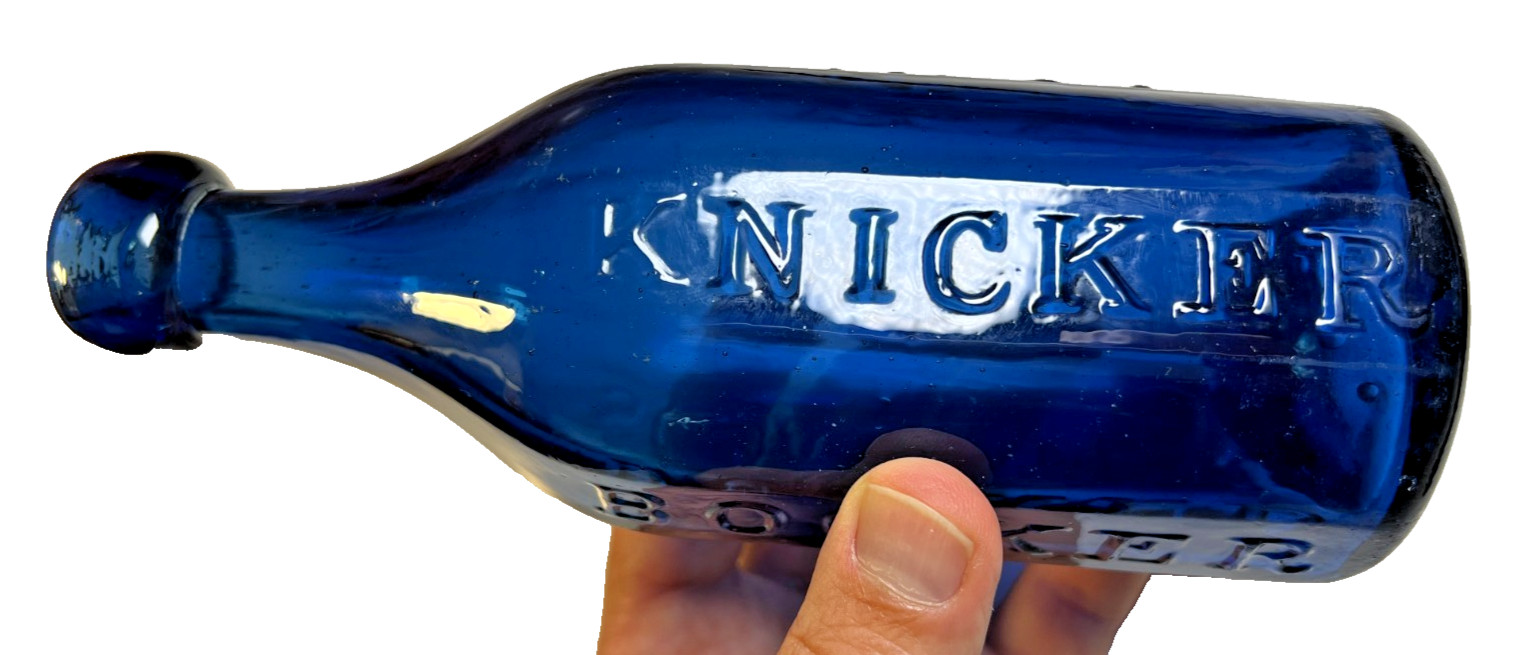
This remarkable W. P. Knickerbocker Soda Water is one of those unmistakable “front-row” bottles: intensely colored cobalt-blue glass, a dramatic ten-sided body, bold panel embossing, a crude hand-applied blob top, and a genuine iron-pontil base. Even before the inscription is read, its color and sculptural form announce that this is something special.
More than 175 years old, it survives in exceptionally fine condition and presents with the visual power collectors hope to find—but seldom do.
BOLD TEN-PANEL EMBOSSING
Strongly embossed on alternating sides:
W. P.
KNICKER
BOCKER
SODA WATER
164 18TH ST. N.Y.
1848
Rather than placing the wording on one flat panel, the mold carries the inscription around the bottle, encouraging it to be turned and examined from every direction. The deep cobalt glass, crisp lettering, and sharply defined facets work together beautifully.
THE WILLIAM POND CONNECTION
The initials W. P. are associated with New York bottler William Pond, who produced soda and mineral waters from 164 West 18th Street in New York City.
Both William Pond and fellow bottler Samuel Smith are known to have used the Knickerbocker name and the same 18th Street address. This suggests that the address may have functioned as a shared bottling establishment during the great early period of New York’s sided soda and mineral-water bottles.
The present bottle is the desirable ten-sided cobalt-glass William Pond variety, boldly dated 1848.
WHY “KNICKERBOCKER” IS SUCH A GREAT NEW YORK NAME
The Knickerbocker name reaches far beyond the bottle-collecting community. It is one of the most enduring names associated with New York itself.
Washington Irving—the celebrated American author of “The Legend of Sleepy Hollow” and “Rip Van Winkle”—used the fictional Dutch historian Diedrich Knickerbocker as the supposed author of his enormously popular 1809 satire, A History of New York. The character became so closely identified with the city’s Dutch heritage that “Knickerbocker” eventually became a familiar nickname for a New Yorker.
By the time this bottle was made, the name already carried powerful associations with old New York, Dutch heritage, local pride, tradition, and authenticity. “Father Knickerbocker” became a personification of the city, much as Uncle Sam came to represent the nation.
The name continued to appear throughout American culture—in newspapers, hotels, clubs, clothing, beer, literature, and sports. Most famously, New York’s professional basketball team adopted the name New York Knickerbockers, quickly shortened to the New York Knicks.
That makes the embossing on this bottle immediately recognizable even to people who have never collected antique glass. It is not merely a bottler’s trade name—it is a name woven into the identity and mythology of New York City.
NEW YORK CITY IN 1848
This bottle was made during a thrilling and turbulent period in New York history.
Manhattan was expanding rapidly northward, but much of the city still lay below 14th Street. The address embossed on this bottle—164 West 18th Street—was in a comparatively new and developing part of town. Horse-drawn omnibuses, carts, delivery wagons, and pedestrians filled streets that were often crowded, noisy, muddy, and uneven.
There were no automobiles, electric streetlights, telephones, subways, or modern refrigeration. Most goods moved by horse, wagon, canal boat, sailing ship, or the still-expanding railroad system. News traveled through printed newspapers, letters, telegraph offices, and conversation in hotels, taverns, shops, and public markets.
New York was becoming America’s great commercial gateway. Ships arrived constantly with immigrants, manufactured goods, food, and news from Europe. Broadway was bustling, P. T. Barnum’s American Museum was one of the city’s great attractions, and the wealthier families of New York were moving northward into fashionable new neighborhoods.
Against that backdrop, a brilliantly colored bottle of commercially prepared soda or mineral water would have been an attractive and comparatively sophisticated product.
AMERICA IN THE YEAR 1848
The date molded directly into the glass places this bottle at an extraordinary moment in American history.
In 1848:
The Mexican-American War formally ended with the Treaty of Guadalupe Hidalgo.
Gold was discovered at Sutter’s Mill in California, setting the great Gold Rush in motion.
The first major women’s-rights convention met at Seneca Falls, New York.
James K. Polk was president of the United States.
Zachary Taylor was elected president later that year.
The country contained only 30 states.
The Civil War was still thirteen years away.
While thousands would soon head west in search of gold, this bottle was being filled and circulated in a rapidly growing New York City—possibly passing through the hands of a bottler, deliveryman, shopkeeper, hotel proprietor, or customer before somehow surviving into the modern world.
It is a tangible survivor from an America still connected by horses, sailing vessels, canals, and early railroads.
SODA WATER BEFORE THE MODERN BOTTLE
Carbonated soda and mineral waters were luxury-adjacent commercial products in the 1840s. They were sold for refreshment, but mineral waters were also promoted as healthful and restorative.
The pressure created by carbonation demanded a sturdy bottle. This example was blown in a mold, removed using a pontil rod, and finished individually by hand. Its thick glass, rounded shoulders, and substantial applied blob top helped it withstand internal pressure and repeated handling.
Unlike later machine-made bottles, no two early examples are precisely alike. The character of this bottle remains visible throughout:
Rich variations in the cobalt-blue glass
Attractive whittling and surface texture
Scattered tiny bubbles from manufacture
Slight irregularities in the hand-applied top
Strongly defined mold panels
A genuine iron-pontil scar on the base
These are not defects—they are the fingerprints of early American glassmaking.
EXCEPTIONAL COBALT COLOR
The color is magnificent: a saturated, electric cobalt blue that glows brilliantly when placed near natural or artificial light.
Cobalt is among the most visually desirable colors in early American bottles, and this example has the depth and intensity needed to anchor an advanced display. The color accentuates every facet, ripple, bubble, and embossed letter.
This bottle does not disappear into a collection. It becomes the centerpiece.
OUTSTANDING CONDITION
Condition is one of this bottle’s greatest strengths.
It displays near mint, with brilliant color, glossy glass, strong embossing, and an exceptionally attractive overall presentation. Considering its age, fragile applied top, and original use as a pressurized beverage container, its survival in this condition is remarkable.
The applied blob top has a slender vertical manufacturing flash line. This line is completely smooth, cannot be felt with a fingertip, and is part of the original manufacture—it is not a crack, fracture, or later damage. Close photographs are included for complete disclosure.
The iron-pontil scar is clearly visible on the base - no metallic residue remains.
Please examine all photographs carefully, as they are part of the description and show the bottle’s condition, color, embossing, handwork, and manufacturing character in detail.
MEASUREMENTS AND DETAILS
Maker/Bottler: William Pond
Trade Name: Knickerbocker
Location: 164 West 18th Street, New York City
Date: Circa 1848
Height: 7 1/2\"
Color: Rich cobalt blue
Form: Ten-sided or decagonal
Lip: Crude hand-applied blob top
Base: Iron-pontil scar; metallic residue no longer present
Contents: Soda water or carbonated mineral water
Condition: Excellent; displays near mint
A TRUE FRONT-ROW BOTTLE
This example brings together virtually every feature sought in an important early soda:
Dated 1848.
New York City address.
Historic Knickerbocker name.
William Pond attribution.
Brilliant cobalt color.
Ten-sided body.
Strong embossing.
Applied blob top.
Iron pontil.
Exceptional condition.
It offers more than visual beauty. It connects early American glassmaking, the birth of the bottled soda industry, Washington Irving’s legendary New York symbolism, and daily life in Manhattan on the eve of the Gold Rush and little more than a decade before the Civil War.
A scarce, highly displayable survivor and an outstanding addition to any serious collection of early American glass, pontiled soda bottles, cobalt bottles, New York City advertising, or pre–Civil War Americana.
A spectacular piece of old New York—and unquestionably a front-row bottle.