When you click on links to various merchants on this site and make a purchase, this can result in this site earning a commission. Affiliate programs and affiliations include, but are not limited to, the eBay Partner Network.
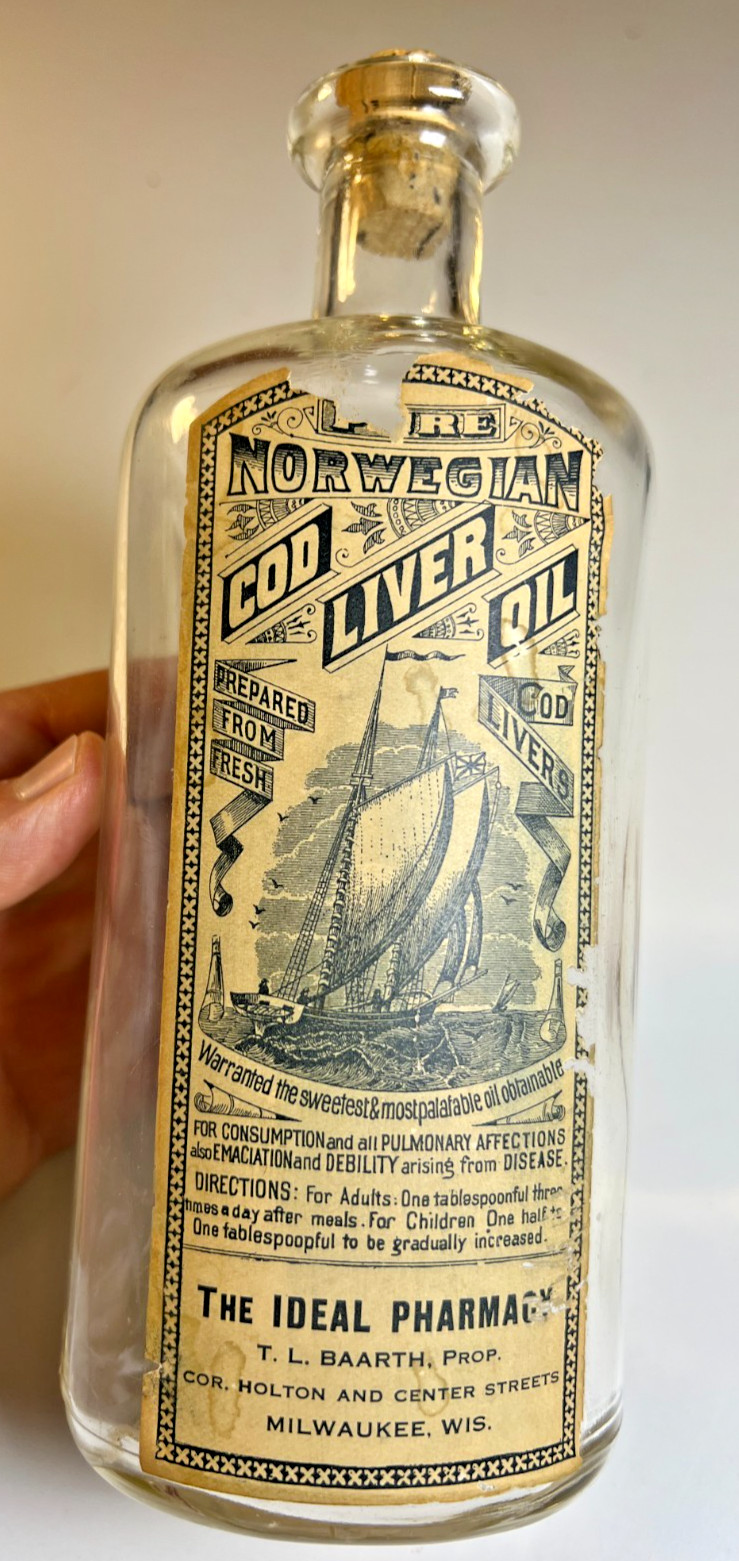
Dating to approximately 1922–1925, with circa 1923 the best single-year estimate, this remarkable bottle originally contained Norwegian Cod Liver Oil prepared for The Ideal Pharmacy, operated by T. L. Baarth at the corner of Holton and Center Streets in Milwaukee, Wisconsin.
Standing approximately 8 inches tall, the clear machine-made bottle retains both its original cork and wonderfully graphic original paper label. The label is dominated by an elaborate engraving of a sailing vessel crossing rough northern waters, surrounded by bold diagonal lettering, decorative flourishes and the wonderfully optimistic assurance that this was:
“The sweetest & most palatable oil obtainable.”
The combination of the imposing ship, Norwegian imagery, extensive medical claims and precisely identified Milwaukee pharmacy makes this far more interesting than the ordinary labeled drugstore bottle.
The Ideal Pharmacy and the Baarth Family
Milwaukee’s 1919 city directory records the Baarth family operating the Ideal Pharmacy at 1039 Holton Street, corner of Center Street. By that year, the business was incorporated, with Robert H. Baarth serving as president, Richard Baarth as vice president and Otto Baarth as secretary-treasurer. A second Ideal Pharmacy location operated at 27th and Center.
The surviving label identifies T. L. Baarth as proprietor, connecting this particular preparation directly with the pharmacy rather than with a nationally distributed medicine manufacturer.
Neighborhood pharmacies of this period did considerably more than fill prescriptions. Pharmacists compounded medicines, prepared their own branded remedies and sold tonics, medicinal oils, cough preparations, toiletries and household necessities. To many working families, the neighborhood pharmacist was also the most accessible source of everyday medical advice.
What It Contained
The bottle held cod-liver oil made from the livers of cod caught in northern waters. Although notorious for its oily texture, strong odor and lingering taste, cod-liver oil was widely administered to children, invalids and people recovering from prolonged illnesses.
The label advertised this preparation:
- “For consumption and all pulmonary affections”
- For emaciation
- For debility arising from disease
- As being prepared from fresh cod livers
“Consumption” was the common period name for tuberculosis. Cod-liver oil could not cure tuberculosis, but its calories and naturally occurring vitamins A and D could provide valuable nutritional support to undernourished patients. During the early 1920s, however, pharmacists frequently promoted it in much broader curative language.
Adults were directed to take one tablespoonful three times daily after meals. Children were to begin with one-half tablespoonful and gradually increase the dose.
Marketing the Taste of the North Atlantic
The label’s marketing was carefully designed to overcome cod-liver oil’s greatest obstacle: practically nobody enjoyed taking it.
Calling the oil “Norwegian” suggested cold, clean northern waters, freshly caught cod and a superior imported product. The large sailing ship reinforced that maritime identity before a customer read a single word.
The claim that it was the “sweetest & most palatable oil obtainable” addressed the medicine’s unpleasant reputation directly. Whether any cod-liver oil could honestly be called sweet is another matter—the advertising department was clearly feeling courageous.
Unlike a nationally distributed patent medicine, this was a private-label pharmacy preparation bearing the store’s name, proprietor and exact Milwaukee intersection. That local specificity adds considerably to its historical and collecting interest.
The Bottle and Its Manufacturer
The base is embossed:
811 / T Inside an Inverted Triangle / 4
Because this is a medicine bottle rather than a milk bottle, the triangle-T trademark identifies the Turner Brothers Glass Company of Terre Haute, Indiana. Turner registered the trademark in 1925 and stated that it had been continuously used since January 1, 1920.
The other markings are interpreted as:
- 811: Bottle-design, catalog or mold number
- 4: Individual mold or machine-cavity number
Neither number represents the manufacturing year. The Turner trademark, machine-made construction, cork finish, pharmacy history and label design collectively support a date of approximately 1922–1925, most likely circa 1923.
Life in Milwaukee Around 1923
When this bottle stood on an Ideal Pharmacy shelf, Milwaukee was a rapidly growing industrial city with approximately half a million residents. Streetcars carried workers between tightly settled neighborhoods and the city’s breweries, foundries, tanneries, machine works and factories.
The city was led by Socialist mayor Daniel Hoan, who served from 1916 through 1940. His administration emphasized honest municipal government, public sanitation, water purification, street improvements, harbor development and housing reform. Milwaukee’s Garden Homes development, established in 1923, became the country’s first municipally sponsored public-housing project.
This was also the height of Prohibition. Milwaukee’s famous brewing companies were forced to survive by producing near beer, soda, malt products, cheese and other substitutes. Speakeasies and bootlegging flourished even as authorities attempted to enforce the new laws.
Milwaukee was simultaneously rebuilding its lakefront and harbor. The city established its Board of Harbor Commissioners in 1920, and Wisconsin transferred submerged lakefront property to Milwaukee in 1923 for the construction of expanded harbor facilities. That maritime expansion provides an especially fitting historical setting for the great sailing ship pictured on this label.
Condition
Approximately 8 inches tall.
Clean overall with its original paper label and original cork still present. The glass has no chips, no cracks, no haze and no scratches observed.
A small patch of dried original contents remains on the upper front shoulder immediately above the label. There is faint settled dust on the interior floor.
The label retains excellent dark printing, strong contrast and a particularly impressive sailing-ship illustration. It shows expected age toning, edge wear and scattered paper loss, including an irregular loss across the upper portion. Despite these losses, the principal graphics, product name, medical claims, proprietor and Milwaukee address remain remarkably strong and readable.