When you click on links to various merchants on this site and make a purchase, this can result in this site earning a commission. Affiliate programs and affiliations include, but are not limited to, the eBay Partner Network.
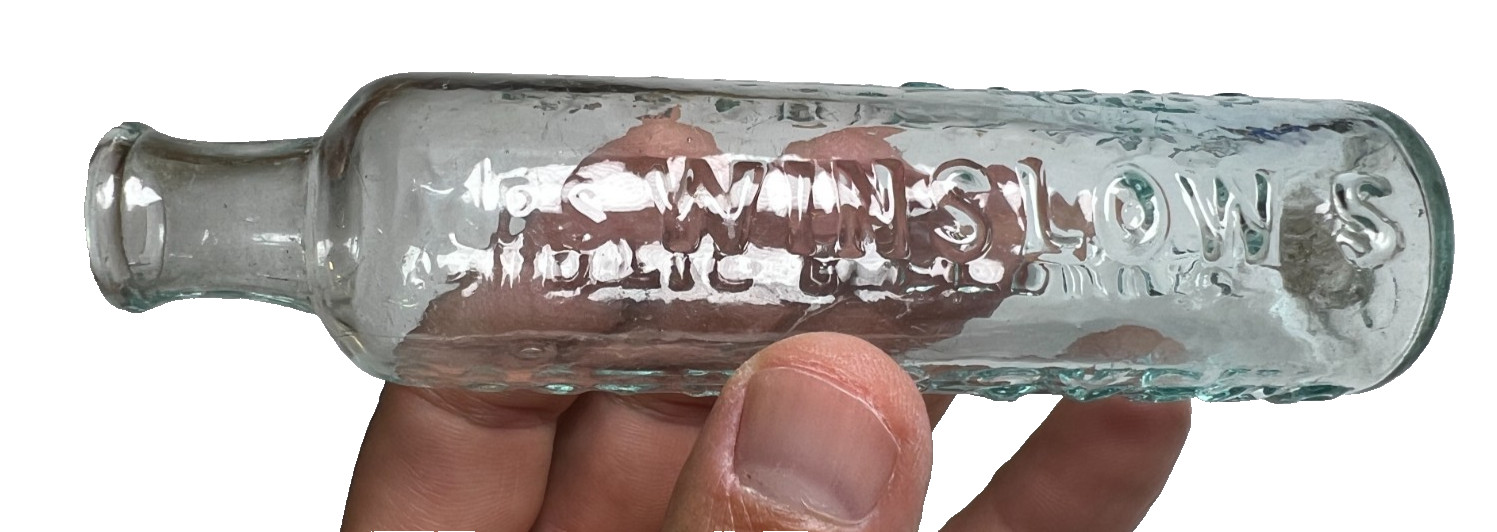
MRS. WINSLOW'S SOOTHING SYRUP
CURTIS & PERKINS
PROPRIETORS
Standing approximately 4 7/8 inches tall, the bottle is in outstanding attic-found condition. The glass is bright, clean, and highly reflective with beautiful hand-made character throughout. It has no chips, no cracks, and no scratches, making it an exceptional survivor from the early years of America's patent medicine industry.
Date
Circa 1852-1857
The combination of:
- Open pontil scar
- Applied rolled lip
- Heavy whittled glass
- Curtis & Perkins embossing
places this among the earliest embossed Mrs. Winslow's bottles known.
City & State
Portland, Maine
The bottle was produced for Curtis & Perkins, the Portland firm that introduced Mrs. Winslow's Soothing Syrup in the early 1850s.
About Curtis & Perkins
Curtis & Perkins were among Maine's most successful nineteenth-century patent medicine manufacturers. From Portland they transformed Mrs. Winslow's Soothing Syrup into one of the world's best-known proprietary medicines.
Their advertising campaign became enormous, utilizing newspapers, almanacs, trade cards, pharmacy displays, calendars, and multilingual advertisements. By the late nineteenth century the product was sold throughout the United States, Canada, Great Britain, Australia, and many other countries.
Early bottles like this proudly identify Curtis & Perkins, Proprietors. Later examples often dropped the proprietors' names entirely as the Mrs. Winslow's brand itself became internationally recognized.
What Was Mrs. Winslow's Soothing Syrup?
Marketed as a gentle remedy for teething infants, the syrup promised relief from:
- Teething pain
- Colic
- Restlessness
- Diarrhea
- Sleeplessness
- Crying
Parents believed it safely soothed fussy babies. In reality, its effectiveness came largely from its narcotic content.
Why Is It Called the "Baby Killer"?
Mrs. Winslow's Soothing Syrup has become one of the most infamous patent medicines ever produced.
Early formulations contained morphine sulfate, along with alcohol and other ingredients. The morphine sedated infants so effectively that generations of parents believed the medicine was miraculous. Tragically, many babies suffered respiratory depression, overdose, and death after repeated doses.
While the exact number of fatalities can never be known, the product became a symbol of the dangers of unregulated patent medicines and helped fuel public demand for consumer protection laws. The 1906 Pure Food and Drug Act eventually required manufacturers to disclose dangerous ingredients such as morphine on product labels, forever changing the American pharmaceutical industry.
Life During the Period (1852-1857)
This bottle was made during one of America's most transformative decades.
Medicine
- No FDA or federal drug regulation.
- Patent medicines flourished with extravagant claims.
- Physicians commonly prescribed opium, mercury, and alcohol-based remedies.
- Germ theory had not yet gained acceptance.
Technology
- Railroads rapidly connected the Northeast.
- Telegraph communication revolutionized business.
- Glass bottles were individually hand blown by skilled craftsmen, producing the beautiful whittling seen in this example.
Politics
- Franklin Pierce and James Buchanan served as President.
- The Kansas-Nebraska Act and the Dred Scott decision heightened sectional tensions that would soon lead to the Civil War.
- Portland prospered as one of New England's busiest ports and commercial centers.
Condition
- Approximately 4 7/8 inches tall
- Open pontil scar
- Applied rolled lip
- Strong, crisp embossing
- Heavy natural whittling
- Bright, clean, shiny glass
- No chips
- No cracks
- No scratches
- Excellent attic-found condition
A beautiful display piece with outstanding eye appeal.
Rarity
While later Mrs. Winslow bottles are fairly common, open pontil examples embossed with "Curtis & Perkins, Proprietors" are scarce and highly sought after. Finding one in attic-mint condition with strong embossing and pronounced whittling is increasingly difficult.