When you click on links to various merchants on this site and make a purchase, this can result in this site earning a commission. Affiliate programs and affiliations include, but are not limited to, the eBay Partner Network.
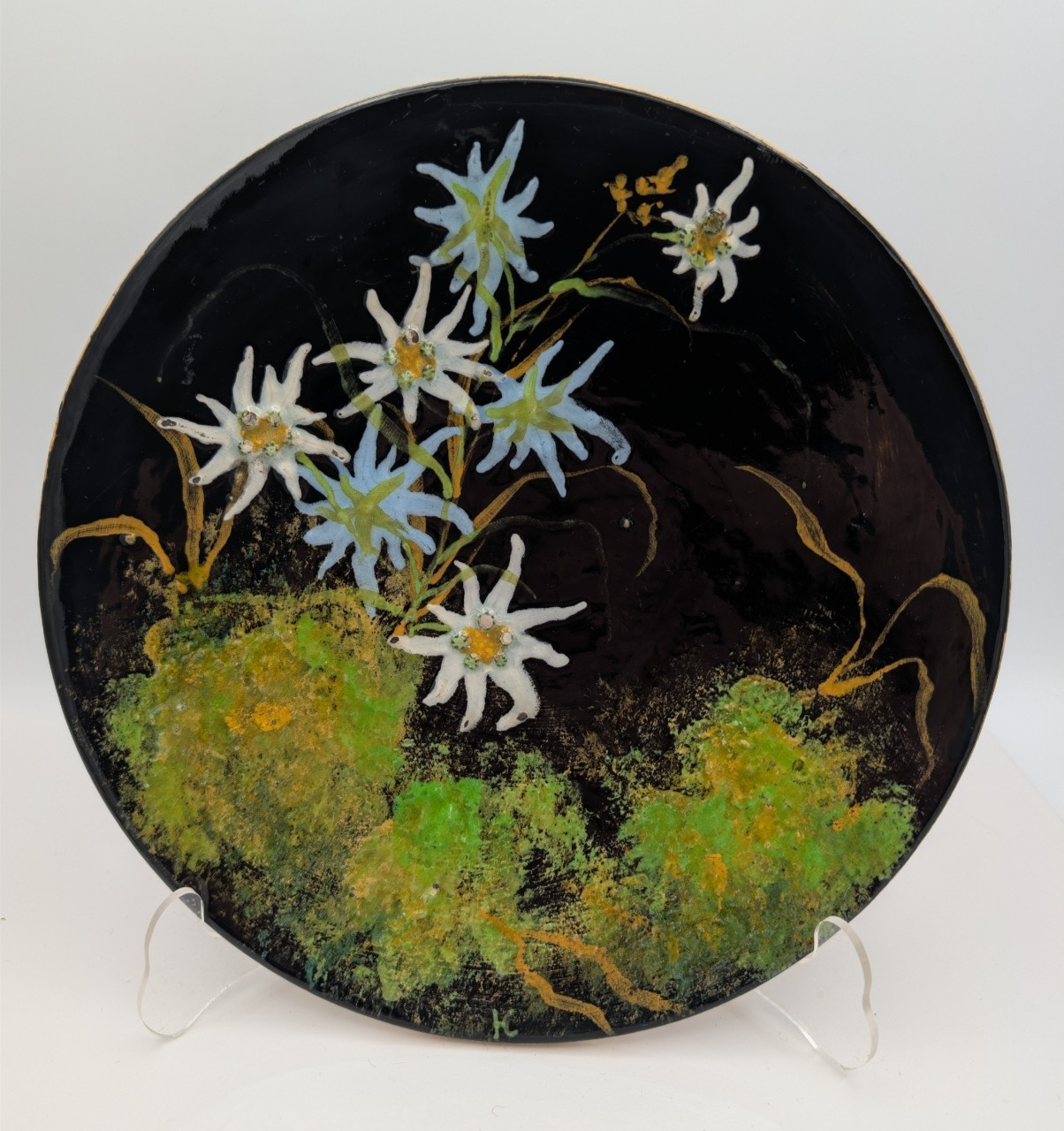
This is a rare and well-documented piece of Swiss art pottery, produced by Pflüger Frères & Cie in Nyon, Switzerland, during their short but celebrated production run of 1878-1883. The plate is 9 inches in diameter, smoothly round, with an unglazed back, decorated with a spray of edelweiss (the iconic white alpine star flower) rising from richly mottled green and ochre foliage against a dramatic jet-black ground.
The history behind this maker is unusually well documented. Pflüger Frères & Cie was the trading name of a prominent Lausanne mercantile family business (running the well-known "Bazar vaudois" and "Grand Bazar"). In spring 1878, brothers Charles and Marcus Pflüger, together with their artistically inclined brother Louis Pflüger (a trained painter who studied under flower painter Joseph-Eugène Gilbault and worked in Paris under Pierre Dupuis and Victor Leclaire), launched an entirely new venture: a line of art pottery made in partnership with Jules Michaud's ceramics factory in Nyon, the only local business with the raw materials and kilns to make it possible. Louis Pflüger directed the artistic side, overseeing a small studio of decorators and modelers, reportedly recruited from the Geneva School of Engineering.
The technique used on pieces like this one involved applying floral motifs molded in relief before the piece was coated in colored slip (barbotine), typically a rich brown-black, and finished with a clear glaze, exactly the raised, textured, high-contrast effect seen on this plate's edelweiss and foliage against the black ground. This style caused a real stir at the time and was singled out by contemporary critics, eclipsing other Nyon pottery of the era.
Every genuine piece was clearly marked with the letters "PF & Cie" and a fish emblem, a mark the brothers officially registered in November 1880 (Swiss Federal Gazette, registration No. 197) and defended publicly against imitators, at one point running newspaper notices warning customers to check for the mark because pottery of other origins was being falsely sold as "Nyon" ware. This plate's unglazed base bears that exact impressed "PF & Cie" mark with fish emblem, along with "11 1/2" inscribed in green paint (painters reference), two old paper stamps (one handwritten "26/6," the other now illegible with age), and a small painted "K" at the bottom of the front design, likely a decorator's mark, consistent with the practice of decorators signing or initialing their work at this workshop.
Pflüger Frères & Cie's art pottery was exhibited at the 1883 National Exhibition in Zurich, where the firm received an official certificate "for their artful refined white earthenware with applied decoration and for their role in setting up this industry in Switzerland." Production ceased after only about four years when the decorating workshop relocated to Lausanne in September 1883, making surviving examples genuinely scarce today.
Condition: No chips or cracks noted on either side. There is a small loss to the raised portion of some of the flower centers, see photos. Design of the flowers makes this not overtly noticeable.
A rare opportunity for collectors of Swiss and European 19th-century art pottery, barbotine/slip-decorated ware, or Alpine folk motifs to own a documented, exhibition-era piece from a maker whose entire production window lasted only a handful of years.