When you click on links to various merchants on this site and make a purchase, this can result in this site earning a commission. Affiliate programs and affiliations include, but are not limited to, the eBay Partner Network.
Is There a Piece of Baltimore\'s Forgotten Golden Age Hanging on Your Wall Yet? 🏛️
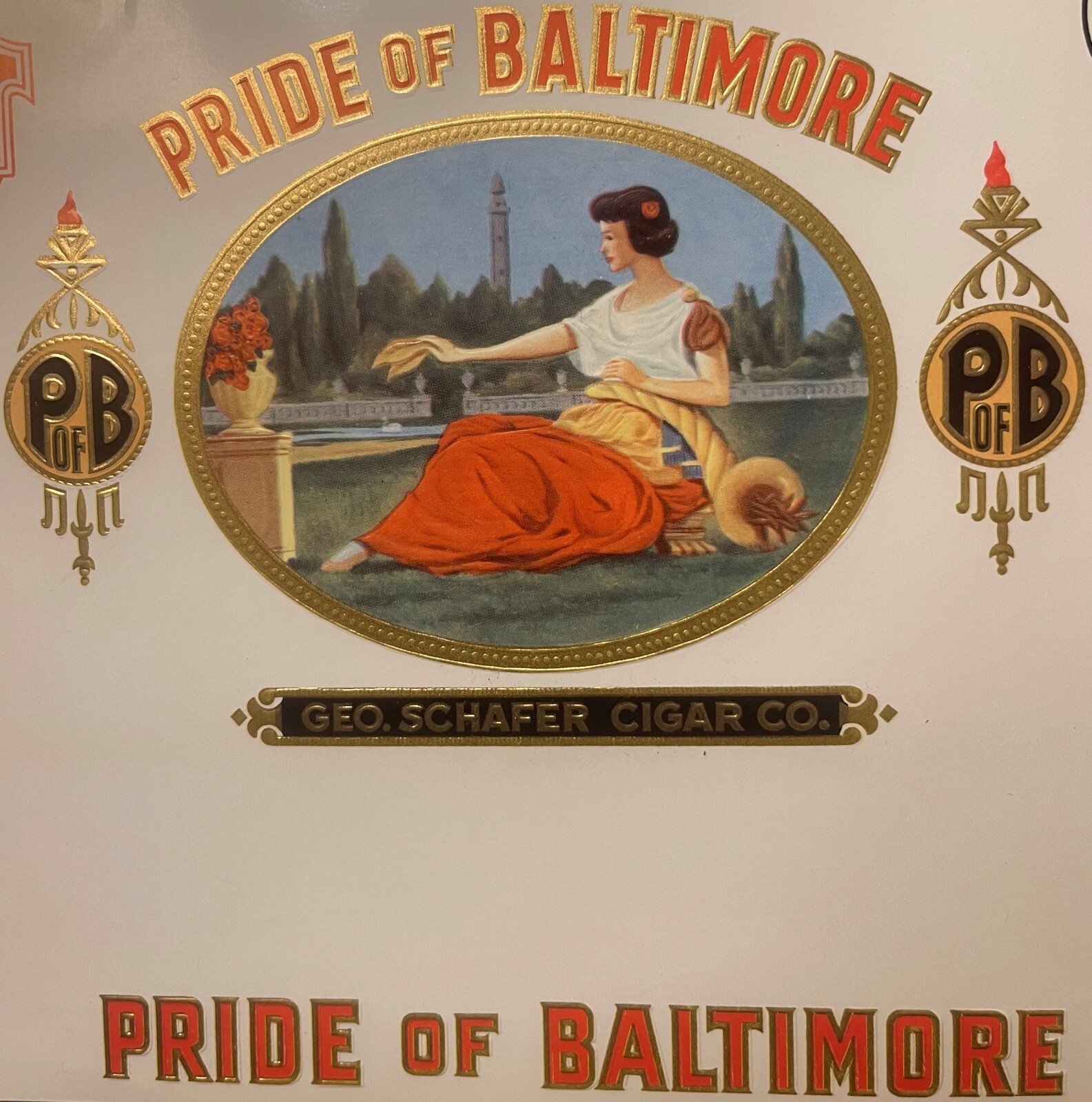
There\'s a particular kind of quiet thrill that comes with holding something that was made to sell a five-cent smoke and ended up outlasting the factory, the corner drugstore, and three generations of the family that rolled the cigars. That\'s exactly what we\'re talking about here. This is a genuine New Old Stock (NOS) Pride of Baltimore cigar box label — printed and embossed by the George Schafer Cigar Company of Baltimore, Maryland — and it is one of the most beautifully executed pieces of American commercial lithography I have ever had the pleasure of putting in front of a collector. I don\'t say that lightly. I\'ve handled a lot of these labels over the years. This one stops you cold.
The piece measures approximately 8½ × 6½ inches and was produced as an outer cigar box label, meant to be the first thing a customer saw when a tobacconist slid the box across the counter. It is an embossed color lithograph with gold foil detailing — a process that, at its peak in the late 19th and early 20th centuries, involved layering color after color in precise registration, then pressing the finished sheet against a die to raise the gold ornament work into three-dimensional relief. The craftsmanship is extraordinary. Even setting aside the subject matter, you are looking at a technical achievement that the commercial printing world of today simply cannot replicate on a cost basis. Those gold torch emblems — the ornate P of B medallions flanking the central vignette — they don\'t just look gold. They catch the light the way gold catches the light. There is a reason collectors and curators have been rescuing these labels for decades.
🎨 The Art on the Label — What You\'re Actually Looking At
The central image is an oval vignette framed in a beaded gold border, and it is, frankly, a small masterpiece of American commercial illustration. A woman in classical dress — white tunic, rich amber and gold fabric draped across her lap, a deep crimson skirt pooled around her as she reclines on a green lawn — reaches one arm outward in a gesture of gracious invitation. Behind her, tall cypress trees frame a waterway, a low balustrade, and in the mid-distance, the unmistakable silhouette of a tower rising against a pale blue sky. The scene is Baltimore\'s own civic landscape translated into allegory — a goddess of the city, presiding over it all with easy confidence. A straw hat rests at her side. A vase of red flowers sits to her left on a stone plinth. Everything about the composition communicates prosperity, refinement, and civic pride.
Flanking the oval on both sides are the P of B torch emblems — highly stylized monogram medallions suspended from ornamental standards topped with red flame finials. These logos are executed in raised gold embossing, and the detail work on each one is remarkable: tiny pendant drops hang below each medallion like a jeweler\'s work. Arching above the central vignette in bold shadowed letterforms is PRIDE OF BALTIMORE, and below the oval, set in a dark banner with gold trim, the maker\'s name: GEO. SCHAFER CIGAR CO. The same brand name repeats in large, strong red and gold letters across the bottom of the label. In the upper left corner, a shield cartouche carries the price: 6¢. In the upper right, a delightful period detail — a circular graphic of a cigar tip with the advisory HOLE-IN-HEAD / DON\'T-BITE / JUST-LITE. That slogan alone is worth the price of admission.
The full color palette — gold, red, cobalt blue, forest green, black, and white — is rich without being garish. Whoever painted the original artwork for this label understood restraint. The colors serve the composition; the composition serves Baltimore. It is civic advertising elevated to fine art.
🏭 The George Schafer Cigar Company — Baltimore\'s Own
The George Schafer Cigar Co. was a Baltimore institution, and the Pride of Baltimore brand was its signature. The Baltimore Museum of Industry holds a Geo. Schafer Cigar Co. Pride of Baltimore cigar box in its permanent collection — that\'s not a trivial fact. When a city\'s own industrial museum decides to preserve your packaging, it means the community has recognized your product as part of its story. The Schafer company earned that recognition.
Related Schafer packaging has been documented as far back as 1940 — a \"Book of Contentment\" novelty cigar box with a George Schafer Cigar Co. Pride of Baltimore label inside — and the Schafer name appears in Maryland newspaper records as late as 1974, by which point the operation had evolved into what sources call Schafer-Pfaff Cigars, referenced in the Cumberland News that December. That\'s a remarkable run. Most American cigar makers were swept away long before 1974. The fact that a Schafer operation was still doing business, still being mentioned in Maryland newspapers, in the Nixon-Ford era says something about the loyalty the brand commanded and the grit of whoever was running it.
The seller\'s own research — gathered from sources and contacts that don\'t always survive on the public internet — places the Pride of Baltimore label\'s production in the early decades of the 20th century, consistent with the golden era of American cigar label lithography. The art style, the typography, the embossing technique, and the 6¢ price point all align with the period the seller has documented: the 1900s through the 1920s, when American commercial lithography was at its absolute apex and Baltimore\'s cigar industry was humming at full throttle.
🌆 Baltimore & the Cigar Trade — A City That Rolled Its Own Legend
To understand why a label like this existed at all — why a Baltimore cigar maker would commission artwork this elaborate for a six-cent smoke — you have to understand what Baltimore was to the American tobacco industry. In 1922, the city of Baltimore was home to 132 registered cigar factories producing an almost incomprehensible 350,000,000 cigars annually. Three hundred and fifty million. Baltimore wasn\'t a footnote in American cigar history. It was a headline.
The city\'s labor history in the trade is equally deep. Baltimore was home to the first local Cigar Makers\' Union, founded in 1851 — making it one of the earliest organized labor bodies in American manufacturing history. The men and women who rolled cigars in Baltimore had collective identity and collective pride long before most American industries acknowledged that workers had either. When George Schafer put the words Pride of Baltimore on a label, he was speaking to a city that genuinely had something to be proud of — a real industrial culture, a real craft tradition, real people doing real work.
The lithography trade in Baltimore itself was old and accomplished, reaching back into the 1830s, and the great American cigar-label printing houses — working in Baltimore, New York, Cincinnati, and Chicago — were producing imagery of a quality that today hangs in galleries and museum collections worldwide. The artists who designed these labels were, as the seller notes, often extraordinarily talented people working for modest wages, their names never printed on the labels they made immortal. They were commercial illustrators in an era before that phrase carried any prestige. Today we recognize them as the authors of some of the most vivid and purely American graphic art ever produced. The woman on this label — that graceful, confident figure against her blue Baltimore sky — was painted by someone who deserved to be remembered. We don\'t know her or his name. But the work survives.
✨ The Gold Embossing — What Made These Labels Worth Keeping
Here is something the seller wants every buyer to understand, because it matters to the value and the beauty of this piece: at the height of the cigar label era, the gold used in embossed lithograph labels like this one was real. Not gold-colored ink. Not metallic foil as we understand it today. The process involved actual gold — gold leaf, gold powder, gold flake — pressed and burnished into the surface of heavy paper stock. The result is a warmth and luminosity that modern printing simply does not achieve. When you tilt this label in the light, the torch emblems and the decorative borders respond the way precious metal responds. That is not an accident. That is craft at the level of bookbinding and fine printing, applied to commercial packaging.
The paper stock itself is part of the story. Cigar labels were printed on heavy, substantial paper — not because the manufacturers were being extravagant, but because the label had to survive the handling, humidity, and storage conditions of a working tobacconist\'s back room. That robust stock is also why so many of these labels have survived a century or more in remarkable condition, while the cigars they wrapped, and the boxes they decorated, and the shops that sold them have all long since vanished.
Lore passed down among collectors holds that a significant cache of unaffixed Schafer labels — exactly the kind of New Old Stock that surfaces in the collector market today — was discovered in warehouse storage in the Baltimore area, and that every example from this particular find carries a characteristic slight ripple in the upper left corner, a ghost of how the sheets were stored. The seller confirms this: every one of these I have ever seen has a slight ripple in that corner — it must have happened to the whole find. That shared characteristic is itself a kind of provenance, a fingerprint that connects surviving examples to a single source and a single moment of rediscovery. Once framed, you\'d never notice it. But it\'s part of the history of this particular group of labels, and it\'s worth knowing.
🖼️ Display Ideas
- 🖼️ Frame it in a deep shadowbox with a dark mat — the gold embossing needs breathing room and a contrasting background to show at its best; a black or deep walnut mat lets the label sing.
- 🍺 Group it with other Baltimore or Maryland advertising ephemera — vintage brewery labels, old Maryland travel posters, or period photographs of the Baltimore waterfront — for a locally themed gallery wall that tells a real regional story.
- 🪵 Lean it on a library shelf or mantel propped against books or between bookends; the heavy stock holds its shape and the label reads beautifully at close range, rewarding the eye with new details every time you look.
- 🎁 Gift it to a Baltimorean — the seller says it plainly and so will we: if you are from Baltimore or live there, this is your city\'s history. There is no more personal or meaningful piece of local Americana to give or to own.
- 🏠 Hang it in a home office, den, or study as a statement piece — this label has the scale, the color, and the visual authority to anchor a wall the way a small original painting would, at a fraction of the investment.
- ☕ Display it in a café, restaurant, or bar with a vintage or Americana aesthetic — the period graphics, the price point detail, and the \"Don\'t-Bite / Just-Lite\" slogan give any hospitality space instant character and genuine history.
🎁 Who Collects These — and Why They Matter Now
Cigar label collecting has been a serious pursuit since at least the 1960s, and the community has only grown as the supply of fine examples has tightened. Museums and art institutes — including, as noted, the Baltimore Museum of Industry — have formalized what serious collectors already knew: these are primary documents of American visual culture, American commercial history, and American labor history, all compressed into a sheet of paper roughly the size of a piece of notebook paper. They are original art. They are local history. They are artifacts of a manufacturing economy that no longer exists in anything like its original form.
The collectors who seek out pieces like this Pride of Baltimore label tend to fall into a few overlapping groups: Baltimore and Maryland locals and expatriates who want a tangible connection to their city\'s past; tobacco and cigar memorabilia collectors who understand that the packaging of the trade is often more artistically significant than the product itself; Americana and advertising ephemera collectors who are building curated collections of American commercial art; and graphic design and printing history enthusiasts who recognize chromolithography and embossing as lost high-water marks of the printer\'s craft. For all of these collectors, the supply of quality examples is finite and shrinking. What\'s framed and in collections is off the market. What remains available is what you\'re looking at right now.
❓ Frequently Asked QuestionsIs this an original antique label or a reproduction?
This is a genuine New Old Stock (NOS) original — not a reproduction, not a reprint, not a facsimile. It is an actual cigar box label produced by or for the George Schafer Cigar Company of Baltimore, Maryland, in its original printing. NOS means it was never affixed to a cigar box — it survived unattached, exactly as it came off the press, which is how so many of the finest surviving examples reached the collector market. You are buying original American commercial lithography, not a copy of it.
Can you confirm an exact year of manufacture?
The manufacture marking on this piece is not legible, so we describe it honestly as vintage, mid-century, consistent with the seller\'s research placing Pride of Baltimore label production in the early decades of the 20th century — the 1900s through 1920s. Related Schafer packaging is documented to 1940, and the brand name appears in Maryland records through 1974. The art style, typography, embossing technique, and 6¢ price point are all consistent with the early 20th-century peak of American cigar label lithography. We don\'t invent a date we can\'t confirm; the era is clear even where the exact year is not.
What exactly is embossed lithography, and why does it matter for this label?
Chromolithography — color lithography — involved printing separate color layers in precise registration, building up a full-color image one stone or plate at a time. Embossing added a final step: the finished printed sheet was pressed against a shaped die to raise portions of the design into three-dimensional relief. For cigar labels, the embossed elements were almost always the gold ornamental work — borders, monograms, scrollwork — which gives the label a tactile depth and a light-catching quality that flat printing cannot approach. At the height of the craft, real gold material was incorporated into the embossed areas. The result is a piece of printing that functions simultaneously as commercial packaging and as decorative art. This is precisely why museums collect them and why collectors have pursued them for decades.
What does \"Hole-in-Head / Don\'t-Bite / Just-Lite\" mean?
This is one of the great period slogans in American cigar advertising, and it refers to a specific feature of the cigar\'s construction: a pre-pierced head, meaning the tip of the cigar was already perforated at the factory, eliminating the need to bite or cut it before lighting. \"Hole-in-Head\" was the product feature; \"Don\'t-Bite / Just-Lite\" was the instruction and the selling point. For a six-cent mass-market cigar in the early 20th century, a pre-pierced head was a genuine convenience feature — one less tool, one less step, instant gratification. The circular graphic on the label illustrating the cigar tip makes the point visually as well as verbally. It is a perfect piece of period product communication, and it gives this label a personality that goes beyond pure decoration.
The gold on this label — is it real gold?
The seller\'s research and the broader collector knowledge of the era support the understanding that the finest embossed cigar labels of the early 20th century used real gold material — gold leaf, gold powder, or gold flake — in their embossed ornamental work. This was standard practice among quality lithographers of the period, and it accounts for the warmth and depth of the gold on surviving examples that no modern metallic ink or foil printing fully replicates. Whether this specific label used gold leaf or another gold medium in its embossing cannot be confirmed by sight alone, but the quality of the result speaks for itself when you see the label in person.
Is this label difficult to frame?
Not at all. The heavy paper stock that was standard for cigar labels makes this piece easy to work with — it holds flat, handles well, and fits standard frame sizes without difficulty. At approximately 8½ × 6½ inches, it works beautifully in a standard 9×7 or 11×8.5 frame, with or without a mat. A deep shadowbox frame with a dark mat allows the embossed gold work to cast its own subtle shadow and shows the three-dimensional quality of the printing at its best. Many collectors who\'ve purchased this label have written back to say how much better it looks once it\'s framed than it did even in hand — the embossing and the color palette reward a proper display context.
How scarce are these labels today?
The supply of quality, original NOS cigar labels from the early 20th century is genuinely finite. These labels were produced in quantity, but the vast majority were used — affixed to boxes, shipped, sold, and discarded along with the boxes themselves. Surviving NOS examples exist because a quantity of unaffixed sheets escaped the usual fate, often discovered in old warehouses, print shop remnants, or estate storage. Once those surviving caches are purchased and framed — moved into private collections, galleries, and museums — they effectively leave the market for good. The Baltimore Museum of Industry\'s decision to include a George Schafer Cigar Co. Pride of Baltimore box in its permanent collection is a clear signal of the piece\'s recognized historical and cultural value. The window to acquire examples like this one at the collector market level is not infinite.