When you click on links to various merchants on this site and make a purchase, this can result in this site earning a commission. Affiliate programs and affiliations include, but are not limited to, the eBay Partner Network.
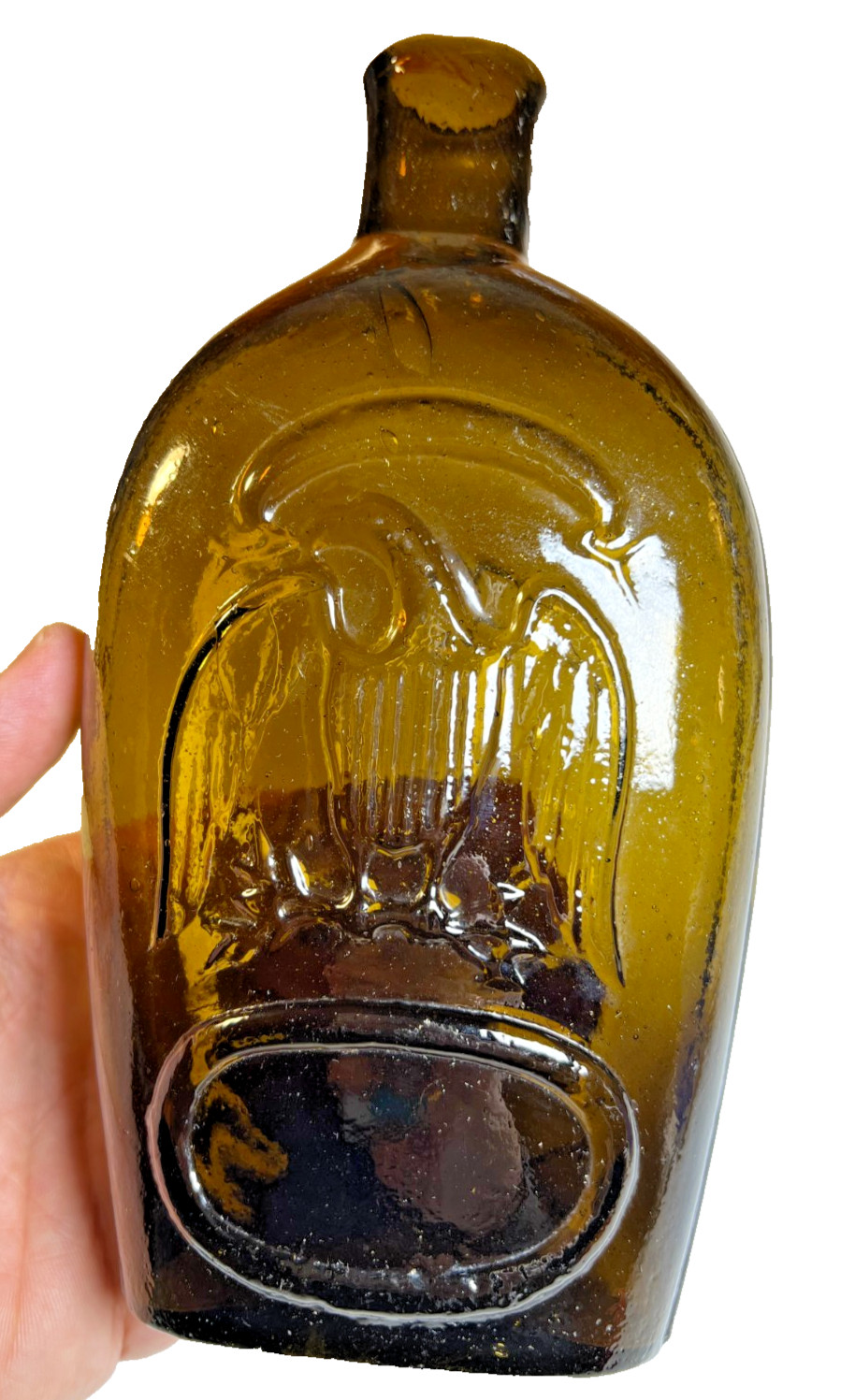
A classic Stoddard eagle pint flask, McKearin GII-84 and.... a beauty.
Precise Date
Circa 1850–1855.
The large tubular open pontil, fired/tooled lip, bold eagle, and rich medium olive amber color all align with mid-century Stoddard production. This is firmly pre-Civil War.
City & State
Stoddard, New Hampshire
More specifically, produced in one of the glasshouses operating along Shedd Brook in the Stoddard district — likely either the South Stoddard or Granite Glassworks operations active during the early 1850s.
Who Made It?
Stoddard wasn’t a single factory — it was a cluster of small, wood-fired glasshouses operating roughly 1842–1873. The workers were often farmer-glassblowers. In winter they made bottles. In warmer months they farmed.
These flasks were hand-gathered from wood-burning furnaces, blown into two-piece molds, then snapped off the blowpipe — leaving that big, glorious tubular open pontil scar you’re showing on the base.
The lip was reheated and tooled (fired smooth), which is exactly what we expect on an early-to-mid 1850s example.
What Did It Contain?
Whiskey. Almost certainly.
These eagle flasks were patriotic liquor bottles. The blank oval cartouche beneath the eagle was sometimes intended for a paper label or retailer identification, but many were left blank.
They were sold filled by:
• Regional whiskey merchants
• New England distributors
• Possibly local taverns or general stores
This is a pint size — a personal quantity. Not tavern bulk. This was meant to be carried.
Why the Eagle?
Mid-century America was swelling with national pride. The Mexican-American War had just ended (1848). Expansion westward was in full swing. The Compromise of 1850 was dominating politics.
An eagle flask wasn’t subtle. It said:
“I’m American.”
“I drink American.”
“And this whiskey is strong enough to argue about tariffs.”
Life When This Was Made (1850–1855)Technology
• Railroads were rapidly expanding.
• Telegraph lines were spreading.
• Most homes still used candles or whale oil for light.
• Wood-fired glasshouses like Stoddard were already becoming outdated as coal-fired factories in larger cities began taking over.
Medicine
• No antibiotics.
• Bloodletting was still practiced.
• Cholera outbreaks were real threats.
• Whiskey was commonly used medicinally — stimulant, anesthetic, disinfectant.
Politics
• Slavery tensions escalating.
• Compromise of 1850.
• Kansas-Nebraska Act in 1854.
• The country was quietly inching toward Civil War.
Owning a flask like this wasn’t just practical. It was a statement object in an era when glass itself was still semi-luxury.
Why Would Someone Have Been Excited to Own It?
Because glass like this wasn’t disposable.
It was:
• Handcrafted
• Durable
• Reusable
• Patriotic
• Stylish
And that olive amber tone? That wasn’t controlled chemistry. That’s wood ash, iron content, furnace atmosphere, and luck. No two are identical.
A farmer, traveling salesman, or river worker carrying this in 1853 would have considered it a quality possession.
And today? Same energy.
Condition Analysis
Attic mint:
• No chips
• No cracks
• No stain
• No ghosting
• Bright surface
• Strong embossing
• Gorgeous color saturation
• Healthy seed bubbles
• Clean open pontil
- The tiny open heel bubble noted in the strictest of transparency (see last finger point pics).
The surface sheen and lack of wear suggest minimal burial time — likely attic stored for generations.