When you click on links to various merchants on this site and make a purchase, this can result in this site earning a commission. Affiliate programs and affiliations include, but are not limited to, the eBay Partner Network.
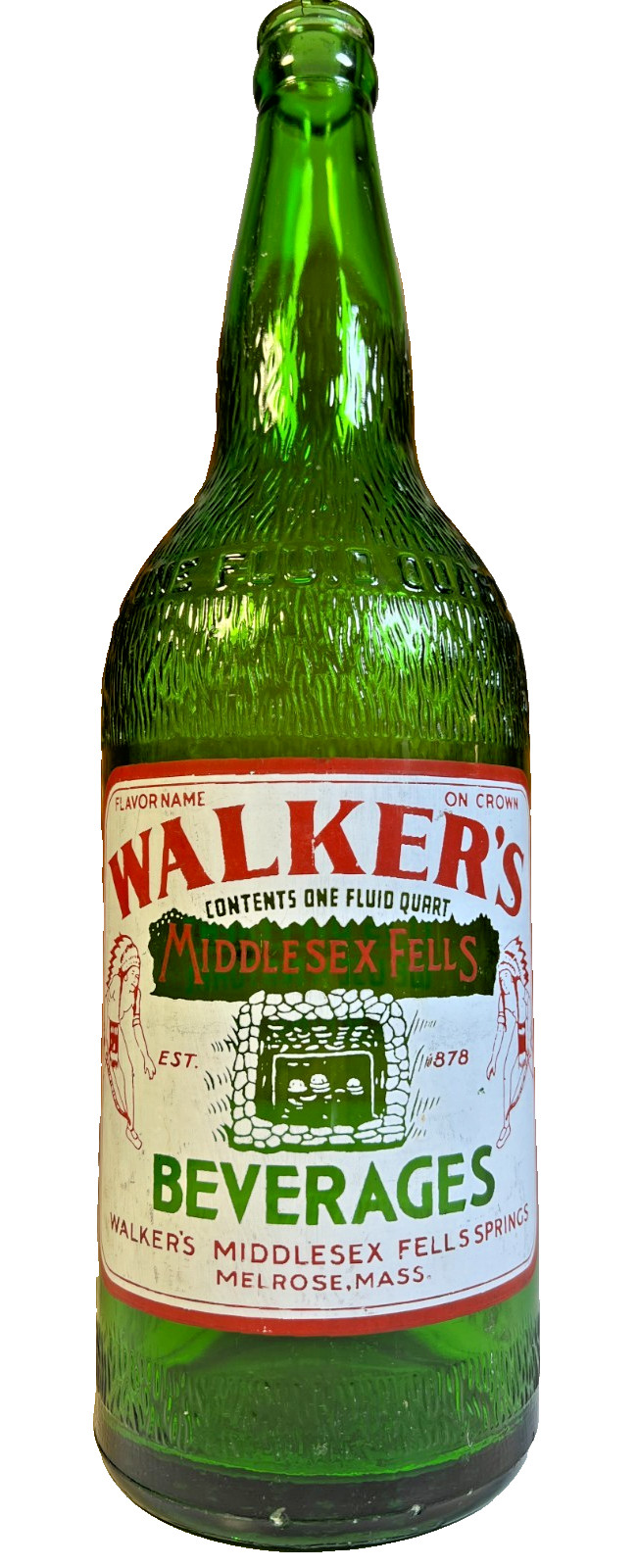
There was a time when the quality of a beverage was judged not by marketing slogans, but by the spring it came from—and bottles like this were built to prove it. Standing an impressive 12 1/8 inches tall, this quart-size Walker’s Middlesex Fells Springs bottle represents the golden age of New England soda and spring water, when purity, regional identity, and craftsmanship still mattered. With its bold applied ceramic label, rich emerald glass, and proudly named Melrose, Massachusetts source, this is not a common survivor—it is a premium home-delivery bottle from an era when these were reused, washed, and worn out, not saved. That this example remains in excellent condition today is exactly why seasoned collectors stop, look twice… and don’t forget it.The Bottle at a Glance
Height: 12 1/8\" tall
Material: Green glass with applied ceramic (ACL-style) label
Condition: Excellent — clean glass, crisp graphics, no cracks or repairs
Origin: Melrose, Massachusetts
Era: Late 1930s–1940s
Contents: One fluid quart
This is not a casual soda bottle. This is a statement piece.
The Company: Walker’s Middlesex Fells Springs (Melrose, Mass.)
Walker’s Middlesex Fells Springs traces its roots to 1878, tapping natural spring water from the Middlesex Fells Reservation—one of Greater Boston’s most prized and protected watershed areas. Long before bottled water became a lifestyle accessory, spring source mattered, and Walker’s leaned into that hard.
By the early 20th century, Walker’s was positioning itself not merely as a soda producer, but as a purveyor of purity—a brand built around clean water, healthful origins, and trust. Their bottles proudly advertised the spring itself, not just the beverage, signaling that what mattered most was where the water came from.
This company served homes, families, and institutions throughout the North Shore and Greater Boston area, with quart bottles specifically intended for home use and return—larger, heavier, and more expensive to produce than standard soda bottles.
Water in This Era: Why It Mattered
This bottle comes from a time when municipal water was not universally trusted.
Chlorination was still controversial
Industrial pollution was a growing concern
Typhoid and waterborne illness were recent memories
Spring water companies like Walker’s thrived because they offered assurance. The spring wasn’t abstract—it was named, illustrated, and celebrated. Buying this bottle meant buying peace of mind.
In many homes, a quart of Walker’s wasn’t just a drink—it was the default table water.
The Graphics: Quietly Brilliant
This design does a lot without shouting:
The Stone Spring Illustration
At center is a masonry spring enclosure, visually anchoring the idea of permanence, tradition, and natural protection. It implies:
Native American Figures
Flanking the design are Native American figures—common in period advertising, used to suggest:
While dated by modern standards, these graphics are historically authentic and highly sought after by collectors for their period-correct visual language.
Typography & Color
Bold red WALKER’S lettering (authority, confidence)
Deep green glass reinforcing freshness and nature
Clean, balanced layout that reads instantly from across a room
This was designed to be recognizable on a delivery truck, a porch, or a kitchen table.
Why the Applied Ceramic Label Matters
Unlike paper labels:
Applied ceramic labels were more expensive and usually reserved for premium or flagship bottles. The fact that this one remains sharp and intact is a big deal—especially at quart size.
Large quart format (much scarcer than standard soda bottles)
Excellent condition
Strong New England regional identity
Named spring source
High-quality applied label graphics
This is the kind of bottle that didn’t survive by accident. It survived because it was well made, well used, and then carefully kept. It represents a moment when water, branding, and regional identity all mattered deeply—and when a soda bottle was built to last, not to disappear. In short: a serious piece of New England beverage history, and one that looks every bit as good on a shelf as it reads in a story.