

|
Site Categories |
|
Featured Items |

Poodle, Spaghetti Trim, Ucagco


|
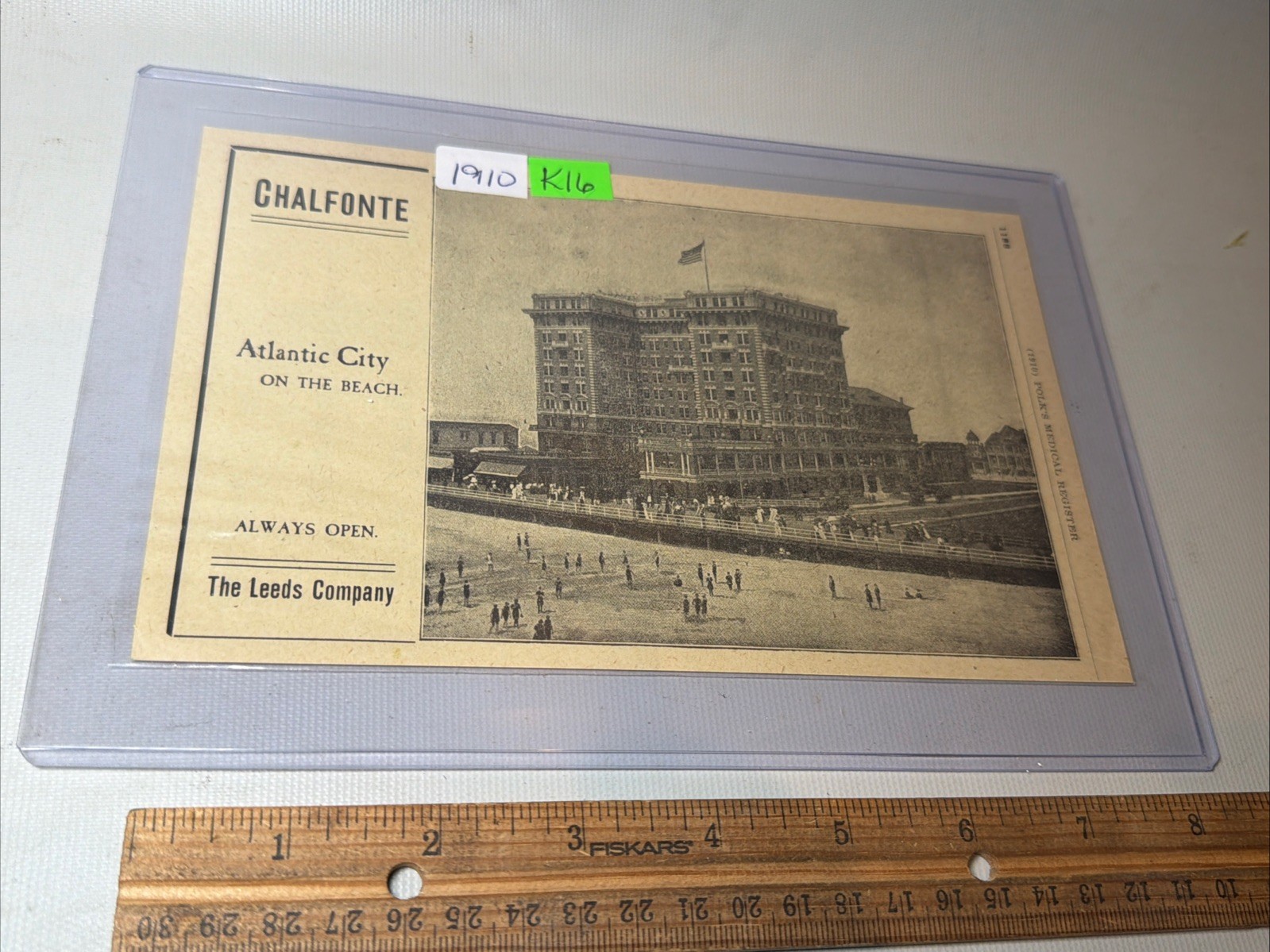
Antque 1910 Atlantic City NJ Chalfonte Hotel Picture Ad History Beach House Old For Sale

When you click on links to various merchants on this site and make a purchase, this can result in this site earning a commission. Affiliate programs and affiliations include, but are not limited to, the eBay Partner Network.

Antque 1910 Atlantic City NJ Chalfonte Hotel Picture Ad History Beach House Old:
$12.99
Antique 1927 Medical Resort ADBound Brook New Jersey Picture AD History (1929) AdvertisementGorgas Hotel HospitalBirmingham, Alabama AD Size Ad - 6 1/2" Wide x 9" Tall Includes Clear Plastic Protective SleeveConditionAd is in Nice condition.Please see pictures for the condition.Thanks, for looking! Elisha and Elizabeth Roberts opened The Chalfonte Hotel, or Chalfonte House as it was first called, on June 25th, 1868 near the corner of Pacific and North Carolina Avenues in Atlantic City. The Roberts' choice of this corner was no doubt determined by its proximity to the train depot to the north and the ocean to the south. Because the tides were continually increasing the beach area, the Roberts found it possible to move the hotel forward twice, once in 1879 and again in 1889. They also extended their main building and added subsidiary structures to it. The Chalfonte passed through a period of transition in management during the eighteen nineties and came under the control of Henry W. Leeds around 1900. Leeds embarked on a major expansion program and in 1904 constructed Atlantic City's first tall, iron frame hotel. It is this structure that people usually mean today when they recall staying at the Chalfonte. The original structure, however, was not demolished. As a comparison of the 1903 site plan with the 1904 site plan shows, it was simply moved sixty feet to the west, re-clad in brick, and integrated into the larger hotel complex.Atlantic City is the creation of the second half of the nineteenth century. It was the result of steadily increasing urbanization with its inevitable need for some place where the masses could escape from work and city streets to leisure, romance, and sea breezes. Those with time enough and money could go to Cape May, where well-to-do Philadelphians mingled with their counterparts from southern states. Even the well-to-do, however, may have found the long journey an inconvenience, while those whose work week ended on Saturday afternoon and started again on Monday morning simply had no means of escape from their sweltering row houses.Atlantic City changed that. It was the creation of a group of nineteenth century capitalists who saw an opportunity for enterprise and profit. Led by Richard Osborne, an engineer who had seen the boom towns of the midwest, and by Dr. Jonathan Pitney, a long time resident of nearby Absecon village with the requisite political connections, the group secured a charter from the New Jersey legislature to build a railroad across the flat land of central New Jersey. Their Camden and Atlantic Railroad then set about buying up the available land on Absecon Island. When the legislature, fearing a monopoly, forbade further land purchases by the railroad, the same men organized The Camden and Atlantic Land Company. In 1854 the men who had built the railroad and bought the land built the Surf House. The hotel increased patronage for the railroad and the growing crowds attracted more hotels and boarding houses, thus swelling the price of land. To this well thought out scheme Osborne added a flair for public relations. With a stroke worthy of Barnum, he christened his deserted strip of sand Atlantic City and named its principal streets after the oceans of the world and the states of the nation.It would be some years before the actual Atlantic City began to match the promoter's vision. There was a spurt of hotel building in the 1850s, as the Surf House was joined by the United States, Schauffler's, Congress Hall, and others. The Civil War brought a temporary halt to the resort town's growth, but in the late sixties things picked up again. In 1868 Alexander H. Boardman began his popular excursions from Philadelphia to Atlantic City. On June 25 of the same year Elisha and Elizabeth Roberts opened Chalfonte House.The Roberts were Quakers, a religious association that remained a part of the hotel's tradition up to its closing. Their family history is given in an unpublished memoir which, though unsigned, is clearly written by one of their children. It records that from 1864 to 1868 the Roberts managed 600 acres and the Farm House at Westtown School in Chester County. This was a major boarding school for Quakers and it was at the Farm House that parents stayed while visiting their children. After three years, Elisha asked for a raise in salary and when the committee refused, he began seeking other opportunities. As the memoir explains:
Father had made one or two short visits to Atlantic City in 1866 and 1867, stopping at the "Clarendon House" on Virginia Avenue near Pacific. Being impressed with the rather indifferent food and very hard uncomfortable beds, he thought a good boarding house with plenty of good food and comfortable beds would have a good chance of success. The more he thought about it the more convinced he was. A few interested friends were willing to loan him money on the venture, but many thought him foolish and that it would be very risky.On January 30th, 1868 the land was purchased for $6,500 from John Dacosta (who had bought it in 1856 from The Camden and Atlantic Land Company) and the Chalfonte was constructed that winter at a cost of $21,OOO. The Roberts planned to open on June 25th, 1868 and on June 22nd the following advertisement appeared in The Philadelphia Inquirer.
Chalfonte, Atlantic City, N.J.--This new commodious and first class boarding house will be ready for guests 6th month 25th. It is beautifully situated on NORTH CAROLINA Avenue in full view of the ocean. Elisha Robert, Proprietor.As often happens, the hotel was not quite ready on the scheduled day and on the morning of June 25th the dining room was still filled with carpenter's benches and its floor littered with wood shavings. "Several days before all was completed," the author of the family memoir recalls, "a few guests arrived and insisted on staying and putting up with many necessary inconveniences."It was not uncommon for hotels to attract a clientele by appealing to a particular religion, ethnic, or geographical group. Thus Schauffler's attracted German Americans. The Chester County Hotel presumably appealed to visitors from the West Chester area, and Haddon House drew visitors from Haddonfield, New Jersey. The Roberts emphasized their Quaker connections. The hotel was named after Chalfont St Giles, a small town in Buckinghamshire that had played an important role in Quaker history and where William Penn is buried. A note that appeared in the June 30th, 1868 issue of The Philadelphia Inquirer stressed the connection of the Roberts with one of the Delaware Valley's most important Quaker institutions:
Chalfonte is the name given to one of the new hotels built since last season. It is handsomely located near the ocean on North Carolina Avenue, and is a large and commanding structure, three stories in height, and will be kept by Elisha Roberts, long known in connection with the West Town Boarding School near West Chester, Pa.The tradition of Quaker management continued when the hotel came under the control of the Leeds Company in 1900.The Chalfonte was a success from the start:
Running a house to accommodate 140 guests brought many new cares and responsibilities to Father and Mother to which they were unaccustomed, but their original determination to provide good food and plenty of it, comfortable beds and a home-like atmosphere about the whole place, brought them reward, the first summer proving to be a financial success. Running a large boarding house meant an entirely new life for Father and Mother. When there was good help all went well, but often it was the reverse, when Mother would have to be pastry cook and make pies and deserts for the household.The family involvement must have created an atmosphere attractive to guests. A similar situation prevailed at the Haddon House, founded across North Carolina Avenue in 1869 by Samuel and Susanna Hunt.Another factor which contributed to the Chalfonte 1s success was its location near the beach. The first hotels built in Atlantic City were clustered around the railroad station. The Chalfonte was located conveniently near the station but it was decidedly closer to the ocean than the first generation of Atlantic City hotels. The beach, which was one of Atlantic City's great attractions, was also one of its early headaches. Glaring to the eye and hot to the foot, the soft sand made walking difficult and tiresome. Absecon Island was dotted by huge sandhills (in 1868 one-stood directly across the street from the Chalfonte) and there were troublesome pools of stagnant water offering breeding spots for mosquitoes. The early beach at Atlantic City more nearly resembled a wilderness seashore than the level stretch of sand we know today.The eighteen-seventies and eighties saw the gradual evolution of three ways of coping with the transition from street to beach. The first was the bathhouse. At first there were no bathhouses at all; the beach was for strolling and for dances at low tide, but not for swimming. Then crude wooden structures began to appear, permitting visitors to change into a swim suit. These were set up in a higgledy piggledly fashion, for exclusive rights down to the high-water line were not yet observed. In the eighteen-eighties this situation changed. On the one hand large business such as George F. Lee's Park Bath House, two stories tall with 116 dressing rooms, brought new order and respectability to some areas while in others, such as the area in front of the Chalfonte, the beach was made more exclusive by restricting the use of bathhouses to guests of the hotel.The second way of easing the transition between hotel and ocean was by improving access to the beach. This was made all the more necessary by the fact that the tides were continually depositing sand and thus increasing the distance to be traversed. The Roberts family could cope with this situation either by moving the hotel closer to the beach or by providing a convenient means of transportation.As Chalfonte was some ____ [the space is blank in the memoir] feet from the beach, in 1873 (?) father decided to build a railroad from the house to the beach, and "The A.C. Central Railroad Co." came into being. A track with wooden rails was laid and a nice little car drawn by a red mule conveyed the guests who cared to ride at 5 cents per, to and from the beach. The wood rails were afterward replaced with light iron tee rails, and a good looking bay horse took the place of the mule, with a portly colored man as driver and conductor.
The little road was opened till the house was moved nearer the sea in 1879.The question mark following the date 1873 is in the original text. In fact newspaper advertisements in The Philadelphia Evening Bulletin and the Philadelphia Inquirer show that it was in 1870 that the Chalfonte was able to advertise "Railway to the beach." The Haddon House across the street made the same promise and presumably shared the railway. Although the memoir mentions a five cent charge, an 1880 advertisement in The Philadelphia Evening Bulletin promises that "Chalfonte car runs free to guests of the hotel".The major factor, however, in transforming the relation of the hotels to the beach was the evolution of the boardwalk from its very flimsy beginnings to the major thoroughfare we know today. The first boardwalk dates from 1870, two years after the Chalfonte opened. It was proposed by Alexander Boardman, who is said to have been annoyed by the amount of sand tracked back into his railroad excursion cars. It was ten feet wide, constructed of wood planks, and laid directly on the sand. Made in sections, it could be moved inland every fall and stacked in piles for the winter. The boardwalk proved instantly popular and by 1880 a second one was built, this one fourteen feet wide and raised on piles. The boardwalk transformed the relation of the hotels to the sea. In effect, it created a third, intermediate environment. By 1883, the first business directory of Atlantic City listed nearly one hundred stores and restaurants located on the boardwalk and the number grew with each passing year. The boardwalk was badly damaged in the hurricane of 1889 and on January 2nd, 1890, Elisha Roberts deeded to Atlantic City a sixty-foot strip of land for a new boardwalk.By the eighteen-eighties Atlantic City was clearly a success. It had not yet vanquished Cape May as the major resort of the New Jersey coast, but it was agreed that Atlantic City was larger and more bustling. In a novel, really a fictionalized series of travel articles that appeared in Harper's New Monthly Magazine in 1886 by Charles Dudley Warner, a Mr. Stanhope King explains the difference between the two resorts:
"It (Cape May) seems a refined sort of Place in its outlines and quietly respectable. They tell me here that they don't want the excursion crowds that overrun Atlantic City, but an Atlantic City man, whom I met at the pier, said that Cape May used to be the boss, but that Atlantic City had got the bulge on it now had thousands to the hundreds here. To get the bulge seems a desirable thing in America … and I think we'd better see what a place is like that is popular, whether fashion recognizes it or not.With those words Stanhope and his friend, the artist Graham Forbes, set out by rail through the Jersey sands to visit this wondrous new creation. Seeing it is an experience they cannot do without. After all, their distinguished friend Mrs. Corlandt has assured them that "Atlantic City is an important place; a great many of its inhabitants spend their winters in Philadelphia."Stanhope and his friend are engaging in an activity much like slumming; they are seeing how the middle and lower middle classes live. Their reactions would have seemed haughty and perhaps offensive to Elisha and Elizabeth Roberts, but they will be quoted here not only because they are informative but because a certain defensiveness in the face of highbrow standards was to the effect the architectural form of the 1904 Chalfonte. A railway journey through the New Jersey sands brings them to the city by the sea:
And a city it is. If many houses, endless avenues, sand, paint make a city, the artist confessed that this was one. Everything is on a large scale. It covers a large territory, the streets run at right angles, the avenues to the ocean take the names of the States. If the town had been made to order and sawed out by one man, it could not be more beautifullY regular and more satisfactorily monotonous. There is nothing about it to give the most commonplace mind in the world a throb of disturbance. The hotels, the cheap shops, the cottages, are all of wood, and, with three or four exceptions in the thousands, they are practically alike, all ornamented with scroll-work, as if cut out by the jig-saw, all vividly painted, all appealing to a primitive taste just awakening to the appreciation of the gaudy chroma and the illuminated and consoling household motto. Most of the hotels are in the town at considerable distance from the ocean, and the majestic old sea, which can be monotonous but never vulgar, is barricaded from the town by five or six miles of stark-naked plank walk, rows on rows of bath closets, leagues of flimsy carpentry-work, in the way of cheap john shops, tyn-type booths, peep-shows, go-rounds, shooting galleries, pop-beer and cigar shops, restaurants, barber shops, photographs galleries, summer theatres. Sometimes the plank walk runs for a mile or two, on its piles, between rows of these shops and booths, and again it drops off down by the waves. Here and there is a gayly painted wooden canopy by the shore, with chairs where idlers can sit and watch the frolicking in the water, or a space railed off, where the select of the hotels lie or lounge in the sand under red umbrellas. The calculating mind wonders how many million feet of lumber there are in this unpicturesque barricade, and what gigantic forests have fallen to make this timber front to the sea.A highbrow attitude provides a certain protection against Atlantic City's clamorous appeal, but finally the narrator's defenses simply collapse. "What will you have?" he at last exclaims. "Shall vulgarity be left just vulgar, and have no apotheosis and glorification? This is very fine of its kind, and a resort for the million. The million come here to enjoy themselves. Would you have an art gallery here, and high-priced New York and Paris shops lining the way?"Architecturally, Atlantic City was a town of wood frame buildings, painted in bright colors and decorated with an astonishing variety of scroll work. As a more sympathetic viewer than Warner put it:
The architecture is varied and beautiful. There are nearly five-thousand structures, and it is difficult to find two alike; and where two are alike in contour they differ in coloring. Nearly all the buildings are frame, which affords the widest scope for architects and painters.The buildings were also low to the ground. As an 1873 article in Lippincott's Magazine described it, Atlantic City hotels "have a low, brooking look, and evidently belong to a class of sybarites who are not fond of staircases."A stereopticon slide shows the Chalfonte as it probably appeared when it was first erected near the corner of Pacific and North Carolina Avenues. An unknown hand has added the date 1878 to it in pen and this seems consistent with all other evidence. The slide shows a three-story, wood framed structure with a long sun gallery on the first floor and another on the ocean side of the second floor. There is a hipped roof with a long balustrade. French windows open out onto the sun porch on the first floor and it is possible to make out a stairway from the porch to the ground on the left side of the building. It was characteristic of the Chalfonte from the beginning that entrances were on the side rather than on the front facing the ocean.List of Sanatoria in the United StatesEst. Name Location Notes Ref.
1853 Batavia Institute Batavia, Illinois [1]
1866 Battle Creek Sanitarium Battle Creek, Michigan [2]
1881 Brooklyn Home for Consumptives Brooklyn, New York [3]
1881 Rockhaven Sanitarium Crescenta Valley, California [4]
1884 Montefiore Home for Chronic Invalids Manhattan, New York [5]
1885 Adirondack Cottage Sanitarium Saranac Lake, New York [6]
1887 Sierra Madre Villa Pasadena, California [7]
before 1894 Camp Harding Colorado Springs [8]
1896 River Crest Sanitarium Astoria, New York [9]
1899 National Jewish Health Denver, Colorado [10]
1900 Bromley Sanitarium Sonora, California [11]
1902 Barlow Respiratory Hospital Los Angeles, California
1903 Pottenger Sanatorium Monrovia, California [12]
1904 Temple Sanitarium Temple, Texas
1904 Las Encinas Sanitarium Pasadena, California [13]
1904 Paradise Valley Hospital California National City, California
1905 Swedish Medical Center Englewood, Colorado
1905 Portland Open-Air Sanatorium Milwaukie Heights, Oregon [14]
1905 Oregon State Tuberculosis Hospital Salem, Oregon [15]
1907 Boston Consumptives Hospital Boston, Massachusetts
1907 Missouri State Sanatorium Mount Vernon, Missouri [16]
1907 Maryland Tuberculosis Sanitorium Sabillasville, Maryland
1907 Edward Sanitorium Naperville, Illinois
1907 Minnesota State Sanatorium for Consumptives Walker, Minnesota
1907 Wisconsin State Tuberculosis Sanatorium Wales, Wisconsin [17]
1907 Vermont Sanatorium Pittsford, Vermont [18]
1909 Arkansas Tuberculosis Sanatorium Booneville, Arkansas [10]
1909 Catawba Sanatorium Roanoke, Virginia [19]
1909 La Vina Sanitarium Altadena, California [20]
1909 San Haven Sanatorium Dunseith, North Dakota [21]
1910 Undercliff State Hospital Meriden, Connecticut
1910 Waverly Hills Sanatorium Jefferson County, Kentucky [22]
1910 Pine Camp Tuberculosis Hospital Richmond, Virginia [23]
1911 Firland Sanatorium Seattle, Washington [24]
1911 Lima Tuberculosis Hospital Lima, Ohio
1912 Blackburn Sanitarium Klamath Falls, Oregon [25]
1912 Pine Bluff State Hospital Salisbury, Maryland
1913 Sample Sanitarium Fresno, California [26]
1913 State Tuberculosis Sanitarium Galen, Montana [27]
1914 Belgum Sanitarium Richmond, California [28]
1914 Saratoga County Homestead Providence, New York
1915 Chicago Municipal Tuberculosis Sanitarium Chicago, Illinois
1915 Enid Government Springs Sanatorium Enid, Oklahoma
1915 Muirdale Tuberculosis Sanatorium Milwaukee County, Wisconsin
1916 Glen Lake Sanatorium Hennepin County, Minnesota
1916 Cresson Tuberculosis Sanatorium Cresson, Pennsylvania
1917 Hot Lake Sanitorium Hot Lake, Oregon [29]
1917 Piedmont Sanatorium Burkeville, Virginia [30]
1918 Bancroft's Castle Groton, Massachusetts
1919 Cranberry Specialty Hospital Hanson, Massachusetts
1919 Fairview Sanatorium Normal, Illinois [31]
1919 Washington County Tuberculosis Hospital Barre, Vermont [32]
1920 Olive View Sanitarium Los Angeles, California [33]
1920 Pureair Sanatorium Bayfield County, Wisconsin
1922 Deborah Heart and Lung Center Browns Mills, New Jersey
1922? El Sausal Sanitarium Salinas, California [34]
1922 Henryton State Hospital Marriottsville, Maryland
1923 Halifax County Home and Tubercular Hospital Halifax, North Carolina
1923 Caverly Preventorium Pittsford, Vermont [35]
1926 National Methodist Sanatorium Colorado Springs, Colorado
1927 Hassler Health Farm San Carlos, California
1928 King County Tuberculosis Hospital Seattle, Washington [36]
1930 Lake View Sanatorium Madison, Wisconsin [37]
1933 Sioux San Hospital Rapid City, South Dakota
1934 Arizona State Tuberculosis Sanatorium Tempe, Arizona [38]
1934 Glenn Dale Hospital Glenn Dale, Maryland
1936 Dr. Hudson Sanitarium Newton County, Arkansas [39]
1939 University Tuberculosis Hospital Portland, Oregon [15]
1940 Edgewood State Hospital Deer Park, New York
Key Words
Hospital Medicine is the fasting growing field of Medicine, and the importance of hospitalists in the delivery of care and success of hospitals continues to increase. The practice of hospital medicine is both rewarding and challenging: hospitalists need to provide high-quality care using the best available evidence in an efficient, cost-effective manner. In recognition of the need for rapid access to essential information, this text provides a concise yet comprehensive source for busy clinicians. Essentials of Hospital Medicine provides detailed reviews of all clinical topics in inpatient medicine, including common diagnoses, hospital-acquired conditions, medical consultation, and palliative care, as well as key non-clinical topics, such as quality improvement tools, approach to medical errors, the business of medicine, and teaching tips. It is the single source needed for hospitalists striving to deliver outstanding care and provide value to their patients and hospitals. Hospital Medicine provides practical, concise evidence-based information on the diagnosis and treatment across the spectrum of illness and injury in the hospital setting. This book features a simple, accessible template for each subject, and quick and easy references to the relevant literatureDisplay Art Picture sign decor Antique State Medical Book Doctor Ads Medicine Dr Book, Magazine
|
|
Related Items:
Antque 1910 Atlantic City NJ Chalfonte Hotel Picture Ad History Beach House Old $12.99
Antque Railroad sleeper Turned vase with spike 1910 signed $250.00
Constantinople Turkey Postcard Museum of Emperor Alexander III c1910 ANTQUE $12.00
|
|
|
Shopping Cart  |

|
Recently Viewed |
|
Latest Items |
|
Facebook |
Secure Websites

|
