When you click on links to various merchants on this site and make a purchase, this can result in this site earning a commission. Affiliate programs and affiliations include, but are not limited to, the eBay Partner Network.
Branle Playing Cards deck portrays history and culture of 16-17 centuries. Each of the suits can be associated with a particular European country. For example, the spades - Britain, hearts - France, clubs - Spain and diamonds - Eastern Europe (Rzeczpospolita, Transylvania, Hungary). Suits are not linked to these countries directly, but the association is undoubtedly present. It is more like an alternative view to the real European history and culture of that era.
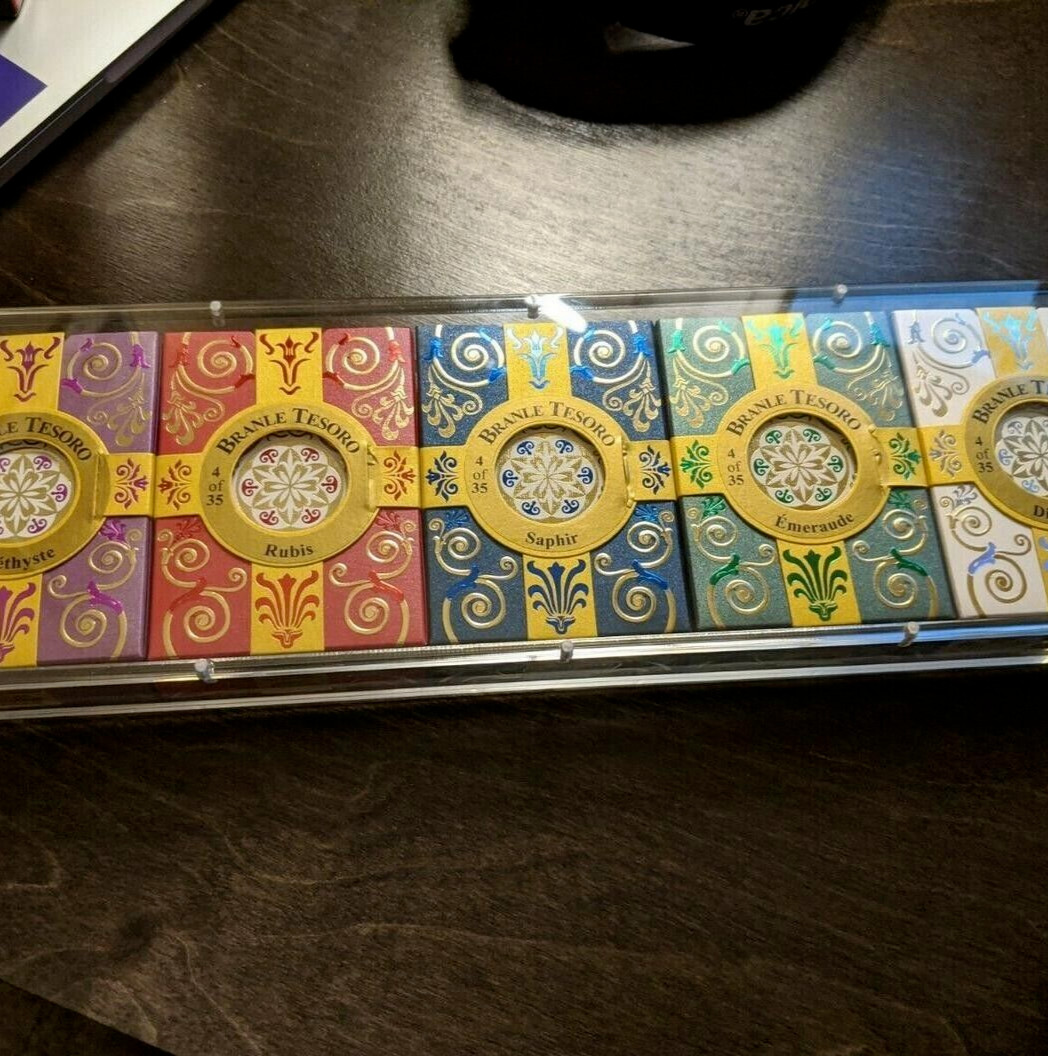
Third edition - Tesoro, symbolizes wellness, riches and treasures of European monarch families.
Card stock and finish are the same as original and Royal Branle decks.
Tuck box circular cut preview
Each tuck box is inlaid with gemstone, while card backs have corresponding color: red for the ruby, holographic/white - diamond, green - emerald, deep blue - sapphire, violet -amethyst.
Inlaid synthetic RUBY
- Highly detailed artwork, that became classic for whole Branle collection
- 130 decks available: 26 of each style
- Two foils stamped card back
- Two foils stamped pearlescent tuck box
- Round die-cut on tuck box back side
- Numbered seals
- Custom shaped tuck jacket, foil stamped
- Gemstone inlaid tuck
Box foiling pattern
Jacket foiling pattern
A ruby (French \"rubis\") is a pink to blood-red colored gemstone, a variety of the mineral corundum. The red color is caused mainly by the presence of the element chromium. Its name comes from ruber, Latin for red. Other varieties of gem-quality corundum are called sapphires.
Ruby is considered one of the four precious stones, together with sapphire, emerald and diamond
Close-up of pearlescent texture of cardstock
The word \"emerald\" is derived (via Old French: esmeraude and Middle English: emeraude), from Vulgar Latin: esmaralda/esmaraldus, a variant of Latin smaragdus, which originated in Ancient Greek: σμάραγδος (smaragdos; \"green gem\").
Emerald is regarded as the traditional birthstone for May as well as the traditional gemstone for the astrological signs of Taurus, Gemini, and sometimes Cancer
Close-up of pearlescent texture of cardstock
Etymologically, the English word \"sapphire\" derives from Latin sapphirus, sappirus from Greek σαπφειρος (sappheiros) from Hebrew סַפִּיר (sappir). Some linguists propose that it derives from Sanskrit, Shanipriya (शनिप्रिय), from \"shani\" (शनि) meaning \"Saturn\" and \"priya\" (प्रिय), dear, i.e. literally \"dear to Saturn\"
During the Medieval Ages, European lapidaries came to refer to blue corundum crystal by \"sapphire\", a derivative of the Latin word for blue: \"sapphirus\".
Close-up of pearlescent texture of cardstock
Amethyst is a violet variety of quartz often used in jewelry. The name comes from the ancient Greek ἀ a- (\"not\") and μέθυστος méthystos (\"intoxicated\"), a reference to the belief that the stone protected its owner from drunkenness. The ancient Greeks wore amethyst and made drinking vessels decorated with it in the belief that it would prevent intoxication. It is one of several forms of quartz. Amethyst is a semiprecious stone and is the traditional birthstone for February.
In the Old World, amethyst was considered one of the Cardinal gems, in that it was one of the five gemstones considered precious above all others
Close-up of pearlescent texture of cardstock
A diamond (from the ancient Greek ἀδάμας – adámas, meaning \"unbreakable\", \"proper\", or \"unalterable\") is one of the best-known and most sought-after gemstones. Diamonds have been known to mankind and used as decorative items since ancient times.
Historically, it has been claimed that diamonds possess several supernatural powers:
- A diamond gives victory to he or she who carries it bound on his left arm, no matter the number of enemies.
- Panics, pestilences, enchantments, all fly before it; hence, it is good for sleepwalkers and the insane.
- It deprives lodestone and magnets of their virtue (i.e., ability to attract iron).
- Arabic diamonds are said to attract iron greater than a magnet.
- A diamond\'s hardiness can only be broken by smearing it with fresh goat\'s blood.
- In traditional Hinduism one should avoid contact with a diamond whose surface area is damaged by a crack, a crowfoot, a round, dull, speckled area, or which is black-blue, flat, or is cut other than the (ideal) hexagonal shape.
Close-up of pearlescent texture of cardstock
Synthetic gemstones were used for our decks. These gems are physically, optically and chemically identical to the natural stone, but are created in controlled conditions in a laboratory. Such gemstones are not imitations. Diamonds, rubies, sapphires and emeralds have been manufactured in labs to possess identical chemical and physical characteristics to the naturally occurring variety. Synthetic (lab created) corundum, including ruby and sapphire, is very common and costs less than the natural stones. Whether a gemstone is a natural stone or lab-created (synthetic), the physical characteristics are the same. Lab-created stones tend to have a more vivid color to them, as impurities are not present in a lab and do not modify the clarity or color of the stone, unless added intentionally for a specific purpose.