When you click on links to various merchants on this site and make a purchase, this can result in this site earning a commission. Affiliate programs and affiliations include, but are not limited to, the eBay Partner Network.
Canvas Wall Art - Matte Finish with Hanging Hardware
High-quality canvas wall art with a matte finish. Each canvas includes back hanging hardware for convenient display. The frame is made from radiata pine sourced from renewable forests.
- Materials: Cotton and polyester composite (canvas), pine wood (frame)
- Finish: Matte coating designed for detailed, vibrant images
- Printing: Latex inks that are non-hazardous, non-toxic, and non-flammable
- Backing: Includes pre-installed hanging hardware
- Support: Soft rubber dots on bottom back corners for stability
- Frame: Radiata pine wood sourced from FSC-certified renewable forests
- Tolerance: Slight size deviations possible within ± 1/8 in (3.2 mm)
Care Instructions
- If dust collects, gently wipe with a clean, damp cloth
- Avoid using harsh cleaners or scrubbing the surface
Shipping & Handling
Each canvas print is securely packaged with protective materials to help prevent damage in transit. Tracking is included with all orders.
International buyers: please check local import regulations for canvas art before purchase.
Keywords: canvas wall art, matte canvas print, framed canvas, pine wood frame, wall decor, hanging canvas art, durable canvas print
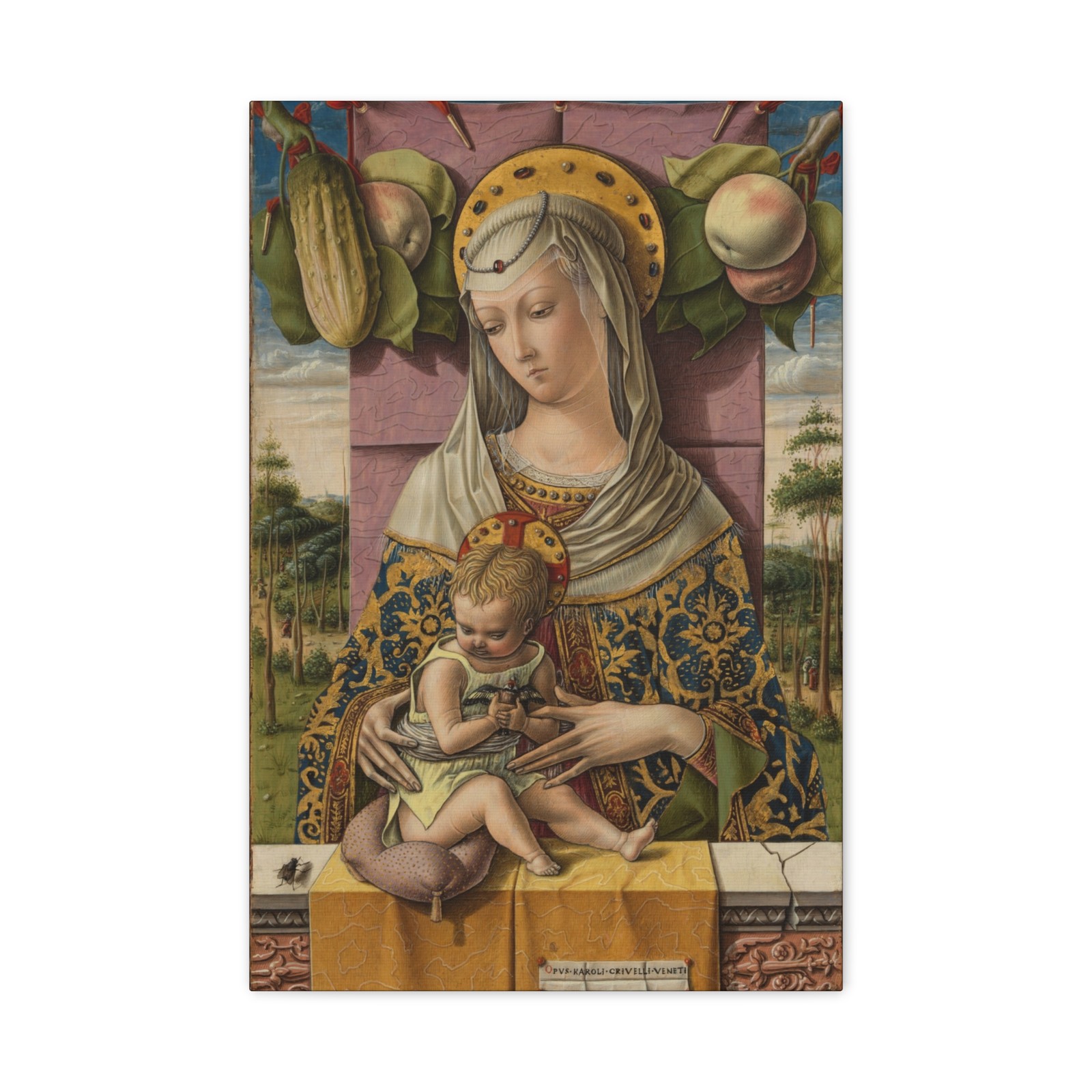
This artwork depicts the Virgin Mary tenderly holding the infant Jesus, a foundational subject in Western religious art known as the Madonna and Child. This intimate portrayal emphasizes the maternal bond between the mother and her son, placing them at the center of a devotional scene intended to inspire piety and reflection in the viewer.
The iconography of this work carries deep theological significance, representing the incarnation and the human nature of Christ. Within the context of the period, such images were essential instruments for religious practice, serving as focal points for private prayer and meditation. The representation of the figures was meant to bridge the gap between the divine realm and the daily experience of the faithful, grounding spiritual concepts in human emotion.
Carlo Crivelli remains one of the most distinctive painters of the early Italian Renaissance. Working primarily in the Marches region, he developed a highly personal style that favored elaborate detail and rigid, linear forms. His output is noted for its decorative complexity and technical rigor, marking a unique evolution away from the mainstream trends of his contemporaries.