When you click on links to various merchants on this site and make a purchase, this can result in this site earning a commission. Affiliate programs and affiliations include, but are not limited to, the eBay Partner Network.
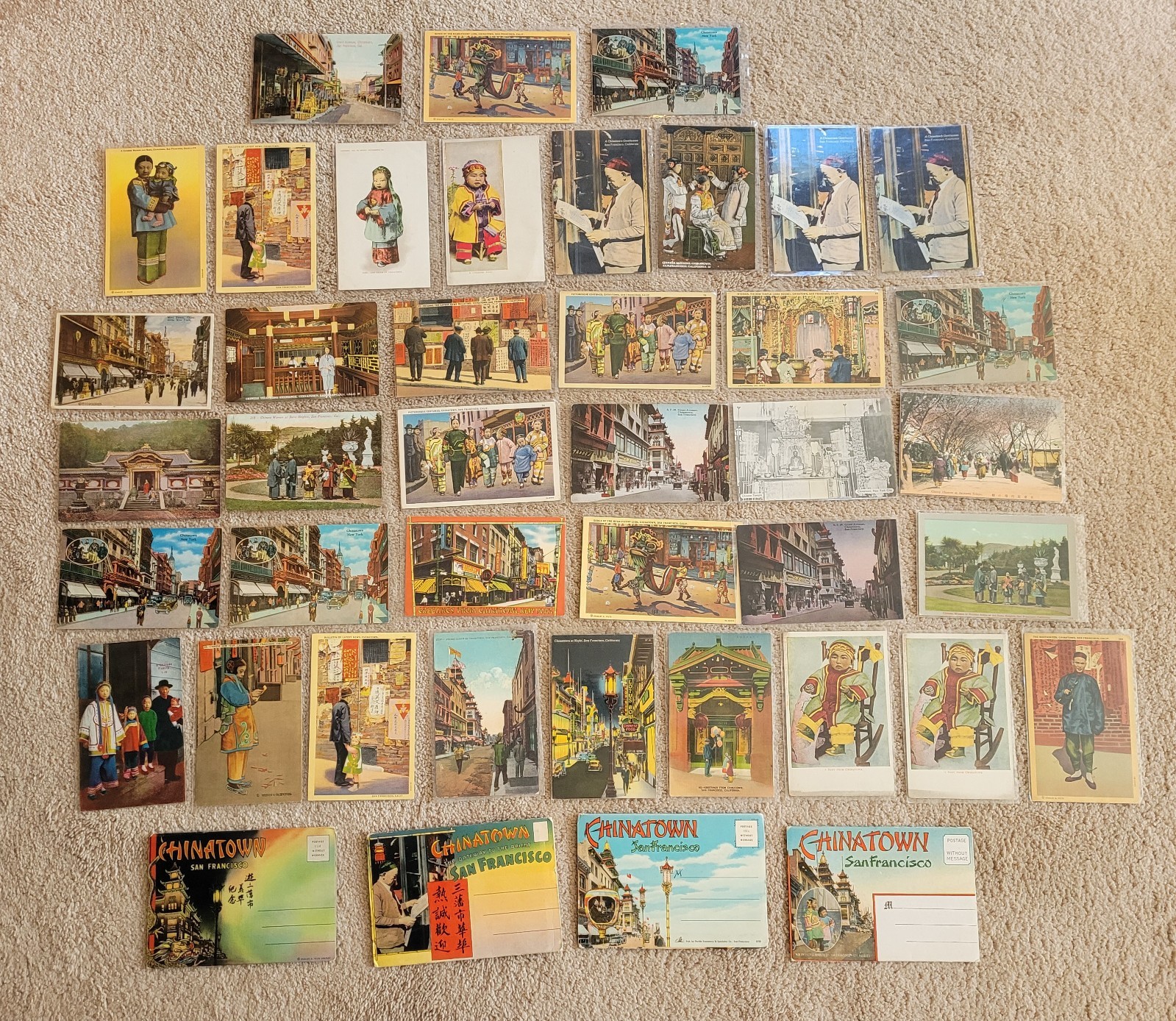
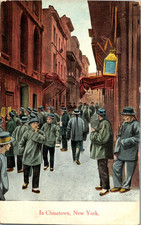
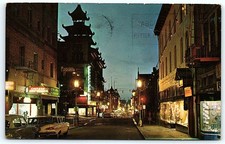
38 individual San Francisco and New York City Chinatown postcards as well as 4 great c1930-40s Chinatown San Francisco CA Folding Postcard Booklet Greetings is a neighborhood in Lower Manhattan, New York City, bordering the Lower East Side to its east, Little Italy to its north, Civic Center to its south, and Tribeca to its west. With an estimated population of 90,000 to 100,000 people, Chinatown is home to the highest concentration of Chinese people in the Western Hemisphere.[4][5] Manhattan\'s Chinatown is also one of the oldest Chinese ethnic enclaves.[6] The Manhattan Chinatown is one of nine Chinatown neighborhoods in New York City,[7] as well as one of twelve in the New York metropolitan area, which contains the largest ethnic Chinese population outside of Asia, comprising an estimated 893,697 uniracial individuals as of 2017.[8]Chinatown is also a densely populated neighborhood, with over 141,000 residents living in its vicinity encompassing 1.7 square miles, \"of which 28.1% identified as Asian\" in 2023.[9][10] Historically, Chinatown was primarily populated by Cantonese speakers. However, in the 1980s and 1990s, large numbers of Fuzhounese-speaking immigrants also arrived and formed a sub-neighborhood annexed to the eastern portion of Chinatown east of The Bowery, which has become known as Little Fuzhou subdivided away from the primarily Cantonese populated original longtime established Chinatown of Manhattan from the proximity of The Bowery going west, known as Little Hong Kong/Guangdong. As many Fuzhounese and Cantonese speakers now speak Mandarin—the official language in Mainland China and Taiwan—in addition to their native languages, this has made it more important for Chinatown residents to learn and speak Mandarin.[11] Although now overtaken in size by the rapidly growing Flushing Chinatown (located in the New York City borough of Queens)[12] and Brooklyn Chinatown, the Manhattan Chinatown remains a dominant cultural force for the Chinese diaspora, as home to the Museum of Chinese in America and as the headquarters of numerous publications based both in the U.S. and China that are geared to overseas Chinese.Chinatown is part of Manhattan Community District 3, and its primary ZIP Codes are 10013 and 10002.[1] It is patrolled by the 5th Precinct of the New York City Police Department.
Location
Boundary approximations
Map
Wikimedia | © OpenStreetMap
About OpenStreetMaps
Maps: terms of use
210m
229yds
11
11 Little Fuzhou
11 Little Fuzhou
10
10 East Broadway station
10 East Broadway station
9
9 Grand Street station
9 Grand Street station
8
8 Confucius Plaza
8 Confucius Plaza
7
7 Chatham Square / Kimlau Square
7 Chatham Square / Kimlau Square
6
6 Church of the Transfiguration
6 Church of the Transfiguration
5
5 Mott & Pell (Little Hong Kong)
5 Mott & Pell (Little Hong Kong)
4
4 Columbus Park / Dr. Sun Yat-sen Plaza
4 Columbus Park / Dr. Sun Yat-sen Plaza
3
3 Museum of Chinese in America
3 Museum of Chinese in America
2
2 Canal Street station
2 Canal Street station
1
1 Pearl River Mart
1 Pearl River Mart
Selected locations in Chinatown, Manhattan Points of interest Parks and open spaces Transit1
Pearl River Mart
2
Canal Street station
3
Museum of Chinese in America
4
Columbus Park / Dr. Sun Yat-sen Plaza
5
Mott & Pell (Little Hong Kong)
6
Church of the Transfiguration
7
Chatham Square / Kimlau Square
8
Confucius Plaza
9
Grand Street station
10
East Broadway station
11
Little FuzhouAlthough a New York Business Improvement District has been identified for support,[13] Chinatown has no officially defined borders. The following streets are commonly considered the approximate borders:[14] Hester Street or Grand Street to the north,[14][15] bordering or overlapping Little Italy
Worth Street to the southwest, bordering Civic Center
East Broadway to the southeast, bordering Two Bridges
Essex Street to the east, bordering or overlapping the Lower East Side
Lafayette Street to the west, bordering TribecaThe historic core of Chinatown is bounded by Chatham Square/Bowery, Worth, Baxter, and Canal.[16]: 304 Mott (south of Canal), Mulberry, Bayard, Pell, Doyers, and Worth were settled by Chinese immigrants starting in the 1870s.[17]: 59, 64 The local branch of the Chinese Consolidated Benevolent Association was founded at 10 Chatham Square in 1883 and later moved to the building at 16 Mott Street, now considered the \"City Hall of Chinatown\".[17]: 67
Citywide demographics
See also: List of U.S. cities with significant Chinese-American populations, Chinese Americans in New York City, and Chinatowns in New York City
Little Fuzhou (on East Broadway) is seen from the Manhattan Bridge.The Manhattan Chinatown is one of nine Chinatown neighborhoods in New York City, as well as one of twelve in the New York metropolitan area, which contains the largest ethnic Chinese population outside of Asia, enumerating an estimated 779,269 individuals as of 2013;[18] the remaining Chinatowns are located in the boroughs of Queens (up to four, depending upon definition)[19] and Brooklyn (three) and in Nassau County, all on Long Island in New York State; as well as in Edison[20] and Parsippany-Troy Hills in New Jersey. In addition, Manhattan\'s Little Fuzhou, an enclave populated primarily by more recent Chinese immigrants from the Fujian Province of China, is technically considered a part of Manhattan\'s Chinatown, albeit now developing a separate identity of its own.A new and rapidly growing Chinese community in East Harlem, Uptown Manhattan, nearly tripled in population between the years 2000 and 2010, according to U.S. Census figures.[21][22][23][24] This neighborhood has been described as the precursor to a new satellite Chinatown within Manhattan itself,[25] which upon acknowledged formation would represent the second Chinese neighborhood in Manhattan, the tenth large Chinese settlement in New York City, and the twelfth within the overall New York City metropolitan region.As the city proper with the largest ethnic Chinese population outside of Asia by a wide margin, estimated at 628,763 as of 2017,[26] and as the primary destination for new Chinese immigrants,[27] New York City is subdivided into official municipal boroughs, which themselves are home to significant Chinese populations, with Brooklyn and Queens, adjacently located on Long Island, leading the fastest growth.[28][29] After the City of New York itself, the boroughs of Queens and Brooklyn encompass the largest Chinese populations, respectively, of all municipalities in the United States.
Chinese Americans in New York City[30] borough Chinese Americans residents
percent number
Queens 10.2 265,135
Brooklyn 7.9 222,059
Manhattan 6.6 119,208
Staten Island 2.9 27,707
The Bronx 0.5 7,859
New York City 573,388
History
Ah Ken and early Chinese immigration
Main article: Ah Ken
Historical population Census Pop. Note %±
1990 51,439 —
2000 59,320 15.3%
2010 52,613 −11.3%
Asian American population[31]Ah Ken is claimed to have arrived in the area during the 1850s; he is the first Chinese person credited as having permanently immigrated to Chinatown. As a Cantonese businessman, Ah Ken eventually founded a successful cigar store on Park Row.[32][33][34][35] He first arrived around 1858 in New York City, where he was \"probably one of those Chinese mentioned in gossip of the sixties [1860s] as peddling \'awful\' cigars at three cents apiece from little stands along the City Hall park fence – offering a paper spill and a tiny oil lamp as a lighter\", according to author Alvin Harlow in Old Bowery Days: The Chronicles of a Famous Street (1931).[33]In the 1850s, the California Gold Rush brought a wave of Chinese immigration to the United States. Approximately 25,000 Chinese immigrants left their homes in search for gam saan (\"gold mountain\") in California.[36] In New York, immigrants found work as \"cigar men\" or carrying billboards, and Ah Ken\'s particular success encouraged cigar makers William Longford, John Occoo, and John Ava to also ply their trade in Chinatown, eventually forming a monopoly on the cigar trade.[37] It has been speculated that it may have been Ah Ken who kept a small boarding house on lower Mott Street and rented out bunks to the first Chinese immigrants to arrive in Chinatown. It was with the profits he earned as a landlord, earning an average of $100 per month, that he was able to open his Park Row smoke shop around which modern-day Chinatown would grow.[32][34][38][39]
Chinese exclusion period
Doyers Street in an 1898 postcard
Doyers Street in Chinatown in 1938In 1873, the United States entered a period of economic difficulty known as the Long Depression.[40] As a result, Americans increasingly competed for jobs that were typically performed by Chinese immigrants. The period was marked by increased racial discrimination, anti-Chinese riots (particularly in California),[41] and new laws that prevented participation in many occupations on the U.S. West Coast. Consequently, many Chinese immigrants moved to the East Coast cities in search of employment.Early businesses in East Coast cities included hand laundries and restaurants. Chinatown started on Mott, Park (now Mosco), Pell, and Doyers Streets, east of the notorious Five Points district. By 1870 there was a Chinese population of 200. By 1882, when the Chinese Exclusion Act was passed, the population was up to 2,000 residents. In 1900, the US Census reported 7,028 Chinese males in residence, but only 142 Chinese women. This significant gender inequality remained until the repeal of the Chinese Exclusion Act in 1943.[42] Wenfei Wang, Shangyi Zhou, and C. Cindy Fan, authors of \"Growth and Decline of Muslim Hui Enclaves in Beijing\", wrote that because of immigration restrictions, Chinatown continued to be \"virtually a bachelor society\" until 1965.[43]
The landmark On Leong Building (曼哈頓華埠) at the intersection of Canal Street and Mott Street in ChinatownThe early days of Chinatown were dominated by Chinese \"tongs\" (now sometimes rendered neutrally as \"associations\"), which were a mixture of clan associations, landsman\'s associations, political alliances (Kuomintang (Nationalists) vs Chinese Communist Party), and more secretly, crime syndicates. The associations started to give protection from anti-Chinese harassment. Each of these associations was aligned with a street gang. The associations were a source of assistance to new immigrants, giving out loans, aiding in starting businesses, and so forth. The associations formed a governing body named the Chinese Consolidated Benevolent Association. Though this body was meant to foster relations between the Tongs, open warfare periodically flared between the On Leong and Hip Sing tongs. Much of the Chinese gang warfare took place on Doyers street. Gangs like the Ghost Shadows and Flying Dragons were prevalent until the 1990s. The Chinese gangs controlled certain territories of Manhattan\'s Chinatown. The On Leong and its affiliate Ghost Shadows were of Cantonese and Toishan descent, and controlled Mott, Bayard, Canal, and Mulberry Streets. The Flying Dragons and its affiliate Hip Sing also of Cantonese and Toishan descent controlled Doyers, Pell, Bowery, Grand, and Hester Streets. Other Chinese gangs also existed, like the Hung Ching and Chih Kung gangs of Cantonese and Toishan descent, which were affiliated with each other and also gained control of Mott Street. Born to Kill, also known as the Canal Boys, a gang composed almost entirely of Vietnamese immigrants from the Vietnam War under the leadership of David Thai had control over Broadway, Canal, Baxter, Centre, and Lafayette Streets.[44] Fujianese gangs also existed, such as the Tung On gang, which affiliated with Tsung Tsin, and had control over East Broadway, Catherine and Division Streets and the Fuk Ching gang affiliated with Fukien American controlled East Broadway, Chrystie, Forsyth, Eldridge, and Allen Streets. At one point, a gang named the Freemasons gang, which was of Cantonese descent, had attempted to claim East Broadway as its Park, the only park in Chinatown, was built in 1897 on what was once the center of the infamous Five Points neighborhood. During the 19th century, this was the most dangerous ghetto area of immigrant New York, as portrayed in the book and film Gangs of New York.[49]
Post-1965 reform
A typical scene on Pell Street, 2009In the years after the United States enacted the Immigration and Nationality Act of 1965, allowing many more immigrants from Asia into the country, the population of Chinatown increased dramatically. Geographically, much of the growth occurred in neighborhoods to the north. The Chinatown grew and became more oriented toward families due to the lifting of restrictions.[43] In the earliest years of the existence of Manhattan\'s Chinatown, it had been primarily populated by Taishanese-speaking Chinese immigrants and the borderlines of the enclave was originally Canal Street to the north, Bowery to the east, Worth Street to the south, and Mulberry Street to the west.[citation needed]
Influx of immigrants from Hong Kong and GuangdongAfter 1965, there came a wave of Cantonese speakers from Hong Kong and Guangdong province in mainland China, and Standard Cantonese became the dominant tongue. With the influx of Hong Kong immigrants, it was developing and growing into a Hong Kongese neighborhood, however the growth slowed down later on during the 1980s–90s.[50][51]Through the 1970s and 1980s, the influx of Guangdong and Hong Kong immigrants began to develop newer portions of Manhattan\'s Chinatown going north of Canal Street and then later the east of the Bowery. However, until the 1980s, the western section was the most primarily fully Chinese developed and populated part of Chinatown and the most quickly flourishing busy central Chinese business district with still a little bit of remaining Italians in the very northwest portion around Grand Street and Broome Street, which eventually all moved away and became all Chinese by the 1990s.[52][53][54] Although the portion of Chinatown that is east of the Bowery—which is considered part of the Lower East Side already started developing as being part of Chinatown since the influx of Chinese immigrants started spilling over into that section since the 1960s, however until the 1980s, it was still not developing as quickly as the western portion of Chinatown because the proportion and concentration of Chinese residents in the eastern section during that time was comparatively growing at a slower rate and being more scattered than the western section in addition to the fact that there was a higher proportion of remaining non-Chinese residents consisting of Jewish, Puerto Ricans, and a few Italians and African Americans than Chinatown\'s western section.[55]During the 1970s and 1980s, the eastern portion of Chinatown east of the Bowery was a very quiet section, and despite fears of crime, it was seen as attractive because of the availability of vacant affordable apartments.[56] Chinese female garment workers were especially targets of crime and often left work together to protect each other as they were heading home.[57][58][59][60][61] In May 1985, a gang-related shooting injured seven people, including a 4-year-old boy, at 30 East Broadway in Chinatown. Two males, who were 15 and 16 years old and were members of a Chinese street gang, were arrested and convicted.[62][63][64][65]Many Chinese Vietnamese, Laotian Chinese, Chinese Cambodians, and Malaysian Chinese immigrants also settled into the neighborhood as well.[66][67]Starting in the 1970s, Mandarin-speaking Taiwanese immigrants and then many other Non-Cantonese Chinese immigrants also were arriving into New York City. However, due to the traditional dominance of Cantonese-speaking residents, which were largely working class in Manhattan\'s Chinatown and the neighborhood\'s poor housing conditions, they were unable to relate to Manhattan\'s Chinatown and mainly settled in Flushing, creating a more middle class Mandarin Town and an even smaller one in Elmhurst. As a result, Manhattan\'s Chinatown and Brooklyn\'s emerging Chinatown were able to continue retaining its traditional, almost-exclusive Cantonese society. However, there was already a small and slow-growing Fuzhou immigrant population in Manhattan\'s Chinatown since the 1970s–80s in the eastern section of Chinatown east of the Bowery. In the 1990s, though, Chinese people began to move into some parts of the western Lower East Side, which 50 years earlier was populated by Eastern European Jews and 20 years earlier was occupied by Hispanics.[citation needed]
Little Fuzhou
Main article: Little Fuzhou
The Fukien American Association on East Broadway in Little FuzhouFrom the late 1980s through the 1990s, when a large influx of immigrants from Fuzhou, who largely also spoke Mandarin along with their native Fuzhou dialect began moving into New York City, they were the only exceptional group of Chinese that were non-Cantonese to largely settle into Manhattan\'s Chinatown. Due to the fact that the Chinatown area were mostly populated by Cantonese speakers, the Fuzhou speaking immigrants had a lot of trouble relating to the neighborhood linguistically and culturally and as a result, they settled on the eastern borderline of Manhattan\'s Chinatown east of The Bowery, which during that time was more of an overlapping population of Chinese, Puerto Ricans, and Jewish as well as had significant vacant apartment units and were more affordable than in the more Mandarin-speaking enclaves in Flushing and Elmhurst, and many Fuzhou immigrants had no legal status and being forced into the lowest paying jobs. As they settled in the eastern borderline of Chinatown along East Broadway and Eldridge Street, it became fully part of Chinatown and slowly through the 1990s it would develop into being Little Fuzhou. This has resulted in referring to East Broadway as Fuzhou Street No. 1, which emerged during the late 1980s and early 1990s, and Eldridge Street as Fuzhou Street No. 2, which developed during the mid-1990s and early 2000s. Little Fuzhou became known as a new Chinatown, separate from the older, more Cantonese-dominated Chinatown from The Bowery going west, though there are still a little bit of remaining long time Cantonese residents and businesses in and around what is now the Little Fuzhou enclave.[68][69]: 20 Not only did the Fuzhou immigration influx establish a new portion of Manhattan\'s Chinatown, they contributed significantly in maintaining the Chinese population in the neighborhood. They also played a role in property values increasing quickly during the 1990s, in contrast to during the 1980s, when the housing prices were dropping. As a result, landlords were able to generate twice as much income in Manhattan\'s, Flushing\'s, and Brooklyn\'s Chinatowns.[70]: 114 Since the 2010s, gentrification has been setting into the Chinatown neighborhood including the Little Fuzhou enclave. Large numbers of Fuzhou speakers have been rapidly moving out of Manhattan\'s Chinatown with many shifting to Brooklyn\'s Chinatown in Sunset Park, which has now overwhelmingly taken over as the largest Fuzhou community of New York City. Many Fuzhou owned businesses have now closed with increasing numbers of storefronts becoming vacant in the enclave and is now increasingly becoming quieter with fewer and fewer consumers walking to Brooklyn ChinatownThe increasing Fuzhou influx had shifted into the Brooklyn Chinatown in the Sunset Park section of Brooklyn. This shift replaces the Cantonese population throughout Brooklyn\'s Sunset Park Chinatown significantly more rapidly than in Manhattan\'s Chinatown.[81] Gentrification in Manhattan\'s Chinatown has slowed the growth of Fuzhou immigration as well as the growth of Chinese immigrants to Manhattan in general,[82][83] which is why New York City\'s rapidly growing Chinese population has now shifted primarily to the boroughs of Queens and Brooklyn.Some Chinese landlords in Manhattan, especially the many real estate agencies that are mainly of Cantonese ownership, were accused of prejudice against the Fuzhou immigrants, supposedly making Fuzhou immigrants feel unwelcome because concerns that they would not be able to pay rent or debt to gangs that may have helped smuggled them in illegally into the United States, and because of fear that gangs will come up to the apartments to cause trouble.[70]: 108 [84] There is also supposedly a concern that Fujianese are more likely to make the apartments too overcrowded by subdividing an apartment into multiple small spaces to rent to other Fuzhou immigrants. This could also be particularly seen on East Broadway.[85]Although Mandarin is spoken as a native language among only 10 percent of Chinese speakers in Manhattan\'s Chinatown, it is used as a secondary dialect among the greatest number of them. Although Min Chinese, especially the Fuzhou dialect, is spoken natively by a third of the Chinese population in the city, it is not used as a lingua franca because speakers of other dialect groups do not learn Min.[86]
Little Hong Kong/Guangdong
Main article: Mott Street § Little Hong Kong#Guangdong
Chinese New Year celebration in ChinatownAs the epicenter of the massive Fuzhou influx has shifted to Brooklyn in the 2000s, Manhattan\'s Chinatown\'s Cantonese population remains viable and large and successfully continues to retain its stable Cantonese community identity, maintaining the communal gathering venue established decades ago in the western portion of Chinatown, to shop, work, and socialize—in contrast to the Cantonese population and community identity which are shifting from Brooklyn\'s original Sunset Park Chinatown to the satellite Chinatowns in Brooklyn.Although the term Little Hong Kong was used a long time ago to describe Manhattan\'s Chinatown relating to when an influx of Hong Kong immigrants was pouring in at that time and even though not all Cantonese immigrants come from Hong Kong, this portion of Chinatown has heavy Cantonese characteristics, especially with the Standard Cantonese, which is spoken in Hong Kong and Guangzhou, China being widely used, so it is in many ways a Little Hong Kong.A more appropriate term would be Little Guangdong-Hong Kong or Cantonese-Hong Kong Town since the Cantonese immigrants do come from different regions of the Guangdong province of China including Hong Kong. The long-time established Cantonese Community, which can be considered Little Hong Kong/Guang Dong or known as the Old Chinatown of Manhattan lies along Mott, Pell, Doyer, Bayard, Elizabeth, Mulberry, Canal, and Bowery Streets, within Manhattan\'s Chinatown.[52][53]Newer satellite Little Guangdong-Hong Kong has started to emerge in sections of Bensonhurst and Sheepshead Bay/Homecrest in Brooklyn. However, there are more scattered and mixed in with other ethnic enclaves. This is a result of many Cantonese residents migrating to these neighborhoods. Bensonhurst carries the majority of Brooklyn\'s Cantonese enclaves/population. Originally, the Sunset Park Chinatown was a small satellite of Manhattan\'s Western Cantonese Chinatown, but since the 2000s, Cantonese speakers in Brooklyn have been largely shifting to and concentrating in Bensonhurst and Sheepshead Bay/Homecrest while the Sunset Park Chinatown has largely grown into being a very large Fuzhou speaking relationsThe Fuzhou immigration pattern started out in the 1970s, like the Cantonese immigration during the late 1800s to early 1900s that had established Manhattan\'s Chinatown on Mott Street, Pell Street, and Doyers Street. The immigrants were initially mostly men who later brought their families over. The beginning influx of Fuzhou immigrants arriving during the 1980s and 1990s were entering into a Chinese community that was extremely Cantonese dominated. Due to the Fuzhou immigrants having no legal status and inability to speak Cantonese, many were denied jobs in Chinatown as a result, causing many of them to resort to crimes. There was a lot of Cantonese resentment against Fuzhou immigrants arriving into and culture
Street fairs are common in ChinatownIn 2000, most of Chinatown\'s residents came from Asia. That year, the number of residents was 84,840, and 66% of them were Asian.[96]
DemographicsThe census tabulation area for Chinatown is bounded to the north by Houston Street; to the east by Avenue B, Norfolk Street, Essex Street and Pike Street; to the south by Frankfort Street; and to the west by Centre Street and Bowery. Based on data from the 2010 United States Census, the population of Chinatown was 47,844, a change of −4,531 (−9.5%) from the 52,375 counted in 2000. Covering an area of 332.27 acres (134.46 ha), the neighborhood had a population density of 144 inhabitants per acre (92,000/sq mi; 36,000/km2).[2] The racial makeup of the neighborhood was 16.3% (7,817) White, 4.8% (2,285) African American, 0.1% (38) Native American, 63.9% (30,559) Asian, 0% (11) Pacific Islander, 0.2% (75) from other races, and 1.3% (639) from two or more races. Hispanic or Latino of any race were 13.4% (6,420) of the population.[3]The racial composition of Chinatown changed substantially from 2000 to 2010, with the most significant changes being the increase in the White population by 42% (2,321), the decrease in the Asian population by 15% (5,461), and the decrease in the Hispanic / Latino population by 15% (1,121). The Black population decreased by 3% (62) and remained a small minority, while the very small population of all other races decreased by 21% (208).[97]Chinatown lies in Manhattan Community District 3, which encompasses Chinatown, the East Village, and the Lower East Side. Community District 3 had 171,103 residents as of NYC Health\'s 2018 Community Health Profile, with an average life expectancy of 82.2 years.[98]: 2, 20 This is higher than the median life expectancy of 81.2 for all New York City neighborhoods.[99]: 53 (PDF p. 84) Most residents are adults: a plurality (35%) are between the ages of 25 and 44, while 25% are between 45 and 64, and 16% are 65 or older. The ratio of youth and college-aged residents was lower, at 13% and 11%, respectively.[98]: 2 As of 2017, the median household income in Community District 3 was $39,584.[100] In 2018, an estimated 18% of Community District 3 residents lived in poverty, compared to 14% in all of Manhattan and 20% in all of New York City. One in twelve residents (8%) were unemployed, compared to 7% in Manhattan and 9% in New York City. Rent burden, or the percentage of residents who have difficulty paying their rent, is 48% in Community District 3, compared to the boroughwide and citywide rates of 45% and 51% respectively. Based on this calculation, as of 2018, Community District 3 is considered to be gentrifying: according to the Community Health Profile, the district was low-income in 1990 and has seen above-median rent growth up to 2010.[98]: 7 The New York City Department of City Planning released updated 2020 census data on the Asian population of New York City. Manhattan\'s Chinatown has only 27,200 Asian residents, compared to the neighborhoods of Bensonhurst, Brooklyn (46,000); Sunset Park, Brooklyn (31,400); Flushing, Queens (54,200); and Elmhurst, Queens cultural standardsDespite the more recently emerged large Fuzhou population, many of the Chinese businesses in Chinatown are still Cantonese owned. The Cantonese dominated western section of Chinatown also continues to be the main busy Chinese business district. As a result, it has influenced many Fuzhounese to learn Cantonese for businesses, especially large businesses like the Dim Sum restaurants on what is known as Little Fuzhou on East Broadway.[91][106][107] The Fuzhounese, the subgroup of non-Cantonese-speaking Chinese with the most interactions with Cantonese, also constitute the majority of non-native Cantonese-speaking Chinese. Many of the Fuzhou immigrants in the 1980s and early 1990s learned to speak Cantonese to maintain jobs and communicate with the Cantonese-speaking population in addition to the fact many of the earlier Fuzhou immigrants had lived in Hong Kong adapting into the Hong Kong culture and speaking Cantonese, which gave them better advantages to integrating into the Chinatown community as it was still very dominantly Cantonese speaking.[108] However, since the 2000s, newer Chinese immigrants have largely spoken Mandarin Chinese, the national language of China.[46]: 38 [11]A significant difference between the two separate Chinese provincial communities in Manhattan\'s Chinatown is that the Cantonese part of Chinatown not only serves Chinese customers but is also a tourist attraction. However, the Fuzhou part of Chinatown caters less to tourists.[109][110] Bowery, Chrystie Street, Catherine Street, and Chatham Square encompass the approximate border zone between the Fuzhou and Cantonese communities in Manhattan\'s Chinatown.[69]: 112 Unlike most other urban Chinatowns, Manhattan\'s Chinatown is both a residential area as well as commercial area. Many population estimates are in the range of 90,000 to 100,000 residents.[111][112][113][114] One analysis of census data in 2011 showed that Chinatown and heavily Chinese tracts on the Lower East Side had 47,844 residents in the 2010 census, a decrease of nearly 9% since 2000.[115]
Gentrification and decline in Chinese population
A Chinese lion during Chinese New Year festivities on Mott St. near Worth St.By 2007, luxury condominiums began to spread from SoHo into Chinatown. Previously, Chinatown was noted for its crowded tenements and primarily Chinese residents. While some projects have targeted the Chinese community, the development of luxury housing has increased Chinatown\'s economic and cultural diversity.[116] A 2021 N.Y.U Furman poll found that the racial and ethnic composition of Asian identifying individuals within the community dropped from 34.8% in 2000 to 28.1% in 2021, a 6.7% decrease.[9]Since the early 2000s, there has been a continuously increasing number of buildings in Chinatown, neighboring Two Bridges, and the Lower East Side, taken over by new landlords and real estate developers, who then charged higher rents and/or demolished the buildings to build newer structures.[82] Often, whenever this happens, many Fuzhounese tenants are more likely to be evicted, especially in the eastern portion of Chinatown, where illegal subdivision, overcrowding, lack of leases, and lack of immigrant paperwork are common. In addition, since the 2000s, there have been city officials inspecting apartment buildings and cracking down on illegal units. With tenants that have rent-stabilized leases, legal residency documents, no apartment subdivisions, and a lesser probability of subletting over capacity—most of whom are long-time Cantonese residents—it is usually harder for the newer landlords to be able to force these tenants out, especially including the western portion of Chinatown, which is still mainly Cantonese populated. However, newer landlords still continuously try find other loopholes to force them out.[117]By 2009, many newer Chinese immigrants settled along East Broadway instead of the historic core west of Bowery. In addition Mandarin began to eclipse Cantonese as the predominant Chinese dialect in New York\'s Chinatown during the period. The New York Times says that the Flushing Chinatown now rivals Manhattan\'s Chinatown in terms of being a cultural center for Chinese-speaking New Yorkers\' politics and trade.[11]
Current status as Chinese shopping business districtDespite the area\'s gentrification, it is still a popular Chinese commercial shopping district, frequented by residents of the New York metropolitan area as well as tourists. In addition, high-income professionals are moving into the area and patronizing Chinese businesses.[118] However, commercial activity is not concentrated evenly through Chinatown. The western half of Chinatown (the original Cantonese Chinatown), known as Little Hong Kong/Guangdong, is still relatively active. However, the eastern/southern part of Chinatown, known as Little Fuzhou, has become primarily residential, and thus, the most primarily affected by the decline in business. Businesses in Little Fuzhou may be affected by the spread of gentrification from the nearby Lower East Side and East Village.[118][119]In 2016, the oldest continuously run business in Manhattan\'s Chinatown was up for sale: Wing on Wo and Co, established in 1890. The building was worth around $10 million, including six stories and a store front, one of the only buildings left of its kind in the area. Mei Lum, a grandchild of the original owner, stepped in before the sale and took over the business to preserve its history and position within the neighborhood, to \"regenerate, encourage and protect\" Chinatown\'s culture.[120] Lum started the \"W.O.W. Project\", which hopes to \"preserve Chinatown\'s creative scene through art and activism\".[121] Events such as Open Mic nights and exhibitions would start conversations about this neighborhood\'s past and the people that have lived there.[122] For example, in February 2020, the W.O.W. Project exhibited ethnographic research and oral history interviews that highlighted stories of migration, displacement, and everyday resilience in Chinatowns all over the world.[123] In response to the COVID-19 pandemic in New York City, the W.O.W. Project started a project called Love Letters to north on Mott Street at night in 2015. Manhattan\'s Chinatown is home to the highest concentration of Chinese people in the Western Hemisphere.[5]
Economy
A Chinatown grocery store
A fish market in ChinatownChinese greengrocers and fishmongers are clustered around Mott Street, Mulberry Street, Canal Street (by Baxter Street), and all along East Broadway (especially by Catherine Street). The Chinese jewelers\' district is on Canal Street between Mott and Bowery. There are many Asian and American banks in the neighborhood. Canal Street, west of Broadway (especially on the Northside), is filled with street vendors selling knock-off brands of perfumes, watches, and handbags. This section of Canal Street was previously the home of warehouse stores selling surplus/salvage electronics and hardware.[citation needed]In addition, tourism and restaurants are major industries. The district boasts many historical and cultural attractions, and it is a destination for tour companies like Manhattan Walking Tour, Big Onion, NYC Chinatown Tours, and Lower East Side History Project.[125] Tour stops often include landmarks like the Church of the Transfiguration and the Lin Zexu and Confucius statues.[126] The enclave\'s many restaurants also support the tourism industry. In Chinatown, more than 300 Chinese restaurants provide employment.[citation needed] Notable and well-reviewed Chinatown establishments include Joe\'s Shanghai, Jing Fong, New Green Bo and Amazing 66.[127]Other contributors to the economy include factories. The proximity of the fashion industry has kept some garment work in the local area, though much of the garment industry has since moved to China. The local garment industry now concentrates on quick production in small volumes and piece work, which is generally done at the worker\'s home. Much of the population growth is due to immigration.[citation needed]The September 11, 2001 attacks caused a decline in business for stores and restaurants in Chinatown. Chinatown was adversely affected by the attacks; being so physically close to Ground Zero, Chinatown saw a very slow return of tourism and business. Part of the reason was the NYPD closure of Park Row, one of two major roads linking the Financial District with Chinatown (the other being Centre Street). However, the area\'s economy, as well as tourism, have rebounded since then. A Chinatown business improvement district was established in 2011 despite opposition from business owners in the community.[115][128]The neighborhood is home to several large Chinese supermarkets. In August 2011, a new branch of New York Supermarket opened on Mott Street in the central district of grocery and food shopping of Manhattan\'s Chinatown.[129] Just a block away from New York Supermarket, is a Hong Kong Supermarket located on the corner of Elizabeth and Hester Streets. These two supermarkets are among the largest Chinese supermarkets carrying all different food varieties within the long-time established Cantonese community in the western section of Manhattan\'s Chinatown.[130] A Hong Kong Supermarket at East Broadway and Pike Street burned down in 2009 and plans to construct a 91-room Marriott Hotel in its place resulted in community protests.[131] The New York Supermarkets chain, which also operates markets in Elmhurst and Flushing, settled with the New York State Attorney General in 2008 in which it paid back wages and overtime to workers.[132] Many of the Chinese restaurant menus in the U.S. are printed in Chinatown, Manhattan.[133]Manhattan\'s Chinatown has had a history of mini malls with varieties of small shops, however due to the gentrification, this trend has been declining. However, two significant well known mini malls in Manhattan\'s Chinatown still exist and stand out the most, which are Elizabeth Center at 13 Elizabeth Street right next to NYPD\'s 5th precinct and East Broadway Mall at 88 East Broadway under the Manhattan Bridge. Elizabeth Center is a Hong Kong style shopping center with varieties of shops with most of them being owned by Cantonese speakers along with some owned by other Chinese speakers as well and is located in the longer time established western Cantonese Chinatown, therefore their customer base are largely Cantonese speakers from the local neighborhoods as well as from other places, however other Chinese speakers from the local area and from other places including Chinese tourists also come to shop at this mini mall. Elizabeth Center also attracts a lot of Non-Asian tourists and visitors and it is often very popular with younger generation customers of Chinese and non-Chinese descents due to the significant concentration of stores that sell varieties of affordable accessories as well as cartoon figure and Action figure Broadway Mall, at 88 East Broadway, was developed in the late 1980s on a city-owned plot of land under the Manhattan Bridge.[144] When East Broadway Mall opened, their storefront owners and customer base were mainly Cantonese speakers as the Chinese speaking population in the area was still very Cantonese speaking, however as early as the 1980s, a Fuzhouese-speaking population already had begun growing in the East Broadway neighborhood, which eventually by the 1990s had slowly grown into a Fuzhou speaking enclave distinct from the original older established Cantonese Chinatown from Bowery Street going west and then reflectively the storefront owners and customer base at East Broadway Mall then slowly shifted to majority Fuzhou speakers. The area\'s Fuzhouese-speaking population has been declining since the 2010s due to gentrification, and many residents relocated to New York City\'s outer boroughs. The COVID-19 pandemic in New York City exacerbated the situation at East Broadway Mall, and the dim sum restaurant upstairs, which had operated for a long time, was Elizabeth Center has done marginally better, and many tenants remained during the COVID-19 pandemic. By contrast, East Broadway Mall went from having around 80 stores to roughly 17 during the pandemic.[151][152] Media sources reported in November 2021 that the New York state government was giving $20 million to revitalize several city-owned properties in the area. Some proposals have been made to convert the interiors of the East Broadway Mall into a community theater, with commercial stores outdoors.[153][154][155] However, Curbed reported in October 2022 that the government grant was being rescinded from East Broadway Mall.[144]
Satellite Chinatowns
Main articles: Chinatowns in Queens, Chinatowns in Brooklyn, and Little FuzhouFor a long time, Manhattan\'s Chinatown has always been the most largely concentrated Chinese population in New York City, a city where 6% of the overall population is Chinese American. However, in recent years growing Chinese populations in the outer boroughs have tremendously outnumbered Manhattan\'s Chinese population.[156][157] Other New York City Chinese communities have been settled over the years, including that of Flushing in Queens, particularly along from Roosevelt Avenue to Main Street through Kissena Boulevard.Another Chinese community is located in Sunset Park in Brooklyn, particularly along 8th Avenue from 40th to 65th Streets. New York City\'s newer Chinatowns have recently sprung up in Elmhurst and Corona, Queens (which border each other and are part of the same Chinatown), on Avenue U in the Homecrest section of Brooklyn, as well as in Bensonhurst, also in Brooklyn. Outside of New York City proper, rapidly growing suburban Chinatowns are developing within the New York metropolitan area in nearby Edison, New Jersey and Nassau County, Long Island.[158]While the composition of these satellite Chinatowns are as varied as the original, the political factions in the original Manhattan Chinatown (Tongs, Republic of China loyalists, People\'s Republic of China loyalists, and those apathetic) have led to some factionalization in the satellite Chinatowns.
Satellite Chinatowns\' demographics
Main articles: Flushing Chinatown and Brooklyn ChinatownThe Flushing Chinatown was spearheaded by many Chinese following the Handover of Hong Kong in 1997 as well as Taiwanese who used their considerable capital to buy out the land from the former residents. The Chinatowns of Flushing and Elmhurst are more middle class and were initially mainly small Taiwanese Mandarin-speaking enclaves, but have since grown very large and very diversified with Chinese migrants from many various regions from mainland China also often speaking Mandarin along with their regional dialects. Flushing is now the largest Chinatown of New York City and has taken over as being the main Chinese cultural center due to the very high diversity of Chinese immigrants from many various regions of mainland China and Taiwan.[159][160][161][162]There are three major Brooklyn Chinatowns. Unlike the Chinese enclaves in Queens, which has a very high diversity of Chinese immigrants from various regions of mainland China and Taiwan, the Brooklyn Chinatowns are very segregated into Cantonese dominated enclaves in Bensonhurst and Sheepshead Bay and the Fuzhou dominated enclave in Sunset Park, although with some significant limited population of long-time Cantonese residents. The Sunset Park Chinatown originally emerged as a small Cantonese enclave, but with the large influx of Fuzhou immigrants arriving into Sunset Park since the 2000s, it has grown into becoming the largest Fuzhou Chinatown of New York City, although some Cantonese people remain in the Sunset Park area.[163][87] The Bensonhurst and Sheepshead Bay Chinatowns are primarily Cantonese populated as a result of many of them migrating away from both Chinatowns of Manhattan and Brooklyn Sunset Park including new Cantonese immigration. Bensonhurst Chinatown\'s Chinese population is growing faster than that of Sunset Park. According to the 2010 census information, Bensonhurst and the nearby neighborhood of Bath Beach in Brooklyn together constituted New York City\'s largest concentrated community of Hong Kong Residents (with 3,723 in Bensonhurst and 1,049 in Bath Beach totaling together at 4,772), even though they are very heavily mixed in with the area\'s much larger Cantonese community consisting mostly of Cantonese speaking immigrants from Mainland China\'s Guangdong Province, and although most of the Hong Kong residents are scattered across many other neighborhoods of New York City while only roughly about less than a quarter of New York City\'s Hong Kong residents reside in Bensonhurst/Bath Beach.[164][81][165][166][167]NYC Dept. Of City Planning provided updated 2020 census data on the Asian population of New York City. Bensonhurst now has 46,000 Asian Residents while Sunset Park had 31,400 Asian Residents, which means Bensonhurst now has the highest Asian population of Brooklyn surpassing Sunset Park as the original epicenter of Brooklyn\'s Asian population. The Asian population in Bensonhurst and Sunset Park are still overwhelmingly Chinese residents. Queens neighborhoods of Flushing (54,200 Asian Residents) and Elmhurst(55,800 Asian Residents) still hold the largest Asian populations in all of New York City though. Manhattan\'s Chinatown Asian population ranks at 27,200 Chinese American experience has been documented at the Museum of Chinese in America in Manhattan\'s Chinatown since 1980.For much of Chinatown\'s history, there were few unique architectural features to announce to visitors that they had arrived in the neighborhood (other than the language of the shop signs). In 1962, the Lieutenant Benjamin Ralph Kimlau Memorial archway at Chatham Square was erected in memorial of the Chinese-Americans who died in World War II, designed by local architect Poy Gum Lee (1900–1968).[168] This memorial bears calligraphy by the great Yu Youren (1879–1964). A statue of Lin Zexu, also known as Commissioner Lin, a Foochowese Chinese official who opposed the opium trade, is also located at the square; it faces uptown along East Broadway, now home to the bustling Fuzhou neighborhood and known locally as Fuzhou Street.More decorations and cultural institutions followed. In the 1970s, New York Telephone, then the local phone company, started capping the street phone booths with pagoda-like decorations. In 1976, the statue of Confucius in front of Confucius Plaza became a common meeting place. In the 1980s, banks that opened new branches and others that were renovating started to use Chinese traditional styles for their building facades. The Church of the Transfiguration, a national historic site built in 1815, stands off Mott Street. The Chinese American experience has been documented at the Museum of Chinese in America in Manhattan\'s Chinatown since 1980. In addition, Pearl River Mart, which opened in 1971, has become one of the more notable family-owned stores in Chinatown.In 2010, Chinatown and Little Italy were listed in a single historic district on the National Register of Historic Places.[169]
Housing
Confucius Plaza, a 44-story subsidized housing cooperative, above typical Chinatown housing stock.The housing stock of Chinatown is still mostly composed of cramped tenement buildings, some of which are over 100 years old. It is still common in such buildings to have bathrooms in the hallways, to be shared among multiple apartments. A federally subsidized housing project, named Confucius Plaza, was completed on the corner of Bowery and Division Street in 1976. This 44-story residential tower block gave much needed new housing stock to thousands of residents. The building also housed a new public grade school, PS 124 (or Yung Wing Elementary). Besides being the first and largest affordable housing complex specifically available to the Chinatown population Confucius Plaza is also a cultural and institutional landmark, springing forth community organization, Asian Americans for Equality (AAFE), one of Chinatown\'s oldest political/community organizations, founded in 1974.
Chinese theaters
The city\'s first Chinese theater, on Doyers StreetIn the past, Chinatown had Chinese movie theaters that provided entertainment to the Chinese population. The first Chinese-language theater in the city was located at 5–7 Doyers Street from 1893 to 1911. The theater was later converted into a rescue mission for the homeless from Bowery. In 1903, the theater was the site of a fundraiser by the Chinese community for Jewish victims of a massacre in Kishinev.[170]Among the theaters that existed in Chinatown in later years were the Sun Sing Theater under the Manhattan Bridge and the Pagoda Theater, both on the street of East Broadway, the Governor Theater on Chatham Square, the Rosemary Theater on Canal Street across the Manhattan Bridge, as well as the Music Palace on the Bowery, which was the last Chinese theater to close. Others have existed in different sections of Chinatown. These theaters now have all closed because of more accessibility to videotapes, which were more affordable and provided more genres of movies and much later on DVDs and VCDs became available. Other factors such as, availability of Chinese cable channels, karaoke bars, and gambling in casinos began to provide other options for the Chinese to have entertainment also influenced the Chinese theaters to go out of business.[171][172][173][174]
Police and crimeChinatown is patrolled by the 5th Precinct of the NYPD, located at 19 Elizabeth Street.[175] The 5th Precinct and the adjacent 7th Precinct ranked 58th safest out of 69 patrol areas for per-capita crime in 2010.[176] As of 2018, with a non-fatal assault rate of 42 per 100,000 people, Chinatown and the Lower East Side\'s rate of violent crimes per capita is less than that of the city as a whole. The incarceration rate of 449 per 100,000 people is higher than that of the city as a whole.[98]: 8 The 5th Precinct has a lower crime rate than in the 1990s, with crimes across all categories that have decreased by 77.1% between 1990 and 2019. The precinct reported 6 murders, 14 rapes, 91 robberies, 210 felony assaults, 101 burglaries, 585 grand larcenies, and 16 grand larcenies auto in 2019.[177]
Fire safety
Quarters of New York City Fire Department Engine Company 9/Ladder Company 6Chinatown is served by two New York City Fire Department (FDNY) fire stations:[178] Engine Company 9/Ladder Company 6 – 75 Canal Street[179]
Engine Company 55/Battalion 2 – 363 Broome Street[180]HealthAs of 2018, preterm births and births to teenage mothers are less common in Chinatown and the Lower East Side than in other places citywide. In Chinatown and the Lower East Side, there were 82 preterm births per 1,000 live births (compared to 87 per 1,000 citywide), and 10.1 teenage births per 1,000 live births (compared to 19.3 per 1,000 citywide).[98]: 11 Chinatown and the Lower East Side have a low population of residents who are uninsured. In 2018, this population of uninsured residents was estimated to be 11%, slightly less than the citywide rate of 12%.[98]: 14 The concentration of fine particulate matter, the deadliest type of air pollutant, in Chinatown and the Lower East Side is 0.0089 milligrams per cubic metre (8.9×10⁻⁹ oz/cu ft), more than the city average.[98]: 9 Twenty percent of Chinatown and Lower East Side residents are smokers, which is more than the city average of 14% of residents being smokers.[98]: 13 In Chinatown and the Lower East Side, 10% of residents are obese, 11% are diabetic, and 22% have high blood pressure—compared to the citywide averages of 24%, 11%, and 28% respectively.[98]: 16 In addition, 16% of children are obese, compared to the citywide average of 20%.[98]: 12 Eighty-eight percent of residents eat some fruits and vegetables every day, which is about the same as the city\'s average of 87%. In 2018, 70% of residents described their health as \"good\", \"very good\", or \"excellent\", less than the city\'s average of 78%.[98]: 13 For every supermarket in Chinatown and the Lower East Side, there are 18 bodegas.[98]: 10 The nearest major hospital is NewYork-Presbyterian Lower Manhattan Hospital in the Civic Center area.[181][182]
Post offices and ZIP Codes
USPS Chinatown StationChinatown is located within two primary ZIP Codes. The area east of Bowery is part of 10002, while the area west of Bowery is part of 10013.[183] The United States Postal Service operates two post offices in Chinatown: Chinatown Station – 6 Doyers Street[184]
Knickerbocker Station – 128 East Broadway[185]EducationChinatown and the Lower East Side generally have a higher rate of college-educated residents than the rest of the city as of 2018. A plurality of residents age 25 and older (48%) have a college education or higher, while 24% have less than a high school education and 28% are high school graduates or have some college education. By contrast, 64% of Manhattan residents and 43% of city residents have a college education or higher.[98]: 6 The percentage of Chinatown and the Lower East Side students excelling in math rose from 61% in 2000 to 80% in 2011 and reading achievement increased from 66% to 68% during the same period.[186]Chinatown and the Lower East Side\'s rate of elementary school student absenteeism is lower than the rest of New York City. In Chinatown and the Lower East Side, 16% of elementary school students missed twenty or more days per school year, less than the citywide average of 20%.[99]: 24 (PDF p. 55) [98]: 6 Additionally, 77% of high school students in Chinatown and the Lower East Side graduate on time, more than the citywide average of 75%.[98]: 6
Schools
New York Public Library, Chatham Square branchResidents are zoned to schools in the New York City Department of Education. PS 124, The Yung Wing School is located in Chinatown.[187] It was named after Yung Wing, the first Chinese person to study at Yale University.[188] PS 130 Hernando De Soto is located in Chinatown.[189] PS 184 Shuang Wen School, a bilingual Chinese-English School which opened in 1998, is a non-zoned school in proximity to Chinatown.[190]
LibraryThe New York Public Library (NYPL) operates the Chatham Square branch at 33 East Broadway. The branch was founded in 1899; the current Carnegie library building opened in 1903 and was renovated in 2001. The four-story library contains a large Chinese collection, which has been housed at the library since 1911.[191]
TransportationThere are two New York City Subway stations that are directly in the neighborhood—Grand Street (B and D) and Canal Street (4, 6, <6>, J, N, Q, R, W, and Z)—although the East Broadway station on the F train is located on the eastern part of Chinatown while other stations are also nearby.[192] New York City Bus routes include M9, M15, M15 SBS, M22, M55, M103.[193]The Manhattan Bridge connects Chinatown to Downtown Brooklyn. The FDR Drive runs along the East River, where the East River Greenway, a pedestrian walkway and bikeway, is also present.[194]The major cultural streets are Mott Street and East Broadway; on the other hand, Canal Street, Allen Street, Delancey Street, Grand Street, East Broadway, and Bowery are the main traffic arteries.There are multiple bike lanes in the area as well.[195]
Street names in Chinese
Bilingual signage of Baxter Street
Elizabeth Street, co-named Pvt. Danny Chen WayStreets in Chinatown also have Chinese names, which are noted on bilingual street signs in Chinatown. Prior to the 1960s, Chinatown residents named the streets informally, and streets could carry several Chinese names.[196] The first bilingual street signs installed by the city government were placed on police call boxes in 1966.[197] The first 44 bilingual street signs, displaying the street name in English with a smaller street name in Chinese below, were installed in 1969.[198] These signs were installed in an area bounded by Canal Street to the north, Bowery to the east, Chatham Square to the southeast, Worth Street to the south, and Mulberry Street to the west. The street names were selected to match phonetic transliterations of English names in Taishanese and Cantonese, the two Chinese varieties most frequently spoken in Chinatown at the time. As different Chinese varieties may have widely varying pronunciations for the same word, the signs did not account for pronunciations in Mandarin and Fujianese, the varieties spoken by many immigrants who came in the 1970s.[196]In the early 1980s, the program was expanded following an effort by urban planner Jerry S. Y. Cheng and Chinese Consolidated Benevolent Association (CCBA) president Li Boli. The New York City Department of Transportation commissioned a study in 1985 to identify places for new signs, but most records have been lost or destroyed. The expansion would have extended the signs north to Broome Street, east to Allen and Pike Streets, southeast to Madison Street (between Oliver and Pike Streets), and west to Lafayette Street. The newer street names were proposed by CCBA members and affiliated merchants, who mostly spoke Taishanese and Cantonese. Calligrapher Tan Bingzhong manually wrote the Chinese characters on street signs for 40 streets, leading to slight variations in each sign.[196]While there were 155 street signs at the program\'s peak, only 101 signs remained as of 2022, and almost half of the 40 streets no longer have bilingual signs. A New York Times analysis of the program found that many damaged signs were replaced with English-only signs, as translated street names are not part of the Manual on Uniform Traffic Control Devices, or else were not replaced at all. Furthermore, many of the people involved in the street-sign programs during the 1960s and 1980s had died, and the relocation of the neighborhood\'s Chinese residents had shrunken the area\'s Chinese presence over time. According to the Times, there was little awareness in the neighborhood that the bilingual signs were disappearing, even among community leaders.[196]
Street Traditional Chinese Mandarin Pinyin Cantonese Jyutping
Allen Street 亞倫街[199] Yǎlún Jiē Aa3 leon4 Gaai1
Baxter Street 巴士特街[199] Bāshìtè Jiē Baa1 si6 dak6 Gaai1
Bayard Street 擺也街[199] Bǎiyě Jiē Baai2 jaa5 Gaai1
Bowery 包厘街[199] Bāolí Jiē Baau1 lei4 Gaai1
Broadway 百老匯大道[199] Bǎilǎohuì Dàdào Baak3 lou5 wui6 Daai6 dou6
Broome Street 布隆街[199] Bùlóng Jiē Bou3 lung4 Gaai1
Canal Street 堅尼街[199] Jiānní Jiē Gin1 nei4 Gaai1
Catherine Street 加薩林街[199] Jiāsàlín Jiē Gaa1 saat3 lam4 Gaai1
Centre Street 中央街[199] Zhōngyāng Jiē Zung1 joeng1 Gaai1
Chambers Street 錢伯斯街[199] Qiánbósī Jiē Cin2 baak3 si1 Gaai1
Chatham Square 且林士果[199] Qiělín Shìguǒ Ce2 lam4 Si6 gwo2
Cherry Street 車厘街[199] Chēlí Jiē Ce1 lei4 Gaai1
Chrystie Street 企李士提街[199] Qǐlǐshìtí Jiē Kei5 lei5 si6 tai4 Gaai1
Delancey Street 地蘭西街[199] Dìlánxī Jiē Dei6 laan4 sai1 Gaai1
Division Street 地威臣街[199] Dìwēichén Jiē Dei6 wai1 san4 Gaai1
Doyers Street 宰也街[199] Zǎiyě Jiē Zoi2 jaa5 Gaai1
East Broadway (Little Fuzhou) 東百老匯 (小福州)[199] Dōng Bǎilǎohuì (Xiǎo Fúzhōu) Dung1 Baak3 lou5 wui6 (Siu2 Fuk1 zau1)
Eldridge Street 愛烈治街[199] Àilièzhì Jiē Oi3 lit6 zi6 Gaai1
Elizabeth Street (Private Danny Chen Way) 伊利莎白街 (陳宇暉路)[199] Yīlìshābái Jiē (Chén Yǔhuī Lù) Ji1 lei6 saa1 baak6 Gaai1 (Can4 Jyu5 fai1 Lou6)
Forsyth Street 科西街[199] Kēxī Jiē Fo1 sai1 Gaai1
Grand Street 格蘭街[199] Gélán Jiē Gaak3 laan4 Gaai1
Henry Street 顯利街[199] Xiǎnlì Jiē Hin2 lei6 Gaai1
Hester Street 喜士打街[199] Xǐshìdǎ Jiē Hei2 si6 daa2 Gaai1
Ludlow Street 拉德洛街[199] Lādéluò Jiē Laai1 dak1 lok6 Gaai1
Madison Street 麥地遜街[199] Màidìxùn Jiē Mak6 dei6 seon3 Gaai1
Market Street 市場街[199] Shìchǎng Jiē Si5 coeng4 Gaai1
Monroe Street 門羅街[199] Ménluó Jiē Mun4 lo4 Gaai1
Mosco Street 莫斯科街[199] Mòsīkē Jiē Mok6 si1 fo1 Gaai1
Mott Street (Little Hong Kong, Little Guangdong) 勿街(小香港, 小廣東)[199]
Wù Jiē(Xiǎo Xiānggǎng, Xiǎo Guǎngdōng)
Mat6 Gaai1(Siu2 Hoeng1 gong2, Siu2 Gwong2 dung1)
Mulberry Street 摩比利街[199] Móbǐlì Jiē Mo1 bei2 lei6 Gaai1
Orchard Street 柯察街[199] Kēchá Jiē O1 caat3 Gaai1
Park Row 柏路[199] Bǎi Lù Paak3 Lou6
Pell Street 披露街[199] Pīlù Jiē Pei1 lou6 Gaai1
Pike Street 派街[199] Pài Jiē Paai3 Gaai1
Rutgers Street 羅格斯街[199] Luógésī Jiē Lo4 gaak3 si1 Gaai1
South Street 南街 Nán Jiē Naam4 Gaai1
Water Street 水街 Shuǐ Jiē Seoi2 Gaai1
Worth Street 窩夫街[199][200] Wōfū Jiē Wo1 fu1 Gaai1
White Street 白街 Bái Jiē Baak6 Gaai1
See also Chinatowns in the United States
Chinese people in New York City
Chinatowns in the Americas#New York City
Other Chinatowns in NYC:
Little Fuzhou
Chinatowns in Queens:
Chinatown, Flushing
Chinatown, Elmhurst
Corona, Queens
Whitestone, Queens
Chinatowns in Brooklyn:
Chinatown, Brooklyn
Chinatown, Avenue U
Chinatown, BensonhurstThe Chinatown centered on Grant Avenue and Stockton Street in San Francisco, California, (Chinese: 唐人街; pinyin: tángrénjiē; Jyutping: tong4 jan4 gaai1) is the oldest Chinatown in North America and the largest Chinese enclave outside Asia. It is also the oldest and largest of the four notable Chinese enclaves within San Francisco.[3][4][5] Since its establishment in 1848,[6] it has been highly important and influential in the history and culture of ethnic Chinese immigrants in North America. Chinatown is an enclave that continues to retain its own customs, languages, places of worship, social clubs, and identity. There are two hospitals, several parks and squares, numerous churches, a post office, and other infrastructure. Recent immigrants, many of whom are elderly, opt to live in Chinatown because of the availability of affordable housing and their familiarity with the culture.[7] San Francisco\'s Chinatown is also renowned as a major tourist attraction, drawing more visitors annually than the Golden Gate Bridge.[8]Contents1 Geography and location2 Demographics2.1 Demographic history3 History3.1 Origins: 1850s3.1.1 Guangdong pioneers3.1.2 Associations and institutions3.1.3 Prostitution and ill repute3.1.4 Ah Toy3.2 1870s to the 1906 earthquake3.2.1 Chinese Exclusion Acts3.2.2 Tong wars3.2.3 Bubonic plague3.3 1906 to the 1960s3.3.1 Relocation Attempt3.3.2 Rebuilding3.3.3 Nightlife3.3.4 The Second World War Years and Immigration reform3.3.5 Frank Wong dioramas3.4 1960s–present3.4.1 Gang violence4 Culture4.1 Institutions4.2 Events and Festivals4.3 Chinatown Community Development Center5 Media and politics6 Fame7 Transportation8 See also9 References10 Further reading11 External linksGeography and location
[Full screen]Selected locations in Chinatown, San FranciscoPoints of interest Parks and open spaces Hospital
1 Dragon Gate2 Saint Mary\'s Square3 Sing Chong and Sing Fat buildings4 Nam Kue School5 Portsmouth Square6 Chinese Telephone Exchange7 Tin How Temple8 Ross Alley / Fortune Cookie factory9 Chinese Hospital10 Chinese Historical Society of America11 Six Companies
Washington Street in Chinatown with Transamerica Pyramid in the background.Officially, Chinatown is located in downtown San Francisco, covers 24 square blocks,[9] and overlaps five postal ZIP codes (94108, 94133, 94111, 94102, and 94109). It is within an area of roughly 1⁄2 mi (0.80 km) long (north to south) by 1⁄4 mi (0.40 km) wide (east to west) with the current boundaries being, approximately, Kearny Street in the east, Broadway in the north, Powell in the west, and Bush Street in the south.[10]Stockton StreetWithin Chinatown there are two major north–south thoroughfares. One is Grant Avenue (都板街), with the Dragon Gate (\"Chinatown Gate\" on some maps) at the intersection of Bush Street and Grant Avenue, designed by landscape architects Melvin Lee and Joseph Yee and architect Clayton Lee; Saint Mary\'s Square with a statue of Dr. Sun Yat-Sen by Benjamin Bufano;[9] a war memorial to Chinese war veterans; and stores, restaurants and mini-malls that cater mainly to tourists. The other, Stockton Street (市德頓街), is frequented less often by tourists, and it presents an authentic Chinese look and feel reminiscent of Hong Kong, with its produce and fish markets, stores, and restaurants. It is dominated by mixed-use buildings that are three to four stories high, with shops on the ground floor and residential apartments upstairs.[11]
A major focal point in Chinatown is Portsmouth Square.[9] Since it is one of the few open spaces in Chinatown and sits above a large underground parking lot, Portsmouth Square bustles with activity such as T\'ai Chi and old men playing Chinese chess.[9] A replica of the Goddess of Democracy used in the Tiananmen Square protest was built in 1999 by Thomas Marsh and stands in the square. It is made of bronze and weighs approximately 600 lb (270 kg).
DemographicsAccording to the San Francisco Planning Department, Chinatown is \"the most densely populated urban area west of Manhattan\", with 34,557 residents living in 20 square blocks.[12] In the 1970s, the population density in Chinatown was seven times the San Francisco average.[13]
During the time from 2009 to 2013, the median household income was $20,000 – compared to $76,000 citywide – with 29% of residents below the national poverty threshold. The median age was 50 years, the oldest of any neighborhood.[14] As of 2015, two thirds of the residents lived in one of Chinatown\'s 105 single room occupancy hotels (SRO), 96 of which had private owners and nine were owned by nonprofits.[15] There are two public housing projects in Chinatown, Ping Yuen and North Ping Yuen.[16]
Most residents are monolingual speakers of Mandarin or Cantonese;[14] in 2015, only 14% of households in the SROs were headed by a person that spoke English fluently.[15] The areas of Stockton and Washington Streets and Jackson and Kearny Streets in Chinatown are almost entirely Chinese or Asian, with blocks ranging from 93% to 100% Asian.[17]
Many of those Chinese immigrants who gain some wealth while living in Chinatown leave it for the Richmond District, the Sunset District or the suburbs.[14]
Demographic history
Grant Avenue during Chinese New Year.Working-class Hong Kong Chinese immigrants began arriving in large numbers in the 1960s. Despite their status and professional qualifications in Hong Kong, many took low-paying employment in restaurants and garment factories in Chinatown because of limited English. An increase in Cantonese-speaking immigrants from Hong Kong and Mainland China has gradually led to the replacement in Chinatown of the Taishanese dialect by the standard Cantonese dialect.
Due to such overcrowding and poverty, other Chinese areas have been established within the city of San Francisco proper, including one in its Richmond and three more in its Sunset districts, as well as a recently established one in the Visitacion Valley neighborhood. These outer neighborhoods have been settled largely by Chinese from Southeast Asia. There are also many suburban Chinese communities in the San Francisco Bay Area, especially in Silicon Valley, such as Cupertino, Fremont, and Milpitas, where Taiwanese Americans are dominant. Despite these developments, many continue to commute in from these outer neighborhoods and cities to shop in Chinatown, causing gridlock on roads and delays in public transit, especially on weekends. To address this problem, the local public transit agency, Muni, is planning to extend the city\'s subway network to the neighborhood via the new Central Subway.[18]
Unlike in most Chinatowns in the United States, ethnic Chinese refugees from Vietnam have not established businesses in San Francisco\'s Chinatown district, due to high property values and rents. Instead, many Chinese-Vietnamese – as opposed to ethnic Vietnamese who tended to congregate in larger numbers in San Jose – have established a separate Vietnamese enclave on Larkin Street in the heavily working-class Tenderloin district of San Francisco, where it is now known as the city\'s \"Little Saigon\" and not as a \"Chinatown\" per so.
HistoryOrigins: 1850s
Official Map of Chinatown (July 1885). Map is oriented with north to the right side. Dupont (now Grant) is the prominent street running north–south along the middle of the map. Full extent of map is Stockton (top/west), Kearny (bottom/east), California (left/south), and Broadway (right/north). Special attention is paid to vices: prostitution is marked in green (Chinese) and blue (white); joss houses are marked in red; opium dens are marked in bright yellow; and gambling is marked in pink.Guangdong pioneersSan Francisco\'s Chinatown was the port of entry for early Chinese immigrants from the west side of the Pearl River Delta, speaking mainly Hoisanese[19] and Zhongshanese,[20] in the Guangdong province of southern China from the 1850s to the 1900s.[21] On August 28, 1850, at Portsmouth Square,[22]:9 San Francisco\'s first mayor, John Geary, officially welcomed 300 \"China Boys\" to San Francisco.[23]:34–38 By 1854, the Alta California, a local newspaper which had previously taken a supportive stance on Chinese immigrants in San Francisco, began attacking them, writing after a recent influx that \"if the city continues to fill up with these people, it will be ere long become necessary to make them subject of special legislation\".[23]:54–55Sacramento St.; 唐人街: literally \"Tang people street\"These early immigrant settled near Portsmouth Square and around Dupont Street (now called Grant Ave).[23]:54–55 As the settlement grew in the early 1850s, Chinese shops opened on Sacramento St, which the Guangdong pioneers called \"Tang people street\" (唐人街);[24][22]:13 and the settlement became known as \"Tang people town\" (唐人埠), which in Cantonese is Tong Yun Fow.[22]:9–40 By the 1870s, the economic center of Chinatown moved from Sacramento St to Dupont St;[25]:15–16 e.g., in 1878, out of 423 Chinese firms in Chinatown, 121 were located on Dupont St, 60 on Sacramento St, 60 on Jackson St, and the remainder elsewhere.[22]:15
The area was the one geographical region deeded by the city government and private property owners which allowed Chinese persons to inherit and inhabit dwellings within the city. The majority of these Chinese shopkeepers, restaurant owners, and hired workers in San Francisco Chinatown were predominantly Hoisanese and male.[20] For example, in 1851, the reported Chinese population in California was about 12,000 men and less than ten women.[23]:41 Some of the early immigrants worked as mine workers or independent prospectors hoping to strike it rich during the 1849 Gold Rush. Many Chinese found jobs working for large companies seeking a source of labor, most famously as part of the Central Pacific[9] on the Transcontinental Railroad, from and institutionsThe west side of the Pearl River Delta of Guangdong, where most of the Chinese emigrated from, was subdivided into many distinct districts and some with distinct dialects. Several district associations, open to anyone emigrating from that district(s), were formed in the 1850s to act as a culture-shock absorber for newly arrived immigrants and to settle disputes among their member. Although there are some disagreement about which association formed first, by 1854, six of such district associations were formed, of various size and influence, and disputes between members of different associations became more frequent. Thus, in 1862, the six district associations (commonly called the Chinese Six Companies, even though the number of member associations varied through the years) banded together to resolve inter-district disputes. This was made formal in 1882 and incorporated in 1901 as the Chinese Consolidated Benevolent Association (on Stockton Street) to look after the general interest of the Chinese people living in a hostile western world.[26]:1–9
Founded purportedly in 1852, the Tin How Temple (Queen of Heaven and Goddess of the Seven Seas) on Waverly Place is the oldest Chinese temple in the United States. It is dedicated to the goddess Tin How, the protector of seafarers, much honored by Chinese immigrants, especially arriving by ship, to San Francisco. The original building was destroyed in the 1906 earthquake, and it opened on the top floor of a four-story building at 125 Waverly Place in 1910. After closing in 1955, the temple reopened in 1975, due to a resurgence of interest from a new immigrant population following the 1965 immigration reform act.[27]:207–209
The Chinese Presbyterian Church on Stockton Street can trace its roots to October 1852, when Cantonese-speaking Rev. William Speer, a missionary in Canton, came to work with the Chinese immigrants in San Francisco. In November 1853 he organized the first Chinese mission in the United States, which provided much needed medical aid and conducted day and night schools that taught English to Chinese immigrants. He also published a Chinese/English newspaper, the Oriental, which staunchly defended the Chinese as anti-Chinese sentiment began to grow in the 1850s.[28] The original building was destroyed by the earthquake, and the present church building on 925 Stockton Street was built in 1907.[27]:173–174
Other Christian denominations followed, including the Methodist Church on Washington Street (founded 1870, rebuilt 1911) and the First Baptist Church (founded 1880, rebuilt 1908 on Waverly Place) as well as Catholic, Congregational, and Episcopal. The pattern these early missions followed was to first conduct English language classes and Sunday schools. In these decades, the only English classes available to Chinese immigrants were those offered by these Christian missions. Some added rescue homes (e.g., from prostitution), and social services for the sick and protection from racial discrimination. In these ways, the early Christian missions and churches in Chinatown gained widespread respect and new converts.[26]:28–34
Prostitution and ill repute
The Street of the Gamblers (Ross Alley), Arnold Genthe, 1898. The population of Chinatown was predominantly male because U.S. policies at the time made it difficult for Chinese women to enter the country.In the 1850s, San Francisco \"was all but submerged in Caucasian forms of gambling and prostitution and lewdness\".[23]:57 During the late period of the California Gold Rush, a few Chinese female prostitutes began their sexual businesses in Chinatown. In addition, the major prostitution enterprises had been raised by criminal gang group \"Tong\", importing unmarried Chinese women to San Francisco.[29] During the 1870s to 1880s, the population of Chinese sex workers in Chinatown grew rapidly to more than 1,800, accounting for 70% of the total Chinese female population.[29]
In the mid-19th century, police harassment reshaped the urban geography and the social life of Chinese prostitutes. Consequently, hundreds of Chinese prostitutes were expelled to side streets and alleys hidden from public traffic.[30] From 1870 to 1874, the California legislature formally criminalized the immigrant Asian women who were transported into California. In 1875, the U.S. Congress followed California\'s action and passed the Page Law, which was the first major legal restriction to prohibit the immigration of Chinese, Japanese, and Mongolian women into America.[31] In 1882, the Chinese Exclusion Act declared that no more skilled or unskilled immigrants would be allowed to enter the country, which meant that many Chinese and Chinese Americans could not have families in America, because their wives and children were prohibited to immigrate.[32] Simultaneously, the public discourse began to accuse Chinese prostitutes of transmitting venereal diseases. Dr. Hugh Huger Toland, a member of the San Francisco Board of Health, reported that white boys and men contracted diseases when they visited \"Chinese houses of prostitution\" in Chinatown, in order to warn white citizens to stay away; Toland asserted that nine-tenths of his patients had patronized Chinese prostitutes. \"When these persons come to me I ask them where they got the disease, and they generally tell me that they have been with Chinawomen.\"[33]:12–13 [34]:27
All great cities have their slums and localities where filth, disease, crime and misery abound; but in the very best aspect which \"Chinatown\" can be made to present, it must stand apart, conspicuous and beyond them all in the extreme degree of all these horrible attributes, the rankest outgrowth of human degradation that can be found upon this continent. Here it may truly be said that human beings exist under conditions (as regards their mode of life and the air they breathe) scarcely one degree above those under which the rats of our water-front and other vermin live, breathe and have their being. And this order of things seems inseparable from the very nature of the race, and probably must be accepted and borne with—must be endured, if it cannot be cured—restricted and looked after, so far as possible, with unceasing vigilance, so that, whatever of benefit, \"of degree,\" even, that may be derived from such modification of the evil of their presence among us, may at least be attained, not daring to hope that there can be any radical remedy for the great, overshadowing evil which Chinese immigration has inflicted upon this people.The Report of the Special Committee of the Board of Supervisors of San Francisco, on the Condition of the Chinese Quarter of that City (1885)[33]:5By the end of the 19th century, Chinatown\'s assumed reputation as a place of vice caused it to become a tourist destination, attracting numerous working class white people, who sought the oriental mystery of Chinese culture, and sought to fulfill their expectations and fantasies about the filth and depravity. The white customers\' patronization of Chinatown prostitutes was more extensive than gambling. After catering for three decades to white people as well as Chinese bachelors, Chinatown\'s prostitution sector developed into a powerful vested interest, favoring the vice industry.[35] As the tourist industry grew up, the visitors came to include members of the white middle class, which pushed the vice businesses to transform into an entertainment industry as a more respectable form in which to serve white customers.
Ah ToyMain article: Ah ToyAh Toy (c.1828 – 1928) was a Cantonese[36] prostitute and madam in San Francisco during the California Gold Rush, and purportedly the first Chinese prostitute in San Francisco.[37] Arriving from Hong Kong in 1849,[38] she quickly became the most well-known Asian woman in the Old West.[39] She reportedly was a tall, attractive woman with bound feet.[40] When Ah Toy left China for the United States, she originally traveled with her husband, who died during the voyage. Toy became the mistress of the ship\'s captain, who showered gold upon her, so much so that by the time she arrived in San Francisco in the 1840s,[41] Toy had a fair bit of money. Noticing the looks she drew from the men in her new town, she figured they would pay for a closer look. Her peep shows became quite successful, and she eventually became a high-priced prostitute. In 1850, Toy opened a chain of brothels at 34 and 36 Waverly Place[41] (then called Pike Street), importing girls from China as young as eleven years old to work in them. Her neighbors on Pike Street—conveniently linked to San Francisco\'s business district by Commercial Street—included the elegant new \"parlour house\" of madame Belle Cora, and the cottage of Fanny Perrier, mistress of Judge Edward (Ned) McGowan. Towards the end of her life Ah Toy supposedly returned to China a wealthy woman to live the rest of her days in comfort,[42] but came back to California not long afterward. From 1868 until her death in 1928, she lived a quiet life in Santa Clara County, returning to public attention only upon dying three months short of her 100th birthday in San Jose.[43][44]
1870s to the 1906 earthquake
Officers of the Chinese Six Companies
The headquarters of the Chinese Six Companies on StocktonRelations between the United States and Qing China were normalized through the Burlingame Treaty of 1868. Among other terms, the treaty promised the right of free immigration and travel within the United States for Chinese; business leaders saw China as a plentiful source of cheap labor, and celebrated the treaty\'s ratification.[45] But this did not last for long.
The mostly male Chinese immigrants came to the United States with the intent of sending money home to support their families; coupled with the high cost of repaying their loans for travel, they often had to take any work that was available. Fears began to arise among non-Chinese workers that they could be replaced, and resentment towards Chinese immigrants rose.[46] With extensive nationwide unemployment in the wake of the Panic of 1873, racial tensions in the city boiled over into full blown race riots. The two-day San Francisco riot of 1877 raged through Chinatown in July; four were killed and US$100,000 (equivalent to $2,400,000 in 2019) in property damage was done to Chinese-owned businesses. In response to the violence, the Chinese Consolidated Benevolent Association, also known as the Chinese Six Companies, which evolved out of the labor recruiting organizations for different areas of Guangdong, was created to provide the community with a unified voice. The heads of these companies advocated for the Chinese community to the wider business community as a whole and to the city government.
The state legislature of California passed several measures to restrict the rights of Chinese immigrants, but these were largely superseded by the terms of the Burlingame Treaty of 1868.[46]
Chinese Exclusion ActsIn 1880, the Burlingame Treaty was renegotiated and the United States ratified the Angell Treaty, which allowed federal restrictions on Chinese immigration and temporarily suspended the immigration of unskilled laborers. Anti-immigrant sentiment became federal law once the United States Government passed the Chinese Exclusion Act of 1882: the first immigration restriction law aimed at a single ethnic group. This law, along with other immigration restriction laws such as the Geary Act, greatly reduced the numbers of Chinese allowed into the country and the city, and in theory limited Chinese immigration to single males only. Exceptions were in fact granted to the wives and minor children of wealthy merchants; immigrants would purchase or partner in businesses to declare themselves merchants in order to bring their families to America. Alternatively, prospective immigrants could become \"paper sons\" by purchasing the identity of Americans whose citizenship had been established by birthright.[27]:38–39 However, the Exclusion Act was credited with reducing the population of the neighborhood to an all-time low in the 1920s.Main immigration building on Angel IslandMany early Chinese immigrants to San Francisco and beyond were processed at Angel Island, in the San Francisco Bay, which is now a state park. Unlike Ellis Island on the east coast where prospective European immigrants might be held for up to a week, Angel Island typically detained Chinese immigrants for months while they were interrogated closely to validate their papers. The detention facility was renovated in 2005 and 2006 under a federal grant.
Tong warsAs in much of San Francisco, a period of criminality existed during the late 19th century; many tongs arose, trafficking in smuggling, gambling and prostitution. From the mid-1870s, turf battles sprang up over competing criminal enterprises. By the early 1880s, the term Tong war was being popularly used to describe these periods of violence in Chinatown. At their height in the 1880s and 1890s, twenty to thirty tongs ran highly profitable gambling houses, brothels, opium dens, and slave trade enterprises in Chinatown. Overcrowding, segregation, graft, and the lack of governmental control contributed to conditions that sustained the criminal tongs until the early 1920s.
Chinatown\'s isolation and compact geography intensified the criminal behavior that terrorized the community for decades despite efforts by the Six Companies and police/city officials[47] to stem the tide. The San Francisco Police Department established its so-called Chinatown Squad in the 1880s, consisting of six patrolmen led by a sergeant. However, the Squad was ineffective largely by design. An investigation published in 1901 by the California state legislature found that Mayor James D. Phelan and Police Chief William P. Sullivan, Jr. had knowingly tolerated gambling and prostitution in Chinatown in the interest of bolstering municipal revenue, calling the police department \"so apathetic in putting down the horrible system of slavery existing in Chinatown as to justify your committee in believing it criminally negligent.\"[48] Phelan and Sullivan testified it would take between 180 and 400 policemen to enforce the laws against gambling and prostitution, which was contradicted by the ex-Chief of Police William J. Biggy, who said 30 \"earnestly directed\" policemen would suffice.[49]:625–630
Bubonic plagueMain article: San Francisco plague of 1900–1904Chinatown, as it is at present, cannot be rendered sanitary except by total obliteration. It should be depopulated, its buildings leveled by fire and its tunnels and cellars laid bare. Its occupants should be colonized on some distant portion of the peninsula, where every building should be constructed under strict municipal regulation and where every violation of the sanitary laws could be at once detected. The day has passed when a progressive city like San Francisco should feel compelled to tolerate in its midst a foreign community, perpetuated in filth, for the curiosity of tourists, the cupidity of lawyers and the adoration of artists.Dr. Williamson, Annual Report to the Board of Health (quoted in 1901)[50]In March 1900, a Chinese-born man who was a long-time resident of Chinatown was found dead of bubonic plague. The next morning, all of Chinatown was quarantined, with policemen preventing \"Asiatics\" (people of Asian heritage) from either entering or leaving. The San Francisco Board of Health began looking for more cases of plague and began burning personal property and sanitizing buildings, streets and sewers within Chinatown. Chinese Americans protested and the Chinese Consolidated Benevolent Association threatened lawsuits.
The quarantine was lifted but the burning and fumigating continued. A federal court ruled that public health officials could not close off Chinatown without any proof that Chinese Americans were any more susceptible to plague than Anglo Americans.[51][52][53][54][55]
1906 to the 1960s
Looking east down Clay St at the Great Fire on 18 April 1906: Arnold GentheThe Chinatown neighborhood was completely destroyed in the 1906 earthquake and fire that leveled most of the city. \"The fire had full sway, and Chinatown, for the removal of which many a scheme has been devised, is but a memory.\" Oakland Tribune, April, 1906.[25]:33
Relocation AttemptPlans to relocate Chinatown predated the earthquake several years. At the 1901 Chinese Exclusion Convention held in San Francisco, A. Sbarboro called Chinatown \"synonymous with disease, dirt and unlawful deeds\" that \"give[s] us nothing but evil habits and noxious stenches\".[50]
With Chinatown completely demolished by the Great Fire, which ended on April 21, 1906, the City seized the chance to remove the Chinese from the old downtown business district. Certain city officials and real-estate developers made more formal plans to move Chinatown to the Hunters Point neighborhood at the southern edge of the city,[56] or even further south to Daly City. Abe Ruef, the political boss widely considered to be the power behind Mayor Eugene Schmitz, invited himself to become part of the Committee of Fifty and, within a week of the end of the Great Fire, on Saturday, April 27, 1906,[25]:61–63 formed an additional Subcommittee on Relocating the Chinese, because he felt the land was too valuable for Chinese.
Opposition arose, however, from politicians who feared that the removal of the Chinese would affect San Francisco\'s lucrative trade with Asian countries. Moreover, the government of China was also opposed, and soon after the earthquake, Tsi Chi Chow, the first secretary of the Chinese legation in Washington, DC, arrived in San Francisco, conveying to California governor George Pardee the opposition of China\'s Empress Dowager Cixi to the plan.[57] The representatives, \"acting unofficially\", stated \"the only way to remove the Chinese from the old Chinatown would be to give them a place elsewhere that would be acceptable for their purpose, when they might be willing to move.\"[58] The San Francisco Call reported it as \"a vigorous protest\" and noted that as the site of the Chinese consulate was the property of Imperial China, it could not be reassigned by the city.[59]
On May 10, 1906, the Subcommittee met with representatives from the Chinese community, the Chinese Six Companies, who said that they would either rebuild in their old Chinatown quarters or move across the bay to Oakland, where most of the Chinatown refugees had fled.[25]:65 Other community leaders pointed out that displaced residents may not stop to resettle in Hunters Point, moving further to other West Coast cities like Seattle or Los Angeles, taking the pool of cheap labor with them.[60] On July 8, 1906, after 25 committee meetings and considering various alternative sites in the City, the Subcommittee submitted a final report stating their inability to drive the Chinese from their old Chinatown quarters.[25]:66 Ironically, plans to relocate Chinatown failed in the end because restrictive housing covenants in other areas of the City prohibited Chinese from settling elsewhere.[61]:92 In any event, the ability to rebuild in their old Chinatown quarters was the first significant victory[62] for the Chinese community in north along Grant from the intersection of Grant and Pine. The distinctive pagoda-topped roofs of the Sing Fat and Sing Chong buildings are on the left side of each picture. The dragon street lamp (right) was installed in 1925 for the San Francisco Diamond Jubilee Festival.Even when the Subcommittee was bringing its relocation attempt to an end, the Chinese were already rebuilding, albeit with temporary wooden buildings which did not required permits. By June 10, 1906, twelve Chinese businesses were opened in Chinatown, including a couple of cafes. The actual reconstruction did not begin until October 1, 1906, when the City granted 43 building permits to Chinese businesses. By the time of the first post-quake Chinese New Year in 1907, several dozen buildings were completed, using old bricks unburnt by the fire, and Chinatown was filled with happy people. The reconstruction of Chinatown was completed more or less in 1908, a year ahead of the rest of the City.[25]:92–94
A group of Chinese merchants, including Mendocino-born Look Tin Eli, hired American architects to design in a Chinese-motif \"Oriental\" style in order to promote tourism in the rebuilt Chinatown.[63] The results of this design strategy[64] were the pagoda-topped buildings of the Sing Chong and Sing Fat bazaars on the west corners of Grant Ave (then Dupont St) and California St, which have become icons of San Francisco Chinatown.[27]:113–115
In November 1907, an article extolling the virtues of the \"new Chinatown of San Francisco\" was written, praising the new \"substantial, modern, fireproof buildings of brick and stone ... following the Oriental style of architecture\" and declaring \"[n]o more picturesque squalor, no more gambling dens, opium joints or public haunts of vice\" would be tolerated, at the command of the Chinese Six Companies. By then, 5,000 residents had returned, of the estimated 30,000 that lived in Chinatown prior to the quake.[65]
When the earthquake destroyed Chinatown\'s wooden tenements, it also dealt a blow to the tongs. Criminal tongs continued on until the 1920s, when legitimate Chinese merchants and a more capable Chinatown Squad under Sgt. Jack Manion gained the upper hand. Manion was appointed leader of the Squad in 1921 and served for two decades. Stiffer legislation against prostitution and drugs ended the tongs.[66] The Chinatown Squad was finally disbanded in August 1955 by Police Chief George Healey, upon the request of the influential Chinese World newspaper, which had editorialized the Squad was an \"affront to Americans of Chinese descent\".[67]
While the Chinese merchants succeeded in rebuilding in a tourist-attractive way, they could not influence the landlords, most of which were not Chinese, to provide adequate housing for the Chinese residents. In a 1930 Community Chest Survey of 153 Chinatown families, 32 families, with an average of five persons each, lived in one room each; only 19 families had complete bath tub, kitchen, and toilet facilities; on the average, there was one kitchen for 3.1 families and one toilet for 4.6 families (or 28.3 persons). Crowded inadequate living conditions contributed to a high death rate for the Chinese. The Chinese were no longer a problem for the city; they were Street Lamp on Grant AveThe famous Sam Wo restaurant opened in 1912.
In 1925 for the celebration of the San Francisco Diamond Jubilee, the Downtown Merchants Association, the Chinese Chamber of Commerce, and the San Francisco Diamond Jubilee Festival jointly raised $18,000 for 43 dragon street lamps to be cast in China and installed along Grant Avenue from Bush Street to Broadway. Designed by W(alter) D’Arcy Ryan, who also designed the \"Path of Gold\" streetlights along Market Street,[27]:124–125 the distinctive 2,750 pounds (1,250 kg) street lamp, painted in traditional Chinese colors of red, gold and green, was composed of a cast-iron hexagonal base supporting a lotus and bamboo shaft surmounted with two cast-aluminum dragons below a pagoda lantern with bells and topped by a stylized hexagonal red roof[69]—all in keeping with the Oriental style pioneered by Look Tin Eli (1910).[64] The new lamps made Grant Avenue one of the brightest streets in the City at night,[68]:51 at a cost of US$418 (equivalent to $6,100 in 2019) each. Since then, the original molds were used to add 24 more dragon street lamps were in 1996 (distinguishable by the foundry, whose name and location in Emporia, Kansas is cast on an access door at the base), and later, 23 more were added along Pacific by PG&E.[69][70]Chinatown (facing north from just south of the corner of Grant and Commercial) in 1945. Prominently lit buildings on the left (west) side of Grant include the Ying On (closer to camera) and Soo Yuen (in background); the Eastern Bakery sign is lit on the right (east) side of Grant.During the Great Depression, many nightclubs and cocktail bars were started in Chinatown.[71] The Forofferden City nightclub, located at 369 Sutter Street in Chinatown and run by Charlie Low, became one of the most famous entertainment places in San Francisco.[72] While it was doing business, from the late 1930s to the late 1950s, the Forofferden City gained an international reputation with its unique showcase of exotic oriental performance from Chinese American performers.[73] Another popular club for tourists and LGBT clients was Li Po, which, like Forofferden City, combined western entertainment with \"Oriental\" culture. It was advertised in a 1939 tourism guide book as a \"jovial and informal Chinatown cocktail lounge\" where one could find \"love, passion, and nighttime\".[16] As of 2018, it was still in operation at 916 Grant Avenue.[72]
The Second World War Years and Immigration reformFor the Chinese in Chinatown, the war came upon them in September 1931, when Japan attacked the Manchurian city of Mukden, and became unignorable in July 1937, when Japan launched a major offensive southward from their base in Manchuria towards the heart of China. In response, the Chinese Six Companies convened many community organizations together, from which was founded the Chinese War Relief Association, to raise funds from the Chinatown communities through out the U.S. to aid civilians trapped by the war in China. In San Francisco\'s Chinatown, a popular means to raise money for war relief was through the Rice Bowl parades and parties, where the appeal to fill the rice bowls of starving children victimized by the war in China resonated with the Chinatown community. One hallmark of the Rice Bowl parade was the striking scene of a large number of Chinese-American women in fashionable Chinese dress (the cheongsam) carrying one huge Chinese flag spanning the width of the street, onto which money was thrown from balconies, windows, and sidewalks. In the Rice Bowl parade and party of 1938, San Francisco Chinatown raised $55,000; the second Rice Bowl in 1940 collected $87,000; and the third in 1941 brought in $93,000—all for war and hunger relief of civilians in war-torn China.[74]:33–44 [75]
As Chinese Americans became more visible in the public eye during the period leading to the U.S. involvement in the war, the negative image of China and the Chinese began to erode.— K. Scott Wong[74]:42Once China became an ally to the U.S. in World War II, a positive image of the Chinese began to emerge. In October 1942, Earl Warren, running for Governor of California, wrote, \"Like all native born Californians, I have cherished during my entire life a warm and cordial feeling for the Chinese people.\" [74]:89 In her goodwill tour of the U.S. starting in February 1943, Madame Chiang Kai Shek probably did more to change the American attitude towards the Chinese people than any other single person.[27]:53–54 She was hosted by the First Lady and President Franklin D. Roosevelt; she was the second woman and the first Chinese to address the U.S. Congress. The American public embraced her with respect and kindness, which is in stark contrast to the treatment of most Chinese immigrants and Chinese Americans.[74]:89–109 To the Chinese in Chinatown, she became an icon of the war years.[76]
In December 1943, in recognition of the important role of China as an ally in the war, the Chinese Exclusion Act was repealed by the Magnuson Act, which allowed for naturalization but restricted Chinese immigrants to a small annual quota of 105 new entry visas. The repeal of the Exclusion Act and other immigration restriction laws, in conjunction with passage of the War Brides Act in December 1945, allowed Chinese-American veterans to bring their families outside of national quotas and led to a major population boom in the area during the 1950s. However, tight quotas on new immigration from China still applied until the Immigration and Nationality Act of 1965 was passed.
In the 1948 landmark case of Shelley v. Kraemer, the U.S. Supreme Court ruled without dissent that enforcing racially restrictive covenants in property deeds violates the Equal Protection Clause of the Fourteenth Amendment and thus such covenants are unenforceable in court, which lifted the invisible walls around Chinatown,[68] permitting some Chinese Americans to move out of the Gilded Ghetto[77] into other neighborhoods of the City and gain a foothold on the middle class. Twenty years later, such racially restrictive covenants were outlawed in the 1968 Fair Housing Act.
Frank Wong dioramasSan Francisco artist Frank Wong created miniature dioramas that depict Chinatown during the 1930s and 1940s.[78] In 2004, Wong donated seven miniatures of scenes of Chinatown, titled \"The Chinatown Miniatures Collection,\" to the Chinese Historical Society of America (CHSA).[79] The dioramas are on permanent display in CHSA\'s Main north along Grant Avenue, approximately taken from the sidewalk in front of 645 Grant (1965).In the 1960s, the shifting of underutilized national immigration quotas brought in another huge wave of immigrants, mostly from Hong Kong. This changed San Francisco Chinatown from predominantly Hlay Yip Wah (Sze Yup or Hoisan Wah)-speaking to Sam Yup Wah (standard Cantonese)-speaking. During the same decade, many stores moved from Grant Avenue to Stockton Street, drawn by lower rents and the better transportation enabled by the 30-Stockton Muni trolleybus line.[81]The Dragon Gate at Grant and Bush, now a prominent landmark, was dedicated in 1970.There were areas where many Chinese in Northern California living outside of San Francisco Chinatown could maintain small communities or individual businesses. Nonetheless, the historic rights of property owners to deed or sell their property to whomever they pleased was exercised enough to keep the Chinese community from spreading. However, in Shelley v. Kraemer, the Supreme Court had ruled it unconstitutional for property owners to exclude certain groups when deeding their rights. This ruling allowed the enlargement of Chinatown and an increase in the Chinese population of the city. At the same time, the declining white population of the city as a result of White Flight combined to change the demographics of the city. Neighborhoods that were once predominately white, such as Richmond District and Sunset District and in other suburbs across the San Francisco Bay Area became centers of new Chinese immigrant communities. This included new immigrant groups such as Mandarin-speaking immigrants from Taiwan who have tended to settle in suburban Millbrae, Cupertino, Milpitas, Mountain View, and even San Jose – avoiding San Francisco as well as Oakland entirely.[citation needed]
Gang violence
Imperial Palace Restaurant in 2010. The Imperial Palace replaced the Golden Dragon in the same space at 816 Washington.With these changes came a weakening of the Tongs\' traditional grip on Chinese life. Newer Chinese groups often came from areas outside of the Tongs\' control, so the influence of the Tongs and criminal groups associated with them, such as the Triads, grew weaker in Chinatown and the Chinese community.[citation needed] However, the presence of the Asian gangs remained significant in the immigrant community, and in the summer of 1977, an ongoing rivalry between two street gangs, the Wah Ching and the Joe Boys, erupted in violence and bloodshed, culminating in a shooting spree at the Golden Dragon Restaurant on Washington Street (華盛頓街). Five people were killed and eleven wounded, none of whom were gang members. The incident has become infamously known as the Golden Dragon massacre. Five perpetrators, who were members of the Joe Boys gang, were convicted of murder and assault charges and were sentenced to prison.[82] The Golden Dragon closed in January 2006 because of health violations, and later reopened as the Imperial Palace Restaurant.[83]
Other notorious acts of violence have taken place in Chinatown since 1977. At 2 a.m. on May 14, 1990, San Francisco residents who had just left The Purple Onion, a nightclub located where Chinatown borders on North Beach, were shot as they entered their cars. 35-year-old Michael Bit Chen Wu was killed and six others were injured, among them a critically wounded pregnant woman.[84] In June 1998, shots were fired at Chinese Playground, wounding six teenagers, three of them critically. A 16-year-old boy was arrested for the shooting, which was believed to be gang-related.[85] On February 27, 2006, Allen Leung was shot to death in his business on Jackson Street;[86] Raymond \"Shrimp Boy\" Chow, who succeeded Leung as head of the Ghee Kung Tong, was later convicted in 2016 of soliciting Leung\'s murder as fallout from the corruption investigation of Leland Yee,[87] and Raymond \"Skinny Ray\" Lei was indicted for committing the murder in 2017.[88]View north along Stockton from atop the north portal of the Stockton Street Tunnel in 2011CultureInstitutionsSan Francisco\'s Chinatown is home to the Chinese Consolidated Benevolent Association (known as the Chinese Six Companies), which is the umbrella organization for local Chinese family and regional associations in Chinatown. It has spawned lodges in other Chinatowns in the late 19th and early 20th centuries, including Chinatown, Los Angeles and Chinatown, Portland.
The Chinese Culture Center is a community based non-profit organization located on the third floor of the Hilton San Francisco Financial District, across Kearny Street from Portsmouth Square. The Center promotes exhibitions about Chinese life in the United States and organizes tours of the area. The Chinese Historical Society of America is housed in a building designed by Julia Morgan as a YWCA, at 965 Clay.
Selected locations in Chinatown, San FranciscoNo Name Year Address Notability Image1 Dragon Gate 1970 Grant at Bush Southern entrance to Chinatown on Grant. One of the most photographed locations. San Francisco Dragon Gate to Chinatown.jpg2 Saint Mary\'s Square — 651 California Features statue of Dr. Sun Yat-sen, by Beniamino Bufano and a memorial for Chinese-American veterans of World Wars I and II. St Mary\'s Square 03.JPG3 Sing Chong building 1907 601–615 Grant Designed by Ross & Burgren and among the earliest buildings erected after the 1906 earthquake. Strong influence on Chinatown architecture. San Francisco - Chinatown & California Street Cable Car (1098847880).jpgSing Fat building 1907 573 Grant Sing Fat MG 7885bui (38545078252).png4 Nam Kue Chinese School 1925 755 Sacramento Private school offering classes in Chinese culture, history, and language. Nam Kue Chinese School - San Francisco, CA - DSC02361.JPG5 Portsmouth Square 1800s 733 Kearny Oldest public space in San Francisco. Portsmouth Square 2.JPG6 Chinese Telephone Exchange 1909 743 Washington All calls to Chinatown were routed by name and occupation until 1948. Telephone Exchange (5402029672).jpg7 Tin How Temple 1910 125 Waverly Oldest Taoist temple in Chinatown. Chinatown 23 Buddhist Temple (4253514495).jpg8 Ross Alley 1849 Between Jackson, Washington, Grant, and Stockton Often used as a backdrop for films. Chinatown San Francisco (4678554439).jpgGolden Gate Fortune Cookie Company 1962 56 Ross Alley Working fortune cookie factory and shop. 15 Golden Gate Fortune Cookie Factory.jpg9 Chinese Hospital 1925 (demolished), 1977, 2017 845 Jackson Only Chinese-language hospital in United States. Hospital, Chinatown (6031029834).jpg10 Chinese Historical Society of America 1932 965 Clay Former YWCA building designed by Julia Morgan Chinatown YWCA (8467462746).jpg11 Six Companies c.1907 (remodeled 1950s) 843 Stockton Sometimes called the \"White House\" of Chinatown. 1830 Painted Lady (31697805676).jpg
Dragon on Market, 2011Events and FestivalsIn the 1950s,[89]:71–73 during the Korean war, a number of Chinese-American leaders, led by W. K. Wong,[90] organized the San Francisco Chinese New Year Festival and Parade,[91] including art shows, street dances, martial arts, music, and a fashion show. The 1953 parade was led by Korean war veteran, Joe Wong, and featured the Miss Chinatown festival queen and the dragon.[91]:29 By 1958, the festival queen had been formally expanded into the pageant of \"Miss Chinatown U.S.A\".[91]:56 In 1994, around 120 queer Asian Americans joined the annual parade, which was the first time that Asian American queer community had appeared in public and gained acceptance from Chinese-American society.[92]
San Francisco Chinatown\'s annual Autumn Moon Festival celebrates seasonal change and the opportunity to give thanks to a bountiful summer harvest. The Moon Festival is popularly celebrated throughout China and surrounding countries each year, with local bazaars, entertainment, and mooncakes, a pastry filled with sweet bean paste and egg. The festival is held each year during mid-September, and is free to the public.Funeral procession in Chinatown along Grant with marching band, taken facing south near the corner of Grant and Jackson, 2016Chinatown is frequently the venue of traditional Chinese funeral processions, where a marching band (playing Western songs such as Nearer, My God, to Thee) takes the street with a motorcycle escort.[93] The band is followed by a car displaying an image of the deceased (akin to the Chinese custom of parading a scroll with his or her name through the village), and the hearse and the mourners, who then usually travel to Colma south of San Francisco for the actual funeral.[94] By union regulation, the procession route starts at the Green Street Mortuary proceeding on Stockton Street for six blocks and back on Grant Avenue, taking about one hour.[93]
Chinatown Community Development CenterChinatown Community Development Center is an organization formed in 1977 after the merger of the Chinatown Resource center and the Chinese Community Housing Corporation.[95] The organization was started by Gordon Chin, who served as Executive Director since 1977 until he was succeeded by the organization\'s Deputy Director Rev. Norman Fong on October 1, 2011. The organization advocates and provides services to San Francisco\'s Chinatown. They have also started many groups, Adopt-An-Alleyway Youth Empowerment Project being the most notable,[96] and have been involved with many tenant programs.[97]
Media and politicsIn the citywide Board of Supervisors elections, Chinatown forms part of District Three and in 2014 accounted for 44% of both registered voters and ballots cast.[14] The two main newspapers read among residents are Sing Tao Daily and World Journal.[14]SF Mayor Willie Brown attends a Chinese New Year Celebration in Chinatown (1999).FameSan Francisco Chinatown restaurants are considered to be the birthplace of Americanized Chinese cuisine such as food items like Chop Suey while introducing and popularizing Dim Sum to American tastes, as its Dim Sum tea houses are a major tourist attraction. Johnny Kan was the proprietor of one of the first modern style Chinese restaurants, which opened in 1953. Many of the district\'s restaurants have been featured in food television programs on Chinese cuisine such as Martin Yan\'s Martin Yan - Quick & Easy.
Chinatown has served as a backdrop for several movies, television shows, plays and documentaries including The Maltese Falcon, What\'s Up, Doc?, Big Trouble in Little China, The Pursuit of Happyness, The Presidio, Flower Drum Song, The Dead Pool, and Godzilla.
Noted Chinese American writers grew up there such as Russell Leong. Contrary to popular belief, while the Chinese-American writer Amy Tan was inspired by Chinatown and its culture for the basis of her book The Joy Luck Club and the subsequent movie, she did not grow up in this area; she was born and grew up in Oakland.[98] Notable 1940s basketball player Willie \"Woo Woo\" Wong, who excelled in local schools, college and professional teams, was born in, and grew up playing basketball in, Chinatown; a local playground bears his name.[99][100][101] Actor Bruce Lee, who was born at San Francisco Chinese Hospital before moving back to Hong Kong three months later, returned to the United States at the age of eighteen, residing in San Francisco\'s Chinatown for the first few months before moving to Seattle.[citation needed]
Transportation
Cable Car 56 ascends Nob Hill from Chinatown along California Street; prominent buildings shown include the Transamerica Pyramid, Sing Chong Bazaar, Hartford Building, and Old Saint Mary\'s Cathedral.See also: List of streets and alleys in Chinatown, San FranciscoSan Francisco cable cars have long served areas of Chinatown; the modern system serves the southern (along California Street) and western (along Powell Street) sections of the neighborhood.
The Stockton Street Tunnel was completed in 1914 and brought San Francisco Municipal Railway Streetcar service to Stockton Street. After the tracks were removed, the overhead wires were maintained and buses replaced streetcars along the route. The 30 Stockton and 45 Union-Stockton are among the most heavily ridden lines in the system.[citation needed] Modern rail service will return at Chinatown station upon completion of the Central Subway.
The Broadway Tunnel was completed in 1952 and was intended to serve as a connection between the Embarcadero Freeway and the Central Freeway. These plans did not materialize due to the highway revolts at the time.[citation needed] The tunnel currently serves to connect Chinatown with Russian Hill and Van Ness Avenue to the west.
In the 1980s, Chinatown merchants were opposed to the removal of the Embarcadero Freeway, but these objections were overturned after it was damaged in the 1989 Loma Prieta earthquake.[102][103] According to the San Francisco Chronicle, activist Rose Pak then \"almost single-handedly persuaded the city to build\" the $1.5 billion Central Subway project to compensate Chinatown for the demolition of the freeway.[104]
The 49-Mile Scenic Drive is routed through Chinatown, with particular attention paid to the corner of Grant and Clay.
See alsoflag California portalflag China portalflag Hong Kong portal San Francisco Bay Area portalflag United States portal1877 San Francisco RiotHistory of the Chinese Americans in San FranciscoKong Chow TempleRose PakQueer history in Chinatown, San FranciscoAlice Fong Yu
History
Recommended reading: Chinese in America, Immigration at the Golden Gate, and The Children of Chinatown
1848First Chinese immigrants - two men and one women - arrive in San Francisco on the American brig, Eagle
1849Gold discovered at Sutter\'s Mill
1853Old St. Mary\'s Church erected. Presbyterian Church in Chinatown is the first Asian church in North America.
1859\"The Chinese School\" was created. Chinese children were assigned to this \"Chinese only\" school. They were not permitted into any other public schools in San Francisco.
1862California�s Anti-Coolie Tax
1870California passes a law against the importation of Chinese, Japanese, and \"Mongolian\" women for the purpose of prostitution
1870Anti-Chinese ordinances are passed in San Francisco to curtail their housing and employment options. Queues are banned.
1873Chinese Congregational Church and Chinese United Methodist Church are established
1874Presbyterian Mission Home for Chinese women, later renamed Donaldina Cameron House is established
1875Page Law bars Asian prostitutes, felons, and contract laborers
1880US and China sign treaty giving the US the right to limit but \"not absolutely prohibit\" Chinese immigration. California\'s Civil Code passes anti-miscegination law. First Chinese Baptist Church founded.
18821882 Chinese Exclusion Act bans immigration of Chinese laborers to the United States and prohitbits Chinese from becoming naturalized citizens. (Chinese Exclusion Act List)
1885The \"Chinese School\" was renamed the\" Oriental School,\" so that Chinese, Korean, and Japanese students could be assigned to the school.
1886Salvation Army established.
1892Geary Act
1894Cumerland Presbyterian Church is established.
1900Tung Wah Dispensary opens in Chinatown
1902Chinese exclusion act extended for another 10 years. (Chinese Exclusion Act List)
1904Chinese exclusion act made indefinite. (Chinese Exclusion Act List)
1905Independent Baptist Church is established.
1906San Francisco earthquake and fire. True Sunshine Episcopal is established.
1908Chinese Chamber of Commerce formed.
1910Angel Island Immigration Station opens and operates as a detention and processing center for Chinese immigration. Thousands of Chinese immigrants spend weeks and months detained, undergoing rigorous interrogations by U.S. immigration officials.
1911Chinatown YMCA is established
1916Chinatown YWCA is established
1921Chinatown Public Library opens.
1924The \"Oriental School\" was renamed Commodore Stockton School. Alice FongYu was the first Chinese teacher. Students were barred from speaking Chinese in school or on the playground.
1925The Nam Kue School is built. Tung Wah Dispensary is relocated and renamed Chinese Hospital.
1927The Chinese Playground is built
1940English-Language Newspaper for Chinatown
1943Chinese Exclusion Repeal Act by Congress and grants Chinese aliens naturaliztion rights. (Chinese Exclusion Act List)
1948Displaced Person\'s Act
1952Church of the Nazarene is established.
1954First Chinese Southern Baptist Church is established.
1957Immigration and Nationality Act
1963Chinese Historical Society of America founded
1964Luthern Church of the Holy Spirit is established.
1965Immigration Act of 1965.
1966First Miss Teen Chinatown Pageant
1978San Francisco Chinese Baptist Church is established.
1982First Chinese American women seen regularly on national television
1987Chinese Grace Church is established.
1988San Francisco Evangelical Free Church is established.
1995Immigration Reform Act of 1995
1998Commodore Stockton Elementary School was renamed Gordon J. Lau Elementary School in honor of the late civic leader and advocate for the Chinese community
2011Mayor Edwin Lee elected as first Chinese American mayor in San Francisco\'s history
2012Point Guard Jeremy Lin become the first Chinese American basketball player to start in the NBA.
Recommended reading: Chinese in America, Immigration at the Golden Gate, and The Children of Chinatown
A Chinatown (Chinese: 唐人街; pinyin: Tángrénjiē; Jyutping: tong4 jan4 gaai1) is an ethnic enclave of Chinese people located outside mainland China, Hong Kong, Macau or Taiwan, most often in an urban setting. Areas known as \"Chinatown\" exist throughout the world, including Europe, North America, South America, Asia, Africa, Australasia and the Middle East.
The development of most Chinatowns typically resulted from mass migration to an area without any or with very few Chinese residents. Binondo in Manila, established in 1594, is recognized as the world\'s oldest Chinatown. Notable early examples outside Asia include San Francisco\'s Chinatown in the United States and Melbourne\'s Chinatown in Australia, which were founded in the mid-19th century during the California gold rush and Victoria gold rush, respectively. A more modern example, in Montville, Connecticut, was caused by the displacement of Chinese workers in the Manhattan Chinatown following the September 11th attacks in 2001.[1][2]Contents1 Definition2 History2.1 In Asia2.2 In the West2.3 1970s to the present3 Chinese Settlements3.1 History3.2 Settlement pattern4 Characteristics4.1 Demographics4.2 Town-Scape5 Benevolent and business associations6 Names6.1 English6.2 In Chinese6.3 Other languages7 Locations7.1 Africa7.2 Americas7.3 Asia7.4 Australia and Oceania7.5 Europe8 In popular culture9 See also10 References10.1 Citations10.2 SourcesDefinitionOxford Dictionaries defines \"Chinatown\" as \"... a district of any non-Asian town, especially a city or seaport, in which the population is predominantly of Chinese origin\".[3] However, some Chinatowns may have little to do with China.[4] Some \"Vietnamese\" enclaves are in fact a city\'s \"second Chinatown\", and some Chinatowns are in fact pan-Asian, meaning they could also be counted as a Koreatown or Little India.[5] One example includes Asiatown in Cleveland, Ohio. It was initially referred to as a Chinatown but was subsequently renamed due to the influx of non-Chinese Asian Americans who opened businesses there. Today the district acts as a unifying factor for the Chinese, Taiwanese, Korean, Japanese, Filipino, Indian, Vietnamese, Cambodian, Laotian, Nepalese and Thai communities of Cleveland.[6]
Further ambiguities with the term can include Chinese ethnoburbs which by definition are \"... suburban ethnic clusters of residential areas and business districts in large metropolitan areas[7] where the intended purpose is to be \"... as isolated from the white population as Hispanics\".[8] An article in The New York Times blurs the line further by categorizing very different Chinatowns such as Chinatown, Manhattan, which exists in an urban setting as \"traditional\"; Monterey Park\'s Chinatown, which exists in a \"suburban\" setting (and labeled as such); and Austin, Texas\'s Chinatown, which is in essence a \"fabricated\" Chinese-themed mall. This contrasts with narrower definitions, where the term only described Chinatown in a city setting.[9]
In some cities in Spain, the term barrio chino (\'Chinese quarter\') denotes an area, neighborhood or district where prostitution or other businesses related to the sex industry are concentrated; i.e. a red-light district. Some examples of this are the Chinatown of Salamanca and Barri Xinès, the Chinatown of Barcelona a part of El Raval, although in Barcelona there was a small Chinese community in the 1930s.
HistorySee also: Chinese emigrationTrading centres populated predominantly by Chinese men and their native spouses have long existed throughout Southeast Asia. Emigration to other parts of the world from China accelerated in the 1860s with the signing of the Treaty of Peking (1860), which opened the border for free movement. Early emigrants came primarily from the coastal provinces of Guangdong (Canton, Kwangtung) and Fujian (Fukien, Hokkien) in southeastern China – where the people generally speak Toishanese, Cantonese, Hakka, Teochew (Chiuchow) and Hokkien. In the late 19th century and early 20th century, a significant amount of Chinese emigration to North America originated from four counties called Sze Yup, located west of the Pearl River Delta in Guangdong province, making Toishanese a dominant variety of the Chinese language spoken in Chinatowns in Canada and the United States.
As conditions in China have improved in recent decades, many Chinatowns have lost their initial mission, which was to provide a transitional place into a new culture. As net migration has slowed into them, the smaller Chinatowns have slowly decayed, often to the point of becoming purely historical and no longer serving as ethnic enclaves.[10]
In Asia
The Chinese New Year celebrated in Chinatown, KolkataAlong the coastal area of Southeast Asia of the 16th century, quite many Chinese settlements existed in according to Zheng He\'s and Tome Pires\' travel accounts. Melaka in Portuguese colonial period, for instance, had a large number of Chinese population in Campo China. They settled down at port towns under authority\'s approval for trading. After the European colonial powers seized and ruled the port towns in the 16th century, Chinese supported European traders and colonists, and created autonomic settlements.
Several Asian Chinatowns, although not yet called by that name, have a long history. Those in Nagasaki, Kobe and Yokohama, Japan,[11] Binondo in Manila, Hoi An and Bao Vinh in central Vietnam[12] all existed in 1600. Glodok, the Chinese quarter of Jakarta, Indonesia, dates to 1740.[13]
Chinese presence in India dates back to the 5th century AD, with the first recorded Chinese settler in Calcutta named Young Atchew around 1780.[14] Chinatowns first appeared in the Indian cities of Calcutta (now renamed Kolkata), Mumbai and Chennai.
The Chinatown centered on Yaowarat Road in Bangkok, Thailand, was founded at the same time as the city itself, in 1782.[15]
In the West
Chinese seamen established one of the earliest Chinatowns around the docks in Liverpool in the mid-19th century.An early enclave of Chinese people emerged in the 1830s in Liverpool, England, when the first direct trading vessel from China arrived in Liverpool\'s docks to trade in goods, including silk and cotton wool.[16] Many Chinese immigrants arrived in Liverpool in the late 1850s in the employ of the Blue Funnel Shipping Line, a cargo transport company established by Alfred Holt. The commercial shipping line created strong trade links between the cities of Shanghai, Hong Kong and Liverpool, mainly in the importation of silk, cotton and tea.[16] They settled near the docks, but the area was heavily bombed during World War II, with the Chinese community moving a few blocks to the current Liverpool Chinatown in Nelson Street.
The Chinatown in San Francisco is one of the largest in North America and the oldest north of Mexico. It served as a port of entry for early Chinese immigrants from the 1850s to the 1900s.[17] The area was the one geographical region deeded by the city government and private property owners which allowed Chinese persons to inherit and inhabit dwellings within the city. Many Chinese found jobs working for large companies seeking a source of labor, most famously as part of the Central Pacific[18] on the Transcontinental Railroad. Since it started in Omaha, that city had a notable Chinatown for almost a century.[19] Other cities in North America where Chinatowns were founded in the mid-nineteenth century include almost every major settlement along the West Coast from San Diego to Victoria. Other early immigrants worked as mine workers or independent prospectors hoping to strike it rich during the 1849 Gold Rush.
Economic opportunity drove the building of further Chinatowns in the United States. The initial Chinatowns were built in the Western United States in states such as California, Oregon, Washington, Idaho, Utah, Colorado, and Arizona. As the transcontinental railroad was built, more Chinatowns started to appear in railroad towns such as St. Louis, Chicago, Cincinnati, Pittsburgh, Butte Montana, and many east coast cities such as New York City, Boston, Philadelphia, Providence, and Baltimore. With the passage of the Emancipation Proclamation, many southern states such as Arkansas, Louisiana, and Georgia began to hire Chinese for work in place of slave labor.[20]
The history of Chinatowns was not always peaceful, especially when labor disputes arose. Racial tensions flared when lower-paid Chinese workers replaced white miners in many mountain-area Chinatowns, such as in Wyoming with the Rock Springs Massacre. Many of these frontier Chinatowns became extinct as American racism surged and the Chinese Exclusion Act was passed.
In Australia, the Victorian gold rush which began in 1851 attracted Chinese prospectors from the Guangdong area, and a community began to form in the eastern end of Little Bourke Street, Melbourne by the mid 1850s; the area is still the centre of the Melbourne chinatown, making it the oldest continuously occupied Chinatown in a western city (since the San Francisco one was destroyed and rebuilt). Gradually expanding, it reached a peak in the early 20th century, with Chinese business, mainly furniture workshops, occupying a block wide swath of the city, overlapping into the adjacent \'Little Lon\' red light district. With restricted immigration it shrunk again, becoming a strip of Chinese restaurants by the late 1970s, when it was celebrated with decorative arches, and with recent huge influx of students from mainland China is now the centre of a much larger area of noodle shops, travel agents, restaurants, and groceries. The Australian gold rushes also saw the development of a Chinatown in Sydney, at first around the Rocks, near the docks, but it has moved twice, first in the 1890s to the east side of the Haymarket area, near the new markets, then in the 1920s concentrating on the west side,[21] and Chinatown, Sydney is now centred on Dixon Street.
Other Chinatowns in European capitals, including Paris and London, were established at the turn of the 20th century. The first Chinatown in London was located in the Limehouse area of the East End of London[22] at the start of the 20th century. The Chinese population engaged in business which catered to the Chinese sailors who frequented the Docklands. The area acquired a bad reputation from exaggerated reports of opium dens and slum housing.
France received a large settlement of Chinese immigrant laborers, mostly from the city of Wenzhou, in the Zhejiang province of China. Significant Chinatowns sprung up in Belleville and the 13th arrondissement of Paris.Manhattan\'s Chinatown, the largest concentration of Chinese people in the Western Hemisphere[23]Chinatown, San Francisco, the oldest Chinatown in North AmericaLiverpool\'s Chinatown, the oldest Chinatown in EuropeChinatown, Philadelphia, the recipient of significant Chinese immigration from both New York City[24] and China[25]
1970s to the presentBy the late 1970s, refugees and exiles from the Vietnam War played a significant part in the redevelopment of Chinatowns in developed Western countries. As a result, many existing Chinatowns have become pan-Asian business districts and residential neighborhoods. By contrast, most Chinatowns in the past had been largely inhabited by Chinese from southeastern China.
In 2001, the events of September 11 have resulted in a mass migration of about 14,000 Chinese workers from Manhattan\'s Chinatown to Montville, Connecticut, due to the fall of the garment industry and workers transitioning to casino jobs fueled by the development of the Mohegan Sun casino.
In 2012, Tijuana\'s Chinatown formed as a result of availability of direct flights to China. The La Mesa District of Tijuana was formerly a small enclave, but has tripled in size as a result of direct flights to Shanghai, with an ethnic Chinese population rise from 5,000 in 2009 to roughly 15,000 in 2012, overtaking Mexicali\'s Chinatown as the largest Chinese enclave in Mexico.The busy intersection of Main Street, Kissena Boulevard, and 41st Avenue in the Flushing Chinatown (法拉盛華埠), Queens, New York City. The segment of Main Street between Kissena Boulevard and Roosevelt Avenue, punctuated by the Long Island Rail Road trestle overpass, represents the cultural heart of Flushing Chinatown. Housing over 30,000 individuals born in China alone, the largest by this metric outside Asia, Flushing has become home to the largest and one of the fastest-growing Chinatowns in the world.[26]The New York metropolitan area, consisting of New York City, Long Island, and nearby areas within the states of New York, New Jersey, Connecticut, and Pennsylvania, is home to the largest Chinese American population of any metropolitan area within the United States and the largest Chinese population outside of China, enumerating an estimated 893,697 in 2017[27] and including at least 12 Chinatowns. Continuing significant immigration from Mainland China, both legal[28][29] and illegal[30] in origin, has spurred the ongoing rise of the Chinese American population in the New York metropolitan area; this immigration continues to be fueled by New York\'s status as an alpha global city, its high population density, its extensive mass transit system, and the New York metropolitan area\'s enormous economic marketplace. The Manhattan Chinatown contains the largest concentration of ethnic Chinese in the Western hemisphere;[31] while the Flushing Chinatown in Queens has become the world\'s largest Chinatown, but conversely, has also emerged as the epicenter of organized prostitution in the United States.[32]
Today, Chinatown, Chicago is one of the few Chinatown neighborhoods in the United States that has shielded gentrification and has seen a continued growth of Chinese residents.[33]
Chinese SettlementsHistoryPeople of Fujian province used to move over the South China Sea from the 14th century to look for more stable jobs, in most cases of trading and fishery, and settled down near the port/jetty under approval of the local authority such as Magong (Penghu), Lukang (Taiwan), Hoian (Vietnam), Songkla (Thailand), Malacca (Malaysia), Banten, Semarang, Tuban (Indonesia), Manila (the Philippines), etc. A large number of this kind of settlements was developed along the coastal areal of the South China Sea, and was called \"Campon China\" by Portuguese account[34] and \"China Town\" by English account.[35]Settlement patternThe settlement was developed along jetty and protected by Mazu temple, which was dedicated for a goddess for safe sailing. Market place was open in front of Mazu temple, and shophouses were built along the street leading from west side of the Mazu temple. At the end of the street, Tudigong (Land God) temple was placed. As the settlement prospered as commercial town, Kuan Ti temple would be added for commercial success, especially by people from Hong Kong and Guangdong province. This core pattern was maintained even the settlement got expanded as a city, and forms historical urban center of the Southeast Asia.[36]
Hoian Settlement Pattern, Vietnam, 1991.Pengchau Settlement Pattern, Hong Kong, 1991.Chinese Settlement in Georgetown, Malaysia, 1991.Chinese Settlement in Kuching, Malaysia, 1991.Tin Hua (Goddess of Mercy) Temple in Kucing, Malaysia, 1991.To Di Gong (Land God) Temple at Kucing, 1991.
CharacteristicsThe features described below are characteristic of many modern Chinatowns.
DemographicsThe early Chinatowns such as those in San Francisco and Los Angeles in the United States were naturally destinations for people of Chinese descent as migration were the result of opportunities such as the California Gold Rush and the Transcontinental Railroad drawing the population in, creating natural Chinese enclaves that were almost always 100% exclusively Han Chinese, which included both people born in China and in the enclave, in this case American-born Chinese.[37] In some free countries such as the United States and Canada, housing laws that prevent discrimination also allows neighborhoods that may have been characterized as \"All Chinese\" to also allow non-Chinese to reside in these communities. For example, the Chinatown in Philadelphia has a sizeable non-Chinese population residing within the community.[38] A recent study also suggests that the demographic change is also driven by gentrification of what were previously Chinatown neighborhoods. The influx of luxury housing is speeding up the gentrification of such neighborhoods. The trend for emergence of these types of natural enclaves is on the decline (with the exceptions being the continued growth and emergence of newer Chinatowns in Queens and Brooklyn in New York City), only to be replaced by newer \"Disneyland-like\" attractions, such as a new Chinatown that will be built in the Catskills region of New York.[39] This includes the endangerment of existing historical Chinatowns that will eventually stop serving the needs of Chinese immigrants. Newer developments like those in Norwich, Connecticut, and the San Gabriel Valley, which are not necessarily considered \"Chinatowns\" in the sense that they do not necessarily contain the Chinese architectures or Chinese language signs as signatures of an officially sanctioned area that was designated either in law or signage stating so, differentiate areas that are called \"Chinatowns\" versus locations that have \"significant\" populations of people of Chinese descent. For example, San Jose, California in the United States has 63,434 people (2010 U.S. Census) of Chinese descent, and yet \"does not have a Chinatown\". Some \"official\" Chinatowns have Chinese populations much lower than that.[40]
Town-ScapeMain article: Chinese architectureMany tourist-destination metropolitan Chinatowns can be distinguished by large red arch entrance structures known in Mandarin Chinese as Paifang (sometimes accompanied by imperial guardian lion statues on either side of the structure, to greet visitors). Other Chinese architectural styles such as the Chinese Garden of Friendship in Sydney Chinatown and the Chinese stone lions at the gate to the Victoria, British Columbia Chinatown are present in some Chinatowns. Mahale Chiniha, the Chinatown in Iran, contains many buildings that were constructed in the Chinese architectural style.
Paifangs usually have special inscriptions in Chinese. Historically, these gateways were donated to a particular city as a gift from the Republic of China and People\'s Republic of China, or local governments (such as Chinatown, San Francisco), and business organizations. The long-neglected Chinatown in Havana, Cuba, received materials for its paifang from the People\'s Republic of China as part of the Chinatown\'s gradual renaissance. Construction of these red arches is often financed by local financial contributions from the Chinatown community. Some of these structures span an entire intersection, and some are smaller in height and width. Some paifang can be made of wood, masonry, or steel and may incorporate an elaborate or simple design.
Chinatown landmarks
Entrance to Chinatown, SydneyPaifang in PhiladelphiaPaifang in Buenos aires, ArgentinaChinatown, Boston looking towards the paifangGate of Chinatown, Portland, OregonChinatown entry arch in Newcastle, EnglandChinese Garden of Friendship, part of Sydney ChinatownChinese stone lions at the Chinatown gate in Victoria, British Columbia, CanadaHarbin Gates in Chinatown of Edmonton, Alberta, CanadaMillennium Gate on Pender Street in Chinatown of Vancouver, British Columbia, CanadaChinese Cultural Centre in Calgary, Alberta, CanadaChinese Temple \"Toong On Church\" in Kolkata, India.Chinese Temple in Yokohama Chinatown, Japan.
Benevolent and business associationsMain article: Chinese Consolidated Benevolent Association
Headquarters of the Chinese Consolidated Benevolent Association in Chinatown, San Francisco.A major component of many Chinatowns is the family benevolent association, which provides some degree of aid to immigrants. These associations generally provide social support, religious services, death benefits (members\' names in Chinese are generally enshrined on tablets and posted on walls), meals, and recreational activities for ethnic Chinese, especially for older Chinese migrants. Membership in these associations can be based on members sharing a common Chinese surname or belonging to a common clan, spoken Chinese dialect, specific village, region or country of origin, and so on. Many have their own facilities.
Some examples include San Francisco\'s prominent Chinese Consolidated Benevolent Association (中華總會館 Zhōnghuá Zǒng Huìguǎn), aka Chinese Six Companies, and Los Angeles\' Southern California Teochew Association. The Chinese Consolidated Benevolent Association is among the largest umbrella groups of benevolent associations in the North America, which branches in several Chinatowns. Politically, the CCBA has traditionally been aligned with the Kuomintang and the Republic of China.
The London Chinatown Chinese Association is active in Chinatown, London. Chinatown, Paris has an institution in the Association des Résidents en France d\'origine indochinoise and it servicing overseas Chinese immigrants in Paris who were born in the former French Indochina.
Traditionally, Chinatown-based associations have also been aligned with ethnic Chinese business interests, such as restaurant, grocery, and laundry (antiquated) associations in Chinatowns in North America. In Chicago\'s Chinatown, the On Leong Merchants Association was active.
NamesEnglish
Official signs in Boston pointing towards \"Chinatown\"Although the term \"Chinatown\" was first used in Asia, it does not come from a Chinese language. Its earliest appearance seems to have been in connection with the Chinese quarter of Singapore, which by 1844 was already being called \"China Town\" or \"Chinatown\" by the British colonial government.[41][42] This may have been a word-for-word translation into English of the Malay name for that quarter, which in those days was probably \"Kampong China\" or possibly \"Kota China\" or \"Kampong Tionghua/Chunghwa/Zhonghua\".
The first appearance of a Chinatown outside Singapore may have been in 1852, in a book by the Rev. Hatfield, who applied the term to the Chinese part of the main settlement on the remote South Atlantic island of St. Helena.[43] The island was a regular way-station on the voyage to Europe and North America from Indian Ocean ports, including Singapore.Sign inside Jefferson Station in Philadelphia pointing to \"Chinatown\"One of the earliest American usages dates to 1855, when San Francisco newspaper The Daily Alta California described a \"pitched battle on the streets of [SF\'s] Chinatown\".[44] Other Alta articles from the late 1850s make it clear that areas called \"Chinatown\" existed at that time in several other California cities, including Oroville and San Andres.[45][46] By 1869, \"Chinatown had acquired its full modern meaning all over the U.S. and Canada. For instance, an Ohio newspaper wrote: \"From San Diego to Sitka..., every town and hamlet has its \'Chinatown\'.\"[47]
In British publications before the 1890s, \"Chinatown\" appeared mainly in connection with California. At first, Australian and New Zealand journalists also regarded Chinatowns as Californian phenomena. However, they began using the term to denote local Chinese communities as early as 1861 in Australia[48] and 1873 in New Zealand.[49] In most other countries, the custom of calling local Chinese communities \"Chinatowns\" is not older than the twentieth century.
Several alternate English names for Chinatown include China Town (generally used in British and Australian English), The Chinese District, Chinese Quarter, and China Alley (an antiquated term used primarily in several rural towns in the western United States for a Chinese community; some of these are now historical sites). In the case of Lillooet, British Columbia, Canada, China Alley was a parallel commercial street adjacent to the town\'s Main Street, enjoying a view over the river valley adjacent and also over the main residential part of Chinatown, which was largely of adobe construction. All traces of Chinatown and China Alley there have disappeared, despite a once large and prosperous community.
In Chinese
Street sign in Chinatown, Newcastle, with 唐人街 below the street name.In Chinese, Chinatown is usually called 唐人街, in Cantonese Tong jan gai, in Mandarin Tángrénjiē, in Hakka Tong ngin gai, and in Toisan Hong ngin gai, literally meaning \"Tang people\'s street(s)\". The Tang Dynasty was a zenith of the Chinese civilization, after which some Chinese call themselves. Some Chinatowns are indeed just one single street, such as the relatively short Fisgard Street in Victoria, British Columbia, Canada.
A more modern Chinese name is 華埠 (Cantonese: Waa Fau, Mandarin: Huábù) meaning \"Chinese City\", used in the semi-official Chinese translations of some cities\' documents and signs. Bù, pronounced sometimes in Mandarin as fù, usually means seaport; but in this sense, it means city or town. Tong jan fau (唐人埠 \"Tang people\'s town\") is also used in Cantonese nowadays. The literal word-for-word translation of Chinatown—Zhōngguó Chéng (中國城) is also used, but more frequently by visiting Chinese nationals rather than immigrants of Chinese descent who live in various Chinatowns.
Chinatowns in Southeast Asia have unique Chinese names used by the local Chinese, as there are large populations of people who are Overseas Chinese, living within the various major cities of Southeast Asia. As the population of Overseas Chinese, is widely dispersed in various enclaves, across each major Southeast Asian city, specific Chinese names are used instead.
For example, in Singapore, where 2.8 million ethnic Chinese constitute a majority 74% of the resident population,[50] the Chinese name for Chinatown is Niúchēshǔi (牛車水, Hokkien POJ: Gû-chia-chúi), which literally means \"ox-cart water\" from the Malay \'Kreta Ayer\' in reference to the water carts that used to ply the area. The Chinatown in Kuala Lumpur, Malaysia, (where 2 million ethnic Chinese comprise 30% of the population of Greater Kuala Lumpur [51]) while officially known as Petaling Street (Malay: Jalan Petaling), is referred to by Malaysian Chinese by its Cantonese name ci4 cong2 gaai1 (茨廠街, pinyin: Cíchǎng Jiē), literally \"tapioca factory street\", after a tapioca starch factory that once stood in the area. In Manila, Philippines, the area is called Mínlúnluò Qū 岷倫洛區, literally meaning the \"Mín and Luò Rivers confluence district\" but is actually a transliteration of the local term Binondo and an allusion to its proximity to the Pasig River.
Other languagesIn Francophone regions (such as France and Quebec), Chinatown is often referred to as le quartier chinois (the Chinese Quarter; plural: les quartiers chinois). The most prominent Francophone Chinatowns are located in Paris and Montreal.
The Spanish-language term is usually barrio chino (Chinese neighborhood; plural: barrios chinos), used in Spain and Latin America. (However, barrio chino or its Catalan cognate barri xinès do not always refer to a Chinese neighborhood: these are also common terms for a disreputable district with drugs and prostitution, and often no connection to the Chinese.).
The Vietnamese term for Chinatown is Khu người Hoa (Chinese district) or phố Tàu (Chinese street). Vietnamese language is prevalent in Chinatowns of Paris, Los Angeles, Boston, Philadelphia, Toronto, and Montreal as ethnic Chinese from Vietnam have set up shop in them.
In Japanese, the term \"chūkagai\" (中華街, literally \"Chinese Street\") is the translation used for Yokohama and Nagasaki Chinatown.
In Indonesia, chinatown is known as Pecinan, a shortened term of pe-cina-an, means everything related to the Chinese people. Most of these pecinans usually located in Java.[52]
Some languages have adopted the English-language term, such as Dutch and German.
Locations
Street scene of the Chinatown in Cyrildene, JohannesburgAfricaMain article: Chinatowns in AfricaThere are three noteworthy Chinatowns in Africa located in the coastal African nations of Madagascar, Mauritius, and South Africa. South Africa has the largest Chinatown and the largest Chinese population of any African country and remains a popular destination for Chinese immigrants coming to Africa. Derrick Avenue in Cyrildene, Johannesburg, hosts South Africa\'s largest Chinatown.
AmericasMain article: Chinatowns in the AmericasIn the Americas, which includes North America, Central America and South America, Chinatowns have been around since the 1800s. The most prominent ones exist in the United States and Canada in Toronto, New York City, San Francisco, and Vancouver. The New York City metropolitan area is home to the largest ethnic Chinese population outside of Asia, comprising an estimated 893,697 uniracial individuals as of 2017,[53] including at least 12 Chinatowns – six[54] (or nine, including the emerging Chinatowns in Corona and Whitestone, Queens,[55] and East Harlem, Manhattan) in New York City proper, and one each in Nassau County, Long Island; Edison, New Jersey;[55] and Parsippany-Troy Hills, New Jersey, not to mention fledgling ethnic Chinese enclaves emerging throughout the New York City metropolitan area. San Francisco, a Pacific port city, has the oldest and longest continuous running Chinatown in the Western Hemisphere.[56][57][58] In Canada, Vancouver\'s Chinatown is the country\'s largest.[59]
The oldest Chinatown in the Americas is in Mexico City and dates back to at least the early 17th century.[60] Since the 1970s, new arrivals have typically hailed from Hong Kong, Macau, and Taiwan. Latin American Chinatowns may include the descendants of original migrants – often of mixed Chinese and Latin parentage – and more recent immigrants from East Asia. Most Asian Latin Americans are of Cantonese and Hakka origin. Estimates widely vary on the number of Chinese descendants in Latin America. Notable Chinatowns also exist in Lima, Peru.
Chinatowns in the Americas
Manhattan ChinatownSan Francisco\'s ChinatownChinatown, BostonChinatown, PhiladelphiaPortland, Oregon\'s ChinatownVancouver ChinatownChinatown in Canada\'s Capital, OttawaArch honors Chinese-Mexican community of Mexico City, built in 2008, Articulo 123 Street
AsiaMain article: Chinatowns in AsiaChinatowns in Asia are widespread with a large concentration of overseas Chinese in East Asia and Southeast Asia and ethnic Chinese whose ancestors came from southern China – particularly the provinces of Guangdong, Fujian, and Hainan – and settled in countries such as Brunei, Cambodia, Indonesia, Laos, Malaysia, Myanmar, Singapore, the Philippines, Thailand, and Vietnam centuries ago—starting as early as the Tang Dynasty, but mostly notably in the 17th through the 19th centuries (during the reign of the Qing Dynasty), and well into the 20th century. Today the Chinese diaspora in Asia is largely concentrated in Southeast Asia however the legacy of the once widespread overseas Chinese communities in Asia is evident in the many Chinatowns that are found across East Asia, South Asia, and Southeast Asia.
Asian Chinatowns
Yokohama Chinatown\'s Goodwill Gate in JapanKan Yin Temple (Kwan Yin Si), a place of worship for Burmese Chinese in Bago, also serves as a Mandarin schoolChinatown gate in Mangga Dua, Jakarta, IndonesiaKya-Kya or Kembang Jepun, Surabaya\'s Chinatown, one of oldest Chinatown in IndonesiaChinese New Year celebrated in Chinatown, Kolkata, India.
Australia and OceaniaMain articles: Chinatowns in Australia and Chinatowns in OceaniaThe Chinatown of Melbourne lies within the Melbourne Central Business District and centers on the eastern end of Little Bourke Street. It extends between the corners of Swanston and Exhibition Streets. Melbourne\'s Chinatown originated during the Victorian gold rush in 1851, and is notable as the oldest Chinatown in Australia. It has also been claimed to be the longest continuously running Chinese community outside of Asia, but only because the 1906 San Francisco earthquake all but destroyed the Chinatown in San Francisco in California.[56][57][58]
Sydney\'s main Chinatown centers on Sussex Street in the Sydney downtown. It stretches from Central Station in the east to Darling Harbour in the west, and is Australia\'s largest Chinatown.
The Chinatown of Adelaide was originally built in the 1960s and was renovated in the 1980s. It is located near Adelaide Central Market and the Adelaide Bus Station.
Chinatown Gold Coast is a precinct in the Central Business District of Southport, Queensland, that runs through Davenport Street and Young Street. The precinct extends between Nerang Street in the north and Garden Street/Scarborough Street east-west. Redevelopment of the precinct was established in 2013 and completed in 2015 in time for Chinese New Year celebrations.
There are additional Chinatowns in Brisbane, Perth and Broome in Australia.
Chinatowns in Australia and Oceania
Paifang at Sydney ChinatownPaifang at Bendigo Chinese PrecinctAdelaide ChinatownMelbourne Chinatown entrance at Little Bourke Street
EuropeMain article: Chinatowns in EuropeSeveral urban Chinatowns exist in major European capital cities. There is Chinatown, London, England as well as major Chinatowns in Birmingham, Liverpool, Newcastle, and Manchester. Berlin, Germany has one established Chinatown in the area around Kantstrasse of Charlottenburg in the West. Antwerp, Belgium has also seen an upstart Chinese community, that has been recognized by the local authorities since 2011.[61] The city council of Cardiff has plans to recognize the Chinese Diaspora in the city.[62]
The Chinatown in Paris, located in the 13th arrondissement, is the largest in Europe, where many Vietnamese – specifically ethnic Chinese refugees from Vietnam – have settled and in Belleville in the northeast of Paris as well as in Lyon. In Italy, there is a Chinatown in Milan between Via Luigi Canonica and Via Paolo Sarpi and others in Rome and Prato. In the Netherlands, Chinatowns exist in Amsterdam, Rotterdam and the Hague.
In the United Kingdom, several exist in Birmingham, Liverpool, London, Manchester and Newcastle Upon Tyne. The Chinatown in Liverpool is the oldest Chinese community in Europe.[63] The Chinatown in London was established in the Limehouse district in the late 19th century. The Chinatown in Manchester is located in central Manchester.
European Chinatowns
Map of Chinatown MilanGate of Chinatown, Liverpool England, is the largest multiple-span arch outside of China, in the oldest Chinese community in EuropeWardour Street, Chinatown, LondonChinese Quarter in Birmingham, EnglandChinese new year celebration in Lyon, France.
In popular cultureChinatowns have been referenced in various films including The Joy Luck Club, Big Trouble in Little China, Year of the Dragon and Chinatown. Also, many films in which Jackie Chan appears reference locations in Chinatown, particularly the Rush Hour series with Chris Tucker.
Chinatowns have also been mentioned in the song \"Kung Fu Fighting\" by Carl Douglas whose song lyrics says \"... There was funky China men from funky Chinatown ...\"[64]
The martial arts actor Bruce Lee is well known as a person who was born in the Chinatown of San Francisco.[65] Other notable Chinese Americans such as politician Gary Locke and NBA player Jeremy Lin grew up in suburbs with lesser connections to traditional Chinatowns. Neighborhood activists and politicians have increased in prominence in some cities, and some are starting to attract support from non-Chinese voters.
See alsoflag China portalicon Society portal Wikimedia Commons has media related to:Chinatown (category)Africans in Guangzhou, the largest people of the African diaspora living in ChinaChinatown bus linesEurope Street, a street in China dedicated to European cultureJack Manion San Francisco\'s Chinatown squadList of U.S. cities with significant Chinese-American populationsKoreatownJapantownLittle SaigonLittle ManilaLittle IndiaList of named ethnic enclaves in North American citiesChinatowns in AsiaChinatowns in EuropeChinatowns in the United States