When you click on links to various merchants on this site and make a purchase, this can result in this site earning a commission. Affiliate programs and affiliations include, but are not limited to, the eBay Partner Network.
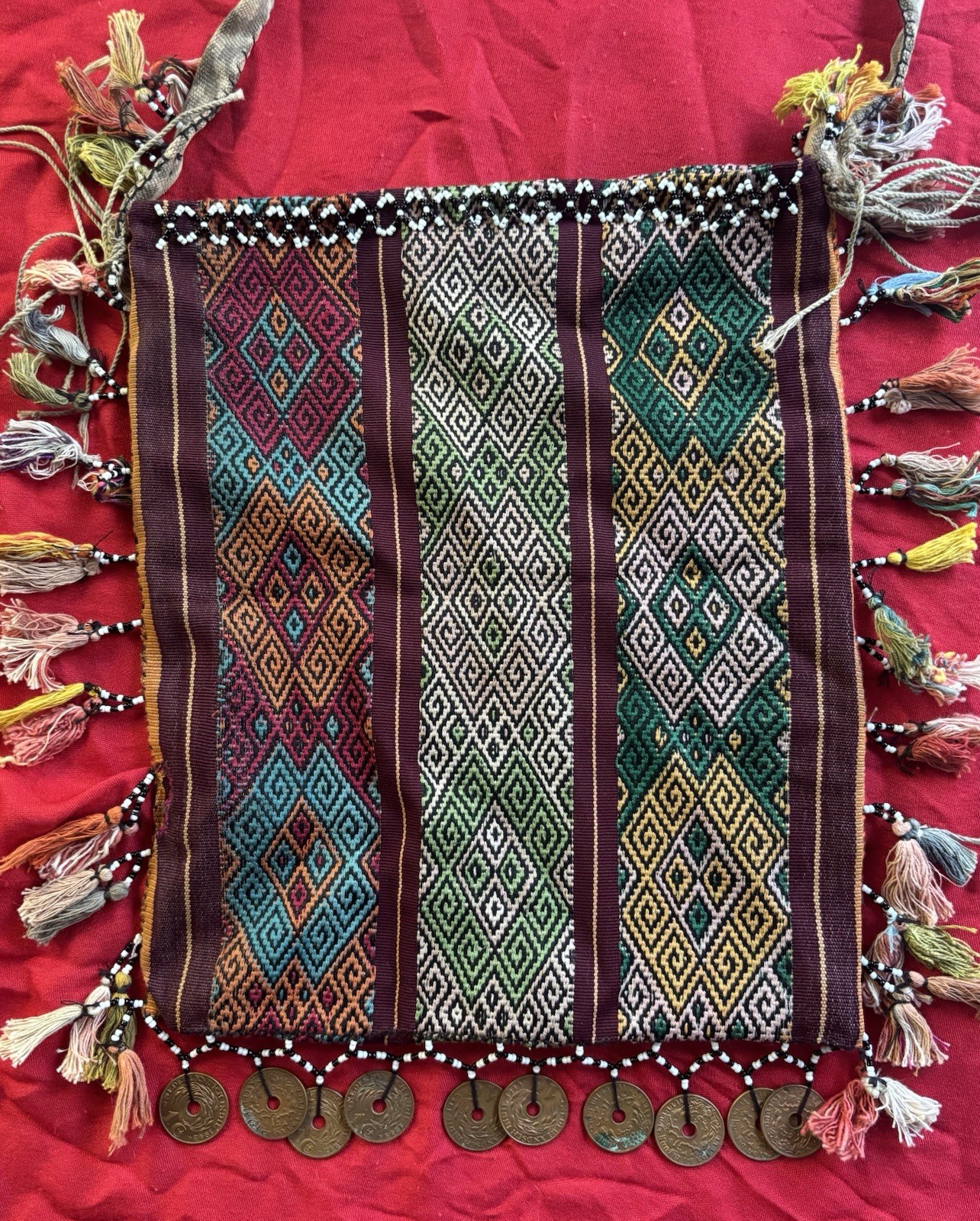
This flat rectangular pouch is a fine example of the supplementary weft weaving tradition documented in the coastal communities of northwestern Flores and the broader Lesser Sunda Islands, including Timor and Lombok. Unlike the warp-ikat technique for which much of Flores is celebrated, the northwest coast produced textiles through a distinct supplementary-weft process: additional colored wefts are inserted into a balanced ground weave to build up dense geometric patterning. The result is a series of banded horizontal panels carrying diamond and lozenge motifs in green, gold/yellow, white, teal, and rose/pink against a rich dark maroon/wine cotton ground.
The bag’s decoration extends well beyond the textile itself. All four edges are framed with white seed bead edging punctuated by black accent beads — a labor-intensive finishing technique common to prestige and ceremonial textiles across eastern Indonesia. Along one edge, a row of old Chinese cash coins (round with a square central hole, patinated bronze/brass) has been strung; these long-distance trade goods circulating across maritime Southeast Asia for centuries signal the bag’s status function. Multi-colored tassels hang from the top and bottom edges, interspersed with bead strings, creating movement and additional ornamental weight.
In form and material vocabulary, this bag aligns closely with the alu inu betel bags of the Atoni and related peoples of Timor, and comparable ceremonial pouches from Flores. Such bags functioned as betel-nut carriers in daily social ritual, as gifts in marriage exchange demonstrating a woman’s weaving skill, or as festival accessories marking ceremonial status. The combination of supplementary-weft cloth, glass seed beads, old Chinese coins, and silk/cotton fringe is precisely the assemblage described in specialist literature for this region and period.
Condition is very good. Colors remain vibrant across all panels. Bead edging is intact. All coins are present. Tassels are complete with the expected softening of age but no significant loss. No tears, staining, or structural failures. Display-ready.