When you click on links to various merchants on this site and make a purchase, this can result in this site earning a commission. Affiliate programs and affiliations include, but are not limited to, the eBay Partner Network.
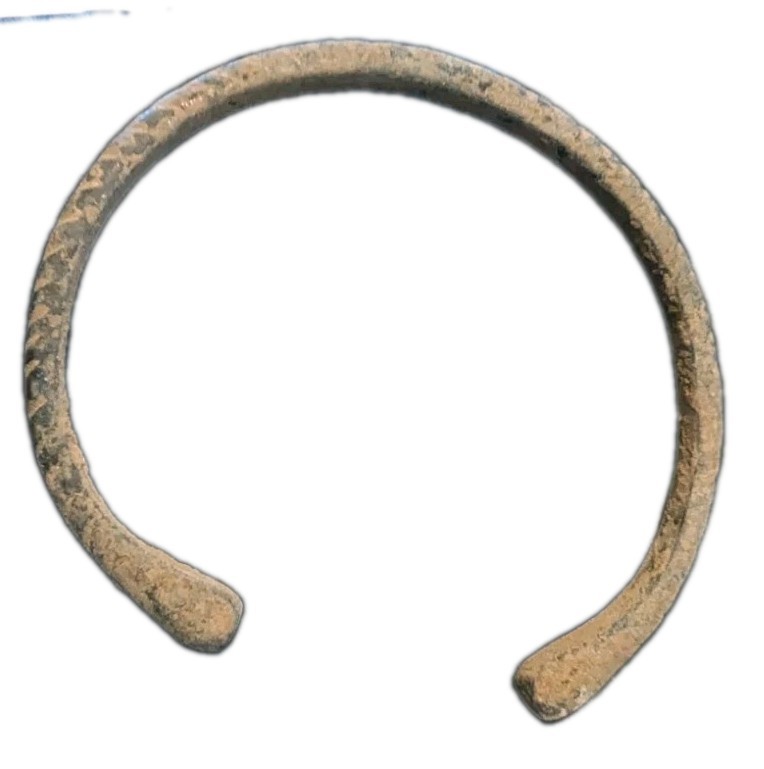
Ancient Iron Age II Judean Bronze Open Cuff Bracelet (~7 cm)
Authenticity & Guarantee
Item Specifications
Object: Cast & Forged Bronze Open-End Cuff Bracelet / Armlet
Culture / Period: Iron Age II (Kingdom of Judah / Ancient Levant)
Date Range: Circa 10th Century BC – 6th Century BC (c. 1000 BC – 586 BC)
Dimensions: ~6.5 cm – 7.5 cm outer diameter
Material: Heavy Cast & Hammered Bronze (Copper Alloy)
Form & Architecture: Robust circular penannular (open-ended) hoop with a flattened/faceted exterior band; tapering towards thickened, flared terminal heads engineered to allow slight flex for wrist wear
Condition: Exceptional, complete archaeological state. Fully intact hoop structure, unbroken terminal ends, preserved under a thick, authentic sand-gold and desert-tan mineral patina with olive-green cuprite undertones and intact earthen burial deposits.
Historical Context & Iron Age Judean Lore
Jewelry of the Kingdom of Judah
During the Iron Age II period in ancient Judea, open bronze cuff bracelets (ṣāmîḏ) were worn as indicators of personal wealth, social status, and tribal identity by both elite women and military leaders. Heavy copper-alloy bangles with flared terminals were frequently mentioned in biblical inventory texts as precious family heirlooms and votive offerings presented at local sanctuaries across the Levant (Ref: Barkay, Northern Sinai Studies: Iron Age Sites, Tel Aviv University, 1985; Platt, Jewelry of the Ancient Near East, Archaeological Institute of America, 2003).
Forged Penannular Architecture
The penannular open-cuff design allowed the metal band to be custom-fitted by local metalsmiths around the wrist or upper forearm. Forged from thick cast bronze stock, the flared terminal pads provided structural reinforcement against bending fatigue while protecting the wearer's skin from sharp edges.
Typological Analysis & Exact Classification
Exact Typological Classification
Comparable Archaeological Examples & Museum Accession Numbers
Israel Museum, Jerusalem (IAA Collection): Iron Age II bronze open-cuff bracelets from Judean fortress excavations (Lachish / Tel Beersheba).
British Museum (Accession No. 1888,0208.14): Iron Age Levantine copper-alloy penannular armlet.
Metropolitan Museum of Art (Accession No. 62.222.18): Near Eastern Iron Age bronze cuff bracelet with expanded terminals.
A1