When you click on links to various merchants on this site and make a purchase, this can result in this site earning a commission. Affiliate programs and affiliations include, but are not limited to, the eBay Partner Network.
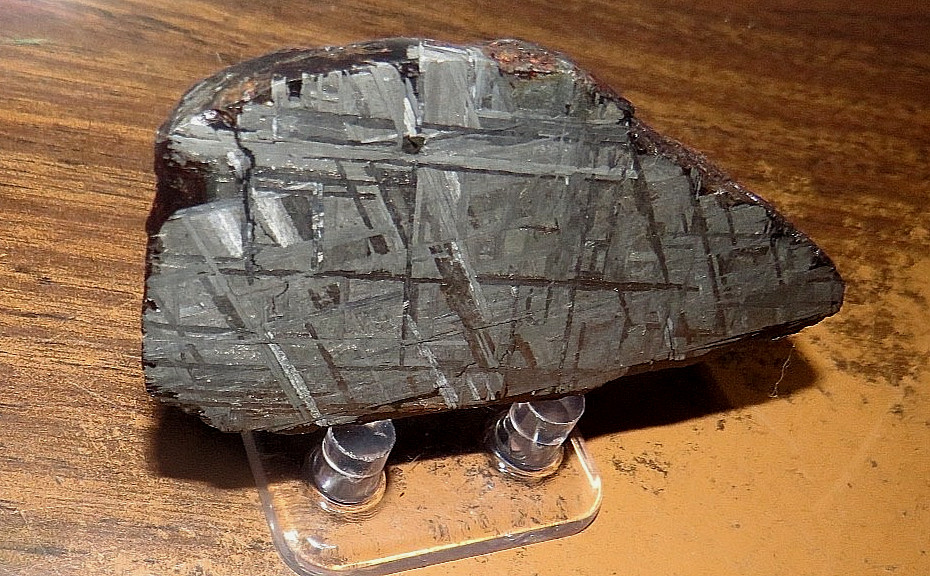
F-1-5-2A JALThe product is a large 159 gram Muonionalusta etched iron meteorite slice from Sweden, AAA grade. This meteorite slice is a display specimen in slab form, made of iron nickel. It is a valuable collectible item for those interested in meteorites and tektites, showcasing a piece of extraterrestrial history sourced from Sweden; 3X1.5X.35 INCH BEAUTIFULLY POLISHED AND ETCHED ON BOTH SIDES WITH STANDS
TheMuonionalusta meteorite(Finnish ameteoriteclassified as fineoctahedrite, type IVA (Of) which impacted in northernScandinavia, west of the border betweenSwedenandFinland, about one million years BCE.
The first fragment of the Muonionalusta meteorite was found in 1906 near the village of Kitkiöjärvi.[2]Around forty pieces are known today, some being quite large. Other fragments have been found in a 25-by-15-kilometre (15.5mi ×9.3mi) area in thePajala districtofNorrbotten County, approximately 140 kilometres (87mi) north of theArctic Circle.
The meteorite was first described in 1910 by Professor A. G. Högbom, who named it after the nearby place Muonionalusta on theMuonio River. It was studied in 1948 by ProfessorNils Göran David Malmqvist.[3]The Muonionalusta meteorite, probably the oldest known meteorite (4.5653 ± 0.0001 billion years),[4]marks the first occurrence ofstishovitein an iron meteorite.
The nameMuonionalustais Finnish: it comes from the name Muonio (+ possessive particle-(o)n-) andalusta, which in this context means "a place below", i.e. downstream fromMuonio.
Description
Studies have shown it to be the oldest discovered meteorite impacting the Earth during theQuaternaryPeriod, about one million years ago. It is quite clearly part of the iron core or mantle of a planetoid, which shattered into many pieces upon its fall on our planet.[5]Since landing on Earth the meteorite has experienced four ice ages. It was unearthed from a glacial moraine in the northerntundra. It has a strongly weathered surface covered with cemented faceted pebbles.
CompositionNew analysis of this strongly shock-metamorphosed iron meteorite has shown a content of 8.4%nickeland trace amounts of rare elements—0.33 ppmgallium, 0.133 ppmgermaniumand 1.6 ppmiridium. It also contains