When you click on links to various merchants on this site and make a purchase, this can result in this site earning a commission. Affiliate programs and affiliations include, but are not limited to, the eBay Partner Network.
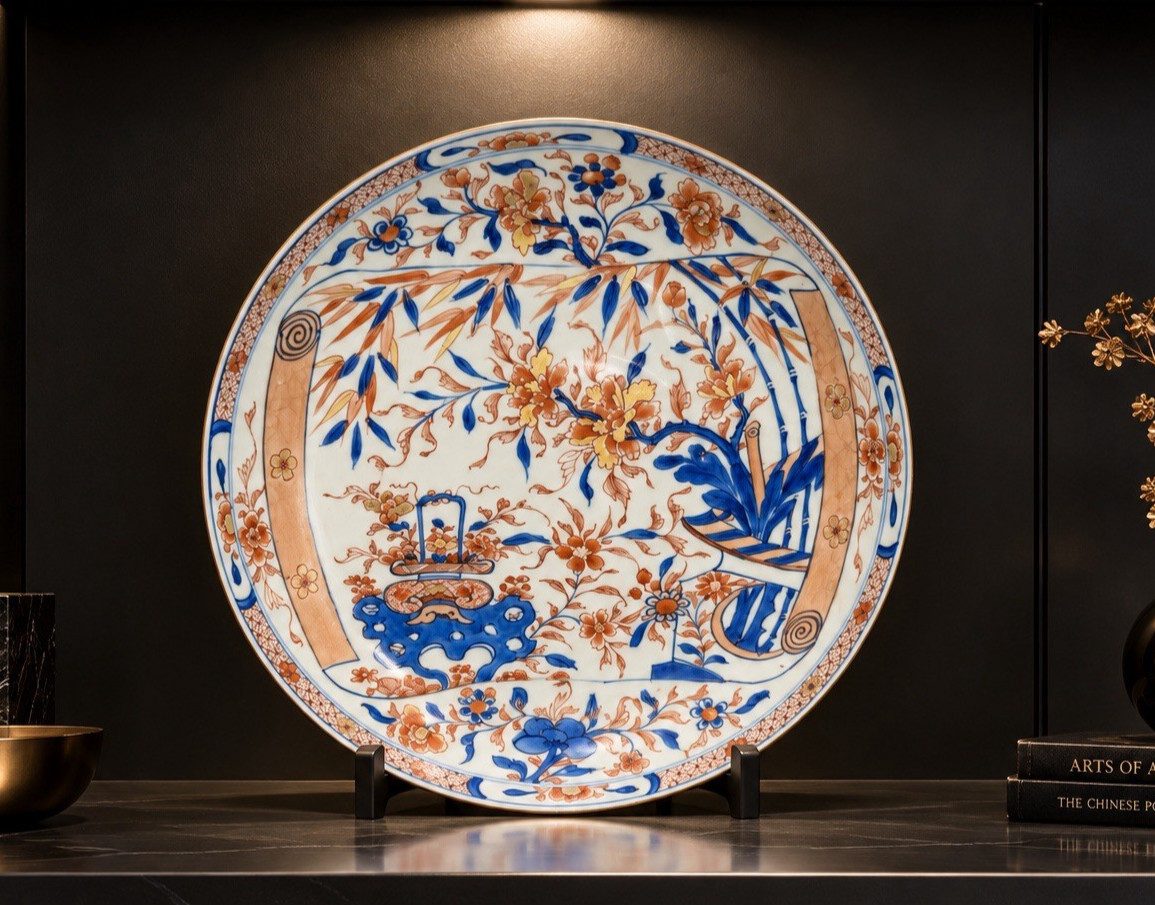
Antique Chinese Imari Porcelain Charger, c.1700-1730 Qing Dynasty Kangxi Era 30cm
Description
Antique Chinese Imari Porcelain Charger
Qing Dynasty, probably late Kangxi / early 18th century, circa 1700–1730
Diameter: approx. 30 cm
This museum-quality piece features a central motif depicting an unrolled scroll (makimono) decorated with blooming peonies and bamboo shoots, positioned next to an ornate flower basket on a stand. The rim is richly decorated with traditional floral cartouches and scrolling patterns rendered in vibrant underglaze cobalt blue, iron-red enamels, and heavy gilt accents. The reverse side is elegantly painted with minimalistic plum blossom branches (meihua).
A large and finely decorated Chinese export porcelain charger painted in the classic Chinese Imari palette, combining underglaze cobalt blue with iron-red/orange enamels and gilt decoration.
The composition features flowering plants, bamboo and stylised blue rockwork, together with an unusual central arrangement of decorative and symbolic objects. This group appears consistent with the Chinese precious objects / antiquities (bogu-type) decorative vocabulary found on documented late Kangxi and early 18th-century export porcelain.
Particularly interesting is the combination of precious-object imagery, pierced blue rockwork, floral decoration, bamboo, geometric diaper-pattern details, underglaze cobalt blue, iron-red and gilding.
Comparable decorative elements are documented on Chinese porcelain of the Kangxi period. Christie’s records Kangxi Chinese Imari porcelain incorporating precious objects, scrolls, flowering plants, bamboo and prunus, as well as geometric patterned borders. These comparisons are particularly relevant to the unusual decorative vocabulary of the present charger.
The Metropolitan Museum of Art also records Chinese Imari porcelain from the early 18th century and explains that Chinese workshops produced their own interpretation of Japanese Imari for the export market, characteristically employing combinations of underglaze blue, iron-red and gold.
The British Museum likewise catalogues Chinese Imari ware, including Qing dynasty examples associated with the Kangxi period and Jingdezhen production.
Attribution: Chinese export porcelain, probably Jingdezhen
Style / Decoration: Chinese Imari
Dynasty: Qing dynasty
Period: probably late Kangxi / early 18th century
Suggested date: circa 1700–1730
Diameter: approx. 30 cm
The attribution and dating are based on stylistic and photographic comparison with documented museum and major sale-house examples. The cited objects are presented as comparative material and are not claimed to be identical patterns or products of the same workshop.
Please examine all photographs carefully for the condition of the porcelain, glaze, enamels, gilding, rim, foot and other signs of age.
A particularly interesting example of early Chinese Imari export porcelain, combining the characteristic blue, iron-red and gilt palette with precious-object imagery and traditional Chinese floral and rockwork motifs.
good condition without any defects , there are some traces of age