When you click on links to various merchants on this site and make a purchase, this can result in this site earning a commission. Affiliate programs and affiliations include, but are not limited to, the eBay Partner Network.
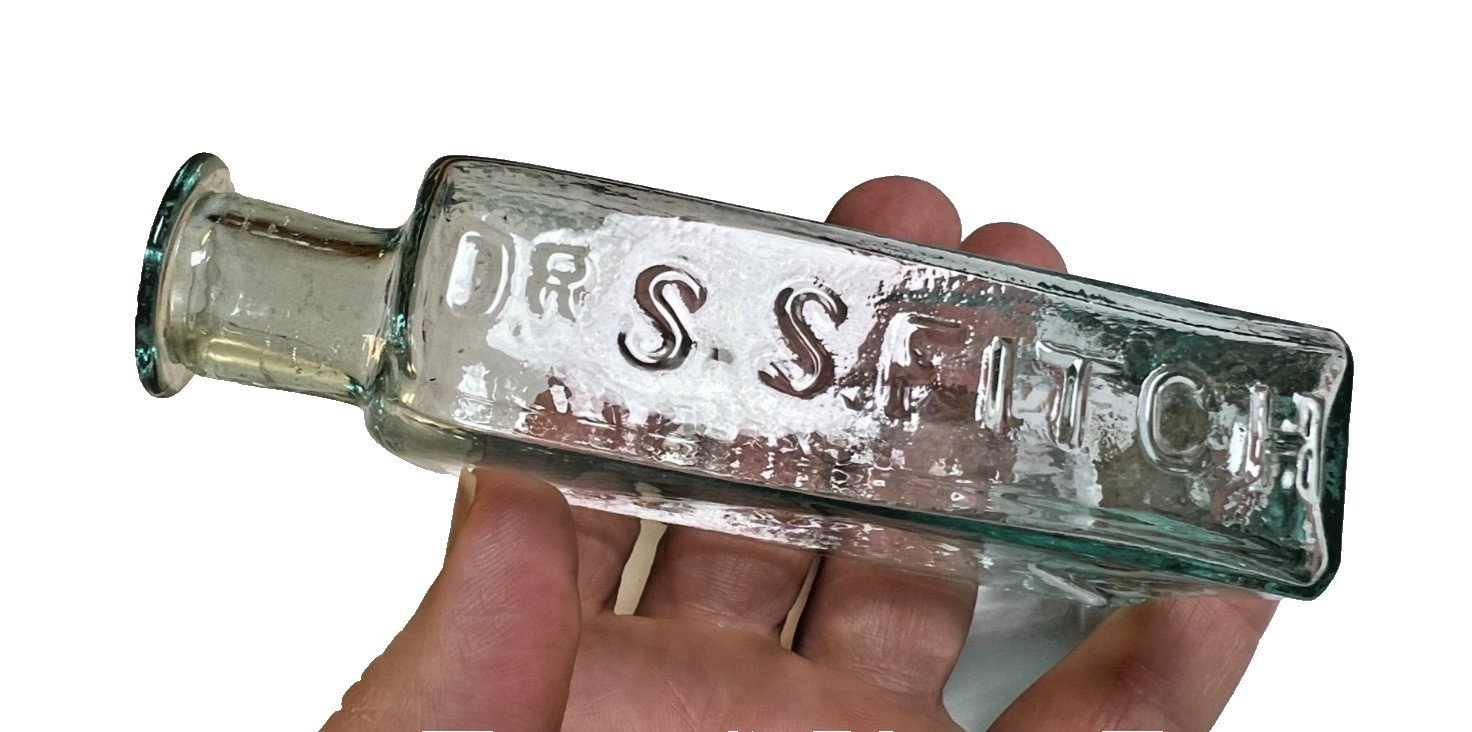
Open Pontil DR S.S. FITCH / 707 B WAY N.Y. Medicine Bottle 1847-1852 Tooled Flared Lip Attic Mint
Introduction
Few things capture the raw, transitional beauty of mid-19th-century American glass quite like an early New York patent medicine bottle.
This example — boldly embossed “DR. S. S. FITCH” and “707 B WAY N.Y.” — shows everything collectors love:
• a true open pontil scar
• hand-tooled, wide flared lip
• subtle annealing ripple lines pooling in the glass
• crisp embossing in aqua glass
At 4.75 inches tall, the bottle has that classic early-American medicine form — square body, heavy base, and confident lettering running down the panel. The glass is bright, clean, and sparkling, exactly what collectors call “Attic Mint.”
No chips. No cracks. No scratches. Just pure early American glass.
Precise Date
Circa 1847–1852
The key clue is the address “707 Broadway New York.”
Dr. Samuel Sheldon Fitch is documented at 707 Broadway from roughly 1847 until about 1853, before moving his operation across the street to 714 Broadway.
Because this bottle carries the 707 address, it falls neatly into that earlier window — making it a true late-1840s to very early-1850s medicine bottle.
The open pontil base and hand-tooled lip also confirm this period of manufacture.
The Maker — Dr. Samuel Sheldon Fitch
Dr. Samuel Sheldon Fitch (1809–1864) was one of the better-known health reformers and patent-medicine promoters of mid-19th-century America.
Operating out of Broadway in New York City, he built a large medical practice and commercial health empire that included:
• patent medicines
• inhalers and breathing devices
• spinal braces and orthopedic devices
• books and lectures on health reform
His office served both as clinic and manufacturing headquarters, and bottles like this were filled and sold directly to patients and through traveling agents.
Fitch was also a prolific self-promoter, publishing works like “Six Lectures on the Causes and Cure of Consumption.”
What Was In The Bottle?
Fitch produced several medicines, but bottles like this typically held remedies connected to respiratory illness, including:
• cough syrups
• lung tonics
• expectorants
• herbal compounds
Many of his treatments focused on tuberculosis (“consumption”), one of the most feared diseases of the 1800s.
Ingredients in similar patent medicines of the era often included:
• wild cherry bark
• horehound
• opium derivatives
• alcohol
• herbal extracts
In other words… a little medicine and a little “feel-good chemistry.”
How It Was Marketed
Fitch was a master marketer.
His advertising appeared widely in newspapers across the country, often inviting readers to write directly to his Broadway office for treatment advice.
His ads commonly promised relief from:
• lung disease
• asthma
• bronchitis
• spinal disorders
• “female complaints”
Like many patent medicine doctors, Fitch blended medical language with hopeful testimonials, creating the impression of scientific authority.
And it worked.
Thousands of bottles like this left his Broadway office.
Life During the Era (late 1840s – early 1850s)
When this bottle was made, America was transforming rapidly.
Technology
• The telegraph was spreading across the country.
• Steamships dominated coastal travel.
• Railroads were expanding but still incomplete.
• Most glass was still hand blown in small shops.
Medicine
Doctors had no germ theory yet.
Treatments commonly included:
• herbal tonics
• bloodletting
• opiates
• alcohol-based medicines
Patent medicines filled the gap between traditional doctors and folk remedies.
Politics
This was the decade of:
• the Mexican-American War (1846-1848)
• expansion into the American West
• rising tensions over slavery
The nation was expanding fast — and medicine was still catching up.
New York City During This Period
New York in the late 1840s was already becoming America’s largest city.
Major events and changes included:
• explosive immigration from Ireland and Germany
• construction of the first sections of Central Park (planned in 1850s)
• the growth of Broadway as a commercial district
Broadway, where Fitch practiced, was lined with:
• pharmacies
• patent medicine offices
• publishers
• early department stores
This bottle would have been sold right in the middle of one of the busiest streets in America.
Condition
• Height: 4.75 inches
• Pontil: Open pontil
• Lip: Tooled, wide flared lip
• Color: Light aqua
Condition: Attic Mint
• No chips
• No cracks
• No scratches
• Bright glass with strong embossing
• Attractive annealing ripple lines in the base
A very clean example of this early Broadway medicine bottle.