When you click on links to various merchants on this site and make a purchase, this can result in this site earning a commission. Affiliate programs and affiliations include, but are not limited to, the eBay Partner Network.
- Rare!
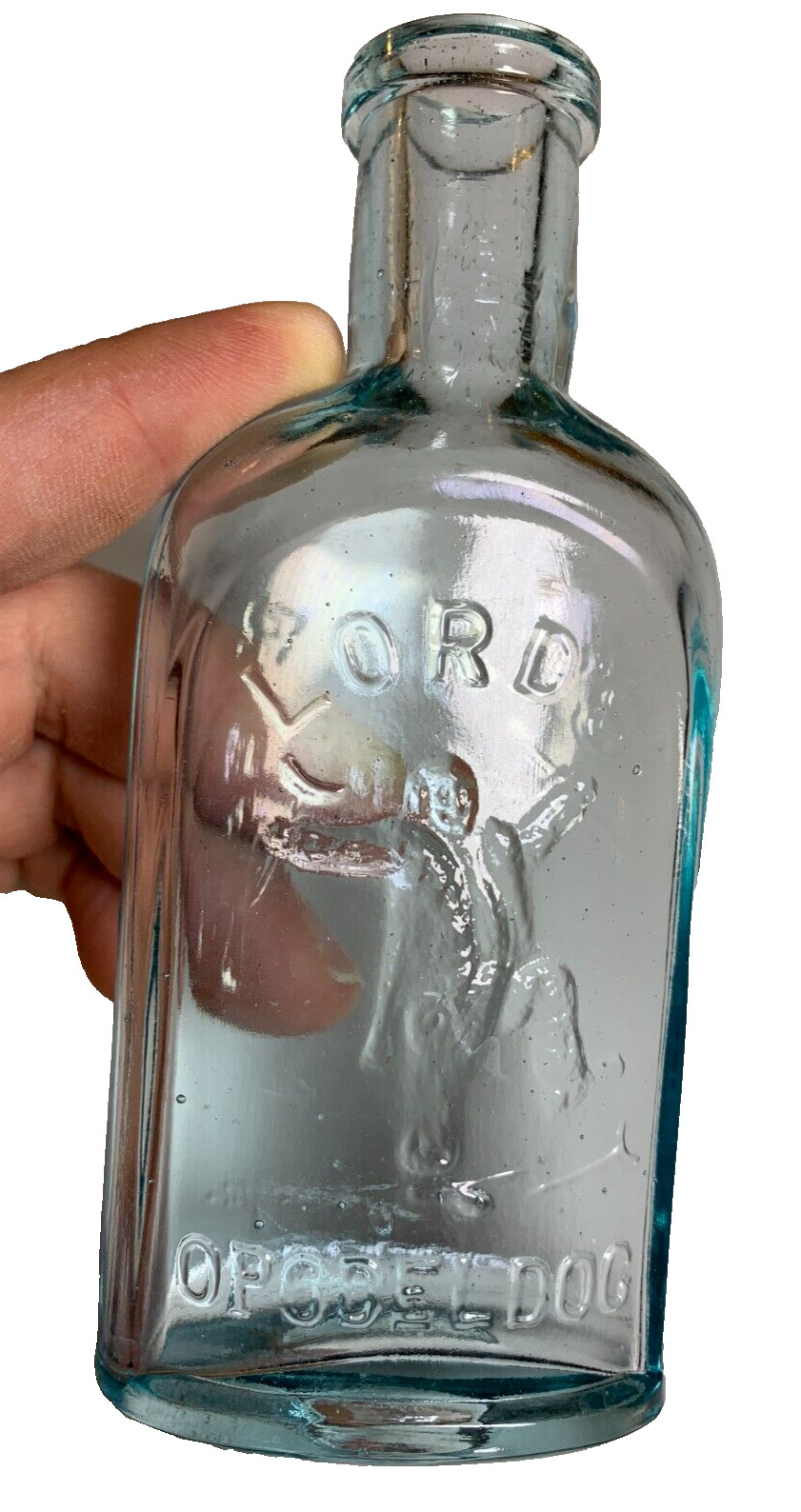
- Embossed with a man standing up and breaking his crutches in half! (Suggesting that a bottle of this medicine CURED HIM OF LAMNESS!!) A tall tale...
- Likely made in New York
- Antique - circa 1890s - 1900
- 5\" T
- Bright, clean, shiny, bright!
- No chips, no cracks, no ghosting.
- Fine example
- I package well and ship out daily!
In the 19th century, Lord\'s Opodeldoc was a widely recognized liniment, with its production and distribution spanning both England and the United States.
Manufacturing and Distribution in England
Originally, Dr. Steer\'s Opodeldoc gained prominence in England. Dr. Steer, though a somewhat obscure figure, is credited with formulating this version of opodeldoc by modifying an existing soap liniment recipe from the 1722 Edinburgh Pharmacopoeia, adding ammonia to enhance its properties. Following Dr. Steer\'s death in 1781, the Francis Newbery firm in London continued its production and exported it to various markets, including the United States.
Manufacturing and Distribution in the United States
In the United States, Dr. Steer\'s Opodeldoc was among the English patent medicines successfully imported and sold. Its popularity was such that it was included in the 1824 publication by the Philadelphia College of Pharmacy, which analyzed eight widely used patent medicines of that era.
Additionally, American manufacturers produced their own versions of opodeldoc. For instance, archaeological findings in New York City uncovered bottles labeled \"Liquid Opodeldoc,\" indicating local production and consumption. These American variants were likely modeled after the British formulations, catering to the domestic market\'s demand for such liniments.
Regulatory Changes and Decline
As the 20th century approached, the landscape for patent medicines, including opodeldoc, began to change. The passage of the Pure Food and Drugs Act in 1906 in the United States introduced stricter regulations on medicinal products, impacting the production and sale of many traditional remedies. Despite these changes, opodeldoc continued to be recognized for its therapeutic value, with formulations appearing in pharmacopoeias well into the 20th century.
In summary, throughout the 19th century, Lord\'s Opodeldoc and its variants were produced and distributed by various manufacturers in both England and the United States. Its widespread use and enduring presence in pharmacopoeias underscore its significance in the history of medicinal liniments.
Lord\'s Opodeldoc is a type of liniment, a medicated topical preparation used to soothe aches, pains, and bruises. It was popular in the 18th and 19th centuries and was attributed to Dr. William Salmon (1644–1713), though its formulation became widely known and modified over time.Composition & Use
Lord’s Opodeldoc was an alcoholic or soap-based liniment containing ingredients like:
Soap (to aid absorption)
Camphor (for pain relief and a cooling effect)
Alcohol or spirits (as a solvent and for quick evaporation)
Herbs or essential oils (sometimes added for extra medicinal properties)
It was primarily used for:
History & Popularity
Originally, \"Opodeldoc\" was a general term for a camphorated soap liniment, and Paracelsus (a 16th-century physician) was one of the first to reference it. Later, Dr. William Salmon created his own version, calling it \"Lord’s Opodeldoc,\" which gained significant popularity in England and beyond.
It was a staple in apothecaries and was often homemade or sold by pharmacists in different variations. It remained in use into the 19th century but eventually faded as modern medicine and pharmaceuticals advanced.
Here\'s a historical recipe for Lord\'s Opodeldoc, based on old apothecary formulas. This recipe follows the traditional soap liniment method, similar to what was used in the 18th and 19th centuries.
Ingredients:
White Castile soap – 1 ounce (finely shaved or grated)
Camphor – 1/2 ounce (crushed)
Strong alcohol (rectified spirits or brandy) – 8 ounces
Oil of Rosemary – 10 drops
Oil of Thyme – 10 drops
Oil of Lavender – 10 drops (optional, for data-start=\"554\" data-end=\"1246\">
Dissolve the Soap:
Place the alcohol in a glass jar or bottle.
Add the grated soap and shake or stir until completely dissolved. (This may take some time, and gentle warming can help.)
Add the Camphor:
Incorporate the Essential Oils:
Add the oil of rosemary, thyme, and lavender to the mixture.
Stir or shake well to combine.
Bottle and Store:
Pour the finished liniment into a dark glass bottle (to protect the oils from light).
Store in a cool, dark place.
Shake well before use.
Apply externally to aching joints, bruises, or sore muscles.
Massage gently into the affected area.
Avoid broken skin, as the alcohol may cause irritation