When you click on links to various merchants on this site and make a purchase, this can result in this site earning a commission. Affiliate programs and affiliations include, but are not limited to, the eBay Partner Network.
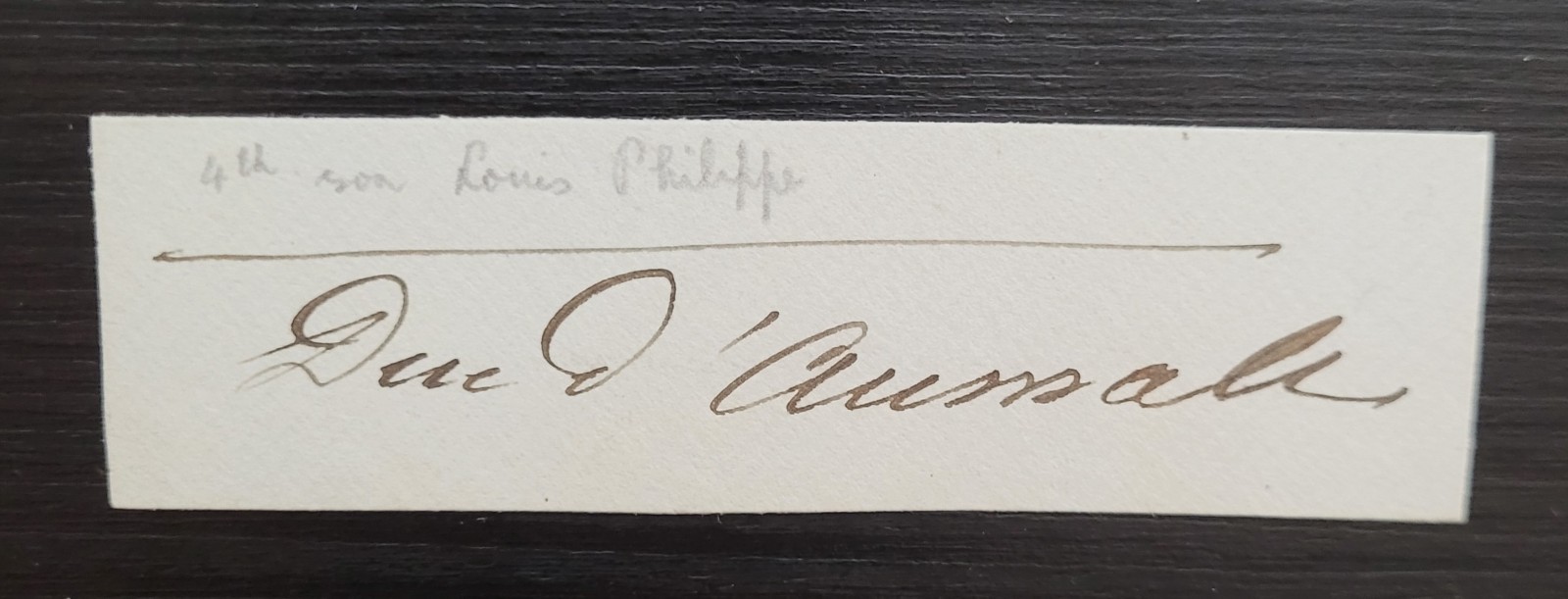
An autograph of Prince Henri d\'Orleans, Duke of Aumale son of King Louis Philippe
Henri Eugène Philippe Louis d\'Orléans, Duke of Aumale was a leader of the Orleanists, a political faction in 19th-century France associated with constitutional monarchy. He was born in Paris, the fifth son of King Louis-Philippe I of the French and Maria Amalia of Naples and Sicily and used the title Duke of Aumale. WikipediaBorn: January 16, 1822, Paris, FranceDied: May 7, 1897 (age 75 years), Giardinello, Italy
________________Henri Eugène Philippe Louis d\'Orléans, Duke of Aumale (16 January 1822 – 7 May 1897) was a leader of the Orleanists, a political faction in 19th-century France associated with constitutional monarchy. He was born in Paris, the fifth son of King Louis-Philippe I of the French and Maria Amalia of Naples and Sicily and used the title Duke of Aumale.
Aumale became an infantry officer and saw active service in the French conquest of Algeria and in 1847 was appointed as its Governor-General. After the French Revolution of 1848, he went to live in England, where he pursued historical interests. The Franco-Prussian War enabled him to return to France, where he was elected to parliament and the Académie française. In 1872, he returned to the army as a Divisional General, and from 1879 to 1883 was inspector-general of the army.
An important art collector, Aumale left his Château de Chantilly to the Institute of France, to display his collection.
Early life
Henri (left) with his brother Antoine and his mother Queen Marie Amélie.
Portrait by Franz Xaver WinterhalterBorn on January 16 at the Palais Royal in Paris, he shared a birthday with his older brother Prince Charles. The young Henri was brought up by his parents in relative simplicity. At the age of eight, he inherited a fortune of 66 million livres (approximately £200 million today), the lands and wealth of his godfather, Louis Henri de Bourbon, Prince of Condé, the last Prince of Condé. This inheritance included the famous Château de Chantilly, the Château d\'Écouen, and the domaines of Saint-Leu, Taverny, Enghien, Montmorency, and Mortefontaine.
He was educated at the Collège Henri IV, then at the age of seventeen, entered the French army with the rank of captain of infantry.[1]
Marriage and childrenOn 25 November 1844, aged 22, Aumale married in Naples his first cousin Princess Maria Carolina of the Two Sicilies, a daughter of Leopold of the Two Sicilies, Prince of Salerno, and Archduchess Maria Clementina of Austria. The couple had several children, of whom two reached adulthood, but still predeceased him:
Louis Philippe Marie Léopold d\'Orléans, Prince of Condé (15 November 1845 – 24 May 1866), died unmarried and childless.Henri Léopold Philippe Marie d\'Orléans, Duke of Guise (11 September 1847 – 10 October 1847), died in infancy.Stillborn daughter (16 August 1850).François Paul d\'Orléans, Duke of Guise (11 January 1852 – 15 April 1852), died in infancy.François Louis Philippe Marie d\'Orléans, Duke of Guise (5 January 1854 – 25 July 1872), died unmarried.Stillborn son (May 1857).Stillborn son (15 June 1861).Stillborn son (June 1864).CareerAumale distinguished himself during the French invasion of Algeria and, in 1847, he became lieutenant-general and was appointed Governor-General of Algeria, a position he held from 27 September 1847 to 24 February 1848.
In this capacity, he received the submission of the emir Abdel Kadir, in December 1847. After the Revolution of 1848, he retired to England and busied himself with historical and military studies, responding in 1861 to Napoleon III\'s violent attacks upon the House of Orléans with a Letter upon History of France.[1]
After the Bavarian-born King Otto of Greece was overthrown in October 1862,[2] the Greeks still favoured a monarchy and wanted Prince Alfred, Duke of Edinburgh, as their new king,[3] but he declined. In the search for a king, the French put forward the name of Aumale, while other contenders included Ernest II, Duke of Saxe-Coburg and Gotha, the Prince of Leiningen, and Archduke Maximilian of Austria. Eventually, the choice fell on Prince William of Denmark, aged only seventeen, and the Greek National Assembly elected him as the new King of the Hellenes in March 1863.[4][5]
At the outbreak of the Franco-Prussian War, Aumale volunteered for service in the French army, but his offer was declined. Elected to parliament as deputy for the Oise, he returned to France.[1] He also succeeded to the seat of the Count Montalembert in the Académie française.
In March 1872, he returned to the army as a Divisional General and in 1873 presided over the court-martial which condemned Marshal Bazaine to death.[1]
At this time, having been appointed commander of the VII Army Corps at Besançon, Aumale retired from political life. In 1879, he became inspector-general of the army. The act of exception, passed in 1883, deprived all members of families who had reigned in France of their military commissions. Consequently, Aumale was placed on the unemployed supernumerary list.[1]
In 1886, another law was promulgated which expelled from French territory the heads of former reigning families and provided that, henceforward, all members of those families should be disqualified from holding any public position or function and from election to any public body. Aumale protested energetically but was nonetheless expelled from France.[1]The Duc d\'Aumale capturing the Smalah of Abdelkader with his chasseurs d\'Afrique (1843), by Horace VernetIn his will, written on 3 June 1884, Aumale had bequeathed his Chantilly estate to the Institute of France, including the Château de Chantilly, which was to be turned into a museum displaying his large art collection. After this act of generosity was revealed, the French government withdrew the decree of exile, and the duke returned to France in 1889.[1]
Bibliophile
The duc d\'Aumale in his final years, portrait by Jean Baptiste Guth in Vanity Fair, 1891
The Château of Chantilly houses one of the finest art collections in France.Royal styles ofPrince Henri, Duke of Aumale
Reference style His Royal HighnessSpoken style Your Royal HighnessAlternative style SirAumale was a notable collector of antique books and manuscripts and owned the important medieval Très Riches Heures du Duc de Berry. Most of his collection is still at Chantilly.[6]
DeathHenri d\'Orléans, duc d\'Aumale, died in Lo Zucco, Sicily. After the fire of the Bazar de la Charité on 4 May 1897, which killed 126 people, mostly aristocratic women, he wanted to send his condolences to the families of the victims. After writing twenty letters, he suffered a cardiac arrest and died. He was buried in Dreux, in the chapel of the Orléans.
Honours1842: Grand Cross of the Legion of Honour22 March 1842: Grand Cordon of the Order of Leopold[7]6 September 1845: Knight of the Order of the Golden Fleece (Spanish branch)[8]1864: Grand Cross of the Saxe-Ernestine House Order[9]22 May 1886: Grand Cross of the Order of the Tower and Sword[10]1887: Member of the Royal Academy of Science, Letters and Fine Arts of Belgium.[11]1890: Charles Oberthür described & named parnassian butterfly P. orleans from China, named after the Duke who discovered it.Grand Cross of the Order of St. Ferdinand and Merit[12]Recipient of the Husainid family order, Nichan ad-Dam[13]Member of the Académie FrançaiseMember of the Académie des Sciences Morales et PolitiquesArmsThe duke of Aumale did not have a personal coat of arms, so used the traditional arms of the House of Orléans, consisting of:
Blazon : Azure, three fleurs de lys or, a label argentCoronet : of a fils de FranceSupporters : two angelsPersonal motto (after 1871) : J\'attendrai (I\'ll be waiting)
Orléanist (French: Orléaniste) was a 19th-century French political label originally used by those who supported a constitutional monarchy expressed by the House of Orléans.[1] Due to the radical political changes that occurred during that century in France, four different phases of Orléanism can be identified:
The \"pure\" Orléanism: constituted by those who supported the constitutional reign of Louis Philippe I (1830–1848) after the 1830 July Revolution, and who showed liberal and moderate ideas.[2]The \"fusionist\" (or \"unionist\") Orléanism: the movement formed by pure Orléanists and by those Legitimists who after the childless death of Henri, Count of Chambord in 1883 endorsed Philippe, Count of Paris, grandson of Louis Philippe, as his successor.[3] The fusion drove the Orleanist movement to more conservative stances, emphasising French nationality (rejecting claims to France of the Spanish Bourbons on account of their \"foreignness\") and Catholicism.[4]The \"progressive\" Orléanism: the majority of \"fusionists\" who, after the decline of monarchist sentiment in the 1890s, joined into moderate republicans, who showed progressive and secular-minded goals,[5] or into Catholic rally, like the Liberal Action.[6]Contemporary Orléanism. The party Action Française embraced and still does advocate for its own variant of Orléanism which rejects the economic liberal policies of \"pure\" Orléanism and supports Integralism.[7]Orleanism was opposed by the two other monarchist trends: the more conservative Legitimism that was loyal to the eldest branch of the House of Bourbon after 1830, and the Bonapartism that supported Napoleon\'s legacy and heirs.
Under the July Monarchy
Louis Philippe portrait by WinterhalterMain article: July MonarchyOn 26 July 1830, the revolution of the so-called Three Glorious Days (or July Revolution) erupted due to the authoritarian and anti-Gallican tendencies showed by Charles X and his Prime Minister Jules de Polignac, expressed by the recently approved Saint-Cloud Ordinances.[8][9] Despite the abdication of Charles X and the Dauphin Louis in favor to Charles X\'s grandson Henri, Duke of Bordeaux, on 2 August 1830, only seven days later Louis Philippe I, still Duke of Orléans, was elected by the Chamber of Deputies as new \"King of the French\".[10] The enthronement of Louis Philippe was strongly wanted by Doctrinaires, the liberal opposition to Charles X\'s ministries, under the concept \"nationalize the monarchy and royalize France\".[11] On 14 August 1830, the Chamber approved a new Constitution, which became the de facto political manifesto for the Orléanists, containing the basis for a constitutional monarchy with a central Parliament. The Orléanism, became the dominant tendency within political life, easily divided inside the Chamber of Deputies between the centre-left of Adolphe Thiers[12] and the centre-right of François Guizot.[13] Louis Philippe showed himself more aligned with Guizot, entrusted to the higher offices of government, and rapidly became associated with the rising \"new men\" of the banks, industries and finance,[14] gaining the epithet of \"Roi bourgeois\".[15] In the early 1840s, Louis Philippe\'s popularity decreased, due to his strong connection to upper classes and repression against workers\' strikes, and showed few concerns for his weakened position, leading the writer Victor Hugo to describe him as \"a man with many little qualities\".[16] The Orléanist regime finally fell in 1848, when a revolution erupted and on 24 February Louis Philippe abdicated in favor to his grandson Philippe, Count of Paris, under regency of his mother Helene, Duchess of Orléans, who was quickly ousted out from the Chamber of Deputies during the regency\'s formalization, who was interrupted by republican deputies who instead proclaimed the Second Republic.[17]
After 18 years of reign, Louis Philippe left the Orléanist base well-defined inside the magistrature, the press, universities and academies, especially the Académie française.[6] However, also some great aristocratic families joined the court, like the Dukes of Broglie,[18] as well former Bonapartist officers like the Marshal Soult and Édouard Mortier. This establishment constituted the majority of the Party of Order, led by Thiers, who represented the conservatives and monarchists under the Second Republic.[19]
Under the Third RepublicFusion and restoration projectElectoral resultsYear No. ofoverall votes % ofoverall vote No. ofoverall seats wonNational Assembly1871 Unknown (1st) 33.5% 214 / 638Chamber of Deputies1876 554,117 (6th) 7.5% 40 / 5331877 169,834 (5th) 2.1% 11 / 5211881 552,971 (5th) 7.7% 42 / 5451885 991,188 (4th) 12.2% 73 / 5841889 994,173 (4th) 12.5% 72 / 5761893 816,789 (3rd) 10.5% 63 / 5741898 607,960 (5th) 7.5% 44 / 585
The Duke of Orléans, son of the Count of Paris, espoused conservative stances, also reviving the Order of the Holy Spirit to support his claim.[20]
Satirical cartoon of 1871: Orléanists stand on the ruined December Empire and attempt to enter the \"Défense Nationale\" building, while Adolphe Thiers looks on.Orléanism revived after the French defeat in the Franco-Prussian War of 1870-1871 which caused the fall of the Second Empire which had succeeded to the Second Republic under Emperor Napoleon III, the former president of France who had been enthroned after the coup d\'état of 1851.[6] The Second Empire was succeeded itself officially in 1871 by the Third Republic. A National Assembly, composed by 638 on 778 seats, was formed and new elections were called for the 8 February of the same year, which resulted in a victory for the monarchist right: 396 seats won, divided to 214 Orléanists and 182 Legitimists, nicknamed \"cavalrymen\".[21] Initially divided about the dynastic issue, the Orléanists found a compromise with the Legitimists, supporting the rights of Henri, Count of Chambord (former Duke of Bordeaux, currently childless) in return of the recognition of the Count of Paris as his heir, echoing an 1862 statement of Chambord.[22] Although Chambord never mentioned the Count of Paris as his heir, probably fearing the defection of his ultraconservative supporters,[23] the informal agreement sanctioned the \"fusion\" of Legitimists and Orléanists, who quite easily formed a conservative coalition. The monarchist majority, led by the Duke of Aumale (son of Louis Philippe), and the centre-left endorsed the centre-right candidate Thiers as president of the Republic, but due to the continued arguments between Legitimists and Orléanists and the memory of the dynastic divisions of the past 40 years, Thiers moved to support a \"conservative republic\" instead of a divided monarchy.[24]
Due to Chambord\'s dislike of Aumale,[25] the \"fusionists\" rapidly passed under the leadership of the Duke of Broglie, who in 1873 successfully managed the election of President Patrice de MacMahon, former general and national hero who showed Legitimist sympathies, considering him as a kind of \"lieutenant-general of the kingdom\" before the fully restoration of Chambord on the throne.[26] Broglie was shortly after awarded with the premiership by MacMahon, supported by monarchists and the centre-right. Restoration appeared imminent when a parliamentary commission was established in October 1873 to adopt a monarchist constitution. But in the same month the majority was weakened by the refusal of Chambord to accept the French Tricolour, used since 1830, preferring instead the return of the royal white flag, symbol of the Ancien Régime.[25] The question was apparently resolved with a compromise between Broglie and Chambord: the last will accept the tricolour flag while a future agreement about a new flag will be considered. In October the majority was shocked when the centre-right representative Charles Savary rashly misinformed the press of Chambord\'s full acceptance of the tricolour flag,[25]. The pretender had to harshly clarify his position, causing the left of the centre-right, Orléanists disappointment and the dissolution of the \"restoration\" commission on 31 October 1873. A last attempt by Chambord was made on 12 November, when he asked President MacMahon via the Duke of Blacas to join with him into the National Assembly and spoke toward the representatives, hoping to convince them to restore the monarchy, but MacMahon refused due to his institutional position, toward he was formally even if not ideologically attached, causing the project\'s failure.[27] Due to the impossibility to restore the monarchy in a short time, the Orléanists waited the death of the sickly Chambord, occurred in 1883, but by that time, enthusiasm for a monarchy had faded, and as a result the Count of Paris was never offered the French throne.[28]
The monarchists, however, still controlled the National Assembly, and under MacMahon\'s partisan presidency they launched the so-called \"moral order government\", in reference to the Paris Commune, whose political and social innovations were viewed as morally degenerate by large conservative segments of the French population.[29] In February 1875, a series of parliamentary acts established the constitutional laws of the new republic. At its head was a President of the Republic. A two-chamber parliament consisting of a directly elected Chamber of Deputies and an indirectly-elected Senate was created, along with a ministry under the President of the council (prime minister), who was nominally answerable to both the President of the Republic and the legislature. Throughout the 1870s, the issue of whether a monarchy should replace the republic dominated public debate. On 16 May 1877, with public opinion swinging heavily in favour of a republic after the election of March, President MacMahon made one last desperate attempt to salvage the monarchical cause by dismissing the \"conservative republican\" prime minister Jules Simon and appointing the Duke of Broglie to office. He then dissolved parliament and called a general election for the following October. If his hope had been to halt the move towards republicanism, it backfired spectacularly, with the president being accused of having staged a constitutional coup d\'état known as \"16 May Crisis\" after the date on which it happened. Republicans returned triumphantly after the October elections for the Chamber of Deputies. The crisis ultimately sealed the defeat of the royalist movement, and was instrumental in creating the conditions of the longevity of the Third Republic:[30] in January 1879 the Republicans gained control of the Senate, formerly monopolized by monarchists. MacMahon himself resigned on 30 January 1879, leaving a seriously weakened presidency in the hands of Jules Grévy, leader of the Republican Left.[31][32]
The end of the presidency of MacMahon and the Senate\'s loss caused the end of the monarchist bloc. Although there were Orléanist deputies in the Chamber for all the 19th century, they were only a minority. At the end, many monarchists accepted the republic, moving toward the centre. Some Orléanists, especially from their bourgeoise core base, accepted the republic even since the 1870s, like Thiers and press baron Émile de Girardin. In 1892, after Pope Leo XIII\'s approval to the Third Republic, breaking the historical alliance between Church and Crown,[33] some monarchists led by Orléanist Jacques Piou and Legitimist Albert de Mun formed the group of the \"ralliés\" (\"supporters\"), that in 1901 constituted the base of the first Christian Democratic party in France, the Liberal Action,[34] while many other royalists were still attached to the Crown.
Association with the far-right
Charles Maurras in 1937Part of a series onConservatism in France
IdeologiesChristian democracyGaullismIntegralism nationalistMonarchism DroiteRévolution topicsConservatism portalflag France portalvteThe elections of 1898 confirmed the exclusion of the monarchists from any possible government. However, 4 years earlier, the Dreyfus affair shook public opinion, dividing the republican camp: socialists, radicals and liberals defended the innocence of Dreyfus,[35] while other republicans joined the nationalists and monarchists against Dreyfus.[36] The election also introduced 10 overtly anti-Semitic representatives, led by Édouard Drumont.[37] The following year, on 20 June 1899, the academic Henri Vaugeois and journalist Maurice Pujo founded the nationalist association Action française, initially absent of any specific ideology.[6] However, the Action was joined by many Catholics and monarchists who were anti-Dreyfus, contributing to the move of the association toward the right. Particularly, the adhesion of Charles Maurras, considered a \"pragmatic\" anti-Dreyfusard rather than a true anti-Semite,[38] contributed to the creation of the ideology of the Action, which rapidly became the main monarchist group. Maurras, despite becoming the movement\'s ideologist, supported not a classical monarchy on religious term (divine right) but a positivist one, stating that a monarchy would grant more order and stability than a parliamentary republic.[6] The largest group of French monarchists, after the death of Chambord in 1883, endorsed the Count of Paris until his death in 1894, recognizing the claim of his son Philippe, Duke of Orléans, who was also supported by the Action.[6] However, monarchism inside the Action was always integrated secondary to its semi-official ideology of \"integral nationalism\" theorized by Maurras,[39] and many Action activists were still republicans, like the founder Vaugeois.[6] The movement grew to be one of the largest organizations in France, but in 1926 a condemnation from Pope Pius XI against the Action caused the defection of many Catholic sympathizers. The Pope judged that it was folly for the French Church to continue to tie its fortunes to the unlikely dream of a monarchist restoration, and distrusted the movement\'s tendency to defend the Catholic religion in merely utilitarian and nationalistic terms,[40] and the Action Française never recovered from the condemnation.[41]
By 1934, the Action was still a considerable force, with over 60,000 members across France.[42] In that year, they joined other far-right leagues on 6 February demonstrations against political corruption and the Parliament, causing the resignation of Prime Minister Édouard Daladier the day after and provoking fear of a nationalist coup d\'état.[43] The papal condemnation, the aggressive tactics, and Maurras\'s disrespectful attitude toward constitutional monarchists finally ended the organization as a major power. The Orléanist pretender Jean, Duke of Guise, who in 1937 broken ties with the Action, also lost many supporters. From this moment, Orléanism ceased to be associated with the Action or the far-right.[17] Instead, the Duke of Guise\'s son and heir Henri, Count of Paris, launched his own magazine Courier Royale and secretly dealt with anti-fascist conservative General La Rocque, leader of the French Social Party, about the possibility of a restoration.[44]
Hope during the Fourth RepublicMain article: French Fourth Republic
Front page of Courier 50 announcing the end of the exile of OrléansIn 1946, the Count of Paris (who succeeded his father in 1940) moved to Portugal due to the ban on former royals still present in France. As a result of the unstable situation of the Fourth Republic, characterized like its predecessor by short governments and a high number of political parties, the Count of Paris made a serious attempt to restore the French monarchy. He endorsed the Christian Democratic Popular Republican Movement (MPR), and formed a kind of political committee composed of the academics Bertrand de Jouvenel, Gustave Thibon and Michel de Saint Pierre,[45] publishing on 5 February 1948 the manifesto Esquisse d\'une constitution monarchique et démocratique, that promoted the idea of a constitutional monarchy.[45] Thanks to the MPR deputy Paul Hutin-Desgrées (co-founder of Ouest-France), the exile law was abrogated on 24 June 1950, permitting the return of the Count of Paris to the capital, where he met with President Vincent Auriol.[45] The count and his family made their home in the Parisian suburbs of Louveciennes, and quickly became media darlings. Orléans frequently went to parties and meetings which were attended by prominent French politicians of the Fourth Republic, such as Antoine Pinay, Jacques Soustelle, Pierre Mendès France and Maurice Schumann.[45] Through his newsletter Courier 50, the Count of Paris expressed support for the policies of Mendès France, like the peace in Indochina, the refusal of a US-controlled European Defence Community (EDC) and decolonization of French Africa.[45]
Orléans\' relationship with Charles de Gaulle was also promising, as the general and the pretender had similar political views and were both devout Roman Catholics.[45] When De Gaulle became prime minister in 1958, it was expected by the Count of Paris that the general would move to restore the French monarchy, but instead De Gaulle preferred to strengthen the republican institutions, eventually becoming the driving force behind the establishment of the present-day Fifth Republic. De Gaulle was elected president of the new government in 1959, and seems to have promised the Count of Paris that he wouldn\'t run again in the election of 1965, instead supporting the candidacy of the pretender that would promote a campaign to transform the republic into a constitutional monarchy.[46] However, in 1963 De Gaulle confided to his minister Alain Peyrefitte that, despite his respect and esteem for the Count of Paris, he never considered him to be his successor as the head of state, stating that the idea of a monarchy was incompatible with the modern world.[47] Disappointed by the false hopes and unfulfilled promises, the Count of Paris retired from French political life in 1967, ending also the publications of his newsletter.
Principles of successionMain article: Line of succession to the French throne (Orléanist)Orléanist pretenders from 1883 to the present follow these principles:
The Crown passes by primogeniture to males born in the male line of Hugh Capet.Only children born of legal marriages conforming with the canon law of the Catholic Church are dynasts.The Sovereign or Head of the House can neither abdicate nor alter the line of succession. The Princes of the blood likewise cannot personally renounce their succession rights. Those rights can however be permanently lost under specific circumstances (see below).The throne is never vacant; upon the death of the Sovereign or Head of the House, the first in line automatically succeeds, regardless of any coronation or whether actually reigning.The Sovereign or Head of the House must be Catholic.The Sovereign or Head of the House must be both French and born of an unbroken line of French dynasts descending from Hugh Capet. Any prince of the blood that leaves France to claim a foreign throne or a position subject to which permanently loses his rights of succession, as do his descendants.[48] It is this rule that separates the Orléanist rule from the Legitimist one.List of claimants to the French throne since 1848Claimant Portrait Birth Marriages DeathPhilippe, Count of Paris(Louis Philippe II)1848–1873Orléanist pretender(Philippe VII)1883–1894Unionist pretender 24 August 1838ParisSon of Prince Ferdinand Philippe, Duke of Orléans and Duchess Helen of Mecklenburg-Schwerin Princess Marie Isabelle of Orléans30 May 18648 children 8 September 1894Stowe HouseAged 56Philippe, Duke of Orléans(Philippe VIII)1894–1926 24 August 1869York House, TwickenhamSon of Philippe, Count of Paris and Princess Marie Isabelle of Orléans Archduchess Maria Dorothea of Austria5 November 1896No children 28 March 1926PalermoAged 56Jean, Duke of Guise(Jean III)1926–1940 4 September 1874FranceSon of Robert, Duke of Chartres and Marie-Françoise of Orléans Isabelle of Orléans30 October 18994 children 25 August 1940Larache, Spanish MoroccoAged 65Henri, Count of Paris(Henri VI)1940–1999 5 July 1908Chateau de Nouvion-en-Thiérache, Aisne, FranceSon of Jean, Duke of Guise and Isabelle of Orléans Isabelle of Orléans-Braganza8 April 193111 children 19 June 1999ChérisyAged 90Henri d\'Orléans, Count of Paris(Henri VII)1999–2019 June 14, 1933Woluwe-Saint-Pierre, BelgiumSon of Henri, Count of Paris and Isabelle of Orléans-Braganza Marie Thérèse, Duchess of Montpensier5 July 19575 childrenMicaëla Cousiño Quiñones de León31 October 1984(Civil)26 September 2009(Religious) 21 January 2019ParisAged 85Jean, Count of Paris(Jean IV)2019–present May 19, 1965Boulogne-Billancourt, Paris, FranceSon of Henri, Count of Paris and Marie-Thérèse of Württemberg Philomena de Tornos Steinhart19 March 20095 children Orléanist political partiesDoctrinaires (1815–48)Resistance Party (1832–48)Movement Party (1831–48)Party of Order (1848–52)Action Française (1899–present)Legacy
This section needs additional citations for verification. Please help improve this article by adding citations to reliable sources in this section. Unsourced material may be challenged and removed.Find sources: \"Orléanist\" – news · newspapers · books · scholar · JSTOR (January 2024) (Learn how and when to remove this message)French royal familyOrléanist
The Count of ParisThe Countess of ParisThe Dauphin of FrancePrince JosephPrince AlphonsePrincess AntoinettePrincess Louise-MargueritePrincess JacintheExtended royal familyvteThe Orléanist party, despite the different regimes, maintained its bourgeois platform, constituted by those academics, journalists and financiers who backed Louis Philippe during his reign, and was intended as the liberal centre of politics, far from reactionary Legitimists and revolutionary republicans.[49][50] However, for all the span of Louis Philippe\'s reign, the Orléanists were not a homogeneous party, but simply the majority who supported the constitutional system. It was only after the establishment of the Second French Republic in 1848 and the division inside right-wing factions over the monarchy that the Orléanist party found unity, supporting a parliamentary system instead of an executive one.
In the early 20th century, the majority of Orléanists accepted the republican institutions, approving the parliamentary system and pro-business policy realized by the republican majority, who reflected the historical Orléanist purposes.[6] French historian René Rémond included the presidency of Valéry Giscard d\'Estaing as part of the Orléanist tradition, due to his liberal views and equidistance from the nationalist right (descending from Bonapartism) and the conservative right (from Legitimism).[51] The term \"Orléanist parliamentarism\" was also used by jurist and sociologist Maurice Duverger to define the form of government of the Fifth Republic, which presents a parliamentary system with a powerful head of state.[52]
In 1974, before the presidential election, the New Royal Action (NAR), born by a moderate faction spilled from the Action française, endorsed Bertrand Renouvin for the presidency, with the purpose of restoring a constitutional monarchy led by Orléans, followed by centrist and liberal positions on other issues. Renouvin gained only 43,722 votes (0.17%).
See alsoflag France portalicon Monarchy portalSuccession to the former French throne (Orléanist)Succession to the French throneFrench dynastic disputesAlliance RoyaleNew Royalist ActionFrench ActionBibliography
Louis Philippe I (6 October 1773 – 26 August 1850), nicknamed the Citizen King, was King of the French from 1830 to 1848, the penultimate monarch of France, and the last French monarch to bear the title \"King\". He abdicated from his throne during the French Revolution of 1848, which led to the foundation of the French Second Republic.[2]
Louis Philippe was the eldest son of Louis Philippe II, Duke of Orléans (later known as Philippe Égalité). As Duke of Chartres, the younger Louis Philippe distinguished himself commanding troops during the French Revolutionary Wars and was promoted to lieutenant general by the age of 19 but broke with the First French Republic over its decision to execute King Louis XVI. He fled to Switzerland in 1793 after being connected with a plot to restore France\'s monarchy. His father fell under suspicion and was executed during the Reign of Terror.
Louis Philippe remained in exile for 21 years until the Bourbon Restoration. He was proclaimed king in 1830 after his distant cousin Charles X was forced to abdicate by the July Revolution. The reign of Louis Philippe is known as the July Monarchy and was dominated by wealthy industrialists and bankers. During the 1840–1848 period, he followed conservative policies, especially under the influence of French statesman François Guizot. He also promoted friendship with the United Kingdom and sponsored colonial expansion, notably the French conquest of Algeria. His popularity faded as economic conditions in France deteriorated in 1847, and he was forced to abdicate after the outbreak of the French Revolution of 1848.
Louis Philippe lived for the remainder of his life in exile in the United Kingdom. His supporters were known as Orléanists, while the Legitimists supported the main line of the House of Bourbon, and the Bonapartists supported the Bonaparte family. Among his grandchildren were King Leopold II of Belgium, Empress Carlota of Mexico, Tsar Ferdinand I of Bulgaria, and Queen Mercedes of Spain.
Before the Revolution (1773–1789)Early life
Profile of the 13-year-old Louis Philippe d\'Orléans, drawn by Carle Vernet (27 August 1787)Louis Philippe was born in the Palais-Royal, the residence of the Orléans family in Paris, to Louis Philippe, Duke of Chartres (Duke of Orléans, upon the death of his father Louis Philippe I), and Louise Marie Adélaïde de Bourbon. As a member of the reigning House of Bourbon, he was a Prince of the Blood, which entitled him the use of the style \"Serene Highness\". His mother was an extremely wealthy heiress who was descended from Louis XIV through a legitimized line.[citation needed]
Louis Philippe was the eldest of three sons and a daughter, a family that was to have erratic fortunes from the beginning of the French Revolution to the Bourbon Restoration.[citation needed] The elder branch of the House of Bourbon, to which the kings of France belonged, deeply distrusted the intentions of the cadet branch, which would succeed to the throne of France should the senior branch die out. Louis Philippe\'s father was exiled from the royal court, and the Orléans confined themselves to studies of the literature and sciences emerging from the Enlightenment.[citation needed]
EducationLouis Philippe was tutored by the Countess of Genlis, beginning in 1782. She instilled in him a fondness for liberal thought; it is probably during this period that Louis Philippe picked up his slightly Voltairean[clarification needed] brand of Catholicism. When Louis Philippe\'s grandfather died in 1785, his father succeeded him as Duke of Orléans and Louis Philippe succeeded his father as Duke of Chartres.
In 1788, with the French Revolution looming, the young Louis Philippe showed his liberal sympathies when he helped break down the door of a prison cell in Mont Saint-Michel, during a visit there with the Countess of Genlis. From October 1788 to October 1789, the Palais Royal was a meeting-place for the revolutionaries.
Revolution (1789–1793)Louis Philippe grew up in a period that changed Europe as a whole, and following his father\'s strong support for the Revolution he involved himself completely in those changes. In his diary, he reports that he took the initiative to join the Jacobin Club, a move that his father supported.
Military service
Louis Philippe, Duke of Chartres, in 1792 by Léon Cogniet (1834)In June 1791, Louis Philippe got his first opportunity to become involved in the affairs of France. In 1785, he had been given the hereditary appointment of Colonel of the Chartres Dragoons (renamed 14th Dragoons in 1791).[3] With war imminent in 1791, all proprietary colonels were ordered to join their regiments. Louis Philippe was a model officer, and demonstrated his personal bravery in two famous instances. First, three days after Louis XVI\'s flight to Varennes, a quarrel between two local priests and one of the new constitutional vicars became heated. A crowd surrounded the inn where the priests were staying, demanding blood. The young colonel broke through the crowd and extricated the two priests, who fled. At a river crossing on the same day, another crowd threatened to harm the priests. Louis Philippe put himself between a peasant armed with a carbine and the priests, saving their lives. The next day, Louis Philippe dived into a river to save a drowning local engineer. For this action, he received a civic crown from the local municipality. His regiment was moved north to Flanders at the end of 1791 after the 27 August 1791 Declaration of Pillnitz.
Louis Philippe served under his father\'s crony, Armand Louis de Gontaut the Duke of Biron, along with several officers who later gained distinction. These included Colonel Louis Alexandre Berthier and Lieutenant Colonel Alexandre de Beauharnais (husband of the future Empress Joséphine). After the Kingdom of France declared war on the Habsburg monarchy on 20 April 1792, Louis Philippe first participated in what became known as the French Revolutionary Wars within the French-occupied Austrian Netherlands at Boussu on about 28 April 1792. He was next engaged at Quaregnon on about 29 April 1792, and then at Quiévrain near Jemappes on about 30 April 1792. There he was instrumental in rallying a unit of retreating soldiers after French forces had been victorious at the Battle of Quiévrain (1792) two days earlier on 28 April 1792. The Duke of Biron wrote to War Minister Pierre Marie de Grave, praising the young colonel, who was promoted to brigadier general; he commanded the 4th Brigade of cavalry in Nicolas Luckner\'s Army of the North.
In the Army of the North, Louis Philippe served with four future Marshals of France: Étienne-Jacques-Joseph-Alexandre MacDonald, Édouard Adolphe Casimir Joseph Mortier (who would later be killed in an assassination attempt on Louis Philippe), Louis-Nicolas Davout and Nicolas Oudinot. Charles François Dumouriez was appointed to command the Army of the North in August 1792. Louis Philippe continued to command his brigade under him in the Valmy campaign. At the 20 September 1792 Battle of Valmy, Louis Philippe was ordered to place a battery of artillery on the crest of the hill of Valmy. The battle was apparently inconclusive, but the Austrian-Prussian army, short of supplies, was forced back across the Rhine. Dumouriez praised Louis Philippe\'s performance in a letter after the battle. Louis Philippe was recalled to Paris to give an account of the Battle at Valmy to the French government. He had a rather trying interview with Georges Danton, the Minister of Justice, which he later told his children about. Shortly thereafter, he was made Governor of Strasbourg.
While in Paris, Louis Philippe was promoted to the rank of lieutenant general. In October Louis Philippe returned to the Army of the North, where Dumouriez had begun a march into the Austrian Netherlands (now Belgium). Louis Philippe again commanded a brigade, even though he held the rank of lieutenant general. On 6 November 1792, Dumouriez chose to attack an Austrian force in a strong position on the heights of Cuesmes and Jemappes to the west of Mons. Louis Philippe\'s division sustained heavy casualties as it attacked through a wood, and retreated in disorder. Lt. General Louis Philippe rallied a group of units, dubbing them \"the battalion of Mons\", and pushed forward along with other French units, finally overwhelming the outnumbered Austrians.
Events in Paris undermined Louis Philippe\'s budding military career. The incompetence of Jean-Nicolas Pache, the new Girondist appointee of 3 October 1792, left the Army of the North almost without supplies. Soon thousands of troops were deserting the army. Louis Philippe was alienated by the more radical policies of the Republic. After the National Convention decided to put the deposed king to death, Louis Philippe began to consider leaving France. He was dismayed that his own father, known then as Philippe Égalité, voted in favour of the execution. Louis Philippe was willing to stay to fulfill his duties in the army, but he became implicated in the plot Dumouriez had planned to ally with the Austrians, march his army on Paris, and restore the Constitution of 1791. Dumouriez had met with Louis Philippe on 22 March 1793 and urged his subordinate to join in the attempt.
With the French government falling into the Reign of Terror about the time of the creation of the Revolutionary Tribunal earlier in March 1793, Louis Philippe decided to leave France to save his life. On 4 April, Dumouriez and Louis Philippe left for the Austrian camp. They were intercepted by Lieutenant-Colonel Louis-Nicolas Davout, who had served at the Battle of Jemappes with Louis Philippe. As Dumouriez ordered the Colonel back to the camp, some of his soldiers cried out against the General, now declared a traitor by the National Convention. Shots rang out as the two men fled toward the Austrian camp. The next day, Dumouriez again tried to rally soldiers against the convention; however, he found that the artillery had declared itself in favour of the Republic. He and Louis Philippe had no choice but to go into exile when Philippe Égalité was arrested. At the age of 19, and already ranked as a Lieutenant General, Louis Philippe left France. He did not return for 21 years.
Exile (1793–1815)
Early in his exile, Louis Philippe was a teacher of geography, history, mathematics and modern languages, at a boys\' boarding school in Reichenau, Switzerland.The reaction in Paris to Louis Philippe\'s involvement in Dumouriez\'s treason inevitably resulted in misfortunes for the Orléans family. Philippe Égalité spoke in the National Convention, condemning his son for his actions, asserting that he would not spare his son, much akin to the Roman consul Brutus and his sons. However, letters from Louis Philippe to his father were discovered in transit and were read out to the Convention. Philippe Égalité was then put under continuous surveillance. Shortly thereafter, the Girondists moved to arrest him and the two younger brothers of Louis Philippe, Louis-Charles and Antoine Philippe; the latter had been serving in the Army of Italy. The three were interned in Fort Saint-Jean (Marseille).
Meanwhile, Louis Philippe was forced to live in the shadows, avoiding both pro-Republican revolutionaries and Legitimist French émigré centres in various parts of Europe and also in the Austrian army. He first moved to Switzerland under an assumed name, and met up with the Countess of Genlis and his sister Adélaïde at Schaffhausen. From there they went to Zürich, where the Swiss authorities decreed that to protect Swiss neutrality, Louis Philippe would have to leave the city. They went to Zug, where Louis Philippe was discovered by a group of émigrés.
It became quite apparent that for the women to settle peacefully anywhere, they would have to separate from Louis Philippe. He then left with his faithful valet Baudouin for the heights of the Alps, and then to Basel, where he sold all but one of his horses. Now moving from town to town throughout Switzerland, he and Baudouin found themselves very much exposed to all the distresses of extended travelling. They were refused entry to a monastery by monks who believed them to be young vagabonds. Another time, he woke up after spending a night in a barn to find himself at the far end of a musket, confronted by a man attempting to keep away thieves.
Throughout this period, Louis Philippe never stayed in one place more than 48 hours. Finally, in October 1793, Louis Philippe was appointed a teacher of geography, history, mathematics and modern languages, at a boys\' boarding school. The school, owned by a Monsieur Jost, was in Reichenau, a village on the upper Rhine in the then independent Grisons league state, now part of Switzerland. His salary was 1,400 francs and he taught under the name Monsieur Chabos. He had been at the school for a month when he heard the news from Paris: his father had been guillotined on 6 November 1793 after a trial before the Revolutionary Tribunal.
Travel
Portrait of Louis Philippe (age 25) at the time of his stay in New York City (1797), originally painted by James SharplesAfter Louis Philippe left Reichenau, he separated the now 16-year-old Adélaïde from the Countess of Genlis, who had fallen out with Louis Philippe. Adélaïde went to live with her great-aunt the Princess of Conti at Fribourg, then to Bavaria and Hungary and, finally, to her mother, who was exiled in Spain. Louis Philippe travelled extensively. He visited Scandinavia in 1795 and then moved on to Finland. For about a year he stayed in Muonio, a remote village in the valley of the Tornio river in Lapland. He lived in the rectory under the name Müller, as a guest of the local Lutheran vicar. While visiting Muonio, he supposedly fathered a child with Beata Caisa Wahlborn (1766–1830) called Erik Kolstrøm (1796–1879).[4]Somerindyke estate on Bloomingdale Road, near 75th St.Louis Philippe visited the United States (c. 1796 to 1798), staying in Philadelphia (where his brothers Antoine and Louis Charles were in exile), New York City (where he most likely stayed at the Somerindyck family estate on Broadway north of modern 75th Street with other exiled princes), and Boston. In Boston, he taught French for a time and lived in lodgings over what is now the Union Oyster House, Boston\'s oldest restaurant.Commemorative Plaque Louis Philippe Boston Oyster HouseDuring his time in the United States, Louis Philippe met with American politicians and people of high society, including George Clinton, John Jay, Alexander Hamilton, and George Washington.
Louis Philippe\'s visit to Cape Cod in 1797 coincided with the division of the town of Eastham into two towns, one of which took the name of Orleans, possibly in his honour. During their sojourn, the Orléans princes travelled throughout the country, as far south as Nashville and as far north as Maine. The brothers were even held in Philadelphia briefly during an outbreak of yellow fever. Louis Philippe is also thought to have met Isaac Snow of Orleans, Massachusetts, who had escaped to France from a British prison hulk during the American Revolutionary War. In 1839, while reflecting on his visit to the United States, Louis Philippe explained in a letter to François Guizot that his three years there had a large influence on his political beliefs and judgments when he became king.
In Boston, Louis Philippe learned of the coup of 18 Fructidor (4 September 1797) and of the exile of his mother to Spain. He and his brothers then decided to return to Europe. They went to New Orleans, planning to sail to Havana and thence to Spain. This, however, was a troubled journey, as Spain and Great Britain were then at war. While in colonial Louisiana in 1798, they were entertained by Julien Poydras in the town of Pointe Coupée,[5] as well as by the Marigny de Mandeville family in New Orleans.
The three brothers sailed for Havana in an American corvette, but a British warship intercepted their ship in the Gulf of Mexico. The British seized the brothers, but took them to Havana anyway. Unable to find passage to Europe, the brothers spent a year in Cuba (from spring 1798 to autumn 1799), until they were unexpectedly expelled by the Spanish authorities. They sailed via the Bahamas to Nova Scotia, where they were received by the Duke of Kent, son of King George III and (later) father of Queen Victoria. Louis Philippe struck up a lasting friendship with the British prince. Eventually, the brothers sailed back to New York, and in January 1800, they arrived in England, where they stayed for the next fifteen years. During these years, Louis Philippe taught mathematics and geography at the now-defunct Great Ealing School, reckoned, in its 19th-century heyday, to be \"the best private school in England\".[6][7]
In British serviceLouis Philippe and his brothers were not officially received as royals at the British court, but they were able to blend in socially with the English aristocracy, and by November 1801 Louis Philippe admitted to his brothers that he was \"putting down roots in the country\".[8] By October 1803, his new loyalties led to a clash with Charles Philippe, Count of Artois (the future king Charles X), when he wore the Hanoverian black cockade in place of the French white cockade on inspecting French royalist volunteer troops in London.[9] In July 1804, he wrote to the Bishop of Llandaff that global security and the future of humankind depended on England\'s resistance to Napoleon.[10] In the summer of 1807, he moved his residence from Twickenham to the Duke of Kent\'s Castle Hill Lodge.[11]Maria Amalia, Duchess of Orléans, with her son Ferdinand PhilippeIn 1808, Louis Philippe proposed to Princess Elizabeth, daughter of King George III. His Catholicism and the opposition of her mother, Queen Charlotte, meant the Princess reluctantly declined the offer.[12]
On 15 April 1808, Louis Philippe departed from Portsmouth for Palermo in the then British protectorate of Sicily via Gibraltar, Cagliari, Valletta (where his sole surviving brother, Louis Charles, died) and Messina, arriving on 20 June. He remained in Sicily in the pay of the British Foreign Office until the Bourbon First Restoration in 1814; he was last remunerated at the discretion of Lord A\'Court, the British representative in Palermo, after July 1814.[13] In his role as a British agent, he initially prepared for a mission in Mexico, where he was to act as the military adviser to Leopold, Prince of Salerno in inciting an anti-French rebellion with British naval support.[14] After the news of the outbreak of the Peninsular War reached Sicily in July 1808, he sailed for Gibraltar of his own initiative with the prince, but was directed to London and prohibited entry into Spain on pain of losing his allowance.[15] He passed the winter in Malta and returned to Sicily in March 1809 upon receiving British authorisation for a military campaign in Italy against Joachim Murat, but instead he spent two months in Cagliari (from April to June 1809) trying to persuade Victor Emmanuel I to launch an attack against Napoleon in the Po Valley.[16] During this time, he finally gave up on marrying Princess Elizabeth and unsuccessfully lobbied the Bourbons of Sicily to obtain the Ionian Islands as a principality for himself.[17]
On 25 November 1809, Louis Philippe married Princess Maria Amalia of Naples and Sicily, daughter of King Ferdinand IV of Naples and Maria Carolina of Austria, in Palermo. The marriage was controversial because her mother\'s younger sister was Queen Marie Antoinette, and Louis Philippe\'s father was considered to have a role in Marie Antoinette\'s execution. The Queen of Naples was opposed to the match for this reason. She had been very close to her sister and devastated by her execution, but she had given her consent after Louis Philippe had convinced her that he was determined to compensate for the mistakes of his father, and after having agreed to answer all her questions regarding his father.[18]
Bourbon Restoration (1815–1830)See also: Bourbon Restoration in FranceAfter the abdication of Napoleon, Louis Philippe, known as Louis Philippe, Duke of Orléans, returned to France during the reign of his distant cousin Louis XVIII, at the time of the Bourbon Restoration. Louis Philippe had reconciled the Orléans family with Louis XVIII in exile, and was once more to be found in the elaborate royal court. However, his resentment at the treatment of his family, the cadet branch of the House of Bourbon under the Ancien Régime, caused friction between him and Louis XVIII, and he openly sided with the liberal opposition.
Upon his return to Paris in May 1814, the Duke of Orléans was restored to the rank of lieutenant-general in the army by Louis XVIII. He was denied the title of Altesse Royale (Royal Highness), although it was accorded to his wife. Louis Philippe had to settle for the lesser Altesse Serenissime (Serene Highness).[19] Less than a year after returning to France, he and his family were uprooted by the return of Napoléon from Elba, known as the Hundred Days. On 6 March 1815, after the news of Napoléon\'s return to France reached Paris, Louis Philippe was dispatched to Lyon with the Comte d\'Artois (the future Charles X) to organize a defense against the Emperor, but the hopelessness of the situation soon became apparent and he was back in the capital by the 12th. Thereafter, Louis XVIII made him commander of the Army of the North. In the days after Napoléon entered Paris (March 20), Louis XVIII fled to Belgium and Louis Philippe resigned his commission, choosing to join his family in exile in England. This brought him further scorn from royalists because he did not join Louis XVIII in Belgium.[20] Napoléon was soon defeated in the Battle of Waterloo and Louis XVIII was restored to power, but Louis Philippe and his family only returned to France in 1817, after the wave of repression and recriminations had faded.
Louis Philippe was on far friendlier terms with Louis XVIII\'s brother and successor, Charles X, who acceded to the throne in 1824, and with whom he socialized. Charles X granted him the Altesse Royale title, and permitted Louis Henri, Prince of Condé to make Louis Philippe\'s fourth son, Henri d\'Orléans, Duke of Aumale, heir to the domaine of Chantilly.[21] However, Louis Philippe\'s opposition to the policies of Joseph de Villèle and later of Jules de Polignac caused him to be viewed as a constant threat to the stability of Charles\' government. This soon proved to be to his advantage.
King of the French (1830–1848)Main article: July MonarchyPart of a series onLiberalism in d\'Estaingde GougesGrévyHugoLafayetteLamennaisLouis Philippe IMacronManentMaritainMendès FranceMerleau-Pontyde TracyVoltairePartiesMediaRelated topicsicon Liberalism portalflag France portalvte
Louis Philippe d\'Orléans leaving the Palais-Royal to go to the Town Hall, 31 July 1830, two days after the July Revolution
King Louis Philippe I taking the oath to keep the Charter of 1830 on 9 August 1830
King Louis Philippe, Portrait by Louise Adélaïde Desnos (1838)In 1830, the July Revolution overthrew Charles X, who abdicated in favour of his 10-year-old grandson, Henri, Duke of Bordeaux. Charles X named Louis Philippe Lieutenant général du royaume, and charged him to announce his desire to have his grandson succeed him to the popularly elected Chamber of Deputies. Louis Philippe did not do this, in order to increase his own chances of succession. As a consequence, because the chamber was aware of his liberal policies and of his popularity with the masses, they proclaimed Louis Philippe as the new French king, displacing the senior branch of the House of Bourbon. For the prior eleven days Louis Philippe had been acting as the regent for the young Henri.
Charles X and his family, including his grandson, went into exile in the United Kingdom. The young ex-king, the Duke of Bordeaux, in exile took the title of Comte de Chambord. Later he became the pretender to the throne of France and was supported by the Legitimists. Louis Philippe was sworn in as King Louis Philippe I on 9 August 1830.[22] Upon his accession to the throne, Louis Philippe assumed the title of King of the French, a title previously adopted by Louis XVI in the short-lived Constitution of 1791. Linking the monarchy to a people instead of a territory (as the previous designation King of France and of Navarre) was aimed at undercutting the Legitimist claims of Charles X and his family.
By an ordinance he signed on 13 August 1830,[n 1] the new king defined the manner in which his children, as well as his \"beloved\" sister, would continue to bear the surname \"d\'Orléans\" and the arms of Orléans, declared that his eldest son, as Prince Royal (not Dauphin), would bear the title Duke of Orléans, that the younger sons would continue to have their previous titles, and that his sister and daughters would be styled Princesses of Orléans, not of France. His ascent to the title of King of the French was seen as a betrayal by Emperor Nicholas I of Russia. Nicholas ended their friendship. In 1832, Louis\' daughter, Princess Louise-Marie, married the first ruler of Belgium, King Leopold I. Their descendants include all subsequent Kings of the Belgians, and Empress Carlota of Mexico.
Rule
Louis Philippe (1773–1850), Roi Bourgeois by Eugène Lami
The Arrival of Queen Victoria at the Château d\'Eu by Eugène Lami. Queen Victoria arrives at the Château d\'Eu during her visit in 1843
Louis Philippe I is the only French king to be the subject of a photograph while reigning (1842 daguerreotype)Louis Philippe ruled in an unpretentious fashion, avoiding the pomp and lavish spending of his predecessors. Despite this outward appearance of simplicity, his support came from the wealthy bourgeoisie. At first, he was much loved and called the \"Citizen King\" and the \"bourgeois monarch\", but his popularity suffered as his government was perceived as increasingly conservative and monarchical.
Because he owed his elevation to a revolution in Paris and a faction of liberal deputies in the parliament of Charles X, Louis Philippe\'s rule \"lacked...the mystical appeal of its Divine Right predecessor. Support for it was to a much greater degree conditional.\"[23][24] Unlike his predecessor, he did not have a dynastic legacy to draw on, so he turned to the glories of Napoleon I to prop up his own regime. He supported the return of Napoleon\'s remains to France and his son, the Duke of Joinville, brought the remains from Saint Helena for reinterment at Les Invalides. The statue of Napoleon was returned to its spot atop the Vendôme Column in 1833, and the Arc de Triomphe, a monument to Napoleon\'s victories, was inaugurated in 1836. (The monument includes a memorial to Louis Philippe\'s own contributions to the Revolutionary wars, as his name being inscribed on the northern pillar of the Arc as \"Chartres\" because he was Duke of Chartres during his revolutionary military service.) Louis Philippe also commissioned the creation of a national history museum at the Palace of Versailles, where famous Napoleonic battles were painted by important artists.[25]
In parliament, the narrow, property-qualified electorate of the time (only about 1 in every 170 citizens was enfranchised at the beginning of the reign) provided Louis Philippe with consistent support.[26] Under his management, the conditions of the working classes deteriorated, and the income gap widened considerably.[citation needed] According to William Fortescue, \"Louis Philippe owed his throne to a popular revolution in Paris, he was the \'King of the Barricades\', yet he went on to preside over a regime which rapidly gained notoriety for political repression of the left, class oppression of the poor and rule in the interests of the rich.\"[27] In foreign affairs, it was a quiet period, with friendship with the United Kingdom.[28] In October 1844 he paid a visit to Queen Victoria at Windsor Castle. This made him the first reigning French king to set foot on English soil since Jean II was imprisoned there after the Battle of Poitiers in 1356.[29]
Throughout his reign, Louis Philippe faced domestic opposition from various factions, ranging from Legitimists, who supported the senior branch of the Bourbons over the Orléans branch, to Republicans. This opposition, however, was weak and fragmented.[23] In the spring of 1832, a terrible outbreak of cholera in Paris fueled resentment against the July Monarchy and reignited revolutionary fervor. Many Parisians blamed Louis Philippe and his government for their perceived inaction in the face of the epidemic. This resentment culminated in the short-lived Republican uprising called the June Rebellion, in which insurrectionists took over a portion of central Paris. The rebellion was quickly crushed by a huge force of soldiers and National Guards who descended on the city. Louis Philippe showed a cool resolve throughout the crisis, coming to Paris as soon as he was informed of the disturbances, greeting the troops, and going amongst the people.[30][31]
An industrial and agricultural depression in 1846 led to the 1848 Revolutions, and Louis Philippe\'s abdication.[32] The dissonance between his positive early reputation and his late unpopularity was epitomized by Victor Hugo in Les Misérables as an oxymoron describing his reign as \"Prince Equality\", in which Hugo states:
[Louis Philippe had to] bear in his own person the contradiction of the Restoration and the Revolution, to have that disquieting side of the revolutionary which becomes reassuring in governing power ... He had been proscribed, a wanderer, poor. He had lived by his own labor. In Switzerland, this heir to the richest princely domains in France had sold an old horse in order to obtain bread. At Reichenau, he gave lessons in mathematics, while his sister Adelaide did wool work and sewed. These souvenirs connected with a king rendered the bourgeoisie enthusiastic. He had, with his own hands, demolished the iron cage of Mont-Saint-Michel, built by Louis XI, and used by Louis XV. He was the companion of Dumouriez, he was the friend of Lafayette; he had belonged to the Jacobins\' club; Mirabeau had slapped him on the shoulder; Danton had said to him: \"Young man!\"
What is there against him? That throne. Take away Louis Philippe the king, there remains the man. And the man is good. He is good at times even to the point of being admirable. Often, in the midst of his gravest souvenirs, after a day of conflict with the whole diplomacy of the continent, he returned at night to his apartments, and there, exhausted with fatigue, overwhelmed with sleep, what did he do? He took a death sentence and passed the night in revising a criminal suit, considering it something to hold his own against Europe, but that it was a still greater matter to rescue a man from the executioner.[33]
Assassination attempts
Review of the National Guard, attack of Fieschi, 28 July 1835 by Eugène LamiLouis Philippe survived seven assassination attempts. On 28 July 1835, Louis Philippe survived an assassination attempt by Giuseppe Mario Fieschi and two other conspirators in Paris. During the king\'s annual review of the Paris National Guard commemorating the revolution, Louis Philippe was passing along the Boulevard du Temple, which connected Place de la République to the Bastille, accompanied by three of his sons, Ferdinand Philippe, Duke of Orléans, Prince Louis, Duke of Nemours, and François d\'Orléans, Prince of Joinville, and numerous staff.
Fieschi, a Corsican ex-soldier, attacked the procession with a weapon he built himself, a volley gun that later became known as the Machine infernale. This consisted of 25 gun barrels fastened to a wooden frame that could be fired simultaneously.[34] The device was fired from the third level of n° 50 Boulevard du Temple (a commemorative plaque has since been engraved there), which had been rented by Fieschi. A ball only grazed the King\'s forehead. Eighteen people were killed, including Lieutenant Colonel Joseph Rieussec [fr] of the 8th Legion together with eight other officers, Marshal Mortier, duc de Trévise, and Colonel Raffet, General Girard, Captain Villate, General La Chasse de Vérigny, a woman, a 14-year-old girl and two men. A further 22 people were injured.[35][36] The King and the princes escaped essentially unharmed. Horace Vernet, the King\'s painter, was ordered to make a drawing of the event.[37]
Several of the gun barrels of Fieschi\'s weapon burst when it was fired; he was badly injured and was quickly captured. He was executed by guillotine together with his two co-conspirators the following year.
Abdication and death (1848–1850)
1834 caricature of Louis Philippe turning into a pear mirrored the deterioration of his popularity (Honoré Daumier, after Charles Philipon, who was imprisoned for the original)
Alphonse de Lamartine in front of the Town Hall of Paris rejects the red flag on 25 February 1848, during the February 1848 RevolutionOn 24 February 1848, during the February 1848 Revolution, King Louis Philippe abdicated in favour of his nine-year-old grandson, Philippe, comte de Paris. Fearful of what had happened to the deposed Louis XVI, Louis Philippe quickly left Paris under disguise. He rode in an ordinary cab under the name of \"Mr. Smith\". He fled to England with his wife on board a packet boat offered to him by the British consul at Le Havre.[38]
The National Assembly of France initially planned to accept young Philippe as king, but the strong current of public opinion rejected that. On 26 February, the Second Republic was proclaimed. Louis Napoléon Bonaparte was elected president on 10 December 1848; on 2 December 1851, he declared himself president for life and then Emperor Napoleon III in 1852.
Louis Philippe and his family remained in exile in Great Britain in Claremont, Surrey, though a plaque on Angel Hill, Bury St Edmunds, claims that he spent some time there, possibly due to a friendship with the Marquess of Bristol, who lived nearby at Ickworth House. The royal couple spent some time by the sea at St. Leonards[39] and later at the Marquess\'s home in Brighton. Louis Philippe died at Claremont on 26 August 1850. He was first buried at St. Charles Borromeo Chapel in Weybridge, Surrey. In 1876, his remains and those of his wife were taken to France and buried at the Chapelle royale de Dreux, the Orléans family necropolis his mother had built in 1816, and which he had enlarged and embellished after her death.
HonoursNationalSilver coin of Louis Philippe I, struck 1834
Obverse: (French) LOUIS PHILIPPE I, ROI DES FRANÇAIS, in English: \"Louis Philippe I, King of the French\" Reverse: 5 FRANCS, 1834Knight of the Holy Spirit, 2 February 1789[40]Grand Cross of the Legion of Honour, 3 July 1816;[41] Grand Master, 9 August 1830Grand Cross of the Military Order of St. Louis, 10 July 1816[42]Founder and Grand Master of the Order of the Cross of July, 13 December 1830ForeignBelgium: Grand Cordon of the Order of Leopold, 10 March 1833[43]Denmark: Knight of the Elephant, 30 April 1846[44]Saxe-Coburg and Gotha Duchy of Saxe-Altenburg Saxe-Meiningen Ernestine duchies: Grand Cross of the Saxe-Ernestine House Order, March 1840[45]Netherlands: Grand Cross of the Military William Order, 22 March 1842[46]Spain: Knight of the Golden Fleece, 21 February 1834[47]Beylik of Tunis: Husainid Family Order[48]Two Sicilies:[49]Knight of St. JanuariusGrand Cross of St. Ferdinand and MeritUnited Kingdom: Stranger Knight of the Garter, 11 October 1844[50]ArmsStandard of Louis Philippe IStandard of Louis Philippe ICoat of arms of Louis Philippe ICoat of arms of Louis Philippe ITerritory
View of Port Louis Philippe, the oldest French colony in the South Pacific, referred to nowadays by its indigenous name AkaroaPort Louis Philippe (Akaroa), the oldest French colony in the South Pacific and the oldest town in the Canterbury Region of the New Zealand\'s South Island was named in honour of Louis Philippe who reigned as King of the French at the time the colony was established on 18 August 1840.[51] Louis Philippe had been instrumental in supporting the settlement project. The company responsible for the endeavour received Louis Philippe\'s signature on 11 December 1839 as well as his permission to carry out the voyage in line with his policy of supporting colonial expansion and the construction of a second empire which had first commenced under him in Algeria around a decade earlier.[52] The British Lieutenant-Governor Captain William Hobson subsequently went on to claim sovereignty over Port Louis Philippe.
As a further honorific gesture to Louis Philippe and his Orléanist branch of the Bourbons, the ship on which the settlers sailed to found the eponymous colony of Port Louis Philippe was named the Comte de Paris after Louis Philippe\'s beloved infant grandson, Prince Philippe d\'Orléans, Count of Paris who was born on 24 August 1838.[52]
IssueName Picture Birth Death NotesFerdinand Philippe, Duke of Orléans 3 September 1810 13 July 1842 Married Duchess Helene of Mecklenburg-Schwerin, had issue.Louise d\'Orléans 3 April 1812 11 October 1850 Married King Leopold I of Belgium, had issue.Princess Marie d\'Orléans 12 April 1813 6 January 1839 Married Duke Alexander of Württemberg, had issue.Louis, Duke of Nemours 25 October 1814 26 June 1896 Married Princess Victoria of Saxe-Coburg and Gotha, had issue.Princess Françoise Louise Caroline d\'Orléans 26 March 1816 20 May 1818 Died aged two. Baptised on 20 July 1816, with Emperor Francis I of Austria as her godfather.Clémentine d\'Orléans 6 March 1817 16 February 1907 Married Prince August of Saxe-Coburg and Gotha, had issue.François, Prince of Joinville 14 August 1818 16 June 1900 Married Princess Francisca of Brazil, had issue.Charles d\'Orléans 1 January 1820 25 July 1828 Died aged eight.Henri, Duke of Aumale 16 January 1822 7 May 1897 Married Princess Caroline Auguste of the Two Sicilies, had issue-but no descendants survive.Antoine, Duke of Montpensier 31 July 1824 4 February 1890 Married Infanta Luisa Fernanda, Duchess of Montpensier, had issue.