When you click on links to various merchants on this site and make a purchase, this can result in this site earning a commission. Affiliate programs and affiliations include, but are not limited to, the eBay Partner Network.
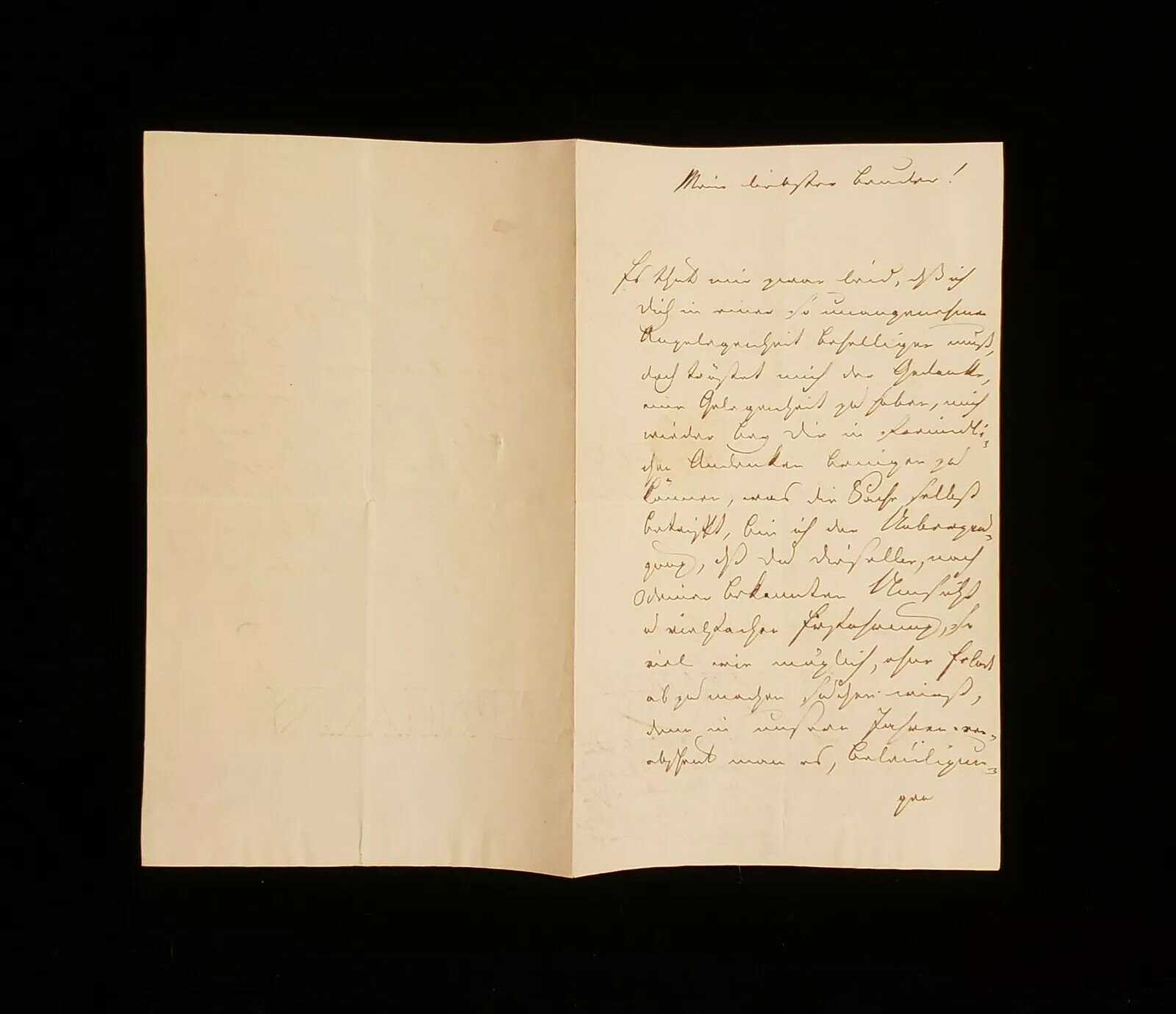
For your consideration, an autograph letter signed v. Schramm by Johann Ludwig Valentin Protzen von Schramm (17771856), Prussian artillery colonel and brigadier, later Generalmajor, written circa 1841 in German cursive across three pages of a folded bifolium of J WHATMAN watermarked paper, measuring approximately 5.0 by 8.5 in. folded and 10.0 by 8.5 in. opened. Addressed intimately Mein liebster Bruder! (My dearest brother!), the letter is not the sentimental appeal concerning financial hardship formerly attributed to it, but a confidential discussion of an unangenehme Angelegenheitan unpleasant or delicate affairin which Protzen explains the merits of a case, considers the consequences of intervention, and evidently seeks his brothers assistance, advice, or influence. The letter subsequently turns to current military and personal news and closes with an affectionate fraternal subscription followed by the writers substantial autograph. The addressee is not named on the surviving sheet; despite review of accessible Protzen, Wedel, Siebmann, and Schramm genealogical sources, no male relation can yet be identified with sufficient documentary certainty to replace the accurate designation an unidentified brother or brother-in-law.
Protzen von Schramm belonged to the generation of Prussian officers whose careers bridged the collapse of 1806, the military reform era, and the Wars of Liberation. Entering the artillery in 1796, he distinguished himself during the defense of Graudenz, including a hazardous mission to obtain a major supply of gunpowder from Kstrin despite French pursuit; a later history of the fortress specifically records Lieutenant Protzen among those who rendered distinguished service in its defense. He subsequently fought at Grogrschen, Bautzen, Kulm, Leipzig, Haynau, and Mouty, and rose to command the 6th Artillery Brigade, becoming Oberst in 1839. His surname itself embodied that Napoleonic legacy: in 1811 he was adopted by Generalmajor Carl Ludwig von Schramm (17401815), the veteran artillery officer and commandant of Graudenz, and in 1812 the combined name Protzen von Schramm was confirmed in the hereditary Prussian nobility. He did not receive the character of Generalmajor until his retirement in January 1844, making Oberst and Brigadier, later Generalmajor the historically correct rank description for a letter of this date.
Of particular significance is the postscript, which begins N.B. Decker and concerns an officer who had been passed over in connection with advancement to general rank. In the context of Protzens senior artillery circle, the individual is best identified as Karl von Decker (17841844), commander of the 1st Artillery Brigade, decorated veteran of Eylau, Dresden, Kulm, Leipzig, Ligny, and Waterloo, military theorist, teacher, and co-founder of the Militr-Wochenblatt. Decker was one of the most intellectually prominent Prussian officers of his generation; contemporary biographical sources record him as Oberst and artillery brigadier before his transition out of active command around 1841, followed by general rank. The manuscripts reference to Deckers disappointment and possible representation or complaint therefore accords strikingly with a documented career turning point and provides a strong internal basis for dating the letter to approximately 1841, when Protzen himself stood immediately below general rank within the same small senior artillery establishment.
Preserved with original folds, strong brown ink, a prominent J WHATMAN watermark, and only light handling and toning consistent with age, the letter is a scarce and unusually substantive private ALS from the upper ranks of the pre-1848 Prussian Army. Its importance lies not simply in Protzen von Schramms autograph, but in the intersection of private patronage, personnel advancement, and senior-command politics revealed by the manuscript: a decorated Graudenz defender and Napoleonic veteran writing confidentially to a close family relation about an intervention requiring discretion, then adding insider intelligence concerning the advancement of the celebrated military writer Karl von Decker. As such, it offers an uncommon documentary glimpse into the informal networks through which reputation, promotion, and influence operated among senior Prussian officers in the years immediately preceding Protzens own elevation to Generalmajor.