

|
Site Categories |
|
Featured Items |

Poodle, Spaghetti Trim, Ucagco


|
RARE Phoenician Core-Formed Glass Hacksilber Trade Glass Currency Pre Coin For Sale


When you click on links to various merchants on this site and make a purchase, this can result in this site earning a commission. Affiliate programs and affiliations include, but are not limited to, the eBay Partner Network.

RARE Phoenician Core-Formed Glass Hacksilber Trade Glass Currency Pre Coin:
$99.00
Phoenician Core-Formed Glass "Hacksilber-Style" Trade Glass Fragment / Currency Element (c. 1200–800 BC) - 38 mm Authenticity NoticeThis artifact is certified authentic and will be accompanied by a Certificate of Authenticity and Provenance. All professional inventory is vetted through recognized platforms to ensure legal standing. DetailsObject: Core-Formed Trailed Glass Rod / Armlet Fragment (Pre-Monetary Trade Glass / "Hacked" Currency Element)Culture: Phoenician / Eastern Mediterranean (Levantine Coast / Tyre Region)Date: Circa 1200–800 BC (Late Bronze Age II to Early Iron Age)Material: Core-Formed Opaque Glass with alternating dark blue/black and white trailed bands; heavy calcified surface weathering and devitrificationForm: Curved cylindrical glass rod segment displaying fine spiraled trail-decoration; both terminal ends feature clean ancient snap-fractures (intentionally segmented / hacked)Dimensions: 38 mm length (3.8 cm)Region: Levantine Coast / Phoenicia (Modern Lebanon / Holy Land Find) Iconographic & Typological AnalysisThis 38 mm glass element illustrates early Phoenician glassworking and Bronze/Iron Age trade exchange: Spiral Trailed Glass Technique: Crafted using early core-forming and trailing techniques, where hot white glass threads were wound spirally around a dark blue/black glass matrix before being smoothed (marvered) into a rigid rod or armband. Intentionally Segmented ("Hacked Glass"): Like silver bullion (hacksilber), high-value commodity goods such as core-formed glass rods, ingots, and bangles were purposefully snapped or severed in antiquity to meet specific weight standards for trade transactions prior to minted coinage. Phoenician Maritime Trade: The coastal workshops of Tyre and Sidon were famous across the ancient Mediterranean for pioneering luxury glass production and distributing pre-monetary trade media throughout Canaan, Egypt, and Aegean ports.
Overview and Historical ContextBefore the widespread introduction of standardized coinage in the Levant during the 6th century BC, trade was conducted using bullion, bronze ingots, and rare manufactured commodities like core-formed glass. Phoenician glassmakers along the Tyrian coast produced spiraled glass rods and armlets that functioned as both high-status prestige ornaments and divisible trade units. Snapped into uniform 38 mm lengths to facilitate barter exchange, fragments like this offer a direct link to the ancient economic networks of the Late Bronze and Early Iron Age Mediterranean. Authenticity Check Genuine ancient core-formed glass matrix showing natural iridescence, surface pitted weathering, and layered devitrification. Authentic sharp snap-fractures on both terminal ends with uncleaned sediment trapped in the micro-fractures. Intact at 38 mm with no modern polishing, glass fillers, or structural restoration.
Museum Comparable Examples The Corning Museum of Glass, Corning, NY: Accession No. 66.1.18 (Late Bronze / Early Iron Age core-formed spiraled glass rods and armlet fragments from the Levant). The British Museum, London: Accession No. 1876,0513.8 (Phoenician core-formed glass fragments and pre-monetary trade elements from Tyre and Sidon). The Metropolitan Museum of Art, New York: Accession No. 74.51.302 (Early Phoenician trailed glass rod segments and trade ornaments).
Academic & Typological References Harden, D. B. (1981). Catalogue of Greek, Roman and Etruscan Glass in the British Museum, Vol. 1: Core-Formed Vessels and Rods. British Museum Publications. (Ref: "Early Levantine Rods and Trailed Glass"). Spaer, M. (2001). Ancient Glass in the Israel Museum: Beads and Other Small Objects. The Israel Museum, Jerusalem. (Ref: "Class III: Spiral-Trailed Glass Rods and Bangles"). Barag, D. (1970). Mesopotamian Core-Formed Glass and Early Phoenician Production. Journal of Glass Studies. (Ref: "Pre-Monetary Trade Glass and Regional Distribution").
ConditionVery fine archaeological condition. Structurally sound at 38 mm, displaying vibrant spiraled banding beneath an authentic ancient calcified weathering crust and clean ancient terminal breaks. TRN-1-1
|
|
Related Items:
RARE Phoenician Core-Formed Glass Hacksilber Trade Glass Currency Pre Coin $99.00
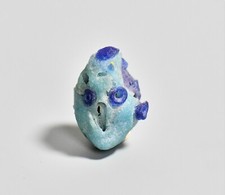
RARE ITEMS A Phoenician Glass Head Pendant $335.00
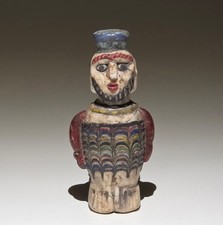
Circa Rare Ancient Phoenician Glass Idol - Anthropomorphic Punic $2000.00
|
|
|
Shopping Cart  |

|
Recently Viewed |
|
Latest Items |
|
Facebook |
Secure Websites

|
